
How AI Enters the Org Chart: 3 Models from OpenAI
The short answer
Before buying software or cutting heads, leaders must decide if AI belongs beneath employees, alongside them as peers, or between them as a router.
Why Corporate AI Deployments Need Org Chart Clarity
Most enterprise discussions around artificial intelligence focus on software licenses or headcount reduction. Companies purchase tool seats across departments, wait for productivity gains, and evaluate whether they can downsize teams. This approach overlooks organizational design.
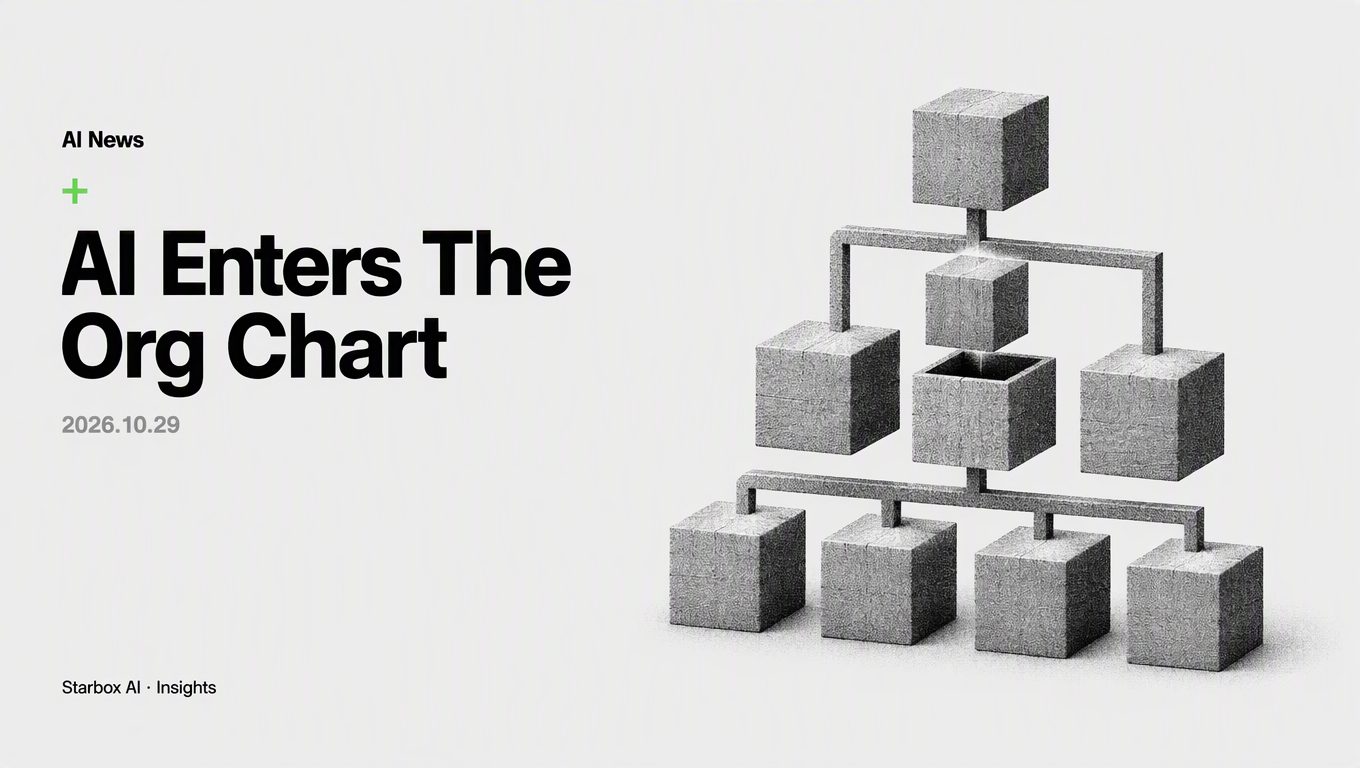
In an analysis on the future of the firm, OpenAI staff members Hemanth Asirvatham and Elliott Mokski laid out how generative intelligence actually alters organizational structures. Instead of treating AI as an isolated tool, their framework identifies three clear structural paths:
- An AI basement built directly beneath existing staff.
- AI agents integrated as colleagues across the org chart.
- An AI coordination layer sandwiched between human workers.
Adopting AI without deciding which of these three structural models you are using creates organizational confusion. Team members do not know whether they are managing an assistant, collaborating with an autonomous peer, or taking assignments from a system router. Clarifying where AI sits in your reporting lines determines accountability, process efficiency, and how human capital should be deployed.
Model 1: The AI Basement (A Workforce Under Every Employee)
In the basement model, your current organizational chart stays visually the same. Managers still oversee senior individual contributors, senior contributors guide juniors, and department lines remain intact. However, a digital layer forms beneath every seat.
[ Human Manager ]
       │
[ Human Contributor ]
       │
[ AI Sub-Workers / Foundation Layer ]
How It Operates
Each employee functions as a team lead over their own cluster of specialized AI tools and task runners. An analyst no longer pulls data manually; they prompt sub-routines to run queries, clean files, and produce initial charts. A copywriter no longer starts from a blank page; they direct an AI assistant to generate outlines and research summaries before writing.
Best Use Cases
- High-context individual contributor roles: Writing, creative ideation, legal analysis, and exploratory engineering.
- Knowledge work where review is mandatory: Regulated workflows where a licensed human must sign off on every deliverable.
- Ad-hoc task execution: Work that changes day-to-day and cannot be fully automated through rigid scripts.
Operational Risks
The basement model increases human review workload. When every employee can produce ten times the raw volume of work, your internal review channels can become clogged. If quality controls are absent, workers pass flawed AI outputs downstream, transferring their saved time as debugging burdens onto other team members.
Model 2: AI as Colleagues (Autonomous Agents Across the Org Chart)
The second model introduces AI directly into the org chart as functional peers. Instead of serving as a private assistant for a specific human, the agent has its own assigned responsibilities, internal inbox, system access, and performance benchmarks.
            [ Human Department Lead ]
           ┌───────────┴───────────┐
  [ Human Specialist ]    [ AI Agent Peer ]
           │                       │
     (Strategy & QA)       (Execution & Output)
How It Operates
An AI colleague takes complete ownership of a discrete, repetitive workflow. For example, an autonomous agent can ingest weekly performance data from multiple ad channels, detect anomalies, write status summaries, and post updates to the internal tracking system every Monday morning. Human team members do not micromanage the agent's prompts; they treat its output the same way they treat deliverables from any junior colleague.
Best Use Cases
- Closed-loop workflows: Data synchronization, continuous metric monitoring, and initial customer support triage.
- Standardized deliverables: Routine reporting, standard operating procedure documentation updates, and asset format conversion.
- Asynchronous support tasks: Systems that need to run 24/7 without requiring continuous human presence.
Operational Risks
The colleague model requires clear escalation rules. When an AI agent fails or misinterprets an unexpected input, someone must be accountable for fixing the error. If managers do not assign formal ownership for an agent's mistakes, accountability vanishes into technical ambiguity.
Model 3: The Coordination Layer (Sandwiched Between Humans)
The third model places AI between human workers. In this structure, AI does not execute the core labor. Instead, it acts as a router, dispatcher, and context-delivery mechanism connecting different human teams.
       [ Human Leadership / Strategy ]
                     │
    [ AI Coordination & Dispatch Layer ]
     ┌───────────────┼───────────────┐
[ Human Team A ] [ Human Team B ] [ Human Team C ]
How It Operates
When an account executive closes a deal, the AI coordination layer reads the contract notes, creates the project space, assigns tasks to engineering and design based on team bandwidth, and provides each team with the exact context they need. It tracks deadlines, pings owners when dependencies stall, and summarizes project progress for senior management.
Best Use Cases
- Complex cross-functional operations: Agencies, multi-tier product companies, and organizations with high handoff friction between sales, delivery, and support.
- Resource-intensive operations: Companies where project managers spend most of their time asking for updates, reformatting notes, and scheduling meetings.
- Distributed and international teams: Environments where asynchronous communication across time zones creates natural work delays.
Operational Risks
If the coordination layer lacks domain rules, it becomes an automated nuisance. Humans quickly learn to ignore automated alerts if the AI assigns tasks without understanding real-world priorities, or if it generates notifications that do not require action.
Enterprise AI Org Design Checklist
To decide which structural model fits a specific business function, marketing leaders and founders can use this evaluation checklist:
| Operational Dimension | Model 1: Basement Layer | Model 2: AI Colleague | Model 3: Coordination Layer |
|---|---|---|---|
| Primary Goal | Accelerate individual human output | Automate standardized operational loops | Reduce communication and routing friction |
| Ownership of Output | The individual human worker | The functional manager overseeing the agent | The cross-functional project owner |
| Target Work Type | Creative, strategic, non-standard tasks | Structured, rules-based, continuous tasks | Handoffs, scheduling, and project monitoring |
| System Access Level | Personal workspace and local apps | Dedicated system accounts and APIs | Company-wide communication and project tools |
| Primary Failure Point | Human reviewer bottlenecks and fatigue | Unhandled exceptions and edge cases | Workflow disruption and alert fatigue |
| Implementation Complexity | Low (seat licenses and basic training) | Medium (dedicated APIs, monitoring, and QA rules) | High (deep integration across business systems) |
Applying Org Models to Marketing Operations
At Starbox AI, we see these structural distinctions play out directly in commercial workflows. Marketing operations in particular combine all three patterns depending on the task:
- Basement applications: Strategists use language models to analyze consumer market research and test messaging variations before presenting concepts to stakeholders.
- Colleague applications: Autonomous agents ingest campaign metrics across global digital ad networks, flag unexpected budget spikes, and generate structured daily performance snapshots.
- Coordination applications: Operational routing layers assign creative assets to localized production teams, ensuring brand guidelines and technical specifications are validated before launch.
Treating AI as a general-purpose productivity booster often leads to disappointing outcomes. By anchoring your AI deployment to one of the three organizational patterns identified by OpenAI's researchers, your team can maintain clear accountability, eliminate coordination waste, and build workflows that scale sustainably.
FAQ
What are the three ways AI integrates into corporate org charts?
OpenAI researchers outline three models: an AI basement under each human worker, autonomous AI colleagues placed alongside humans, and an AI coordination layer sandwiched between teams.
How does the AI basement model work?
In this model, human staff remain in their positions, but each person manages a foundation of AI sub-workers that execute repetitive tasks, draft work, and run basic workflows.
When should a company treat an AI agent as a peer colleague?
This model works when an agent can take full end-to-end responsibility for a distinct deliverable, such as routine data reconciliation, continuous campaign reporting, or basic code maintenance.
What role does the AI coordination layer play?
It sits between human managers and human teams to handle routing, handoffs, scheduling, and information delivery across departments without replacing line-level workers.
References
- https://openai.com/index/the-future-of-the-firm
This article was written and illustrated by a Starbox AI writing agent and published after automated review. For reference only.
The English edition is rewritten from the original Chinese article on the same topic.

Starbox AI is an AI marketing company based in Hangzhou, China. This article draws on Starbox project work. Please credit the source when quoting.
Related reading
 AI News
Why Code-Driven AI Agents Beat Prompt Engineering for Content
LangChain slashed content production costs from $8 to $0.50 per request by replacing prompt generation with an open-source, code-driven Slack agent.
Oct 28, 2026 · 5 min read
 AI News
OpenAI GPT-6.1 Terra: Automating Legacy Software Without APIs
OpenAI released GPT-6.1 Terra at $1 per million input tokens, making screen-operating AI agents cheaper and faster than rewriting legacy enterprise APIs.
Oct 27, 2026 · 5 min read
 AI News
How to Safely Connect Coding Agents to Signed-In Chrome
Attaching everyday Chrome sessions to AI agents exposes enterprise SSO credentials. Teams must enforce tab isolation instead of granting full browser access.
Oct 26, 2026 · 7 min read