
Starbox Content Factory · content on autopilot
A large topic library,
agents across nine angles,
content every day.
Snap a product photo, or pull topics from the library in order, at random or by trend. Writing agents across nine angles (brand voice, third-party voice and word of mouth) apply frameworks and styles from a library of over a thousand proven formats and write from your brand knowledge base, producing social posts, long-form articles and short-video scripts for every channel. No more running out of content.
- 01 · Topic library
2,486 topics
Photo to full setIn orderRandomTrendingFinally, a Chinese-style vest I can wear every day: groceries, school run, no problem
- 02 · Writing agents, 9 angles
Short postVideo scriptLong-form Brand 3rd party Customer
- 03 · Five-step pipelineAudienceScenarioDraftPolish & complianceFinal + images
- 04 · Today's drafts · to review
27 pieces
Social post · Finally, a Chinese-style vest I can wear every day!
What Content Factory is
Topics, writing, images and compliance, on one production line.
Why we built it
Every company knows it needs content marketing.
The hard part is publishing every day.
Working with companies, we kept seeing the same thing. Every channel needs regular updates, the content team is two or three people, and by the second month they run out of topics. New hires do not know the product, so the writing does not sound like the brand. Generic AI mixes up facts, reads like an ad and makes every post look the same. When the content stops, traffic and enquiries drop with it.
- Not enough content; accounts go quiet
Many channels, high frequency, and people cannot keep up. Once updates stop, platform reach and followers fall, and earlier investment is wasted.
- Same-looking content that does not convert
The same few angles over and over. Readers tune out, platforms stop pushing it, and plenty of content brings no more enquiries or sales.
- Running out of topics
Deciding what to write each day takes the most time and depends on one person's inspiration.
- Hard to hire and keep writers
People who know the product and can write are rare, and when they leave, the style and know-how leave too.
- Uneven quality
Different people at different times write at different levels, and product facts and selling points are often wrong.
- Compliance risk
Superlatives, efficacy claims and competitor comparisons easily break advertising law or platform rules.
So we turned content production into an automated line
A topic library supplies topics, writing agents across nine angles share the writing, and the brand knowledge base checks every fact. The team only reviews, and content goes out every day.
The process
From topic library to finished piece,
every step runs on its own.
- 01Build the knowledge base
- 02Generate topics
- 03Pick topics
- 04Write across 9 angles
- 05Review and publish
- 016types of brand material
Build the brand knowledge base
AutomaticBefore starting, we organize your material with you into six types (D01–D06), then keep it updated as products and campaigns change.
SmartWhich facts each piece uses, what voice it takes and which words it avoids all come from the knowledge base. Nothing is made up.
- 022,486topics · sample brand
Generate the topic library
AutomaticSelling points, target customers, use scenarios and emotions are combined into thousands of topics.
SmartEach topic states who it is for, in what situation, what problem it solves and which selling point it leads with.
- 034ways to pick topics
Pick topics in four ways
AutomaticTopics are pulled by product photo, in order, at random or by trend, and scheduled every day.
SmartFrom a product photo, AI recognizes the style and selling points and derives topics; the trending mode matches the day's holidays, seasons and platform trends to topics that fit the brand.
- 049content angles
Agents write across nine angles
AutomaticEach topic goes to the writing agent for its angle, and all nine work at the same time.
SmartEvery piece follows five steps: anchor the audience → derive the scenario → draft → polish and check compliance → finalize with images, using frameworks and styles from the style library that fit the account.
- 0536pieces / day · example
Review and publish
AutomaticDrafts wait for review; once approved, titles and formats are adapted to each platform. Drafts not handled within 48 hours are approved automatically.
SmartUsed topics are marked so the same angle is not repeated, and rejection notes are carried into the next piece.
Demo
The library feeds topics,
nine writing agents start at once.
An interactive animation of the Content Factory workspace, rebuilt from the real system. All four topic modes use the same sample apparel brand and play in turn; click the tabs above to switch.
Photo to full set · by product
One product photo,
a whole set of content.
When new stock arrives or a sample is ready, an employee takes a photo and hands it to Content Factory. AI recognizes the style, fabric and selling points, works out the best audience and topic, writes copy for each platform and generates images. The images use the photo as a reference, so the product in them is the real product.
01Upload a photo
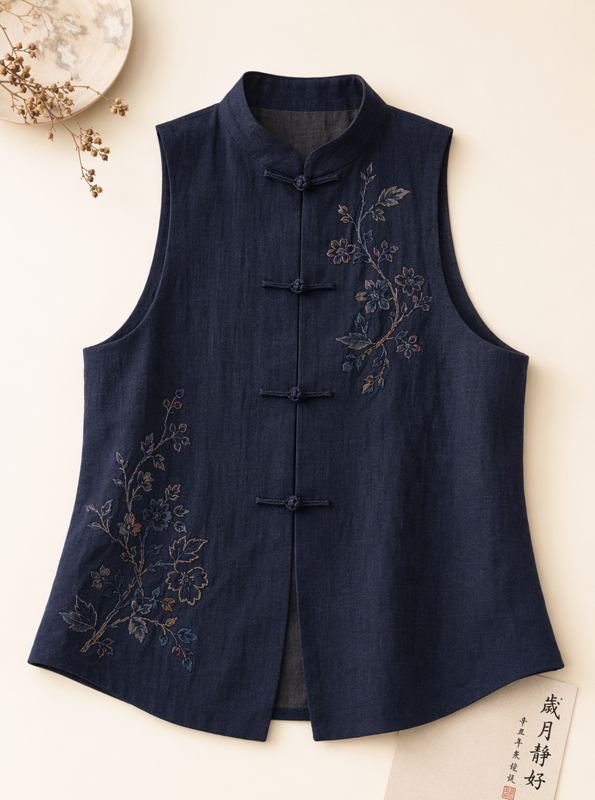
02What AI recognizes and derives
- Best-fit audience
- Women aged 41–48 with a taste for cultural style, mid to plus sizes, who want something with character that still works every day
- Target scenario
- Between work and semi-formal: school open days, afternoon tea with friends, gatherings that call for neat but not dressy
- Emotional angle
- Western dresses feel wrong, older styles feel dated, a full traditional skirt is too formal: finally a Chinese-style piece for every day
- Chosen topic
- Finally, a Chinese-style vest I can actually wear every day: groceries, school run, the subway, no problem
03The full set
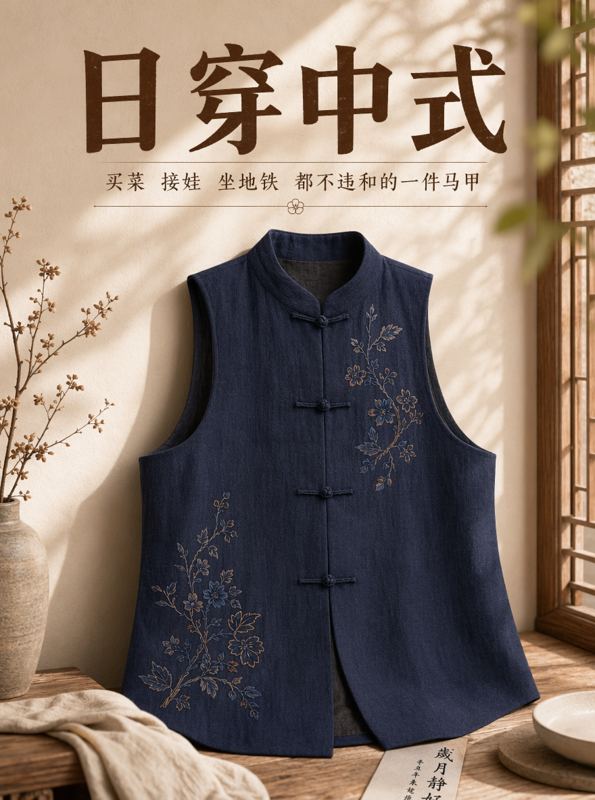



- XiaohongshuFinally, a Chinese-style vest I can wear every day! Groceries and school run, no problem
- DouyinCan't wear new Chinese style out? Pair this vest with jeans and go
- WeChat Channels19 years in apparel, and this is the Chinese-style vest I'd pick: if you can wear it every day, it's truly good-looking
Show the full post (translated)
After almost twenty years in apparel, the question I hear most these days is: "New Chinese style looks great, but can you really wear it out on a normal day?"
I get it. Plenty of wardrobes hold one or two Chinese-style pieces: a mandarin collar, knot buttons, embroidery. They catch your eye in the shop, then sit in the closet. Either too formal, like you're off to a banquet, or the cut is off and it hangs loose.
That's why I want to talk about this navy Chinese-style vest. Mandarin collar, a small spray of plum blossom embroidered on the left, knot-button closure. It is clearly Chinese in style. The clever part: it's a vest. A vest is an everyday shape by nature, easy over a white shirt or a light knit, and the deep navy goes with everything.
The fabric has a linen feel and holds its shape, so the shoulders don't sag. Most practical of all: you really can wear it every day. Groceries, the school run, the subway. Add a pair of jeans and you're out the door without putting together a whole outfit.
The same photo can also produce private-channel posts, video scripts, long-form articles and e-commerce product pages. This example comes from a real demo for a Chinese apparel brand, with brand details removed. Content Factory writes in your market's language.
Brand knowledge base
Whether the content is right
depends on the brand knowledge base.
The knowledge base is the foundation of Content Factory. Before starting, Starbox works with you to organize brand material into six types. After that, every product fact, customer scenario, tone of voice and banned word in every piece comes only from here. General rules, agents and style samples are shared, so a new brand only needs a new knowledge base.
Every selling point, with the pain point and experience it maps to, marked as must-mention or optional.
Decision types, personas, scenarios, emotions and how to respond; the main source for the topic library.
Hard rules, brand persona and style, and general writing principles.
Banned words and limits on competitors, prices, categories and emotional tone.
Real stories of the founder and the brand, built when needed.
Business knowledge, processes, methods, technical product detail and industry background.
- Facts only from the knowledge basePrices, ingredients, processes and certifications are never made up or exaggerated.
- Constraints checked on every pieceBanned words, competitor and price rules are scanned during polishing.
- Updates apply right awayWhen a product launches or a campaign changes, update the knowledge base and the next piece uses it.
Topic library · four ways to pick
One large topic library,
four ways to use it.
The topic library is generated from the selling points, target customers, use scenarios and emotions in the knowledge base. It holds thousands of topics and grows with the knowledge base. Each day topics are pulled in the four ways below and handed to the writing agents. The most used is the first: one product photo is enough.
Photo · by product
Snap a product photo; AI recognizes style, fabric and selling points, derives topics and writes a full set. Or name a product to focus output on it.
One vest photo → posts for three platforms + cover, scene and detail imagesIn order
Write down the library one topic at a time: full coverage, nothing missed, nothing repeated.
No. 128 "How long should a vest be for a pear-shaped figure" → No. 129 "First new Chinese-style purchase: which piece is safest"Random
Random combinations of customer, scenario, selling point and emotion, so even one product gets new angles.
Frequent traveler × light luggage × one piece, many looks → "One vest for a week of business travel: five outfits"Trending
Holidays, seasons and platform trends are checked daily and matched to topics that fit the brand.
First frost → "Layering for first frost: one vest, warm without the bulk"Writing agents across 9 angles
Brand, third-party, customer: nine angles, each with its own agent.
A brand needs to speak for itself, needs creators and experts to speak about it, and needs customers to speak about it. Three voices times three formats (short posts, video scripts, long-form) make nine content angles, and each one has a dedicated writing agent.
 Content Factory · 9-angle writing agentsVoice × format
| Short post | Video script | Long-form | |
|---|---|---|---|
| Brand | A1Product posts / private channel | B1Brand video / explainer | C1Brand / knowledge article |
| 3rd party | A2Creator posts | B2Creator video | C2Expert visit |
| Customer | A3User posts | B3Customer case video | C3Case story |
Short posts: social feeds and image posts · Video scripts: talking-head, visit and case videos · Long-form: blogs, articles, press releases
Style library
Over a thousand proven frameworks and styles:
the same content, told by a different person.
Starbox keeps collecting high-performing posts from each platform, breaks down how creators talk and how successful content is structured, and adds them to the style library. After writing, the agent applies any style that fits the account: video scripts imitate a person's voice, image posts apply a structure.
Decides how the content is laid out
Topic, structure and order of information decide what a piece says and in what logic. A reusable content frame.
Decides how this person talks
Feel, wording, rhythm, catchphrases and endings decide who tells the same content. The two layers combine freely.
Imitate, do not analyze
The moment you summarize a "list of language features", imitating a real person turns into filling a template. Keeping that human feel is what makes the library valuable.
All names are rewritten English names; the demo text is rewritten from style library samples.
Results
The same team,
from "can't keep up" to "publishing every day".
Using the sample brand: a two-person content team used to publish two or three pieces a day. With Content Factory, the team only reviews, and every channel is updated daily.
336
29
202,486
61%92%
Illustrative data for the feature demo.
How to use it
Use Content Factory on its own, or inside Starbox Starbox!.
Deploy Content Factory on its own
For companies that run content and social marketing: it writes content for every channel each day from your brand knowledge base, you review and publish, and you never run short of content.
Get a Content Factory plan → Inside Starbox Starbox!Drafts on request, in one sentence
An employee says "Starbox Starbox! Write a social post" and the system hands it to the agent for that angle; you can also schedule daily production.
About Starbox Starbox! →Starbox Content Factory and Starbox GEO are two separate systems: Content Factory solves the content shortage; Starbox GEO is dedicated to AI search optimization.
FAQ
Content Factory FAQ
How is Content Factory different from using AI directly?
Writing directly with standard AI means brainstorming topics yourself every time, getting inconsistent output, and dealing with an AI that doesn't understand your brand. Content Factory first builds a brand knowledge base, then automatically draws topics from a vast topic pool using four methods, and sends them to AI writing agents across nine dimensions—brand voice, third-party voice, and word of mouth. Every piece follows a fixed five-step pipeline and draws facts exclusively from the knowledge base, ensuring consistent, compliant, and non-repetitive output.
What types of content can Content Factory produce?
Nine dimensions: brand voice (brand product seeding & Moments, brand-spoken video & industry explainers, long-form brand articles & educational deep dives), third-party voice (influencer seeding, influencer video scripts, expert site visits), and word of mouth (everyday user notes, customer case study videos, case stories)—covering platforms like Xiaohongshu (RED), WeChat Official Accounts, Douyin, WeChat Video Account, WeChat Moments, Zhihu, and more.
Where do topics come from? Will the content repeat itself?
The topic pool is generated by combining elements from your brand knowledge base—such as product selling points, target audiences, use cases, and emotional hooks—creating thousands of topics that expand continuously. Topics are retrieved daily using four methods (sequential, randomized, trending, or product-focused). Used topics are automatically tagged to avoid repeating the same angle.
Do we need to rebuild the system for another brand?
No. General rules, AI agents, and tone-of-voice samples are all reused. Switching brands only requires updating the brand knowledge base (D01–D06).
What problem does Content Factory solve?
It solves content shortages and inconsistent output in enterprise marketing: managing multiple platforms and frequent posting makes relying solely on human writers unsustainable; topic ideation dries up quickly; and staff turnover leads to lost brand voice and expertise. Content Factory turns content production into an automated assembly line, so your team only needs to review.
When should each of the four topic retrieval methods be used?
Sequential is best for steady, everyday volume to ensure complete coverage without gaps. Randomized keeps content fresh by finding new angles even for the same product. Trending leverages current events by automatically matching daily holidays, solar terms, and platform trends. Product-focused is designed for new launches and core product pushes, concentrating content output.
What do brand voice, third-party voice, and word of mouth mean?
They represent three perspectives based on who is speaking: brand voice comes from the brand and its founder to build brand awareness; third-party voice comes from influencers and outside experts to build trust from an external standpoint; word of mouth comes from everyday users and real customers to deliver social proof and case studies. Multiplying these three voices across three formats—short image-text posts, video scripts, and long-form articles—yields nine content dimensions.
What materials do we need to prepare for the brand knowledge base?
Six categories: D01 Product Arsenal, D02 Target Audience & Scenario Library, D03 Writing Rules, D04 Brand-Specific Constraints, D05 IP Story Library, and D06 Enterprise Knowledge Base. Starbox will help you organize these; you only need to provide product information, customer profiles, and existing top-performing content.
How much content can be produced daily?
Output is configured according to the platforms and frequency your business needs. In a typical benchmark setup, a brand steadily produces around 36 pieces a day, covering platforms like Xiaohongshu (RED), WeChat Official Accounts, Douyin, WeChat Video Account, and WeChat Moments (illustrative figure).
How are content quality and compliance guaranteed?
Facts are pulled exclusively from the brand knowledge base with zero hallucination. Each piece is crafted through a five-step process: audience anchoring, scenario derivation, initial draft, polishing & compliance check, and finalization with image matching. During polishing, every piece is scanned for advertising law superlatives, brand-banned terms, competitor mentions, and pricing constraints before reaching human review.
Does our team need to review the content?
Yes. Completed drafts go into a pending review queue where they can be approved, returned with revision notes, or downloaded. Drafts unreviewed after 48 hours are automatically approved. Any return notes are fed into the next writing pass.
What content can be generated from a photo?
An employee takes a photo of a product, and the AI identifies its style, fabric, and selling points, deduces the best audience and angles, and generates titles and copy for platforms like Xiaohongshu (RED), Douyin, and WeChat Channels. Using that photo as a reference, it creates covers, lifestyle scene images, and detail shots—with the actual product in the visuals. The same photo can also be used to generate WeChat Moments posts, spoken-video scripts, WeChat Official Account articles, and e-commerce product detail pages.
What is the style library? Can we use our own brand voice?
The style library is Content Factory's built-in collection of high-performing frameworks and writing styles, featuring 895 spoken-video styles, thousands of proven graphic-and-text frameworks, and over 35,000 style samples. When drafting, you can apply any style based on account positioning: spoken-video styles mimic an individual persona's tone, while graphic-and-text frameworks follow structured storytelling templates. Top-performing content from your own accounts can also be compiled into the knowledge base as custom brand voice samples.
What is the difference between Content Factory and Starbox GEO?
They are two independent systems. Content Factory solves social media content shortages for day-to-day operations on platforms like Xiaohongshu (RED), WeChat Official Accounts, and short video platforms. Starbox GEO specializes in Generative Engine Optimization, ensuring AI search engines recommend your brand when buyers ask.
Guides
Methods and field notes
 AI Content Marketing
Why Anti-Promo AI Copy Converts Better During Shopping Festivals
Shouting discounts triggers platform penalties and buyer fatigue. AI copy that dissuades the wrong buyers delivers far higher conversions.
Oct 22, 2026 · 9 min read
 AI Content Marketing
How to Schedule Content on Zhihu for a Product Launch
Avoid post-bombing on launch day. Spread Zhihu publishing over a 21-day window—pre-seeding, launch response, and long-tail capture—to avoid rate limits.
Oct 22, 2026 · 6 min read
 AI Content Marketing
Should You Feed Real Cost Breakdowns into Private Domain AI?
Never feed raw bottom-line costs into private domain AI during major promotions. Use sanitized structural ratios to win sales while protecting pricing power.
Oct 21, 2026 · 5 min read
 AI Content Marketing
How to Choose an AI Writing Tone for WeChat Moments
Don't use generic AI templates for WeChat Moments. Match your AI tone to your price point and sales cycle across three distinct personas.
Oct 21, 2026 · 5 min read
 AI Content Marketing
Why White Papers Fail on Zhihu—and Flame Wars Work
Zhihu's algorithm rewards debate over authority. Cold-start distribution depends on whether your answer sparks friction, trade-offs, and replies.
Oct 20, 2026 · 4 min read
 AI Content Marketing
3 Labor-Hour Tests to Trim Your Campaign Knowledge Base
Overloading your promotion knowledge base causes rule conflicts and dull copy. Use net editing hours saved to keep only high-return content modules.
Oct 20, 2026 · 6 min read