
Starbox GEO · generative engine optimization on autopilot
Automated GEO
that gets AI to recommend you.
Diagnosis, topics, writing, images, publishing and retests run as one loop. AI finds and analyzes the data, AI writes and publishes the content, and your team only approves.
What Starbox GEO is
When buyers ask AI for a supplier, you are in the answer.
Why we built it
Companies see the value of GEO,
then get stuck on both results and process.
Over the past two years we kept running into the same story. A buyer asks an AI assistant first and ends up choosing a competitor. An executive asks the AI and finds their brand missing, or its product details wrong. The company wants to do GEO but has no proven method; people who combine AI search, content and data skills are hard to hire; and even with a team, the work is hard to manage and the results are hard to measure.
- AI cannot find your brand, or gets it wrong
When buyers ask "who is reliable", AI recommends competitors; when it mentions you, product, price or certification details are wrong. Checking question by question by hand is neither complete nor accurate.
- No way to measure the return
Without a fixed question set and regular retests, months of work cannot show in data whether AI's view of your brand has improved.
- The value is clear, the method is not
Which questions to track, which platforms matter, what content AI will cite: there is no proven, repeatable method on the market.
- The right people are hard to hire
It takes AI search, content and data analysis skills at once. These people are rare, expensive and move on quickly.
- The work is hard to manage
Topics depend on experience, output varies, and content has to go to a dozen platforms. The process is opaque and quality is hard to guarantee.
- No measurement system
Which metrics to watch, how to sign off, what improved since last month: there is no set of numbers you can compare directly.
So we turned the whole GEO process into an automated system
It solves the results problem and takes on the method, staffing, management and measurement along the way. Intelligence handles finding and analyzing data; automation runs the whole process and cuts management and staffing costs.
The automatic loop
Six steps that run on their own,
each one driven by data.
- 01Diagnose
- 02Pick topics
- 03Write
- 04Add images
- 05Publish
- 06Retest
- 01125fixed questions
Automatic diagnosis
AutomaticA fixed question set is asked of AI on schedule (the Global edition uses Gemini with Google Search, the China edition uses Doubao with web search). No one checks question by question.
SmartFor each question it records whether you are mentioned, your position, which competitor replaced you and whether your facts are right, and combines this into an AI visibility index.
- 02540topics
Automatic topics
AutomaticTopics are generated as soon as the diagnosis finishes, sorted by category and buying stage. No manual planning.
SmartIt mines the answers for the sources AI cites most, the question types where you are most absent and the facts AI gets wrong, and aims each topic at a gap.
- 035writing agent types
Automatic writing
AutomaticFive types of writing agent produce content every day: short posts, product recommendations, brand articles, knowledge articles and third-party review articles.
SmartFacts come only from the brand knowledge base, and the writing follows what AI cites: conclusion first, full names, verifiable facts.
- 042–3images / article
Automatic images
AutomaticImages are generated for every article with no designer involved.
SmartImages match the article and the platform; the agent decides how many each piece needs.
- 05214published links · 7 platforms
Automatic publishing
AutomaticApproved content is published automatically and every link is logged in the workspace. Your team only reviews.
SmartIt publishes first to the platforms AI cites most in your diagnosis, running brand-voice and third-party-voice content side by side.
- 0631.8 → 76.4three retests · AI visibility index
Automatic retests
AutomaticThe same question set is retested every 30 days and the report appears in the workspace.
SmartEach question is compared with the last round, the gains and drops are flagged, and the next round of topics is updated. The loop keeps turning.
Intelligence
Data found and analyzed automatically
- Mentions, rank, replacement and factual accuracy judged per question
- Which sources AI cites, and how often
- Mention rate by question type, to find the weakest layer
- Every round compared with the last, question by question
Automation
Lower management and staffing costs
- Diagnoses and retests run on schedule, around the clock
- No manual scheduling for topics, writing, images or publishing
- Five writing agents work in parallel at a steady pace
- Your team only approves, free of the heavy lifting
Demo
Inside the GEO workspace:
every step of the loop.
These are real screens from the Starbox GEO workspace (China edition, interface in Chinese), one per step. Click a step on the left to switch; screenshots scroll and can be enlarged.
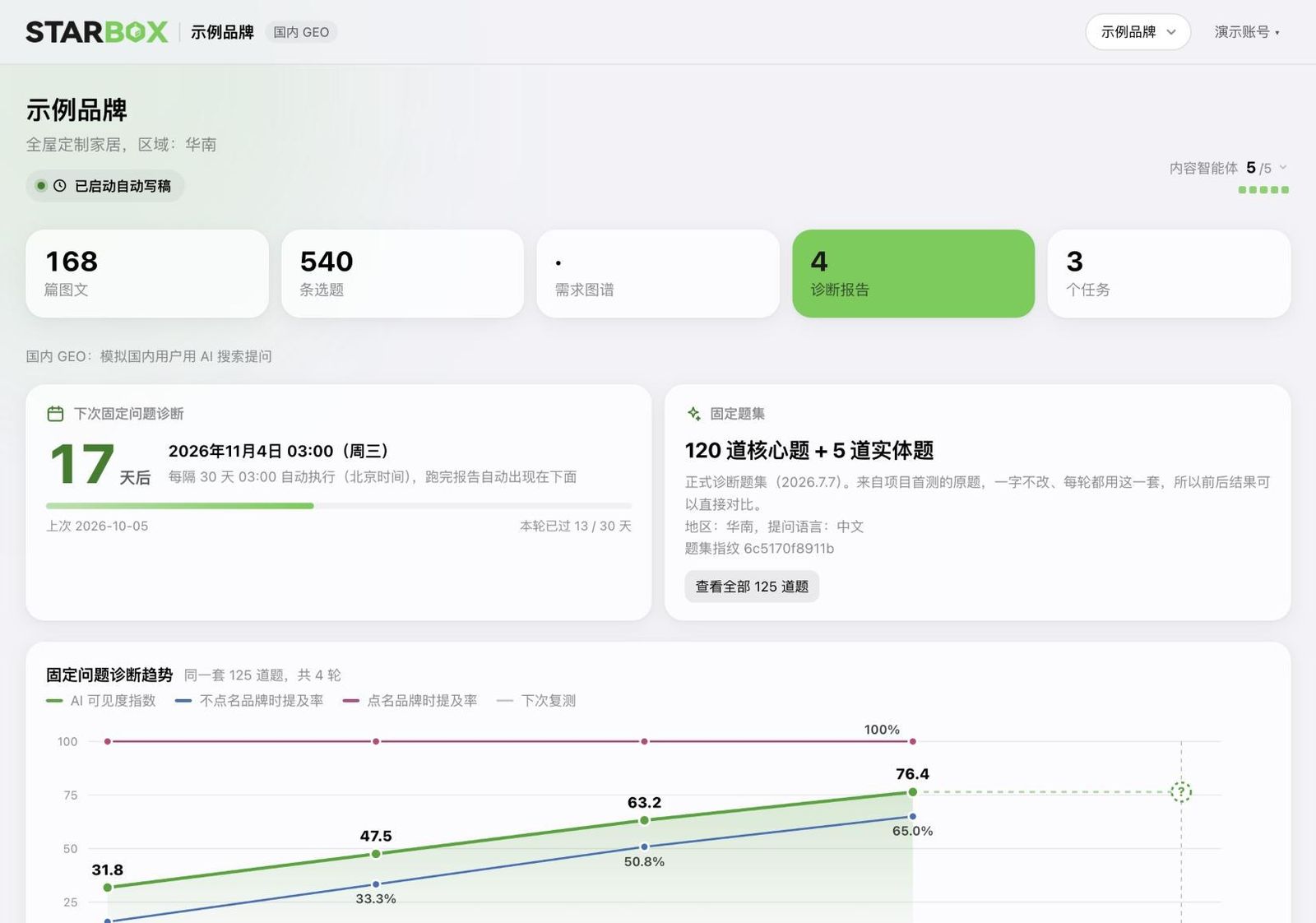
- 125 fixed questions, run automatically overnight
- AI visibility index 76.4, +13.2 on the last round
- Retests are scheduled automatically, no reminders needed
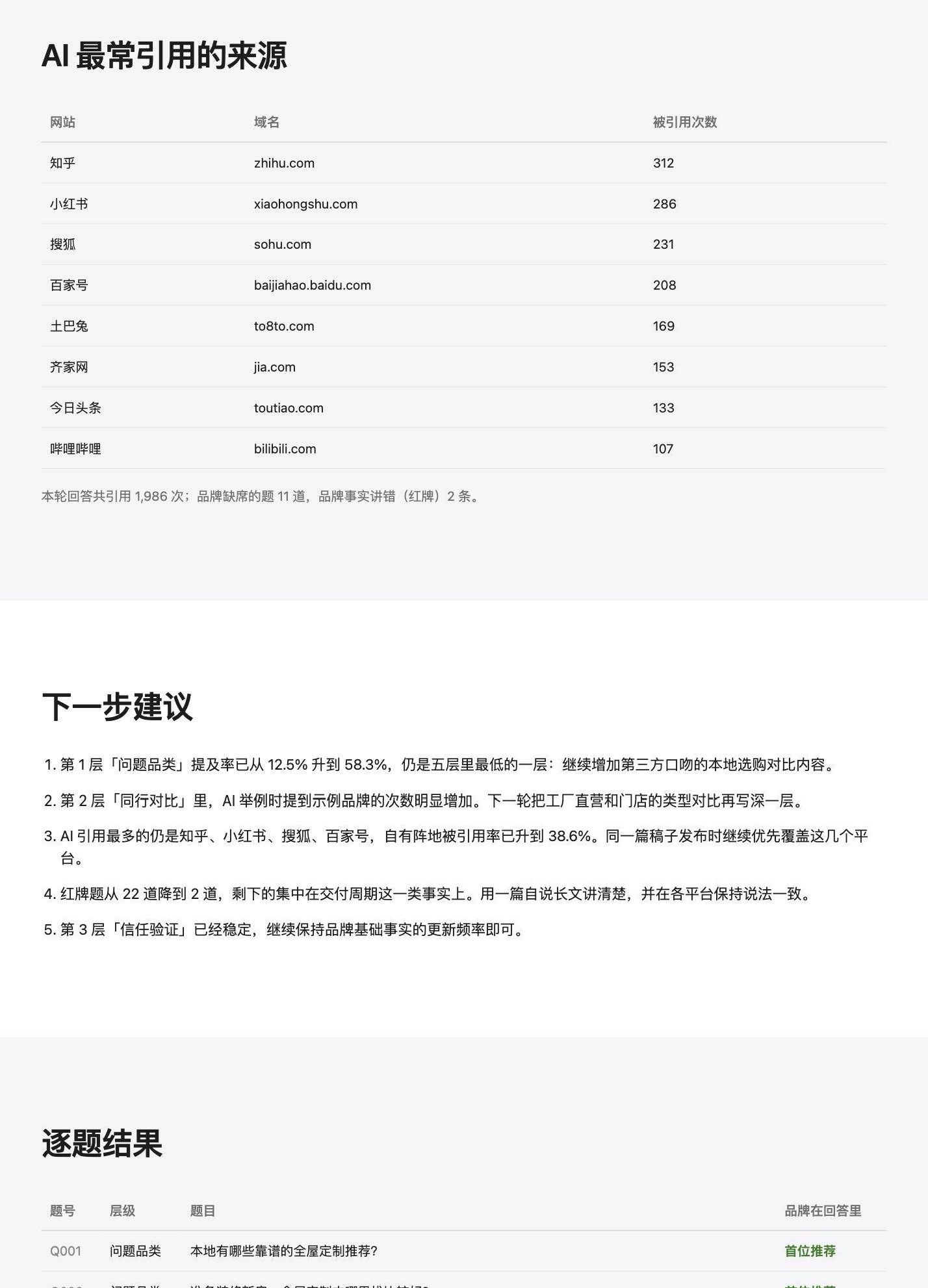
- The sources AI cites most, and how often
- "Next steps" written by the system
- All 125 questions judged: top pick / listed / not mentioned
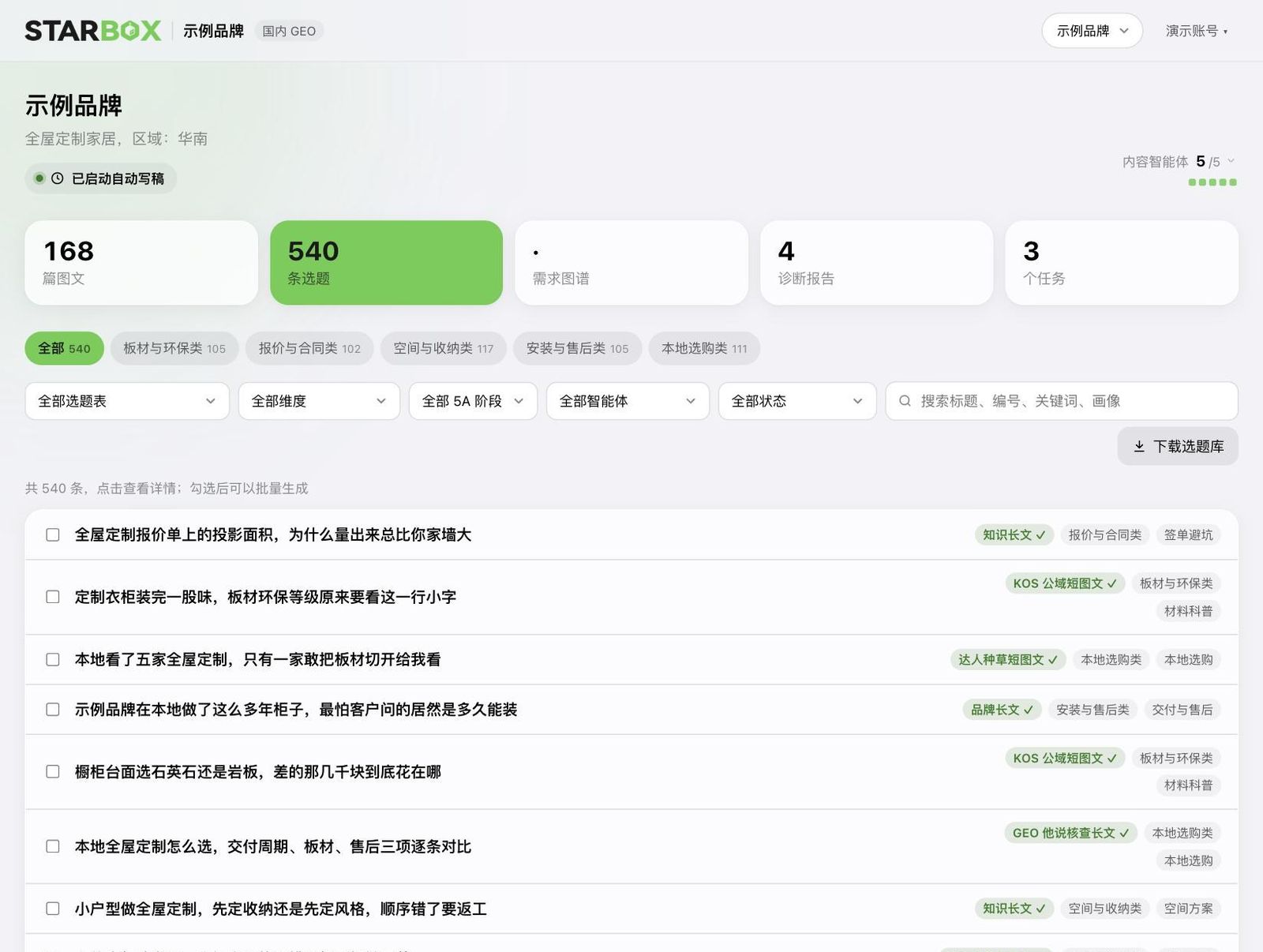
- 540 topics sorted by category, angle and 5A buying stage
- Each topic tagged with the writing agent that will write it
- Tick to generate in bulk

- 168 articles, written daily by 5 types of writing agent
- To review, approved and to rewrite, at a glance
- Brand-voice and third-party-voice content published side by side




- 2–3 images added to every article automatically
- Copy or download title, text and images in one click
- Auto-approved after the review window, so nothing stalls
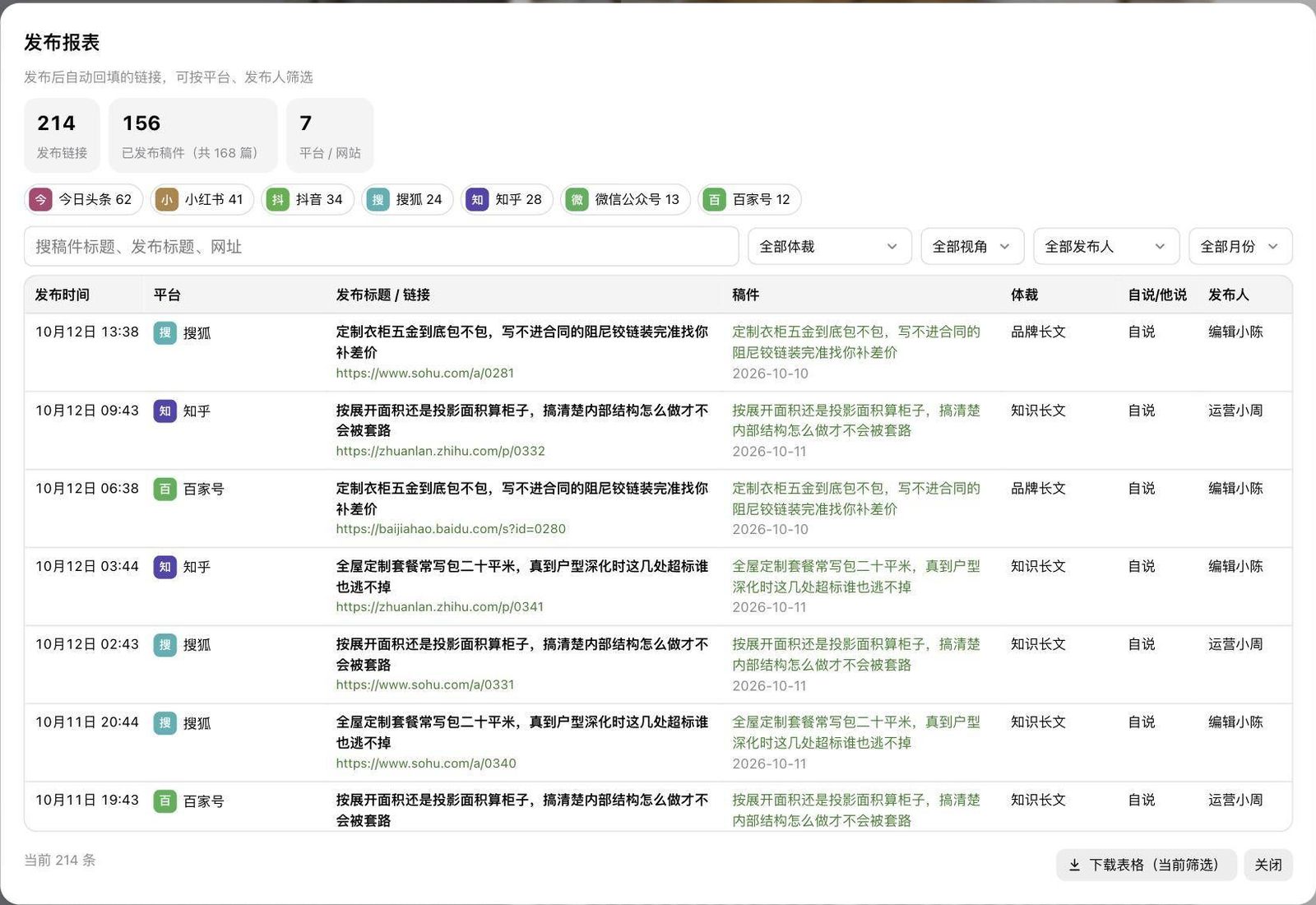
- 214 published links across 7 platforms
- Every link logged automatically, filter by platform or publisher
- Export the report in one click, ready for reporting
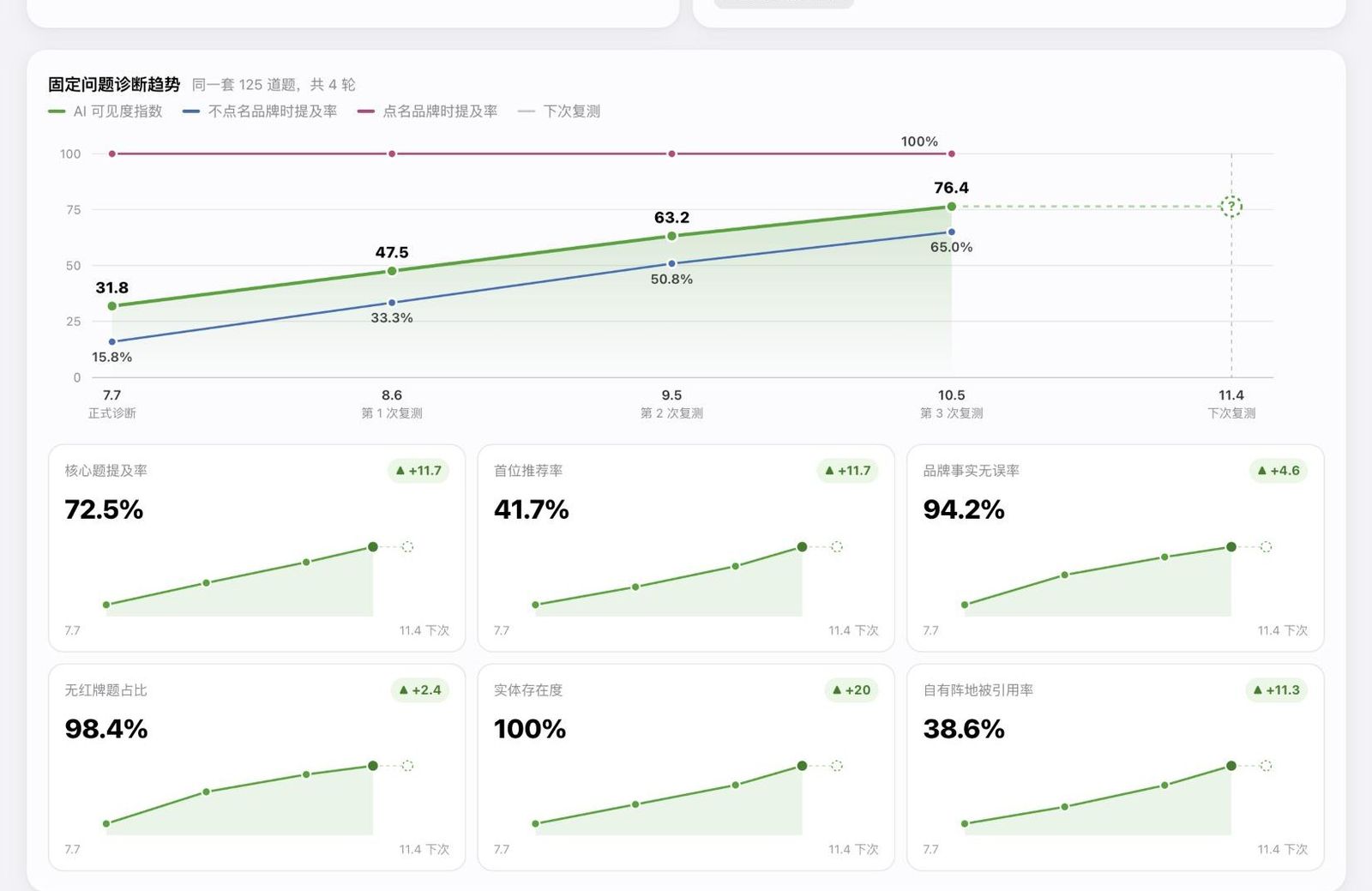
- The same 125 questions, compared over 4 rounds
- All six core metrics up
- Each retest updates the next round of topics, and the loop continues
Results
After three rounds of the loop,
AI starts recommending the brand.
The same 125 questions, retested every 30 days after the baseline. Over three months the loop handled topics, writing, images and publishing; the team only approved.
31.876.4
15.8%65.0%
6.7%41.7%
222
Every retest, every metric up
| Metric | Baseline | Month 1 | Month 2 | Month 3 | Total change |
|---|---|---|---|---|---|
| AI visibility index | 31.8 | 47.5 | 63.2 | 76.4 | ▲ 44.6 |
| Core question mention rate | 28.3% | 45.0% | 60.8% | 72.5% | ▲ 44.2 |
| Top-pick rate | 6.7% | 17.5% | 30.0% | 41.7% | ▲ 35.0 |
| Unprompted mention rate | 15.8% | 33.3% | 50.8% | 65.0% | ▲ 49.2 |
| Brand fact accuracy | 68.0% | 81.5% | 89.6% | 94.2% | ▲ 26.2 |
| Share of questions without red flags | 82.4% | 91.2% | 96.0% | 98.4% | ▲ 16.0 |
| Entity presence | 40% | 60% | 80% | 100% | ▲ 60.0 |
| Citation rate of owned channels | 5.0% | 14.8% | 27.3% | 38.6% | ▲ 33.6 |
Three months of change
AI visibility indexUnprompted mention rate
At which buying stage AI mentions you
BaselineMonth 3
12.5 → 58.3%
16 → 64%
75 → 100%
38.9 → 88.9%
33.3 → 83.3%
The fastest gains are in "category" and "comparison": even when buyers have no brand in mind and only ask how to choose, AI starts naming you.
What the loop did in three months
- 500automatic questions
125 × 4 rounds - 540topics
generated - 168articles
written - 420images
added - 214published links
on 7 platforms - 3automatic retests
each with a report
Illustrative data for the feature demo.
Global edition · China edition
One automatic loop,
tuned for global and Chinese markets.
Where your buyers are, which AI they use and what language they ask in decide how we diagnose, what we write and where we publish.
| GEO Global edition | GEO China edition | |
|---|---|---|
| Best for | B2B manufacturers, D2C consumer brands and SaaS companies selling internationally | Companies selling to buyers in mainland China, nationwide or in one city |
| AI covered | ChatGPT Search, Perplexity, Google AI Overviews, Claude | Doubao, DeepSeek, Tencent Yuanbao, Qwen, ERNIE Bot |
| How we diagnose | Question by question on Gemini with Google Search | Question by question on Doubao with web search |
| Questions and content | Only in your target market's language, including text in images | Simplified Chinese, in the words Chinese buyers actually use |
| Where we publish | Reddit, YouTube, industry media, company blogs and other sources global AI cites | Zhihu, Xiaohongshu, Toutiao, Baijiahao, Sohu and other platforms Chinese AI cites |
| What is specific | Let AI crawlers in and add structured data first; build third-party mentions so AI trusts a brand it knows little about | Local projects add the city to author profiles; healthcare and finance content stays educational |
When buyers ask AI for a supplier, it recommends you.
- Trust gapAI is cautious with brands it knows little about, Chinese brands included; verifiable third-party content closes the gap
- Thin content footprintA website alone is not enough; we add community answers, industry media and video
- Unnatural languageNo machine translation; we write the way buyers in your market talk
Get your brand into Doubao and DeepSeek answers.
- NationwideCompete for category and comparison questions such as "which brand is best" and "how to choose"
- LocalCompete for "city + question" so AI links your brand with the city
- Regulated industriesHealthcare and finance content stays educational to avoid advertising risk
FAQ
Frequently asked questions
How long before we see results from GEO?
Starbox GEO re-tests every 30 days using the same fixed question set, tracking changes in your AI visibility index and metrics each round. The exact timeline depends on industry competition and existing content foundations; our consultants provide an estimate after the initial audit.
If it is fully automated, what does our team need to do?
Just review. Audits, topic planning, writing, image generation, publishing, and re-testing all run automatically on schedule. Every draft enters a pending review queue where you can approve, reject for a rewrite, or download it; drafts are approved automatically once the review window expires.
Can we use GEO if we only serve a single city?
Yes, as a local project. For local projects, author profiles include the city name across every version, ensuring that when users ask "city + question", AI connects the brand directly to that city.
We only have an official website and no overseas social media. Can we use the Global edition?
Yes, and that is where most Chinese businesses expanding overseas start. We begin with your official site's AI readability, structured data, and content assets, then gradually expand brand mentions across third-party platforms and industry media.
What is the difference between GEO China edition and GEO Global edition?
The China edition targets domestic AI engines such as Doubao, DeepSeek, Tencent Yuanbao, and Tongyi Qianwen, using Doubao web search for diagnostics. The Global edition targets overseas AI engines like ChatGPT Search, Perplexity, and Google AI Overviews, using Gemini plus Google search for diagnostics, with content written in the target market's language.
What do we need to provide for GEO?
Brand and product information, target audience, target markets, and key competitors. Starbox uses this to build your brand knowledge base, and all factual claims in generated content are drawn exclusively from this knowledge base.
What is GEO?
GEO (Generative Engine Optimization) is the practice of making your brand and content discoverable, trusted, and cited in AI engine answers. As more buyers ask AI directly "which one is best" and "how to choose," GEO determines whether your brand appears in those answers.
Who publishes the GEO content?
Brand voice content is published through the brand's own accounts. Third-party voice content provides an external perspective and is recommended for publishing via third-party accounts. The workspace supports review, downloading, copying, and publishing, and automatically syncs publishing records.
What is the AI Visibility Index?
A comprehensive metric that measures whether AI can "see" your brand when answering buyer queries. Based on a fixed set of prompts, the system checks prompt by prompt whether your brand is mentioned, where it ranks, which competitors replace it, and whether facts are accurate. It aggregates this into an overall score and compares each retest with the previous round.
What is the difference between GEO and traditional SEO?
SEO aims to rank webpages in search results; GEO aims to get your brand cited in AI-generated answers. Because AI synthesizes multiple sources to produce conclusions, GEO focuses on whether content can be parsed, trusted, and cited by AI, and whether verifiable brand mentions exist across third-party platforms.
What stages are included in the Starbox GEO automated loop?
Six stages: automated diagnostics, automated topic selection, automated drafting, automated image matching, automated publishing, and periodic automated retesting. Retest results drive the next round of topics, creating a continuous loop where your team only needs to review and approve.
How are Starbox GEO and Starbox Content Factory related?
They are two independent systems. Starbox GEO focuses specifically on AI search optimization, producing content tailored to diagnosed visibility gaps to get AI to recommend your brand. Starbox Content Factory focuses on digital and social media content to solve marketing content shortages. They can be used separately or together.
