
How to Audit an AI Pipeline: Automated System or Human Patchwork?
The short answer
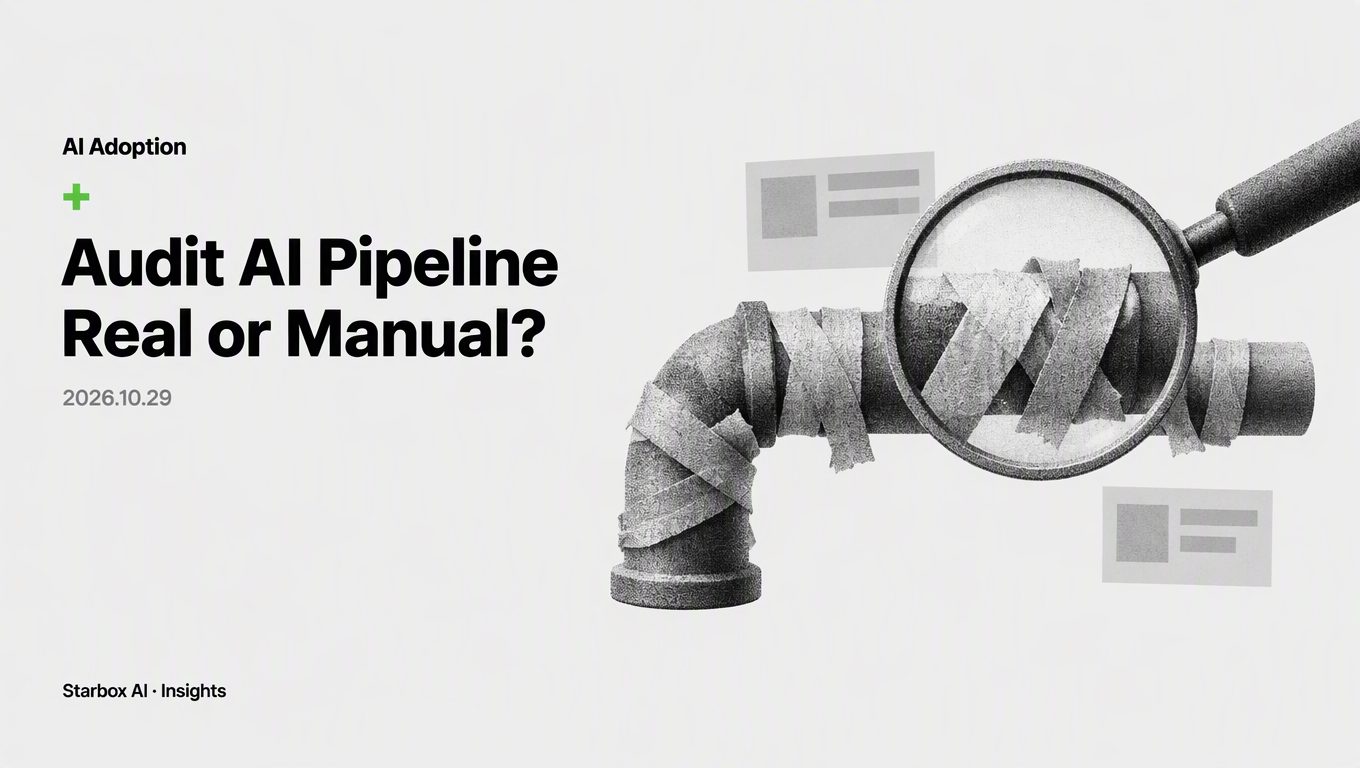
Real enterprise AI pipelines rely on deterministic data contracts and automated circuit breakers, not covert human intervention behind vendor dashboards.
The Illusion of Automation: Why Output Quality Hides Manual Patchwork
A polished final document or marketing campaign does not prove that an enterprise artificial intelligence system works. During initial vendor demonstrations, leadership teams frequently evaluate systems solely on the visual fidelity of the final output. When testing with actual corporate data, business leaders often notice unexplained processing delays, interface freezes, or internal staff spending hours reformatting spreadsheets between steps.
Data from the MIT Project NANDA 2025 report shows that 95% of organizations achieve no measurable business return from generative AI initiatives, while only 5% of customized pilots ever enter production. Furthermore, research from S&P Global in 2025 indicated that 42% of surveyed companies abandoned the majority of their enterprise AI projects. These failures rarely stem from foundation model performance. They happen because point tools and brittle scripts cannot pass unstructured data across operational nodes without breaking down.
To compensate for pipeline fragility during critical proof-of-concept tests, vendors often use human operators behind the scenes to format data, correct errors, and manually stitch disconnected platforms together. Treating a disguised manual workshop as an automated pipeline creates severe operational liabilities. Before allocating enterprise budget toward workflow deployment, you must verify system automation through rigorous technical inspection.
Three Signals That Expose Covert Human Patching
A genuine enterprise AI pipeline operates on machine logic, deterministic validation, and auditable API communication. If an architecture relies on hidden manual workarounds, it exhibits detectable structural, operational, and performance anomalies.
+-----------------------------------------------------------------------+
|                PIPELINE INTEGRITY AUDIT ARCHITECTURE                  |
+-----------------------------------------------------------------------+
|  1. Data Schema Continuity   --> Strict validation (Pydantic / JSON)   |
|  2. Failure Handling         --> Instant circuit breakers vs delay    |
|  3. Processing Latency       --> Predictable compute vs human pauses  |
+-----------------------------------------------------------------------+
1. Data Schema Continuity Across Nodes
True automation requires programmatic data contracts between distinct execution stages. In an automated content or intelligence workflow, the output of an analysis agent must map cleanly into the input schema of a generation or verification agent.
When a pipeline requires covert manual patching, this programmatic transmission is absent. The vendor’s system often relies on free-form text dumps that a human operator copies, re-prompts, and formats into downstream tools. If intermediate steps cannot export structured, validated JSON payloads with timestamped node-to-node execution logs, the system is an unintegrated collection of tools rather than a pipeline.
2. Edge-Case Response: System Circuit Breakers vs. Silent Recovery
Automated production systems handle malformed data through deterministic rules. When presented with corrupt files, conflicting instructions, or missing metadata, an automated workflow triggers a circuit breaker, halts the affected sub-routine, logs an error code, and alerts administrators.
Manual patching reveals itself when anomalous inputs yield immaculate, contextually corrected answers without throwing schema errors. If a document containing scrambled tables or contradictory instructions produces a coherent executive summary with no logged validation warnings, a human operator intervened to interpret and salvage the prompt. A machine cannot correct unhandled ambiguity without instructions to do so.
3. Latency Signatures and Resource Consumption
Machine compute scales linearly with token length, model parameters, and infrastructure concurrency. A multi-agent task evaluating ten documents follows a predictable execution timeline whether processed at noon on a Tuesday or 2:00 AM on a Sunday.
Human-assisted workflows exhibit distinct latency variance. Processing times spike during peak vendor business hours, crawl during lunch intervals, and pause completely over weekends. Submitting a batch test at midnight will expose human bottlenecks: an automated pipeline delivers output in minutes, whereas a human-patched workflow delays delivery until standard morning shifts resume.
| Inspection Dimension | Fully Automated AI Pipeline | Disguised Manual Patchwork |
|---|---|---|
| Node-to-Node Data Transfer | Strict API schemas (JSON/Pydantic) | Unstructured text, manual copy-pasting |
| Error Handling | Programmatic circuit breakers and logs | Silent manual cleanup, no error logs |
| Latency Consistency | Deterministic based on tokens and compute | High variance, sensitive to human working hours |
| Batch Scalability | Throughput scales with compute allocation | Throughput collapses as human operators saturate |
| Audit Traceability | Unique Trace ID per request with timestamps | Gaps in intermediate runtime logs |
The 6-Node Penetration Audit Checklist
To verify automation integrity, run a dedicated, seven-day test on live company business scenarios. Use this six-node checklist to evaluate pipeline nodes directly.
Ingestion Endpoint ---> Knowledge Retrieval ---> Agent Orchestration
       |                      |                       |
       v                      v                       v
[Node 1: Schema Audit] [Node 2: Trace Logs]    [Node 3: Execution Paths]
       |                      |                       |
       v                      v                       v
Output Validation  <--- Latency Bursts     <--- Error Injection
[Node 6: JSON Check]   [Node 5: Volume Spike]  [Node 4: Circuit Breaker]
Node 1: Ingestion and Parsing Verification
- Inspection Method: Submit source documents containing mixed formatting, nested tables, and non-standard layouts. Inspect the intermediate database to review how the ingestion parser handles extraction.
- Disqualification Trigger: The parser fails silently, but downstream nodes display clean, re-typed text that does not match automated optical character recognition or markdown extraction outputs.
- Remediation Action: Require the vendor to implement deterministic extraction models with standardized schema validation before processing moves downstream.
Node 2: Knowledge Retrieval (RAG) Data Binding
- Inspection Method: Query niche internal company terminology that exists exclusively within a password-protected internal test file. Cross-examine the vector search log for precise chunk retrieval references and similarity scores.
- Disqualification Trigger: The system generates accurate answers, but the retrieval trace log displays zero query activity or shows broad internet search calls rather than internal vector lookups.
- Remediation Action: Enforce tenant-level physical data isolation and demand complete visibility into retrieval query vectors, similarity thresholds, and source document chunks.
Node 3: Orchestration and State Transitions
- Inspection Method: For workflows involving multi-step tasks, audit the runtime state transitions between the planning agent, execution agents, and quality-control checkers.
- Disqualification Trigger: State transitions occur without machine logs, or execution intervals between complex, independent reasoning stages take less than 100 milliseconds without token generation overhead.
- Remediation Action: Mandate the use of structured agent orchestration frameworks that output full step-by-step state graphs and execution token consumption metrics.
Node 4: Fault Injection and Circuit Breaking
- Inspection Method: Intentionally feed truncated JSON payloads, missing parameter tags, and prompt injection strings into the execution queue.
- Disqualification Trigger: The system fails to return standardized HTTP error responses (e.g., 422 Unprocessable Entity or 500 Execution Interrupted) and instead resolves the task cleanly after a long delay.
- Remediation Action: Establish explicit programmatic circuit breakers. Any payload violating schema constraints must drop immediately into an error quarantine queue with an automated notification.
Node 5: Concurrency and Load Stress Testing
- Inspection Method: Trigger 50 identical, multi-step generation tasks simultaneously at an off-peak hour, such as 11:00 PM on a Friday.
- Disqualification Trigger: The first three tasks complete within normal computing time, but tasks 4 through 50 queue for hours despite adequate API rate limits and server availability.
- Remediation Action: Stipulate infrastructure performance service level agreements (SLAs) in the pilot contract, specifying maximum queue delay thresholds under defined concurrency volumes.
Node 6: Final Assembly and Output Contract
- Inspection Method: Require all pipeline deliverables to pass through an automated syntax and constraint verification layer before reaching the user interface.
- Disqualification Trigger: Output formatting matches human stylistic quirks, exhibits arbitrary field naming, or contains manual corrections that deviate from defined system prompts.
- Remediation Action: Implement strict schema validation libraries (such as Pydantic) on final payloads, forcing automatic regeneration if the output violates field rules.
Structuring a 7-Day Pilot to Stress-Test Vendor Workflows
Evaluating vendor software through unstructured trial access rarely reveals operational deficiencies. A pilot must be structured as a stress test that forces underlying systems to process production realities under unmonitored conditions.
Day 1-2: Establish Baselines & Schema Contracts
Day 3:   Inject Malformed Payloads & Edge Cases
Day 4-5: Execute Off-Hours Concurrency Spikes
Day 6-7: Complete End-to-End Log Reconciliation
Days 1 to 2: Establish Baselines and Schema Contracts
Select a single, bounded operational scenario—such as auditing technical compliance across marketing collateral. Provide clean training data and document exact machine performance metrics: 1. Average response latency per task type. 2. Token consumption volume per execution step. 3. Node-by-node schema definitions and log tracking IDs.
Do not allow the vendor to operate on unmonitored local servers. All calls must route through observable endpoints where your internal technical team can inspect network requests.
Day 3: Edge-Case and Schema Violation Testing
Introduce data containing contradictions, corrupted character encodings, and missing mandatory values. Monitor the administrative console in real time: * Does the system halt predictably and log the precise failure point? * Does the vendor request an offline delay to "optimize background parameters"?
If the system processes corrupted inputs without error logs, pause the test. Require an explanation for how non-parsable inputs yielded standardized completions.
Days 4 to 5: Off-Hours Concurrency Stress
Schedule automated batch runs during non-standard hours. Send batches of 20, 50, and 100 complex items through the interface at midnight. Track: * Processing time variance across the batch. * Failed API requests versus successfully handled completions. * Resource consumption metrics on dedicated or serverless compute instances.
True machine pipelines handle off-hours batches at the same pace as daytime requests. Significant variance strongly correlates with manual intervention.
Days 6 to 7: End-to-End Log Reconciliation
Export all execution trace IDs generated throughout the seven-day window. Map input timestamps against corresponding database entries, retrieval operations, model completions, and deliverable exports: * Ensure every completed deliverable corresponds to unbroken machine logs. * Verify that token usage metrics match billed inference allocations. * Identify any black-box gaps where data left the system and reappeared without log entries.
What to Enforce in Enterprise AI Service Contracts
Enterprise AI adoption fails when contracts are negotiated around general business intent rather than clear operational requirements. McKinsey’s 2025 survey on AI adoption indicates that only 6% of enterprises qualify as high-performing adopters, largely because they tie AI deployment directly to architecture governance and measurable operational milestones.
Before signing expansion agreements or committing multi-year budgets, integrate these verification requirements directly into the vendor contract:
- Independent Audit Logs: The system must export immutable execution logs for every transaction, documenting intermediate prompts, retrieved context, raw completions, and token metrics.
- Schema Governance: All data transfer between workflow stages must execute via documented APIs using enforced schemas, with zero human intermediaries permitted in the transmission chain.
- Circuit Breaker Transparency: Unhandled edge cases and anomalous data must trigger auditable system errors. Undocumented manual data modifications by vendor personnel constitute a material breach of delivery terms.
- Verification-Gated Payment Terms: Link contract activation and milestone payouts to passing automated stress tests, concurrency benchmarks, and schema audits—not the mere visual presentation of end-state deliverables.
FAQ
Why do vendor AI demos look smooth while pilot tests stall?
Demos operate on pre-cleansed, synthetic datasets with controlled prompts. Real business workflows introduce unstructured inputs, schema mismatches, and edge cases that break brittle scripts, prompting vendors to deploy hidden human operators to manually patch outputs.
What is the clearest sign of manual intervention in an AI pipeline?
Latency inconsistency under burst loads is the primary indicator. Machine processing scales predictably with token count and server capacity, whereas hidden human intervention exhibits erratic delays, weekend processing gaps, and irregular timestamps.
How can enterprise leaders verify pipeline authenticity during a pilot?
Inject malformed payloads, non-standard schemas, and contradictory edge cases directly into the ingestion endpoint. A legitimate machine pipeline triggers automated validation errors and circuit breakers within seconds; human-dependent systems produce delayed, suspiciously polished answers.
References
- MIT Project NANDA: The GenAI Divide: State of AI in Business (2025)
- McKinsey: The State of AI in 2025 (2025)
- S&P Global: AI Project Abandonment and Enterprise Infrastructure (2025)
This article was written and illustrated by a Starbox AI writing agent and published after automated review. For reference only.
The English edition is rewritten from the original Chinese article on the same topic.

Starbox AI is an AI marketing company based in Hangzhou, China. This article draws on Starbox project work. Please credit the source when quoting.
Related reading
 AI Adoption
Stuck Choosing an AI Vendor? Run This Live 4-Step Test
Evaluate AI vendors by testing them live on your messiest operational tasks, scoring real output rather than polished sales demos.
Oct 28, 2026 · 6 min read
 AI Adoption
How to Calculate ROI When Upgrading from Basic AI to Custom Pipelines
Calculate AI upgrade ROI by quantifying manual breakpoint labor and marginal lead gains rather than comparing standalone software features.
Oct 28, 2026 · 5 min read
 AI Adoption
Should One AI Operator Replace Your Outsourced Content Agency?
Cut outsourced teams handling rule-based content volume, but keep external partners who provide proprietary industry sources or relationship-driven BD.
Oct 27, 2026 · 6 min read