
Should You Implement llms.txt? A Decision and Acceptance Guide
The short answer
llms.txt is neither required for AI search indexing nor used by Google Search. Focus on content quality, crawlability, and clear site structure first.
If you are exploring Generative Engine Optimization (GEO)—optimizing your content and site architecture for visibility across generative AI—you have likely heard that deploying an llms.txt file is mandatory. The claim usually goes: without it, AI models cannot discover, understand, or cite your website.
For technical documentation hubs, API reference portals, or websites integrating with tools confirmed to read the file, llms.txt can serve as a lightweight compatibility layer. However, whether you should implement it should not depend on what your competitors are doing. It depends on four concrete questions: who reads it, what do they extract, who maintains it, and how do you verify the output?
What llms.txt Actually Is
Introduced in 2024 as an open proposal, llms.txt suggests placing a plain-text file in a website's root directory:
https://www.example.com/llms.txt
Written in Markdown, the file uses plain text with headings, lists, and links so that both humans and automated parsers can process it easily.
A standard llms.txt file generally contains two elements:
- A brief summary of the organization, product, or project.
- A curated list of links pointing to core pages, paired with brief context for each.
The original goal was to help large language models (LLMs) locate key reference material more efficiently when answering user prompts. For large documentation hubs, developer portals, and API directories, it acts like an executive summary of essential resources.
To evaluate it objectively, keep three boundaries in mind:
- It is an open proposal: It is not an established, mandatory internet standard.
- It offers summaries and entry points only: It does not govern crawl permissions, nor can it substitute for the actual content on your web pages.
- It requires active consumer support: Only tools explicitly programmed to fetch and parse
llms.txtwill ever use the data inside it.
Publishing the file to your root directory confirms only that the file is public. It does not prove that AI platforms will parse it, nor does it guarantee indexing or citations.
Why It Is Often Sold as a GEO Requirement
The main reason llms.txt gets so much attention is simple: it is fast to deploy and easy to deliver.
Most companies struggle to see which pages AI bots crawl and extract. Restructuring website copy, improving page hierarchy, and cleaning up internal links take sustained engineering and editorial effort. Dropping a text file into the root directory provides an immediate, visible deliverable.
Easy implementation, however, does not equal verified impact.
Official documentation from Google Search Central makes this clear: websites do not need to create machine-readable files, AI text files, or specialized Markdown files to appear in Google Search or its generative AI experiences. Google Search does not read llms.txt. Adding one will neither improve nor harm your visibility or rankings in Google Search.
When evaluating llms.txt, distinguish between three separate stages:
- Can the file be accessed publicly?
- Does a specific tool actively fetch and parse it?
- Does parsing the file alter the final answer or citation?
A working URL only confirms deployment. A single tool reading the file does not mean mainstream AI search engines do the same. Even if a system parses the file, that does not guarantee your site will be cited in generated answers.
Keep these foundational concepts distinct:
- Crawling: An automated system fetches and reads your page content.
- Indexing: A search engine stores and organizes that content for retrieval.
- Citation: An AI assistant references, links, or names your brand in an answer.
- Parsing
llms.txt: A specific tool retrieves and reads your root text file.
These steps are related, but one does not imply the others.
It Does Not Replace robots.txt or sitemap.xml
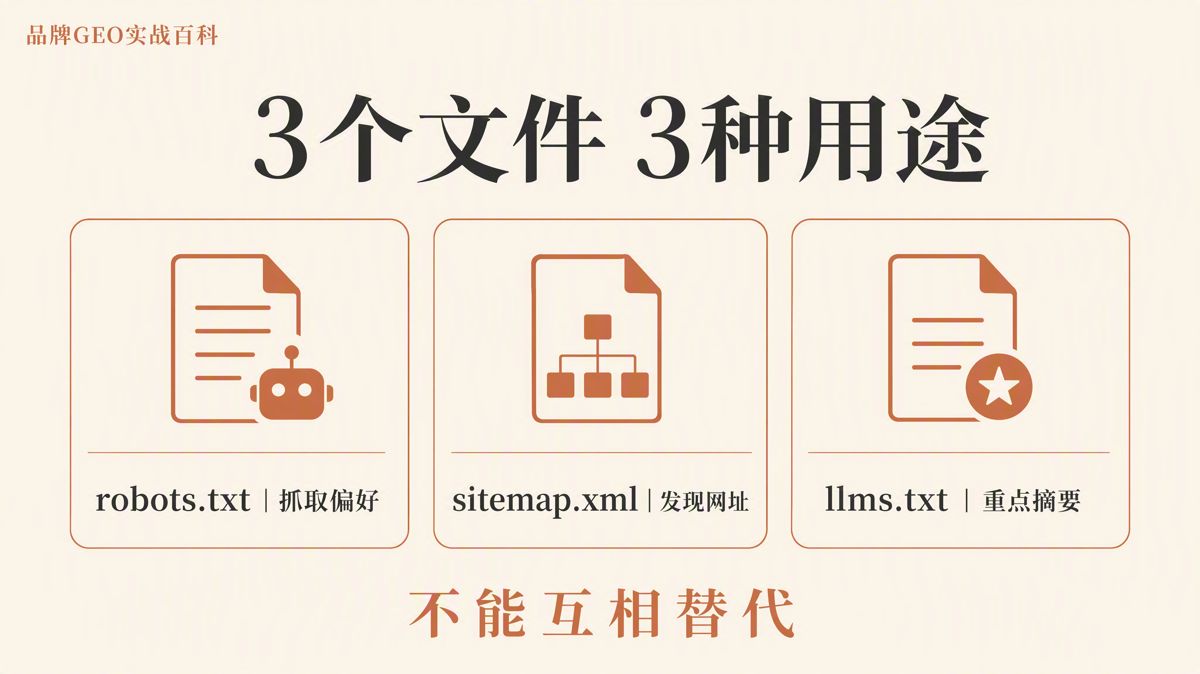
These three files handle completely different responsibilities:
| File | Primary Role | Can llms.txt Replace It? |
|---|---|---|
robots.txt |
Communicates crawling permissions and restrictions to compliant bots | No |
sitemap.xml |
Supplies search engines with an index of URLs intended for discovery | No |
llms.txt |
Offers a curated directory of site summaries and key links for compatible tools | No; parsing is optional and tool-dependent |
A robots.txt file manages crawler access, telling bots which sections of your site they may or may not visit. It does not curate content.
A sitemap.xml file provides search engines with a structured index of pages you want discovered.
An llms.txt file is an extra layer: a curated summary of priority links for systems designed to look for it.
Even if you deploy llms.txt, you still need to maintain your robots.txt and sitemap.xml files according to standard web practices.
Four Questions to Ask Before Scheduling the Work
Before allocating developer hours, answer these four questions:
- Can you name an active system or workflow that will read this file?
- Does your site have a complex library of documentation, API specs, or knowledge base articles to organize?
- Are your core pages already crawlable, fast, and factually consistent?
- Is someone assigned to update the file whenever site content changes?
Use these scenarios to guide your decision:
Scenario A: You answered "Yes" to question 1 or 2, and "Yes" to questions 3 and 4.
Your site has substantial material to organize or serves a workflow that reads the file, and your operational foundations are ready. You can schedule llms.txt as a low-priority technical task.
Scenario B: You answered "No" to both questions 1 and 2.
You have neither a confirmed consumer nor a complex library requiring curated navigation. Deploying the file offers minimal return. Do not implement it simply because competitors have.
Scenario C: You answered "No" to question 3 or 4.
Your core pages or maintenance workflows are not ready. Focus on body copy, crawlability, search indexing, internal link architecture, and factual accuracy first. Adding llms.txt right now only creates another outdated asset to maintain.
Sites That Benefit Most
1. Documentation Hubs and API Reference Sites
These sites typically feature hundreds of deeply nested URLs and multiple version paths. Providing an index of active, canonical resources cuts down discovery friction and helps internal teams verify documentation coverage.
2. Products with Complex Rules and Architectures
When technical specs, pricing models, service boundaries, terminologies, and release notes live across different URLs, an llms.txt file helps compatible parsers find the right source of truth—provided those pages are public, active, and free of contradictions.
3. Sites Connected to Known Toolchains
If your workflow or developer community uses an agent or search tool that explicitly parses llms.txt, build the file to that tool's specifications and test it directly. Never deploy it based on vague industry claims that "AI systems need it."
4. Teams Conducting Content Audits
Even without external bots reading it, listing your site's top 10 to 20 primary URLs forces your team to audit broken links, eliminate duplicate versions, and spot missing information. Keep in mind: this delivers value through internal content hygiene, not guaranteed AI visibility.
Issues to Fix Before You Build llms.txt
Postpone llms.txt if your website has any of the following problems:
- Core information sits behind a mandatory login.
- Primary text relies on client-side JavaScript that search and AI bots fail to render reliably.
- Important documentation lives inside scanned PDFs without extractable text.
- Your company profile, product descriptions, pricing, and case studies contain conflicting facts across pages.
- You lack structured core pages and plan to use
llms.txtpurely as a promotional brochure. - Your team views the file as a shortcut to secure Google rankings or guaranteed AI citations.
- You cannot identify who reads the file, what they extract, who updates it, or how you will audit it.
A supplementary text file cannot fix underlying technical or editorial debt. It only reorganizes what is already accessible on your domain.
A Minimal Template You Can Adapt
# Example Company

> Example Company builds [product/service category] for [target audience], focusing on [core capability within clear scope].

## Core Pages

- [About Us](https://www.example.com/about): Entity background, leadership, and verified contact channels
- [Products](https://www.example.com/products): Active product lineup and primary use cases
- [Services](https://www.example.com/services): Scope of delivery, implementation processes, and project boundaries
- [Case Studies](https://www.example.com/cases): Public, verifiable customer implementations
- [Documentation](https://www.example.com/docs): Technical documentation and user guides

## Additional Resources

- [Changelog](https://www.example.com/changelog): Version history and feature updates
- [FAQ](https://www.example.com/faq): Answers to common technical and operational questions
Every link in the file must point to an active, canonical page, and every accompanying description must match the content on that page.
Do not include certifications, customer logos, pricing tiers, or performance metrics that do not exist on your public pages. The file must reflect verified, public information rather than an unvetted marketing narrative.
Whenever a page changes, update the file immediately. Leaving outdated URLs, legacy pricing, or obsolete rules in place creates conflicting signals for crawlers.
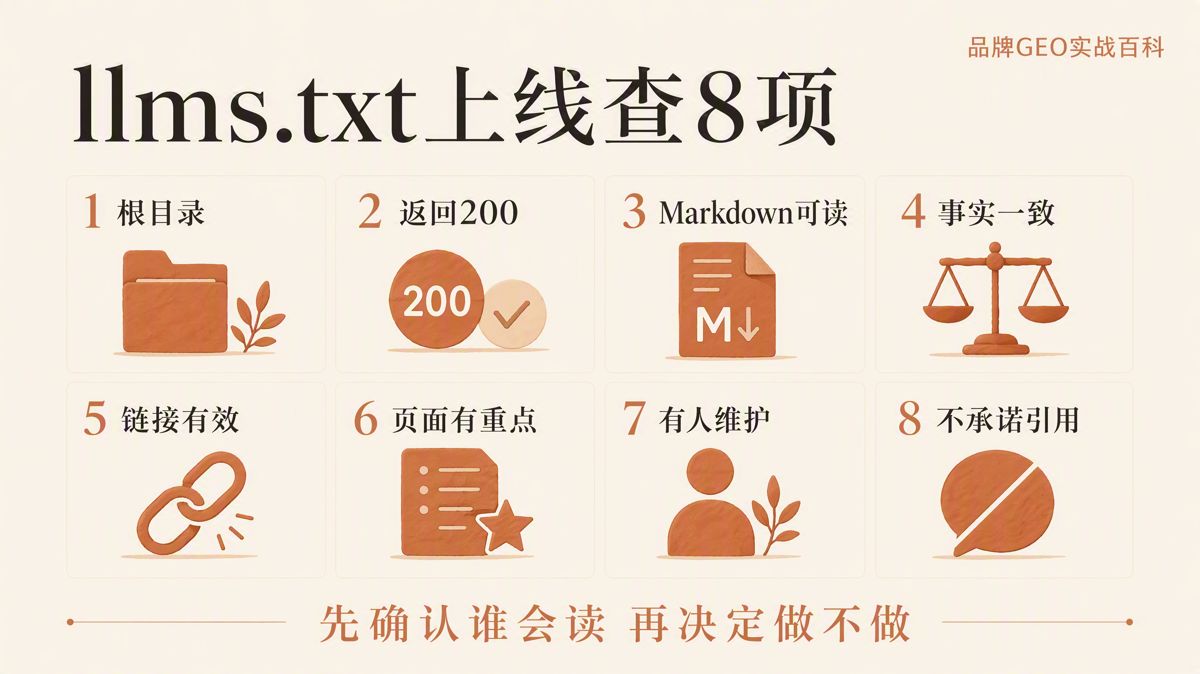
Pre-Launch Checklist: 8 Verification Steps
Run through this checklist before pushing the file live:
| Checkpoint | Passing Standard |
|---|---|
| File Location | Accessible directly at /llms.txt in the root domain |
| HTTP Status | Returns a clean 200 OK status; no redirects, login walls, or CAPTCHAs |
| Format | Clean, valid Markdown with readable headers and structured links |
| Factual Consistency | Entity details, pricing, and claims align perfectly with live web pages |
| Link Integrity | All URLs resolve to active pages with zero 404 errors or broken redirect chains |
| Page Selection | Contains only essential, current, high-priority URLs |
| Maintenance Owner | A designated team member is assigned to update the file when pages change |
| Performance Expectations | Deployment is audited for compatibility, not mistaken for guaranteed citations |
A passing grade requires more than an active URL. If the file returns 200 OK but contains outdated pricing, or links to a deprecated version, it fails the audit.
How to Audit the File Post-Deployment
Step 1: Verify Direct Public Access
Navigate directly to /llms.txt in a clean browser session. Confirm the HTTP status, text encoding, and formatting render properly. Never assume internal server placement translates to clean public access.
Step 2: Validate Every URL and Summary
Open every link listed in the file. Verify that none return 404s, land on soft-404 redirects, or point to legacy products. Confirm that the summary text next to each link accurately reflects what the target page says today.
Step 3: Record Version Metadata
Log the deployment date, the cryptographic file hash, and the assigned owner. Tracking the file hash helps you spot unintended changes or confirm whether an external bot is reading the latest version.
Step 4: Run Real-World Retrieval Tests
If you deployed llms.txt to support a specific tool, run prompt tests inside that platform. Verify whether the tool actually fetches the file and parses the URLs correctly.
Remember: successful retrieval does not guarantee a citation. If an AI platform fails to cite your domain in a single prompt, that does not mean the file is broken. Conversely, if the model mentions your brand, that does not prove it extracted the data from llms.txt. Track file delivery and citation results as separate metrics.
Four Common Implementation Mistakes
1. Treating It as a Crawl Rule Directive
llms.txt cannot block bots or manage crawler access. If you need to restrict search engines, AI training scrapers, or specific automated agents, configure your robots.txt and server firewalls instead.
2. Dumping the Entire Sitemap into the File
The format is meant to highlight priority entry points, not replicate your entire sitemap. Stuffing hundreds of URLs into the file increases maintenance overhead and dilutes the value of your core content.
3. Publishing Contradictory Claims
If your live pricing page says one thing and your llms.txt file lists an older rate, you introduce factual conflict. The file must summarize existing web pages, not publish independent assertions.
4. Buying Services That Promise "Guaranteed AI Indexing"
Google does not read llms.txt, and major AI platforms do not use it as a blanket indexing switch. Any agency or tool claiming that creating an llms.txt file guarantees citations or placement in AI answers is misrepresenting how these systems operate.
The Bottom Line
Deploying llms.txt is an optional compatibility measure, not a foundational prerequisite for Generative Engine Optimization.
For technical documentation hubs, products with extensive rule sets, and engineering teams integrating with specific LLM workflows, the file provides an inexpensive way to point compatible parsers toward the right source of truth.
For most commercial websites, resources are far better spent on fundamentals: reliable page rendering, clean internal link architecture, factually consistent copy, and verifiable citations across your primary pages. Without those assets in place, an llms.txt file will not move the needle.
Before scheduling implementation, make sure you can answer four questions: who will read it, what will they extract, who will keep it updated, and how will you verify the results?
If you cannot answer those four questions today, leave llms.txt off your technical backlog.
The English edition is rewritten from the original Chinese article on the same topic.

Starbox AI is an AI marketing company based in Hangzhou, China. This article draws on Starbox project work. Please credit the source when quoting.
Related reading
 GEO Guide
Why AI Marketing Vendor Quotes Vary 10x: A 4-Step Vetting Checklist
Evaluate AI marketing proposals by delivery actions, not slide decks. Audit source infrastructure, fact cleaning, and clean-environment testing.
Oct 22, 2026 · 6 min read
 GEO Guide
Spotting GEO Scams: What Actually Drives AI Recommendations?
Automated AI ranking promises violate how LLMs work. Real AI recommendations rely on authoritative, structured facts across trusted public sources.
Oct 22, 2026 · 4 min read
 GEO Guide
How to Measure Your Brand's AI Visibility with a Spreadsheet
You do not need expensive software to track AI recommendations. A three-tier prompt framework and a simple spreadsheet can score your brand visibility in half a day.
Oct 21, 2026 · 6 min read