
Global Entity Modeling: Schema and sameAs Across 8 Platforms
The short answer
Generative engines rely on consistent entity signals. Here is how to model your brand using Schema.org, sameAs, and Wikidata across eight platforms.
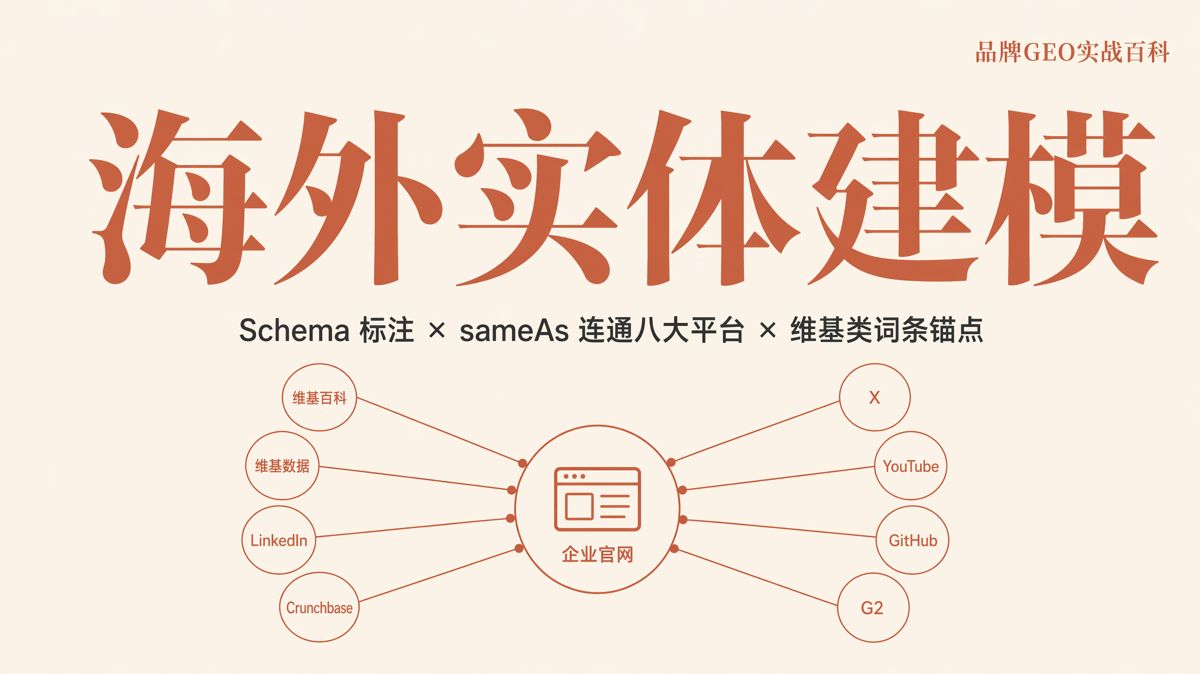
Generative Engine Optimization (GEO) focuses on whether generative engines like ChatGPT and Perplexity can accurately retrieve, recognize, and cite your brand. Overseas entity modeling ensures that your official website and external profiles present identical, verifiable facts about your company, products, and leadership. This minimizes the risk of AI engines confusing your business with another brand or hallucinating basic corporate details.
Execution consists of three core components:
1. Using Schema structured data on your website to define your corporate identity.
2. Using the sameAs property to declare that external platform accounts belong to that exact entity.
3. Establishing third-party references such as Wikipedia and Wikidata to enable cross-verification.
All three layers must align. Any discrepancies in company name, founding year, or business scope can disrupt entity disambiguation.
The Evidence Behind Entity Modeling
Public research and industry observations highlight several data points:
- Geneo (2025): Pages with structured data are cited by generative AI engines 8.2 times more frequently than pages without it.
- Industry Benchmarks: Pages deploying both
OrganizationandFAQPageschemas show a 37% higher citation rate in Google AI Overviews compared to pages lacking structured data (unverified by third-party audits). - seoClarity: Cross-platform entity consistency correlates with AI citations at $r = 0.664$, whereas backlink correlation sits at $r = 0.218$. A correlation coefficient indicates a statistical relationship, not direct causation.
- Digital Applied (March 2026): In its analysis of Google's March 2026 update, Digital Applied noted that a "verifiable author or publisher entity"—including
sameAsreferences pointing to Wikipedia and Wikidata—acts as a strong trust signal. This is an agency interpretation rather than an explicit rule from Google. - 5W Research: Wikipedia accounts for 47.9% of ChatGPT's top ten citation sources. In a separate US-focused study, Wikipedia and Reddit collectively accounted for more than 25% of ChatGPT citations.
- AmICited: Pages implementing
FAQPageschema saw a 320% increase in ChatGPT citations and a 3.2x higher likelihood of appearing in Google AI Overviews within their research sample. - Wikipedia Pass Rates: Industry estimates suggest Chinese companies face a 30% to 50% first-time approval rate for English Wikipedia articles, with preparation and review typically taking 12 to 18 months (unverified).
One common industry framework divides AI content evaluation into five dimensions, estimating that entity consistency carries a weight of 15% to 20%. While unverified by engine providers, this heuristic helps prioritize optimization work.
1. Which Schema Types to Deploy
Schema.org is the shared structured data vocabulary maintained by Google, Microsoft, and other search engines. Websites typically implement it using JSON-LD (JavaScript Object Notation for Linked Data) placed inside the page code for crawlers to read.
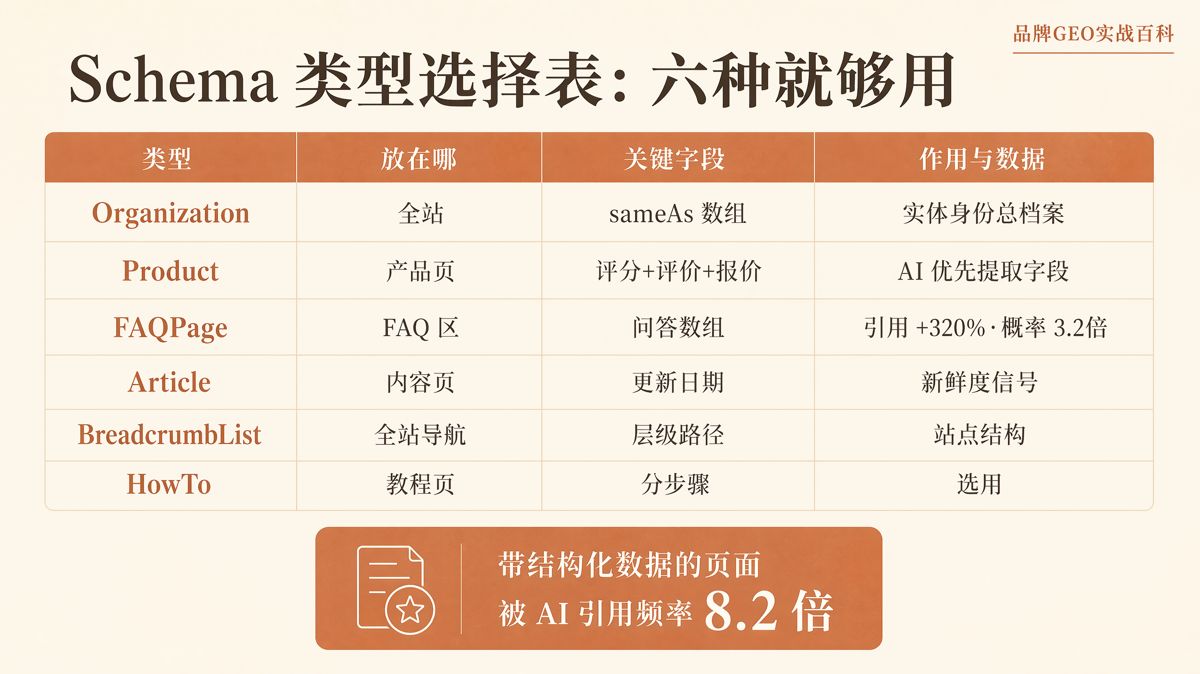
While Schema.org lists hundreds of types, cross-border businesses primarily need six:
| Schema Type | Target Pages | Key Properties | Primary Role |
|---|---|---|---|
Organization |
Site-wide (prioritize Homepage & About page) | Full legal name, logo, address, founding details, sameAs array |
Defines a unified corporate entity and prevents brand confusion |
Product |
Product detail pages | Name, description, aggregateRating, review, offers |
Outlines product specs, verified ratings, reviews, and pricing |
FAQPage |
Pages with FAQ content | mainEntity array with Question and acceptedAnswer |
Helps machines parse queries and direct answers |
Article |
Blog posts, guides, and news pages | Headline, author, datePublished, dateModified |
Validates author identity and editorial freshness |
BreadcrumbList |
Site-wide navigation | Hierarchical site paths | Helps crawlers map page position within the site structure |
HowTo |
Step-by-step tutorials | Ordered step array |
Clarifies sequential instructions for instructional content |
Implement Organization and BreadcrumbList across your entire site. Add Product, FAQPage, Article, and HowTo where page content calls for them. In a standard 90-day GEO roadmap, schedule Schema deployment for week two, using 20 fully configured pages as your phase milestone.
Technical Requirements for Clean Schema
- Use JSON-LD in the
<head>: Place your JSON-LD script inside the HTML<head>tag. This is Google's recommended format and works across platforms like WordPress, Webflow, and Shopify. - Populate the
sameAsarray: List verified, actively maintained official platform URLs within yourOrganizationmarkup so machines can link your domain to external profiles. - Keep product fields factual: For
Productpages, fields likeaggregateRating,review, andoffersmust reflect visible page content. Never mark up reviews or pricing that do not appear to visitors. - Structure FAQs for conversational queries: In
FAQPage, place each Q&A inside themainEntityarray. Target natural long-tail user queries (10–20 words) for theQuestionname, and provide clear, direct conclusions (50–150 words) in theacceptedAnswertext. - Match visible text with code: Schema content must mirror what the human visitor sees. Showing one set of answers to visitors and another in the markup violates search engine guidelines and risks algorithmic penalties.
Validate your implementation using two tools: - Schema.org Validator: Checks JSON-LD syntax and attribute hierarchy. - Google Rich Results Test: Confirms whether Google can parse the markup for rich snippets.
Resolve all errors and warnings before moving to the next phase.
2. Schema in SEO vs. GEO
In traditional SEO, Schema earns rich snippets—search listings enhanced with review stars, price ranges, or expandable FAQ accordions. Industry data shows rich snippets can increase click-through rates by 5% to 30%, depending on the query and position.
On May 15, 2026, Google stated that optimizing for generative AI search remains an extension of fundamental SEO. Google explicitly dismissed the need for "AI-specific Schema tags." Agency packages promoting "AEO Schema" or "AI-ready markup" do not represent official requirements.
The universal types—Organization, Product, FAQPage, Article, BreadcrumbList, and HowTo—remain the standard.
GEO relies on Schema primarily for entity disambiguation. Combining the sameAs array with a Wikidata QID (the unique identifier assigned to every Wikidata item) allows generative models to confirm that different online profiles point to the same business.
Set realistic expectations across three tiers: 1. Rich snippets are the immediate benefit in traditional search. 2. Disambiguation across AI knowledge graphs is the core value for GEO. 3. Schema alone does not guarantee AI citations. Structured markup cannot compensate for thin content, factual inaccuracies, or an absence of external authority.
3. Connecting 8 Core Platforms via sameAs
The sameAs property inside Organization schema lists your official web properties.
When search bots read these URLs, they cross-reference corporate profiles. If your website, LinkedIn, Crunchbase, and GitHub profiles share the exact registered legal name, founding year, address, and industry taxonomy, generative engines can resolve them into a single entity.
Before configuring sameAs, standardize your legal English name. Ensure identical capitalization, spacing, and corporate identifiers (such as "Inc." or "Ltd.") across every overseas channel. Character-level consistency is your baseline requirement.
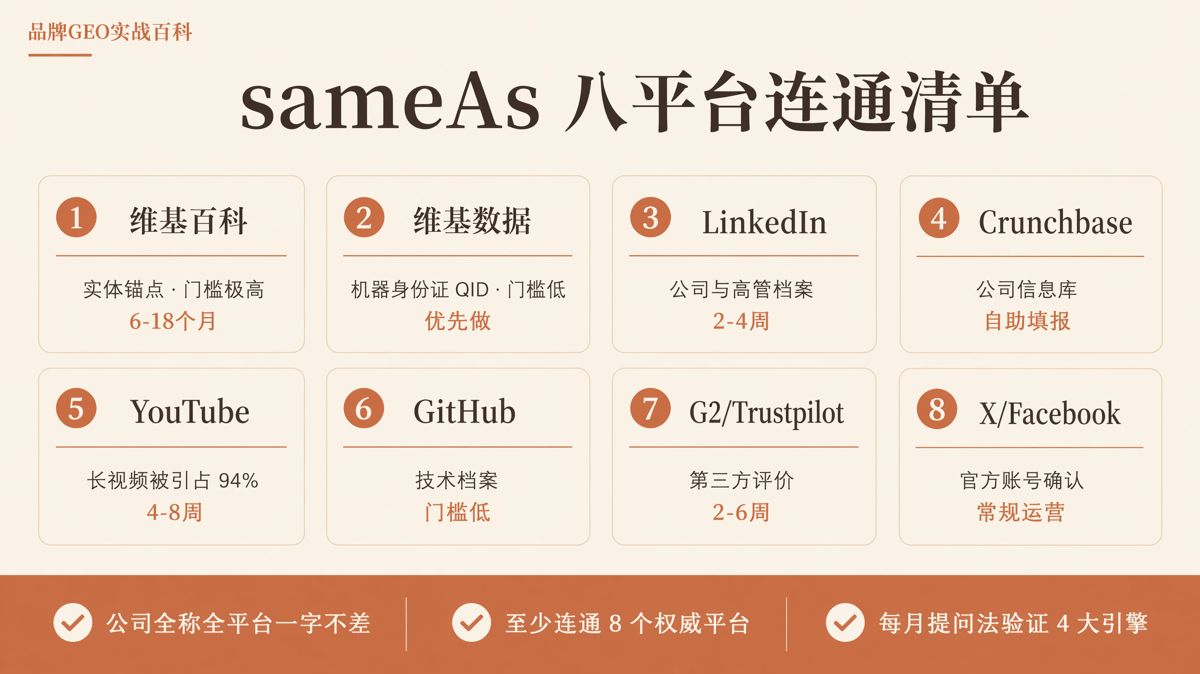
Aim to connect at least eight of the following ten platforms:
| Platform | Role in Entity Recognition | Operational Hurdles for Cross-Border Teams | Setup Timeline |
|---|---|---|---|
| Wikipedia | High-authority encyclopedia entry with independent citations | Very high editorial bar; strict non-promotional standards | 6–18 months |
| Wikidata | Structured entity database providing a unique QID | Moderate; community-driven, straightforward data entry | 1–2 weeks |
| Corporate entity and executive leadership verification | Moderate; requires an overseas corporate entity and verified accounts | 2–4 weeks | |
| Crunchbase | Company background, funding rounds, and leadership data | Low; primarily self-serve registration | 1–2 weeks |
| YouTube | Official video channel metadata; Otterly (2026) reports long-form video represents 94% of AI-cited video content | Moderate; requires verified channel ownership and content publishing | 4–8 weeks |
| GitHub | Code repositories and technical organization profiles | Low; standard organizational setup | 1–2 weeks |
| G2 / Trustpilot | Independent third-party B2B or consumer review profiles | Moderate; avoid using .cn email addresses for admin registration to prevent manual review delays |
2–6 weeks |
| X / Facebook | Verification of primary social media handles | Moderate; account verification requirements | 1–2 weeks |
Execute in order of complexity: - Week 1: Complete self-serve profiles on Wikidata, Crunchbase, and GitHub. - Weeks 2–4: Establish and populate LinkedIn, YouTube, and review profiles (G2 or Trustpilot). - Long-term: Accumulate press coverage for English Wikipedia.
Update your sameAs array iteratively as each profile goes live. You do not need all eight profiles ready before deploying your initial Schema markup. Accurate, consistent information across a few profiles is far more valuable than an inflated list of incomplete accounts.
4. The Value of Wikipedia and Wikidata
5W Research found that Wikipedia represents 47.9% of ChatGPT's top ten citation sources, and combined with Reddit, accounts for over 25% of ChatGPT citations in the US.
Furthermore, Wikipedia and Wikidata dumps are routinely included in the pre-training datasets for large language models. A compliant, stable entry not only feeds real-time retrieval-augmented generation (RAG) systems today, but may also influence a model's foundational parameters in training runs 12 to 18 months down the line.
For cross-border brands, an English Wikipedia entry has the longest lead time. The most frequent rejection reasons include: - Citations relying solely on self-published content or paid press releases. - Promotional tone or marketing adjectives. - Lack of in-depth coverage in independent, non-Western, or notable trade media.
A viable path involves spending 12 months securing three to five feature stories written independently by trade journalists. Once sufficient independent coverage exists, submit a draft through the Articles for Creation (AfC) process. AfC reviews take 4 to 12 weeks, with an estimated initial pass rate of 30% to 50%.
Follow two critical Wikipedia community policies:
- Disclose conflicts of interest: Never create or edit your own entry from an anonymous corporate account. Wikipedia's WP:PAID policy mandates explicit disclosure of paid or affiliated editing. Violations lead to draft rejections or permanent blacklisting.
- Start with Wikidata: Anyone can create a structured Wikidata entry adhering to community guidelines. Record the company name, founding date, official URL, and industry classification to obtain a unique QID. Add this Wikidata URL to your sameAs array immediately without waiting for a full Wikipedia article.
5. Validating Entity Recognition in AI Engines
After deploying Schema, test how generative engines perceive your brand rather than merely checking code validators. Run an "Entity Presence Matrix" test every month across ChatGPT, Perplexity, Gemini, and Claude using these five prompts:
| Prompt | Verification Objective |
|---|---|
Tell me what you know about [Full English Legal Name] |
Can the engine identify the company and summarize its core business? |
Who is the founder or CEO of [Full English Legal Name]? |
Can it identify key corporate leadership accurately? |
When was [Full English Legal Name] founded? |
Can it surface the correct founding year? |
Is [Full English Legal Name] a reliable supplier? |
What external sources does it cite to evaluate credibility? |
What products does [Full English Legal Name] make? |
Can it delineate the exact product line and category? |
Your baseline acceptance criteria: the AI correctly states your founding year, primary product lines, and company scale without conflating your business with another entity.
If an engine hallucinates or combines your company with a competitor, audit your assets in order: your website's fact sheet, Schema markup, and external profiles. Look for outdated addresses, conflicting names, or mixed product categories.
Archive full query responses each month. Monitoring data from Profound indicates that AI answers to identical prompts fluctuate roughly 70% of the time. Do not rely on a single query session to evaluate performance; look at consistency over multi-month trends.
Pre-Launch 10-Point Checklist
- The registered English company name is identical across all international platforms down to character, spacing, and legal suffix.
OrganizationSchema is deployed with asameAsarray containing at least eight verified profiles.Productpages display accurateaggregateRating,review, andoffersfields that match visible page copy.- FAQ page text mirrors the contents of
FAQPageSchema character for character. ArticleSchema correctly populatesdateModifiedwhenever content is updated.- The official website features an "About Us" or corporate fact sheet detailing founding year, headquarters address, leadership, and operational scale.
- A Wikidata entry is published, with the corresponding QID recorded and linked in
sameAs. - The brand is actively gathering independent press coverage, targeting three to five editorial articles before applying for English Wikipedia.
- Schema passes both Schema.org Validator and Google Rich Results Test without unresolved errors.
- The Entity Presence Matrix test is scheduled as a recurring monthly audit across all target AI engines.
Frequently Asked Questions
Can non-technical teams implement Schema markup?
Yes. JSON-LD is a standard script placed inside the HTML <head>. Templates for Organization, Product, and FAQPage are publicly available. Modern platforms like WordPress, Webflow, and Shopify allow custom code injection without backend development. Validate the final code through the Schema.org Validator and Google Rich Results Test. Most teams can deploy initial markup across key pages within a week.
Should brands add as many sameAs profiles as possible?
No. Consistency is far more important than quantity. The seoClarity correlation ($r = 0.664$) reflects entity consistency, not link volume. Linking to twenty abandoned, incomplete, or contradictory social accounts increases the risk of entity confusion. Maintain eight accurate, fully verified profiles before expanding to niche networks.
What should a company do if it cannot get an English Wikipedia page yet?
Take a two-step approach. First, publish a structured Wikidata entry to secure a unique QID, and link that URL in your sameAs array. Second, spend 12 to 18 months building legitimate, earned press coverage in recognized industry publications. Once that editorial foundation is established, submit a draft through Wikipedia's Articles for Creation (AfC) queue, ensuring full compliance with WP:PAID disclosure rules.
How long does it take for Schema deployment to impact AI visibility?
Timeline varies by surface. For traditional search engines, rich snippets can appear within weeks as crawlers re-index modified URLs. For generative AI knowledge graphs, updates take longer. Industry case studies show initial GEO visibility shifts occurring around week six, with meaningful changes evident around the 90-day mark. Plan for a three- to six-month observation window, tracking results monthly via the Entity Presence Matrix.
Is creating an llms.txt file necessary for AI search optimization?
No. An llms.txt file is an optional plain-text summary intended for AI crawlers. Google stated in May 2026 that special text files are unnecessary for search engine discovery. Furthermore, an SE Ranking study of 300,000 domains found zero bot requests for llms.txt from primary generative search engines. Treat it as an optional, low-cost experiment, but do not invest significant budget into it.
Does having both a Chinese and an English company name cause entity confusion?
Not if they are segmented by language and geography. Use your English legal entity name consistently across all global digital assets, and use your registered Chinese name across domestic channels. Entity confusion arises when multiple English variations exist simultaneously—such as alternating between "Company Ltd.", "Company Inc.", and informal abbreviations across different international profiles.
How can a business correct inaccurate information generated by AI engines?
Run the Entity Presence Matrix prompts to pinpoint where the hallucinations occur. Inspect your site's corporate fact sheet, Schema markup, and external profiles to identify conflicting or obsolete information. Update those discrepancies, refresh the dateModified tag in your page markup, and track answers monthly. As generative engines refresh their search indexes and training references, responses will align with the verified sources.
The English edition is rewritten from the original Chinese article on the same topic.

Starbox AI is an AI marketing company based in Hangzhou, China. This article draws on Starbox project work. Please credit the source when quoting.
Related reading
 GEO Guide
Why AI Marketing Vendor Quotes Vary 10x: A 4-Step Vetting Checklist
Evaluate AI marketing proposals by delivery actions, not slide decks. Audit source infrastructure, fact cleaning, and clean-environment testing.
Oct 22, 2026 · 6 min read
 GEO Guide
Spotting GEO Scams: What Actually Drives AI Recommendations?
Automated AI ranking promises violate how LLMs work. Real AI recommendations rely on authoritative, structured facts across trusted public sources.
Oct 22, 2026 · 4 min read
 GEO Guide
How to Measure Your Brand's AI Visibility with a Spreadsheet
You do not need expensive software to track AI recommendations. A three-tier prompt framework and a simple spreadsheet can score your brand visibility in half a day.
Oct 21, 2026 · 6 min read