
What Is an Entity? Why AI Understands the World Through Entities
The short answer
Generative AI engines must identify who your brand is as a distinct entity before they can cite, describe, or recommend you in answers.
Generative Engine Optimization (GEO) is the practice of making your brand and content easier for generative AI engines to identify, retrieve, cite, and recommend. When discussing GEO, one core question always comes first: AI must establish who you are before it can cite your material, describe your business, or include you in purchase recommendations.
Here, "you" does not mean a raw brand name or a few keywords placed across a webpage. It means the uniquely identifiable object behind that name. AI refers to such an object as an entity. Once your brand is recognized as an unambiguous entity, your published content, brand mentions, and third-party references can be mapped to it.
This article covers the core concepts of brand entity modeling. The previous installment covered foundational operational steps; this piece explains what entities are and why AI needs them to interpret information. Understanding these mechanisms will clarify how to execute international Schema configurations and local encyclopedia page builds.
What Research Shows About Entity Recognition
Multiple studies and industry observations demonstrate that generative engines evaluate brands based on far more than just web pages and hyperlinks:
- Empirical research by seoClarity shows that the correlation coefficient between brand entity consistency and AI citation is r=0.664, whereas the correlation between backlinks and AI citation is r=0.218. The former is roughly three times higher, though correlation does not imply causation.
- Research by iProspect/Hallam observed that the correlation between third-party brand mentions and AI citations is roughly three times stronger than that of traditional backlinks.
- Data from Geneo in 2025 indicates that content with structured data markup is cited by AI 8.2 times more frequently than unstructured content. Industry claims also suggest that combining Organization and FAQPage schemas correlates with a 37% increase in AI overview citation rates, though this figure has not been independently verified and should not be treated as a universal causal rule.
- A citation study by 5W Research found that Wikipedia accounts for 47.9% of ChatGPT's top ten citation sources. Wikipedia and Reddit together make up over 25% of all ChatGPT citations in the United States.
- Official Google documentation indicates that starting in March 2026, a "verifiable author or publisher entity" is treated as a strong signal, which includes using the
sameAsschema property to point to authoritative sources like Wikipedia and Wikidata. - The 57th report from CNNIC (China Internet Network Information Center) reports that as of December 2025, domestic generative AI users in China reached 602 million, representing a 42.8% penetration rate.
- Industry observers estimate that within the five primary ranking dimensions of generative engines, "entity consistency" carries a weight of roughly 15% to 20%. This estimate is unverified by third parties and serves as an operational reference.
While these studies vary in scope, methodology, and sample sets—meaning their numbers cannot simply be summed—they point to a unified shift: generative engines do not merely evaluate whether a piece of content is relevant. They evaluate whom the content is about, and whether different sources refer to the exact same subject.
An Entity Is Not a Word—It Is What the Word Points To
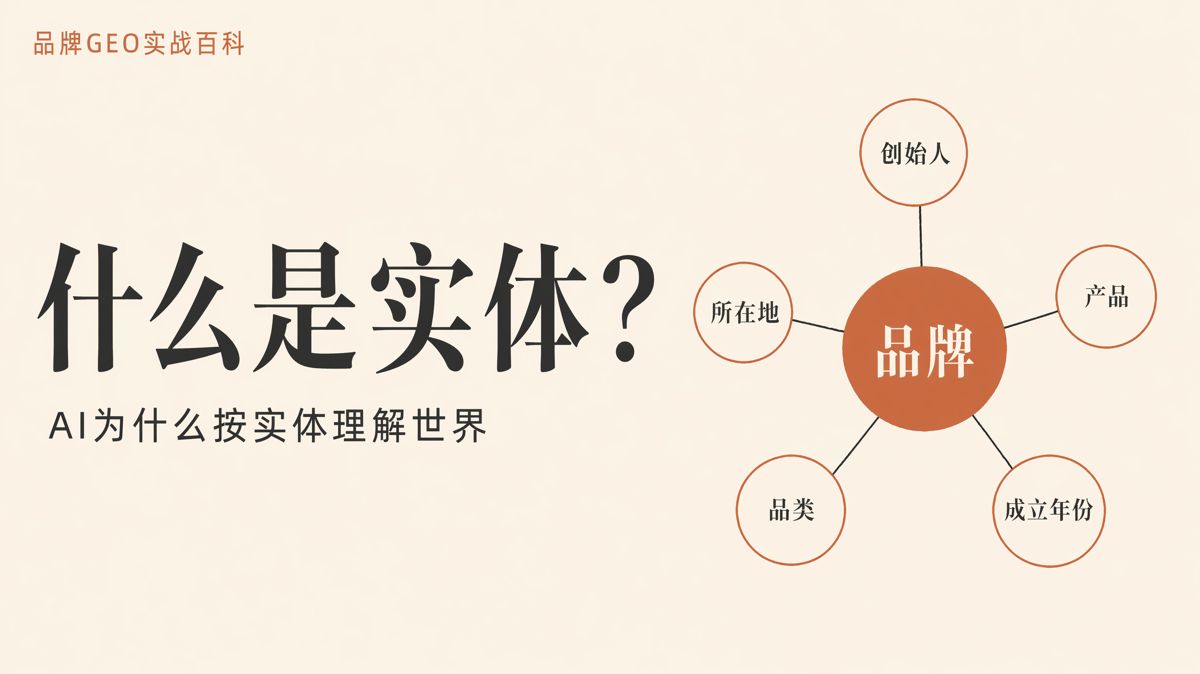
An entity is an object that exists independently and can be uniquely identified. A company, a person, a product, a geographic location, or an abstract concept can all be entities.
The word "Apple" can refer to a fruit, or it can refer to Apple Inc. These two meanings represent two entirely different entities. AI must rely on contextual data to determine which object a passage refers to. This process is called entity disambiguation—eliminating confusion caused by identical or similar names.
Traditional search engines primarily process strings and keywords within web documents. Generative engines must confirm the real-world object behind those characters when assembling an answer. Even if two brands share the same name, as long as their founding dates, locations, products, and key executives differ, the engine must distinguish them as two separate entities.
For a brand, an AI model records a set of attributes: founding year, industry category, founders, product lines, and headquarters. The brand also forms relationships with other entities (for instance, "Company A manufactures Product B" or "Person C founded Company A"). Together, these objects, attributes, and relationships construct a knowledge graph that AI can query. Every identifiable object functions as a node within that graph.
When a user asks "Who is this brand?", "Which vendors provide this software?", or "Which company should I hire?", the AI model first selects candidate entities from its graph before pulling retrieved text to compose an answer.
Why AI Identifies Entities First
Mainstream generative engines include international platforms like ChatGPT, Perplexity, and Google AI Overviews, alongside Chinese platforms such as Doubao (ByteDance's AI assistant), DeepSeek, Tencent Yuanbao, Baidu ERNIE Bot, and Alibaba Tongyi Qianwen.
According to public documentation and industry studies from 2025 and 2026, these products rely on Retrieval-Augmented Generation (RAG). Under RAG, the system retrieves external documents relevant to the prompt, and the large language model (LLM) generates an answer grounded in those retrieved texts.
A standard pipeline works like this: the engine retrieves 20 to 100 candidate documents, filters them down to 5 to 15 items, and splits those documents into chunks of roughly 200 to 500 words. These chunks are the operational text units the model evaluates and cites. The model assesses each chunk's credibility and relevance, then constructs the final response.
Industry observers broadly categorize the ranking criteria across five dimensions: semantic relevance, authority, freshness, readability, and entity consistency. Entity consistency is estimated to account for 15% to 20% of the scoring weight, though this estimate has not been verified by third-party audits.
Before an engine uses an excerpt, it must answer three questions:
- Who is this passage discussing?
- Is this source trustworthy?
- Are these different platforms talking about the exact same company?
This is where entity identification becomes critical. LLMs convert natural language into semantic vectors—numerical representations of meaning. Even if a webpage omits your exact brand name, the AI can still connect the content to your entity if the semantic context points to it clearly. Conversely, even if an article mentions your brand name repeatedly, that mention provides little value if the AI cannot confirm which specific company the name refers to.
The seoClarity findings (r=0.664 for entity consistency versus r=0.218 for backlinks) indicate that within their test scope, entity consistency correlates far more strongly with AI citations than backlink counts do. While this does not prove direct causation, it demonstrates that cross-platform identity resolution is a major factor in how generative engines select content.
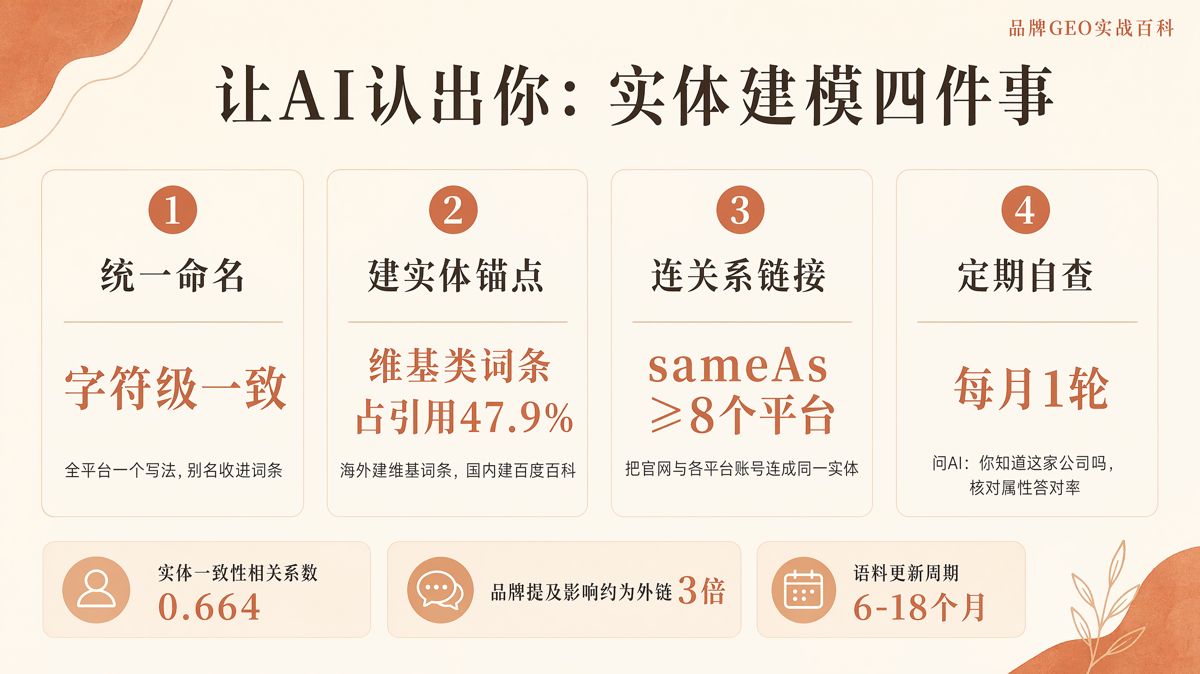
There is also a longer-term implication. Base models typically update their training corpora every 6 to 18 months. Once your brand entity data enters the base training corpus, it becomes part of the model's default parametric memory. This default understanding is far more stable than real-time search retrieval. Uniform identifiers, such as sameAs links and Wikidata IDs, help the model determine that disparate pages belong to the same entity.
Entity Understanding vs. Keyword Matching
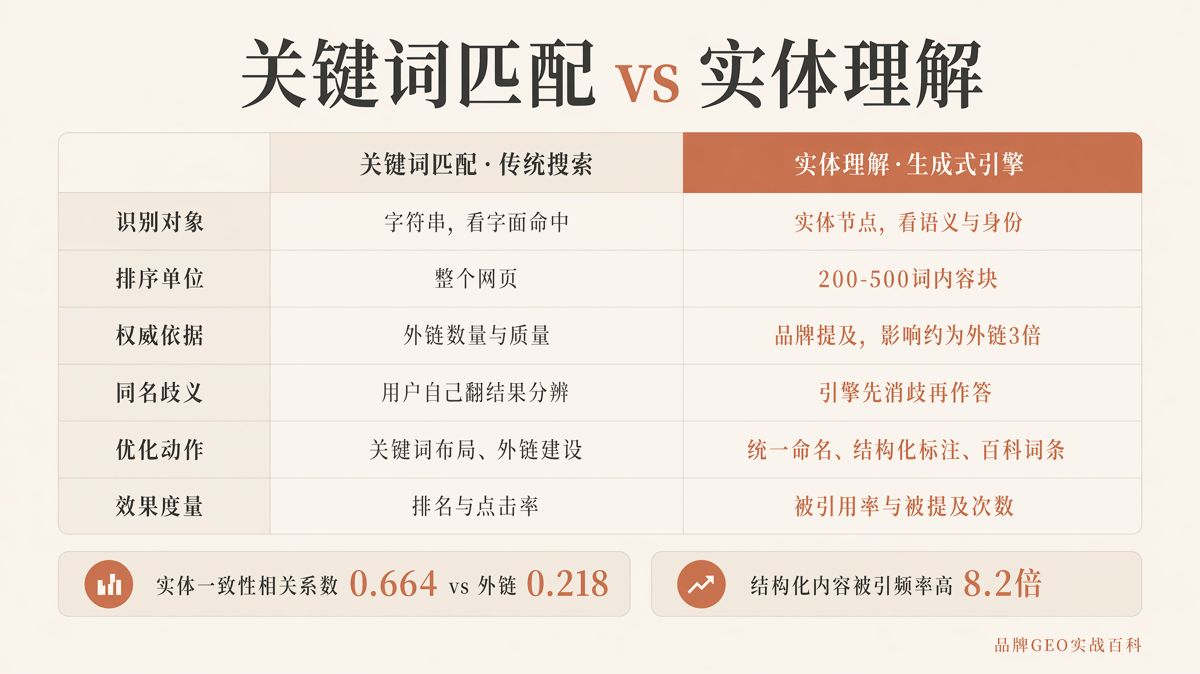
Traditional Search Engine Optimization (SEO) ensures that web pages can be crawled, indexed, and ranked. GEO inherits these prerequisites, but generative engines require additional steps: entity identification, cross-source consolidation, and answer synthesis.
| Dimension | Keyword Matching (Traditional Search & SEO) | Entity Understanding (Generative Engines & GEO) |
|---|---|---|
| Identification Target | Character strings and keyword occurrences | The entity behind the text and its unambiguous identity |
| Ranking Unit | The entire webpage | Chunks of roughly 200 to 500 words |
| Authority Evaluation | Volume and quality of backlinks | Brand mentions, source authority, and entity consistency |
| Homonyms | Users filter ambiguous search results manually | Engines disambiguate entities before generating answers |
| Core Optimization | Keyword placement, indexation, and link building | Standardized naming, structured schema, encyclopedias, and cross-platform identity mapping |
| Performance Metrics | Rankings and click-through rates (CTR) | Citation rate, brand mention share, and attribute accuracy |
These two disciplines do not conflict. Content must still be crawled, rendered, and indexed. On May 15, 2026, Google Search Relations stated that optimizing for generative AI search remains, at its core, a form of search optimization.
SEO remains the foundation of GEO. The difference lies in the evaluation criteria: search historically prioritized pages, keywords, and links; generative engines prioritize verified entities, cross-source consolidation, and corroborating third-party data.
How AI Determines Brand Identity
AI engines establish brand identity through three steps:
- Detection: Identifying whether a passage refers to an organization, person, or product.
- Disambiguation: Determining which specific organization, person, or product is meant.
- Consolidation: Mapping data from different websites and platforms to a single entity record.
All three steps depend on publicly verifiable web data. AI will not guess missing information, nor will it assume that slight variations in brand naming belong to the same entity.
The baseline requirement is naming consistency. If your primary website uses "Far Mountain Tech", an encyclopedia uses "Far Mountain (China)", and your social profiles use "YS Tech" without clear relationship mapping, the engine may split your brand into three fragmented entity profiles. Mentions, coverage, and reviews will fail to consolidate.
Beyond consistent naming, engines look for authoritative records and explicit relationship markup. Internationally, this is handled through Wikipedia, Wikidata, and the sameAs attribute within Schema.org structured data, which ties your primary domain to your LinkedIn, Crunchbase, and GitHub profiles. Schema.org provides standard vocabularies for search engines, and sameAs establishes that two URLs represent the exact same entity.
Official Google updates from March 2026 explicitly state that verifiable author and publisher entities—supported by sameAs links to Wikipedia and Wikidata—serve as strong trust signals.
In China, Baidu Baike and Sogou Baike serve as authoritative public identity benchmarks. When your official website, corporate encyclopedias, press coverage, and platform accounts uniformly present your legal business name, founding year, and primary category, AI can disambiguate and consolidate your entity profile cleanly.
You can run a straightforward test in ChatGPT or Doubao by asking: "Do you know [Full Legal Company Name]?" If the model accurately returns your founding year, core product category, and business scope without confusing you with a namesake company, your brand has an established entity profile. If it hallucinates, errors, or confuses you with another firm, your public entity records require remediation.
How Entity Modeling Affects Brand Performance
1. Determining Inclusion in Candidate Sets
When generative engines answer recommendation or vendor-discovery queries, they build a candidate pool of entities before writing the response. If your brand lacks a verifiable entity record, it may never enter the candidate set.
In B2B purchasing, a March 2026 multi-source analysis covering 680 million citations reported that 73% of B2B buyers now use AI tools during vendor research. Additional B2B procurement data indicates that suppliers excluded from an initial AI shortlist fail to make the final evaluation pool 99% of the time.
2. Consolidating Multi-Source Brand Evidence
Research by iProspect/Hallam observed that the correlation between third-party brand mentions and AI citations is roughly three times that of backlinks. Geneo's 2025 research found that content with structured data markup is cited 8.2 times more frequently than unannotated text.
While these studies do not prove that buying more mentions or adding tags yields a direct, linear citation gain, they demonstrate that third-party mentions, structured data, and identity consistency all influence engine retrieval.
This data only matters if it maps back to your primary entity. Inconsistent names and fragmented corporate profiles scatter your brand proof across disconnected entity nodes, leaving none of them with sufficient authority to trigger a citation.
3. Shaping Long-Term Parametric Memory
LLM training corpora update on 6- to 18-month cycles. The authoritative, consistent entity data you maintain today influences how the next model generation describes your brand out of the box.
If your public footprint contains persistent namesake confusion, stale data, or incorrect product mappings, those errors can bake into the model's base weights and persist across future model releases. Entity modeling impacts real-time RAG retrieval today and permanent model perception tomorrow.
Building Entity Data for International Brands
For international audiences, entity optimization combines structured Schema markup with authoritative public databases.
First, implement Schema.org markup on your official website. Priority types include:
Organization: Defines company name, official URL, brand logo, and related profiles.Product: Specifies product names, parent brand, specifications, and SKU details.FAQPage: Formats questions and answers for direct engine parsing.
Within the Organization schema, use the sameAs array to connect your site directly to your LinkedIn, Crunchbase, Wikipedia, Wikidata, GitHub, and YouTube profiles. Aim to cover at least eight authoritative public profiles, ensuring every target profile displays consistent brand data.
Industry benchmarks suggest that pairing Organization and FAQPage schemas correlates with a 37% improvement in AI overview citation rates. Treat this figure as an observational metric rather than a guaranteed result.
Once structured data is deployed, focus on triggering a Google Knowledge Panel—the dedicated information box Google renders for established entities.
Building Entity Data for Chinese Platforms
China lacks an open, cross-platform Schema ecosystem. Local AI engines rely heavily on encyclopedia entries, official website declarations, and consistency across closed ecosystem accounts.
Baidu Baike and Sogou Baike serve as the primary public identity references for Chinese AI engines. Because encyclopedia entries remain active long-term, your legal corporate name, founding date, core business, and flagship products must be backed by authoritative citations.
Alongside encyclopedias, unify your brand naming across your official site, WeChat Official Accounts, Baijiahao (Baidu's content platform), and Douyin (TikTok's sister app). Relying on a single profile is rarely enough for domestic engines to construct a full entity graph.
Platform citation tendencies observed across the industry show distinct patterns: Tencent Yuanbao pulls heavily from WeChat Official Accounts; Baidu ERNIE Bot favors Baijiahao and Baidu Baike; Doubao frequently cites Douyin and Toutiao; while DeepSeek and Kimi (Moonshot AI) commonly surface references from Zhihu (China's largest Q&A platform). These observations are unverified by third-party audits and vary depending on query type, freshness, and source availability.
Is It Too Late to Start Entity Modeling?
Generative AI is already a primary discovery channel. CNNIC's 57th report records 602 million generative AI users in China as of December 2025 (42.8% penetration). First-quarter 2026 data from QuestMobile estimates Doubao's monthly active users at approximately 345 million.
On the supply side, most businesses have yet to establish clear entity records. An evaluation of 50 B2B SaaS companies by DerivateX found an average "AI Presence" score of 56.9, with 44% failing to achieve a passing grade. While this benchmark reflects European and US firms and direct comparative data for China remains limited, it shows that most brand entity graphs remain incomplete.
Brands that build structured, verifiable entity profiles early help shape how generative models understand their category. Latecomers must invest significantly more effort to dislodge established parametric associations.
Begin with two low-friction steps: unify your exact brand name across every public channel, and query the primary AI engines to see if they recognize your business. If the engines lack basic facts, prioritize encyclopedia entries. If they return conflicting information, implement sameAs schema and align your corporate profiles.
Frequently Asked Questions (FAQ)
Q1: Is an entity the same thing as a brand name?
No. A brand name is simply one attribute of an entity. A brand entity also includes its founding date, industry category, founders, product portfolio, headquarters, and relationships to other companies and individuals.
Brands can rebrand, use abbreviations, or operate under aliases, but those variations should resolve to a single underlying entity. If your profiles use different names without explicit cross-references, AI may fragment your company into multiple incomplete records.
Q2: Does AI treat startups and small businesses as entities?
Yes, but often as "weak entities." A weak entity is one where the engine recognizes the name as an organization, but cannot accurately state its founding date, industry category, or core products.
Remediate this sequentially: standardize your name across all public web assets, establish authoritative encyclopedia or database entries, and publish your founding year, category, and product scope clearly on your primary website. Test query responses regularly; improving attribute accuracy indicates your entity profile is strengthening.
Q3: How long does entity modeling take to show results?
The timeline depends on the technical layer: - Name alignment and Schema.org deployment take effect immediately upon indexing. - Inclusion in real-time RAG retrieval pipelines typically takes a few weeks. - Approved encyclopedia entries provide immediate and durable reference data. - Base model weights update every 6 to 18 months, which is when entity data integrates into the model's core memory.
Entity modeling should be managed as a multi-quarter operational initiative. Expecting an engine to permanently change its baseline brand responses within 30 days is unrealistic.
Q4: Do bilingual names, acronyms, or former names confuse AI?
Yes. Multiple names without explicit relationship mapping complicate entity disambiguation and split your citations.
Select one primary legal and operational brand name for all primary channels. Secondary names and former titles should be recorded as aliases within structured data (alternateName) and encyclopedia entries. For international markets, use sameAs to connect profile URLs. You do not need to scrub historical brand names; documenting when they were used and what they correspond to helps engines consolidate historical references.
Q5: Can I focus exclusively on my official website and skip encyclopedias and third-party profiles?
No. Generative engines evaluate 10 to 30 external sources when answering complex queries; an isolated website carries limited independent authority. In China, engines rely heavily on established media and major platforms, citing standalone corporate websites less frequently.
Your website provides primary first-party facts, encyclopedias establish verified identity, and third-party platforms provide corroborating proof. All three layers are necessary.
Q6: How do I verify my entity modeling progress?
Query ChatGPT, Doubao, DeepSeek, and Tencent Yuanbao monthly using a standard evaluation prompt set:
- Do you know [Company Name]?
- What year was [Company Name] founded?
- Who is the founder of [Company Name]?
- What is the primary business of [Company Name]?
- Is [Company Name] a reputable vendor?
Track three outcomes each month: attribute accuracy, namesake confusion, and cited reference sources. These metrics provide a clear benchmark of your entity strength over time.
Q7: Does entity modeling conflict with existing SEO?
No. They share the same technical foundation. SEO ensures that pages can be crawled, rendered, and indexed while emphasizing content quality and source credibility—prerequisites for GEO.
Entity modeling builds on SEO by adding identity verification, cross-platform entity mapping, and attribute consistency. With Google designating verifiable author and publisher entities as strong signals since March 2026, structuring your content for entity recognition ensures your organic marketing investments support both search engines and generative AI models.
To get started, unify your brand names across every public touchpoint, audit your profile data, and run baseline entity queries across the major AI engines. The results will show whether your immediate bottleneck is missing structured markup, absent encyclopedia entries, or conflicting platform data.
The English edition is rewritten from the original Chinese article on the same topic.

Starbox AI is an AI marketing company based in Hangzhou, China. This article draws on Starbox project work. Please credit the source when quoting.
Related reading
 GEO Guide
Why AI Marketing Vendor Quotes Vary 10x: A 4-Step Vetting Checklist
Evaluate AI marketing proposals by delivery actions, not slide decks. Audit source infrastructure, fact cleaning, and clean-environment testing.
Oct 22, 2026 · 6 min read
 GEO Guide
Spotting GEO Scams: What Actually Drives AI Recommendations?
Automated AI ranking promises violate how LLMs work. Real AI recommendations rely on authoritative, structured facts across trusted public sources.
Oct 22, 2026 · 4 min read
 GEO Guide
How to Measure Your Brand's AI Visibility with a Spreadsheet
You do not need expensive software to track AI recommendations. A three-tier prompt framework and a simple spreadsheet can score your brand visibility in half a day.
Oct 21, 2026 · 6 min read