
How to Break AI Content Homogenization: Fix Your Pre-Writing Prep

The short answer
When ten people hand AI the same general prompt, they get ten identical articles. True differentiation starts before drafting begins.
Give ten people the exact same prompt, and an AI model will likely produce ten nearly identical articles.
Faced with common prompts, AI naturally defaults to safe, widely repeated phrasing. If your team is tackling broad industry topics using standard public search results, telling the AI to "make it fresh" or "rephrase with a unique tone" only changes sentence structures. It does not create real differentiation.
Whether an article sounds generic is usually decided before drafting even starts: how specific the topic is, whether the source material contains first-hand observations, what concrete operational problem the piece solves, and what review standards you apply before publishing.
Where Generic Content Actually Starts
Identical content usually traces back to three bottlenecks:
1. The topic
Many teams write about topics like "How AI Improves Workplace Efficiency" without specifying the role, the task, or the real-world constraints. When a topic lacks a specific target audience, the piece inevitably defaults to obvious platitudes.
2. The source material
If your process simply feeds search results into the model, the AI can only synthesize viewpoints already repeated across the web. Changing the vocabulary does not change the substance.
3. The structure
Most AI-generated pieces follow the same template: explain the concept, list the benefits, provide generic steps, and conclude with a summary. Readers know the rest of the article after skimming the first paragraph.
If these three elements remain unchanged, post-generation editing only polishes prose—it cannot fix structural sameness. Real differentiation comes from real business operations, not from manufacturing contrarian takes for the sake of it.

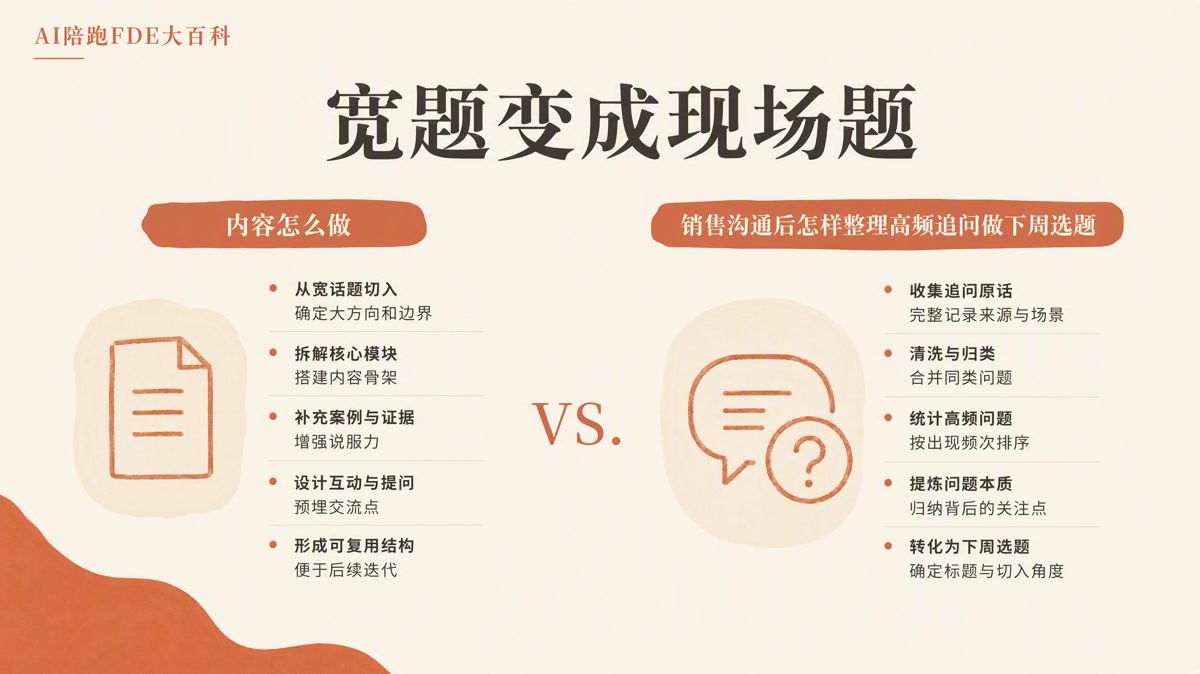
Turn Broad Topics into Concrete Operational Questions
A broad topic like "How to do content marketing" produces answers that are technically correct but practically useless.
Reframe it as a concrete operational problem:
"After a sales rep completes a discovery call, how should they turn the customer's recurring objections into next week's editorial topics?"
This framing defines the user, the workflow stage, the specific action, and the source material. It leaves no ambiguity about what the article must answer.
The closer your topic is to an actual business decision or action, the easier it is to write something substantive. Around a single service or offering, a team can map out distinct angles: execution workflows, roles involved, post-mortems of failed attempts, required resource investment, evaluation criteria, or client handoffs. The core subject remains the same, but because each piece handles a distinct problem, your content will not keep repeating the same conclusions.
Build Differentiation on Verifiable Internal Materials
Every company builds up valuable raw source material through daily operations: customer objections, project retrospectives, editorial revision logs, meeting minutes, and common user misunderstandings.
When working with proprietary customer or project information, anonymize it first by stripping or altering names, company details, and contact points. Every logged record should note its date, source, context, and whether it is cleared for external publication, making it easy for writers to verify what can be used.
When drafting, pick your specific internal evidence first, then prompt the AI to structure the piece around those findings. This forces the article to develop around real operational facts rather than generic assertions.
If you lack internal data for a topic, frame it honestly as a general guide. Do not package public web summaries as proprietary case studies. Originality depends on unique observations and verified inputs long before it depends on word choice.
Assign Every Article a Single Job
A single subject can serve different editorial functions: defining a concept, providing an evaluation checklist, conducting a failure retrospective, or answering a specific user question.
Different jobs demand different source inputs and structures: - An evaluation checklist needs explicit qualification criteria and clear sequencing. - A failure retrospective needs a clear timeline, what broke down, and how it was corrected. - A Q&A piece must reconstruct the exact scenario before prescribing an action.
Teams can also maintain a shared index of past article titles and core takeaways. Before drafting a new piece, include negative constraints in your prompt: state which points must not be repeated, and ask the model to flag areas that overlap with earlier pieces. Catching duplicate angles before generation saves far more time than manually weeding them out after the draft is written.
Run a Differentiation Check Before Publishing
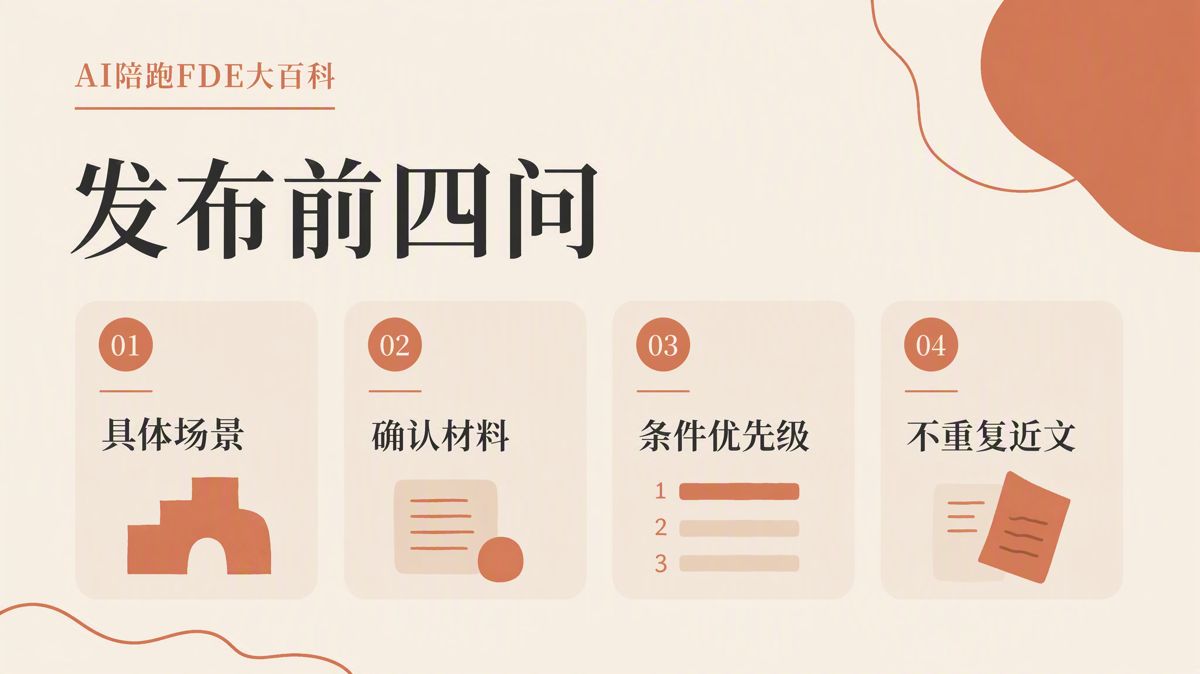
Smooth prose is the bare minimum. Before approving a piece for publication, check it against four questions:
- Does the piece describe a specific operating scenario that a competitor cannot simply copy and paste?
- Does it cite at least one verified piece of internal observation or verified external evidence?
- Does it provide concrete execution conditions and steps rather than broad advice?
- Does the intro, structure, or conclusion overlap heavily with your last three published pieces?
If an article fails these four checks, tweaking sentences will not fix it. Narrow down the topic, pull in concrete internal materials, and redefine the specific job the article is supposed to do.
Homogenization is not an AI-specific flaw. Human writers produce the exact same clichés when they lack source material, write for vague topics, and have no clear review standards. AI can only structure the questions and materials you provide. The more specific your operational problems are, and the more grounded your internal inputs, the more distinct your content will be.
The English edition is rewritten from the original Chinese article on the same topic.

Starbox AI is an AI marketing company based in Hangzhou, China. This article draws on Starbox project work. Please credit the source when quoting.
Related reading
 AI Adoption
Can One AI Operator Really Replace 10 People?
Claims of 10x headcount cuts count generation speed, not QA and rework. Real efficiency measures net pipeline hours saved.
Oct 22, 2026 · 6 min read
 AI Adoption
Bought Basic AI and Seeing Zero ROI? A 4-Step Activation Playbook
Activating entry-level AI is not about model parameters. Turn open chat boxes into defined operational stations with clear inputs, templates, and QA checklists.
Oct 22, 2026 · 6 min read
 AI Adoption
Why One-Click AI Fails at Work: How to Pick Enterprise Agents
One-click AI tools seem easy, but their first-draft accuracy is terrible. Real business ROI requires multi-step workflows with your own knowledge base.
Oct 21, 2026 · 6 min read