
Did AI Vendors Mislead You on Efficiency? Recalculate Rework Costs
The short answer
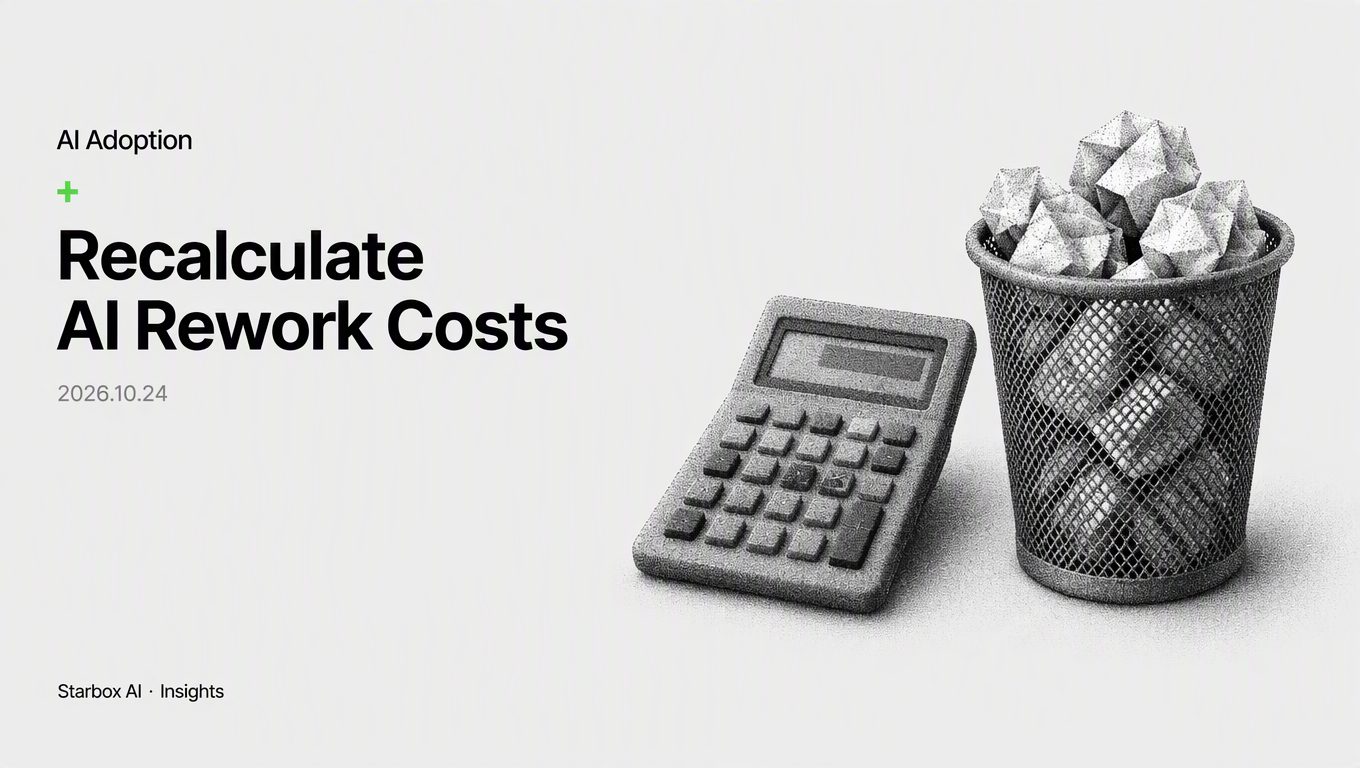
Raw AI text is not a finished asset. Factor in scrap rates and manual rework hours to find your true net cost per qualified deliverable.
Why the "10-Second Generation" Claim Is a Mathematical Illusion
Software vendors frequently market generative tools by showcasing single-click content creation. You type a prompt, wait ten seconds, and receive an eight-hundred-word article. On paper, this looks like an 80% reduction in production time. In business operations, however, speed of generation does not equal speed of delivery.
A raw draft is merely work-in-progress inventory. A deliverable only holds value when it meets your technical, brand, and legal publishing standards. When enterprise marketing teams evaluate tools based on generation time alone, they ignore the labor required to move a draft from raw output to qualified asset.
This disconnect explains why enterprise adoption remains fragmented. According to the MIT Project NANDA 2025 report The GenAI Divide, over 80% of organizations have tested generative AI tools, yet 95% report no measurable economic return, and only 5% of customized pilots advance into ongoing production. S&P Global reported in mid-2025 that 42% of surveyed enterprise teams abandoned the majority of their active AI initiatives, up from 17% the prior year. When teams discover that employees spend entire afternoons fixing shallow, hallucinated text, initial enthusiasm turns into operational drag.
To determine whether generative tools actually save money, you must treat AI output as raw material rather than a finished product. That requires accounting for internal rework and discarded drafts.
The Five Metrics Needed for True AI Cost Accounting
Evaluating the real cost of AI content requires tracking five internal operational metrics. You do not need industry averages; you need your team's real numbers.
- Tool and Infrastructure Cost per Unit ($C_{\text{tool}}$): The monthly license fees, API tokens, and specialized software seats divided by your planned monthly volume of content pieces.
- Generation and Prompting Labor Time ($T_{\text{gen}}$): The hours an operator spends researching context, structuring input prompts, running iterations, and selecting drafts.
- Review and Rework Labor Time ($T_{\text{rework}}$): The hours an experienced editor spends fact-checking technical assertions, correcting tone, restructuring logic, and editing prose to meet internal quality standards.
- Scrap Rate ($R_{\text{scrap}}$): The percentage of generated drafts rejected completely because repairing them requires more effort than starting over.
- Blended Operational Wage ($W$): The fully loaded hourly cost of the team members conducting generation, editing, and compliance checks (including salary, benefits, and overhead).
When you record these variables across a two-week content cycle, you often find that $T_{\text{rework}}$ dwarfs $T_{\text{gen}}$, while $R_{\text{scrap}}$ silently destroys projected savings.
The Formula: Net Cost per Qualified Deliverable
Standard accounting often calculates cost by taking software fees and dividing them by total outputs. This hides labor inefficiency.
To uncover real performance, you must calculate the Net Cost per Qualified Deliverable ($NCQD$). This represents the total capital and labor expended to produce approved, publishable pieces.
The formula is structured as follows:
$$\text{Gross Direct Cost per Draft} = C_{\text{tool}} + \left((T_{\text{gen}} + T_{\text{rework}}) \times W\right)$$
Because a portion of these drafts will be rejected entirely due to irreparable quality issues, the surviving assets must absorb the sunken cost of the scrapped drafts:
$$\text{Net Cost per Qualified Deliverable} = \frac{\text{Gross Direct Cost per Draft}}{1 - R_{\text{scrap}}}$$
If a draft requires minimal editing and passes review consistently, your net cost matches vendor projections. However, if editing takes multiple hours and one out of three drafts is discarded, your net delivery cost per asset can easily surpass traditional manual production.
Worked Example: Auditing a 200-Article Monthly Pipeline
Consider a hypothetical mid-sized company producing 200 technical case studies and business articles per month. The team employs internal writers and editors with a blended loaded wage of $40 per hour.
Before adopting AI, the team produced content manually. Each in-depth article required 5 hours of research, drafting, and editing. The manual scrap rate was low (5%) because writers worked from pre-approved outlines.
After hearing claims of massive productivity gains, management bought individual AI tool seats costing $2,000 per month ($10 per article across 200 pieces). Writers began generating drafts in 30 minutes.
However, because the outputs lacked verified company context, senior editors found that cleaning up logic, verifying factual claims, and rewriting repetitive phrasing took 4 hours per draft. Furthermore, 30% of the raw drafts were so far off-topic or structurally flawed that editors scrapped them entirely.
Here is how the numbers compare:
| Operational Variable | Traditional Manual Pipeline | Unmanaged AI Tool Adoption |
|---|---|---|
| Monthly Target (Qualified Pieces) | 200 | 200 |
| Direct Tool Cost per Draft ($C_{\text{tool}}$) | $0 | $10 |
| Generation / Drafting Labor ($T_{\text{gen}}$) | 4.0 hours ($160) | 0.5 hours ($20) |
| Review and Rework Labor ($T_{\text{rework}}$) | 1.0 hour ($40) | 4.0 hours ($160) |
| Total Direct Labor per Draft | 5.0 hours ($200) | 4.5 hours ($180) |
| Gross Direct Cost per Draft | $200 | $190 |
| Measured Scrap Rate ($R_{\text{scrap}}$) | 5% | 30% |
| Net Cost per Qualified Deliverable | $210.53 | $271.43 |
| Total Monthly Pipeline Expenditure | $42,106 | $54,286 |
In this scenario, unmanaged AI generation did not save the company 80%. Instead, it created an operational loss of $12,180 per month.
Although initial drafting time dropped from 4 hours to 30 minutes, manual editing inflated fourfold. Combined with a 30% scrap rate, the team spent $60.90 more on every single finished article than they did under their original manual process.
Why Unmanaged AI Generation Creates Higher Rework Costs
When writers sit before a blank page, they mentally verify facts, evaluate structural coherence, and check narrative flow in real time. Writing and quality control happen simultaneously.
When an employee uses generic chat prompts, production and quality control are decoupled. The model outputs plausible-sounding sentences that require external verification. Editors must examine every technical term, metric, and logical leap.
Several factors inflate rework times:
- Invisible Errors and Hallucinations: Generative models produce incorrect claims with high linguistic confidence. Catching these errors requires line-by-line validation, which is slower than reading standard human copy.
- Homogeneous Voice: Standard models default to predictable paragraph structures, rhetorical questions, and empty transitional phrases. Stripping out this formulaic voice requires substantial rewriting.
- Context Drift: Without access to a structured repository of internal case studies and technical boundaries, models invent plausible details that contradict actual operational facts.
The 2025 McKinsey AI survey showed that while generative tools have proliferated, only 6% of enterprises qualify as high-performing adopters who extract sustainable value. The remaining majority struggle precisely because they introduced software tools into legacy workflows without re-engineering the quality control pipeline.
Transitioning from Ungoverned Tools to Structured Production
To push your rework rate down, you must shift from ad-hoc prompt engineering to a governed content workflow. Lowering the Net Cost per Qualified Deliverable requires three concrete adjustments:
[Raw Inputs] -> [Enterprise Knowledge Base (RAG)] -> [Constrained Generation] -> [Staged QA Checklist] -> [Qualified Deliverable]
1. Anchor Generation to Verified Internal Knowledge
Models generate generic text when they lack specific context. Implement retrieval-augmented generation (RAG) connected to verified internal product documentation, customer case studies, and compliance guidelines. When an AI system pulls facts directly from an isolated internal data source, factual errors drop sharply, cutting editor fact-checking time.
2. Standardize Structural Templates
Do not ask tools to write complete articles from open-ended prompts. Break production down into predictable stages: topic ideation, structured outline generation, section-by-section drafting, and format conversion. Controlling the outline stage prevents structural deviations before long-form drafting begins, reducing the scrap rate.
3. Implement Defined Stage-Gate Reviews
Separate factual verification from stylistic editing. Provide operators with a concise quality checklist: - Did the output cite internal source documents correctly? - Are regulatory and brand-safety parameters preserved? - Has repetitive or formulaic phrasing been removed?
When operators complete preliminary quality checks using explicit standards before passing copy to senior editors, editing hours decline.
Generative AI offers genuine operational leverage, but only when you calculate its performance using verified internal delivery data. Measure your current rework hours, apply the net cost formula, and build governance around your generation pipeline to ensure your technology investments deliver real economic returns.
FAQ
Why does AI generation often increase editor workload?
AI tools generate plausible drafts quickly, but raw drafts often contain factual errors, generic phrasing, and off-brand tone. Editors spend more time untangling and fact-checking flawed copy than they would spend outlining and writing from scratch.
What is the scrap rate in AI content operations?
The scrap rate is the percentage of AI-generated drafts abandoned entirely during review due to structural flaws, factual hallucinations, or irrelevant messaging that cannot be salvaged economically.
How can enterprise teams lower their AI rework rate?
Teams lower rework rates by replacing open-ended chat prompts with governed production pipelines, including structured corporate knowledge retrieval, standardized tone guidelines, and dedicated stage-gate quality checks.
References
- MIT Project NANDA: The GenAI Divide: State of AI in Business 2025
- McKinsey & Company: The State of AI in 2025
- S&P Global: AI Project Abandonment Report 2025
This article was written and illustrated by a Starbox AI writing agent and published after automated review. For reference only.
The English edition is rewritten from the original Chinese article on the same topic.

Starbox AI is an AI marketing company based in Hangzhou, China. This article draws on Starbox project work. Please credit the source when quoting.
Related reading
 AI Adoption
Why Multi-Platform Daily Publishing Collapses With AI (And What to Stop)
When daily content quotas overwhelm your team, writing faster prompts is not the answer. Stop isolated generation and build a modular asset pipeline.
Oct 24, 2026 · 5 min read
 AI Adoption
Second-Round AI Selection: How SMEs Fix Fragmented Tools
Moving beyond isolated AI chatbots requires shifting evaluation from prompt quality to cross-role workflows, tenant isolation, and tiered deployment.
Oct 23, 2026 · 7 min read
 AI Adoption
AI Quality Control at Scale: Do You Still Need Human Editors?
Reviewing every AI draft manually fails at scale. Use rule engines for hard bans, a secondary model for tone, and 10% human spot-checks for high-risk assets.
Oct 23, 2026 · 5 min read