
How to Get Cited by AI Answers: 6 Concrete Steps
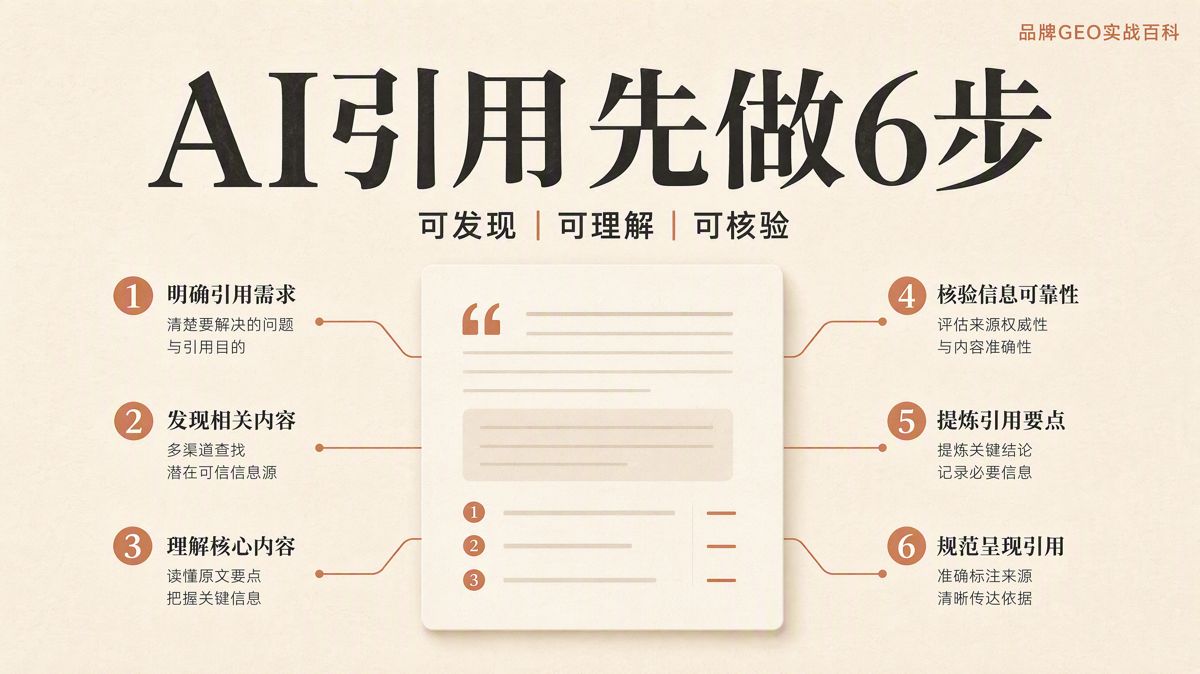
The short answer
Make your pages discoverable, readable, and verifiable before running systematic retests. Official documentation offers no citation guarantees.
What kind of content actually gets cited as a source in AI-generated answers?
It is rarely the longest article, nor is it the post blasted across dozens of external channels. More often, it is a page that loads reliably, matches a clear question with a direct answer, provides verifiable facts, identifies its publisher, and gets updated when details change.
These requirements are straightforward, but they require solving four separate hurdles: discoverability, machine comprehension, factual adoptability, and source display.
First, set realistic expectations. Official public documentation indicates that search-augmented AI systems retrieve real-time data across the open web and can return the publisher name, title, URL, and relevant source snippets. This proves that public web pages meet the technical criteria to serve as search results, but it does not mean every compliant page enters the final synthesized response. Furthermore, current user agreements for conversational AI tools explicitly state that generative outputs carry inherent randomness and cannot guarantee legality, factual truth, accuracy, or completeness.
You can increase your probability of being cited, but no one can promise guaranteed placement. The operational goal is to make your content easy to discover, parse, and verify, and then run structured retests to observe whether visibility improves.
6 Documented Facts from Official Sources
The following facts are drawn directly from official documentation verified as of August 17, 2026. They reflect documented operating constraints, not speculative promotional claims.
- Retrieval results can return 4 types of source metadata. Official AI search product documentation notes that retrieval can return the site name, page title, URL, and relevant original text snippets across web pages, images, and video. While this confirms the technical capability to display source citations, the exact algorithmic selection criteria for final answers remain undisclosed.
- Content quality relies on at least 4 public evaluation pillars. Published quality guidelines from April 1, 2020, outline creator credibility, browsing experience, depth and professionalism, and user recognition as key assessment criteria across diverse content types.
- Page summaries should remain tight and focused. Basic metadata standards published on June 17, 2022, recommend that page summaries encapsulate the core message clearly in roughly 50 characters, without promotional clutter. Crucial information must be presented as plain text rather than embedded exclusively inside images.
- Low-quality pages share 6 documented flaws. An official release on August 29, 2023, identified garbled text, broken syntax, duplicate or stitched text, irrelevant insertions, poor layouts, and low-grade scraping as factors that directly suppress indexing and display.
- Active submission speeds up discovery, but guarantees nothing. Official webmaster tool manuals state that fast-crawl submissions (via API or manual submission) reduce the time crawlers take to discover URLs. However, the documentation explicitly notes that submissions do not guarantee indexing or live display.
- Generative answers carry inherent variance. A conversational AI product agreement effective January 20, 2026, notes that outputs are bounded by the algorithm's accessible training and retrieval data, offering no guarantee of absolute accuracy or completeness. Identical prompts can yield different answers across runs. A single test never proves permanent inclusion.
These six facts establish a disciplined workflow: build stable, accessible pages before optimizing copy; supply verifiable facts before submitting URLs; and run ongoing prompt tests instead of treating a single citation as a permanent win.
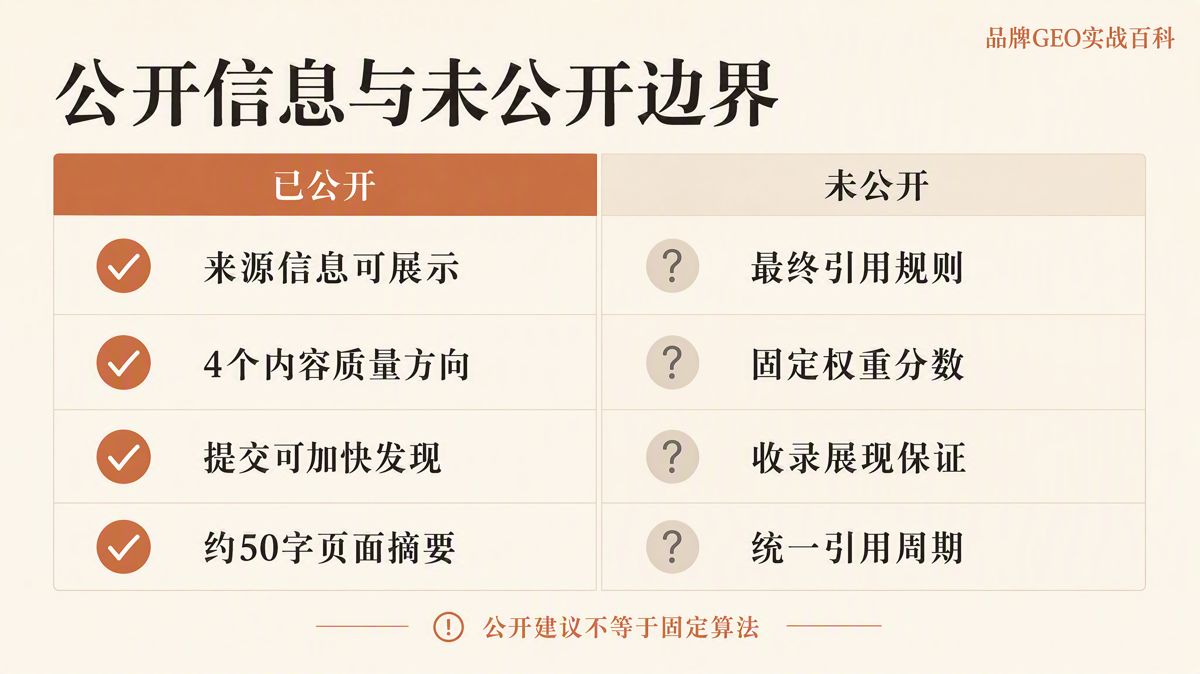
Disclosed Rules vs. Undisclosed Assumptions
Many marketing teams confuse official engineering guidelines with private algorithmic mechanics. It is critical to separate the two.
| Question | What Official Documentation States | What You Cannot Assume |
|---|---|---|
| Where data comes from | Retrieval spans government sites, official portals, and user-shared public web content | A fixed, permanent whitelist of preferred domains exists |
| How pages get discovered | Active submission shortens crawler discovery time | Submitted URLs are guaranteed to be indexed or cited |
| What makes content superior | Public criteria include credibility, experience, depth, and user reception | Any single pillar carries a fixed weight or absolute score |
| When results appear | Search tools accelerate crawling and discovery | All sites follow an identical, predictable indexing timeline |
| Whether a citation happens | Search extracts source snippets; generative engines filter and summarize them | Any channel, agency, or content format can guarantee citation |
As of the verification date, public technical materials do not reveal fixed preferred-site rosters, specific domain authority formulas, uniform indexing schedules, or citation guarantees.
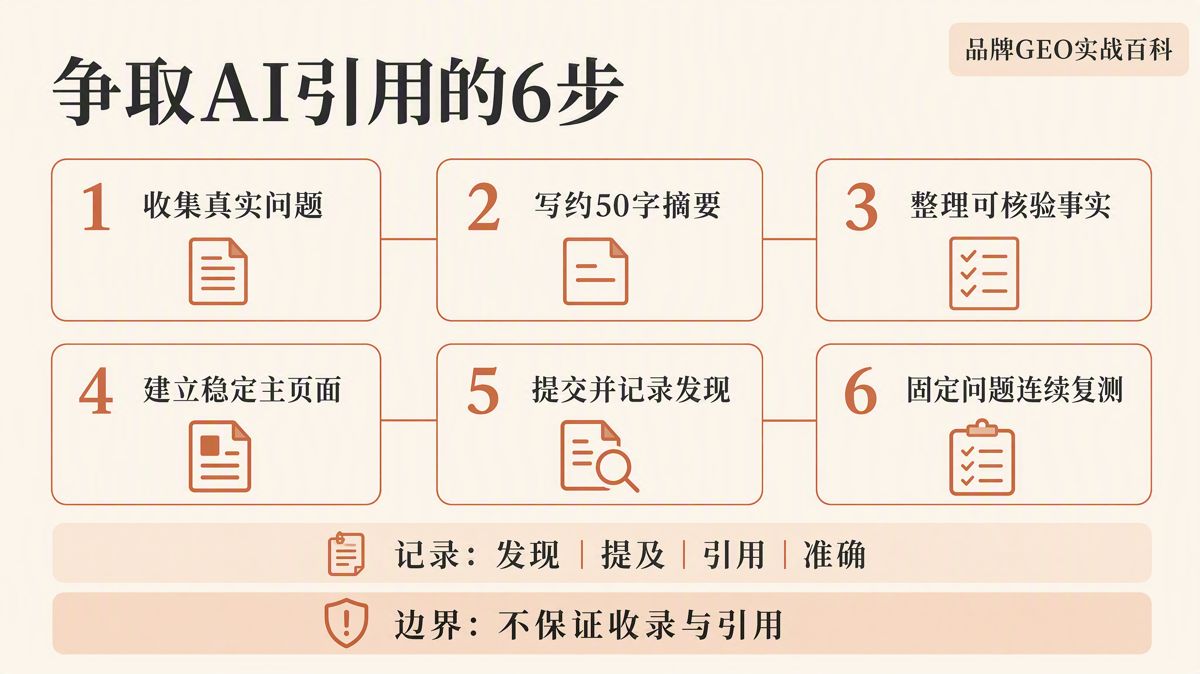
6 Traits of Content That AI Engines Readily Adopt
1. It Answers a Real Problem First
Do not open with company history, generic industry forecasts, or claims about your expertise. Start by auditing the questions your sales, customer support, and implementation teams hear every day. Record them using the customer's exact phrasing: When is this suitable? What drives the pricing? How long does deployment take? What prerequisites are required? Who is this not for? What happens if something breaks?
Dedicate each page to one core question. If the user asks "Who is this for?", outline the qualifying criteria and clear exclusions upfront. If they ask "How do I choose?", provide comparative decision criteria and trade-offs. If they ask "How much does it cost?", break down the billing units, base inclusions, add-ons, and variables that raise fees. Clear boundaries make it easier for retrieval engines to match your page to specific search intents.
Start by gathering 30 real customer questions. Select the 10 closest to purchase decisions, service delivery, and risk assessment, and build a dedicated page for each. Choosing 10 out of 30 is an operational best practice, not an official search engine rule.
2. It Can Be Read Instantly by Humans and Machines
Put the user's question directly in the title. Give the core answer in the opening lines, followed by conditions, evidence, and exceptions. Never bury the conclusion behind hundreds of words of background narrative, and avoid repeating the same concept just to stuff keywords.
A reliable page structure looks like this:
- Title: The exact question the user asks.
- Summary: A concise abstract outlining what the page resolves.
- Direct Answer: A 60-to-120-word summary delivering the core takeaway.
- Qualification Criteria: Where this applies, and where it does not.
- Factual Evidence: Numbers, dates, entities, and primary source attribution.
- Next Steps: Actionable instructions for the reader.
- Version History: Original publication date, last updated date, and content owner.
The 60-to-120-word range is an editorial operational recommendation, while concise abstracts align with published platform standards. Keep editorial best practices distinct from algorithmic mandates.
3. It Structures Key Facts into Verifiable Units
Vague marketing phrases like "exceptional performance," "highly reliable service," or "broad customer adoption" provide nothing an AI can verify. A factual assertion requires complete context: who published it, when, regarding what subject, with what exact metric, under what conditions, and where the original record lives.
Track every key factual claim in an internal reference table:
| Field | What to Include | Common Mistake |
|---|---|---|
| Conclusion | One clear sentence stating the fact | Subjective adjectives without an identifiable subject |
| Metrics | Exact number, unit of measure, and methodology | Numbers without sample size, scope, or measurement unit |
| Date | Date of publication or last verification | Reusing outdated numbers without a timestamp |
| Scope | Region, product version, target user segment | Framing a narrow test as a universal rule |
| Source | Original publishing entity and original URL | Citing secondary commentary without linking to the primary source |
| Boundaries | Exclusions, exceptions, and non-viable use cases | Listing benefits while hiding limitations |
You do not need to publish every internal audit column on the live page, but readers and search parsers should easily understand where the facts originate and under what parameters they hold true. Topics involving pricing, technical performance, legal compliance, or policy demand explicit timestamps and verified sources.
4. It Prioritizes Controllable, Maintainable URLs
There is no universal shortcut for where to publish. The most dependable strategy is to publish core answers on assets you own and control—your primary website, documentation hub, help center, or product specifications—before syndicating adaptations elsewhere.
Your primary page must satisfy five technical criteria: a permanent URL, unauthenticated public access, plain-text body content, clean mobile rendering, and an in-place update mechanism that preserves the URL when content changes. Diagrams can support the text, but core facts must never live solely inside graphics.
External distribution channels are meant to reach audiences across different reading contexts and generate genuine discussion. They do not hold an innate, permanent advantage within AI search engines. Public documentation confirms that AI retrieval models draw from government portals, official sites, and public user forums alike, without publishing a rigid tier list of source formats.
When distributing a single finding across multiple platforms, maintain one primary canonical version. Channel-specific posts can adjust introductions or case studies, but metrics, dates, and operational boundaries must stay uniform. When data changes, update the primary canonical page first, then sync external channels against your checklist.
5. It Is Discoverable and Crawlable
Writing content does not mean search engines have found it. After publication, verify the basics: the URL returns a clean 200 HTTP status code, the main text renders without complex client-side interaction, page titles align with the body copy, internal links point to the URL, robots directives do not block crawlers, and key points are written in indexable text rather than flattened images.
Once verified, submit the link through official webmaster search consoles. Submission accelerates discovery; it does not buy algorithmic favor or guarantee citations. Tool documentation explicitly notes that prioritized crawling does not guarantee indexing or live display.
Log four milestones for every page: date published, date first submitted, date first detected in search logs, and date of the most recent retest and content update. This logging reveals whether a visibility bottleneck stems from a failure to discover the page, poor semantic alignment with the prompt, or outdated content.
6. It Retests Continuously Against Fixed Prompts
Relying on a single screenshot of an AI answer creates false confidence. Generative outputs fluctuate based on prompt phrasing, login status, test timestamps, and model updates. To evaluate real visibility trends, keep your testing parameters consistent.
Build an evaluation set of 12 recurring prompts split across 4 categories: - Brand awareness (3 prompts) - Category selection (3 prompts) - Product comparison (3 prompts) - Purchasing and deployment (3 prompts)
Test these 12 prompts across two target AI search platforms on Days 0, 3, 7, 14, and 30 following publication. That produces 120 standardized observation checkpoints (12 prompts × 2 platforms × 5 evaluation rounds).
These test intervals reflect an internal operational protocol, not an official search engine update schedule. At each checkpoint, record four data points: - Was the target brand or product mentioned? - Did a source citation appear? - Did the citation link back to the correct page? - Were the generated facts accurate?
Track negative signals as carefully as positive ones: incorrect citations, outdated metrics, or confusion with similarly named brands. If visibility does not improve by Day 30, audit the page foundation: verify that the underlying user problem is genuine, the title is clear, the direct answer is complete, the facts cite primary sources, the URL is crawled, and conflicting duplicate versions do not exist across your channels. Fix content structure and access issues before adding more distribution channels.
A 30-Day Execution Checklist
| Timeline | Core Action | Acceptance Criteria |
|---|---|---|
| Day 0 | Select 10 high-value customer questions and create primary URLs | Each page addresses exactly one primary question |
| Days 1–3 | Add concise summaries, direct answers, fact tables, and timestamps | Core data renders in plain text with traceable sources |
| Day 3 | Verify crawl access, internal links, and submit URLs | Pages return clean status codes; submission timestamps are logged |
| Day 7 | Conduct the first complete retest round | Results logged across all 12 prompts and both target AI tools |
| Days 8–14 | Refine titles, fill answer gaps, and clarify constraints | Fix factual ambiguity without adding unverified claims |
| Day 14 | Conduct the second structured retest round | Run direct comparisons against Day 7 findings |
| Days 15–30 | Update primary pages and sync necessary secondary channels | Key metrics and boundary conditions match across channels |
| Day 30 | Synthesize findings across all 120 observation checkpoints | Categorize results into discovered, mentioned, cited, and accurate |
The objective of this checklist is not to collect 120 screenshots, but to generate actionable, comparable tracking data. You can only evaluate whether an editorial change worked if you hold the prompts, target platforms, test dates, and tracking fields constant.
4 Bad Habits to Stop Immediately
- Copy-pasting identical articles across multiple channels. Duplicate, stitched content is explicitly flagged in official quality guidelines as a suppression factor. When syndicating, adapt the framing for each audience while keeping facts and figures consistent.
- Chasing word count for its own sake. Official webmaster documentation confirms that teams should not pad articles with fluff or force in arbitrary images to lengthen a page. Brief content is not penalized simply for being concise; page length should match question complexity.
- Placing core conclusions inside a single infographic while leaving the body text empty. Technical guidelines recommend publishing critical information as plain text. Relying exclusively on images impairs an engine's ability to extract and parse facts.
- Trusting promises of guaranteed indexing or citations. Public search engine documentation offers no guaranteed indexing timelines, channel whitelists, or paid citation paths. If a vendor promises guaranteed placement in AI answers, demand the official technical documentation and effective policy date supporting that claim.
FAQ
1. Should content be published on an owned website first or on external platforms?
Build a primary page on an owned domain that you can maintain long term first, then adapt it for relevant external channels. The primary page holds the verified source facts, while external posts reach readers across different touchpoints. Publishing on more channels does not automatically increase citation probability.
2. Does publishing on official content platforms make citations more likely?
Public documentation does not show a fixed platform priority. Official AI search documentation notes sources ranging from government portals and official sites to user-shared web content. Whether a page is cited depends on query relevance, content quality, freshness, and retrieval conditions.
3. How many days after active submission does indexing typically take?
There is no documented universal indexing timeline across all sites. Search engine tools state that submission speeds up discovery, but explicit policies note they do not guarantee indexing or online display. Track when pages are actually discovered rather than assuming a set number of days.
4. Should one article be republished across a dozen channels?
No. Write one comprehensive primary page first, then adapt it for specific channel formats. Wholesale syndication creates version conflicts and increases maintenance overhead. When key numbers change, unupdated duplicate copies can mislead AI models.
5. Is image-only or video-only content sufficient?
Images and video can support your content, but critical facts should always be in plain text. Official guidelines advise presenting important information as text, since relying solely on images hampers accurate system parsing. If you use video, include accurate titles, abstracts, subtitles, or transcripts.
6. Does longer content perform better?
No. Official guidelines advise against padding text or forcing in images just to increase length, and confirm that concise pages are not classified as low-quality purely for being short. Article length should match the complexity of the question.
7. Should keyword density be deliberately increased?
No. Titles, summaries, and body copy should naturally address a real question. Stacking similar keywords degrades reading experience and confuses the page's core topic.
8. Do AI products only cite official brand websites?
No public evidence supports the claim that AI products only cite official websites. Public documentation confirms a variety of public sources are used. Official sites provide primary first-party facts, but third-party reviews, user experiences, and public databases are also cited depending on the query.
9. How can you tell if optimization efforts are working?
Fix the test prompts, target products, dates, and recorded fields, then compare results over time. Track four distinct states: discovered, mentioned, cited with source link, and accurately quoted. A single screenshot cannot prove consistent inclusion.
Final Thought
If you want to appear in AI answers, stop hunting for magic distribution channels. Focus on building pages that answer real user questions—pages that machines can find, parse, verify, and track over time.
What you can control is content quality, crawl accessibility, and version discipline. When it comes to hidden domain weights, universal crawl schedules, or guaranteed citations, if the official platforms have not documented them, do not make assumptions on their behalf.
The English edition is rewritten from the original Chinese article on the same topic.

Starbox AI is an AI marketing company based in Hangzhou, China. This article draws on Starbox project work. Please credit the source when quoting.
Related reading
 GEO Guide
Why AI Marketing Vendor Quotes Vary 10x: A 4-Step Vetting Checklist
Evaluate AI marketing proposals by delivery actions, not slide decks. Audit source infrastructure, fact cleaning, and clean-environment testing.
Oct 22, 2026 · 6 min read
 GEO Guide
Spotting GEO Scams: What Actually Drives AI Recommendations?
Automated AI ranking promises violate how LLMs work. Real AI recommendations rely on authoritative, structured facts across trusted public sources.
Oct 22, 2026 · 4 min read
 GEO Guide
How to Measure Your Brand's AI Visibility with a Spreadsheet
You do not need expensive software to track AI recommendations. A three-tier prompt framework and a simple spreadsheet can score your brand visibility in half a day.
Oct 21, 2026 · 6 min read