
7 Steps to Get Cited by AI Search Engines

The short answer
Make your page publicly accessible and fact-checked, then track results with a fixed question set. No method guarantees citations, but this testing workflow works.
Key Facts
- As of August 17, 2026, the target platform's user agreement was updated on July 15, 2026, and took effect on July 22. Clause 2.2.2 states that real-time web search automatically retrieves publicly accessible information from third-party links.
- The same clause notes that sources and related materials appear above search-backed answers. Showing a source confirms only that the model used the material during that session; it does not endorse the truth, accuracy, or reliability of the webpage.
- Official algorithm filings state that the underlying large language models combine pre-trained data with real-time web search across text generation and search scenarios. Pre-trained knowledge, live retrieval, and final citation are three distinct mechanisms.
- Developer documentation updated on January 16, 2025, listed four categories of live web resources: open-domain web pages, platform posts, weather data, and platform encyclopedias. This lists available data sources; it does not indicate fixed consumer ranking priorities.
- The platform's search API documentation supports returning 1 to 50 results per query, with configurable parameters for recency, domains, page text, URLs, and summaries. These are API capabilities, not proof that consumer-facing AI chat uses identical ranking weights.
- Platforms do not publish fixed citation weights, standard indexing timelines, or guaranteed citation probability. The seven steps below represent a repeatable content experimentation framework, not an official algorithm guarantee.
Clarify the Goal: Which Outcome Are You Measuring?
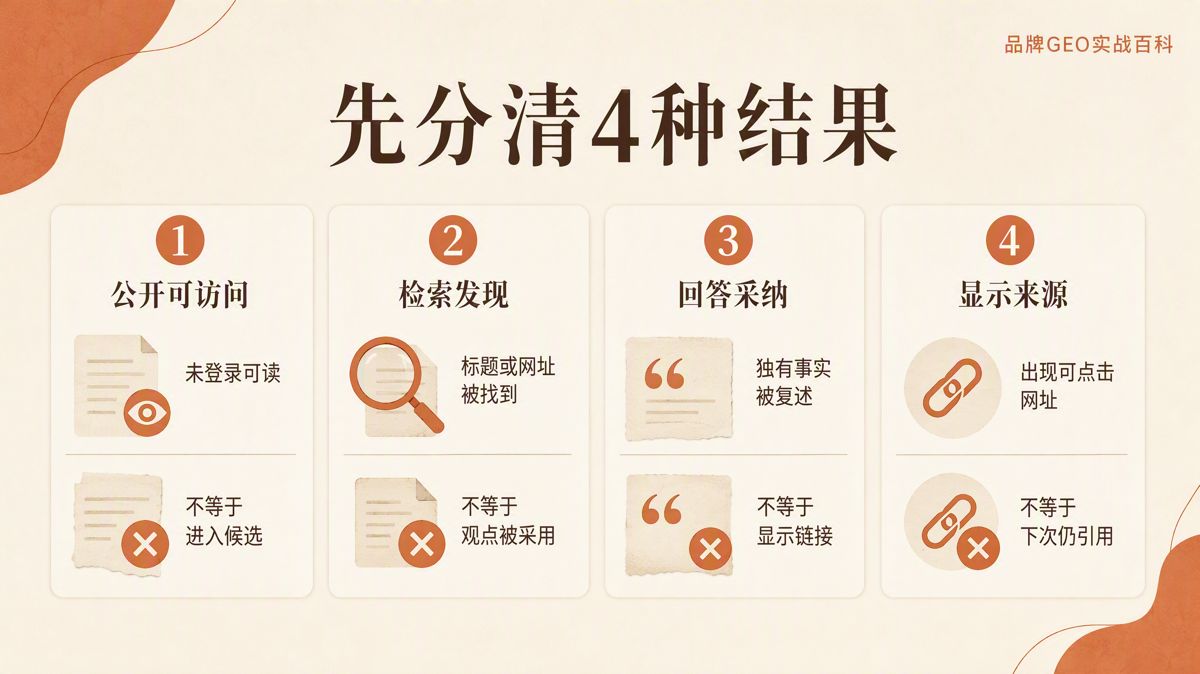
Before trying to earn citations in AI search engines, break down what "getting indexed" actually means. Many marketing teams run a single prompt, spot a familiar phrase in the AI answer, and assume their content is permanently indexed. That conclusion is premature. Public accessibility, search discovery, answer adoption, and clickable citations are four distinct stages.
| Outcome Level | What You See | Valid Proof | What It Does Not Prove |
|---|---|---|---|
| Publicly Accessible | Page opens in an incognito browser without logging in | Stable URL, 200 HTTP status, selectable text | Page is included in search retrieval candidates |
| Retrieval Discovery | Target page appears during search or retrieval trace | Page title, URL, or snippet found in retrieval log | The model adopted the page's core point |
| Answer Adoption | AI answer restates proprietary facts from the page | Identical figures, boundaries, and phrasing | A source link will be displayed |
| Source Displayed | Answer includes a clickable link to the target URL | Screenshot, target URL, cited snippet, timestamp | The URL will be cited on the next identical query |
Platform terms confirm both real-time retrieval of third-party public web pages and source link display, while reminding users that consolidated web output may contain errors. When running tests, record the URL, the quoted snippet, the answer position, and whether facts were represented accurately. Tracking brand mentions alone will not tell you which stage broke down.
Step 1: Build a Fixed 12-Question Test Set
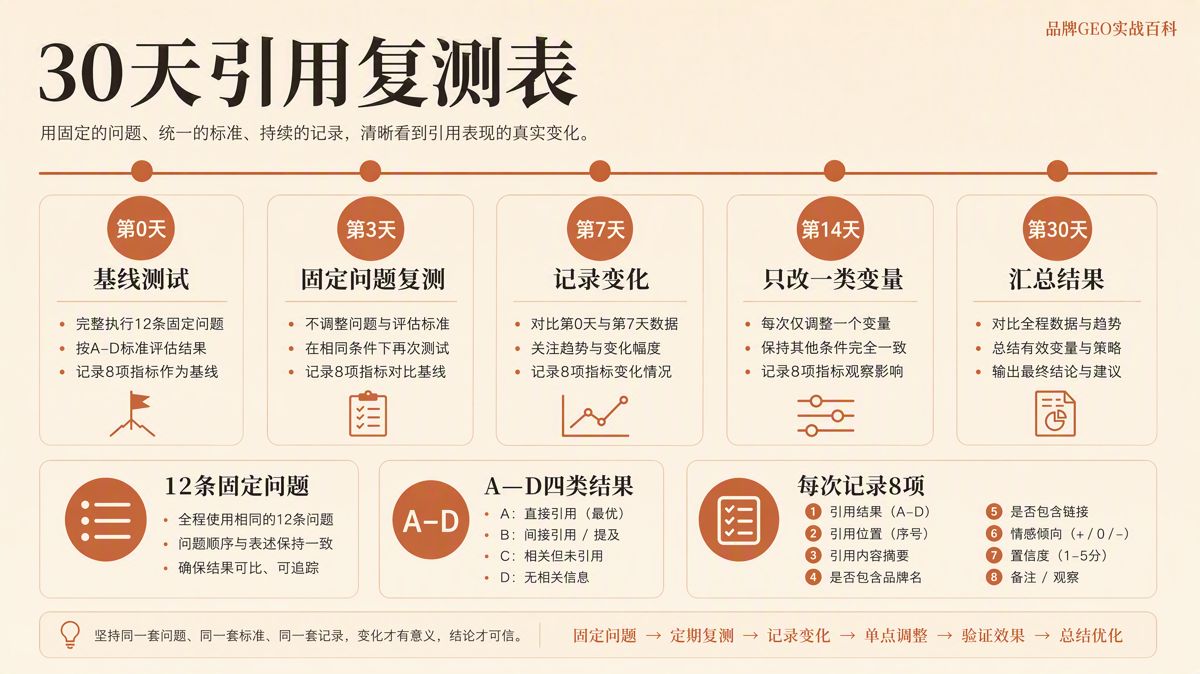
Pick one core topic and write 12 fixed questions: three definitions, three comparisons, three execution steps, and three risk boundaries. Every question in a category should target the same core fact, varying only the natural phrasing a user might type. This prevents false positives where content only triggers on a single keyword, and stops teams from tweaking prompts just to get a favorable result.
For example, to test an enterprise service, test: "What is it?", "Who is it for?", "How does it compare to standard methods?", and "How do you execute it?". Keep the original questions locked in your tracking sheet. If the testing conditions change between runs, your historical data becomes useless.
| Question Type | Count | Verification Target | Common False Positive |
|---|---|---|---|
| Definition | 3 | Entity name, category, operational scope | Counting a bare brand mention as a citation |
| Comparison | 3 | Core differentiators, conditional limits | Mistaking generic model reasoning for your point |
| Execution | 3 | Workflows, required inputs, audit methods | Assuming generic steps came from your page |
| Risk | 3 | Inapplicable scenarios, compliance limits | Only testing positive queries, ignoring edge cases |
Step 2: Prepare a Fact Sheet for Each Question
Whether an AI engine quotes your page accurately depends on whether your page contains clear, verifiable facts. For each question, establish one primary answer backed by 5 to 7 pieces of evidence: exact entity names, publication dates, target audience, execution steps, data definitions, scope limitations, and primary sources. Audit your draft against this list before publishing.
Divide content into three categories: 1. Proprietary company facts (founding dates, product version logs, service boundaries). 2. Third-party primary facts (statutes, industry standards, public statistical releases). 3. Editorial judgments.
Keep primary sources cited for the first two categories. Clearly mark the third category as editorial analysis rather than presenting it as platform policy.
Be disciplined with numbers. Because AI platforms do not publish domain weights or average indexing timelines, never publish unverified claims like "indexed in 7 days" or "80% citation probability." Fabricated figures weaken your credibility and complicate auditing.
Step 3: Structure Pages into Independent Answer Units
A resource page can be comprehensive, but each section should answer exactly one question. Write H2 and H3 subheadings using natural user query phrasing. Give the direct answer in the very first sentence below the heading, then follow with evidence, conditions, and exceptions. Keeping paragraphs between 60 and 150 words makes content easier to parse and verify.
Structure the page systematically: - A summary under 40 words - 5 to 7 key facts - Detailed explanatory body text - At least one comparison table - 6 to 8 frequently asked questions
This layout helps readers verify claims quickly and helps your team pinpoint which section the AI extracted. It does not guarantee citation, but it eliminates conflicting statements on the same page.
Anchor every key data point with four details: the exact figure, the data cutoff date, the operational scope, and the primary source. When product versions, service scopes, or policies change, update the timestamp and keep a revision log rather than silently editing copy.
Step 4: Run an Incognito Readability Audit Before Publishing
AI search documentation confirms that crawlers retrieve public open-web data, but platforms rarely provide exact rendering specifications. Set "incognito readability" as your technical baseline: open a private browser window, visit the URL directly, and confirm the text loads without a login prompt, text can be selected and copied, and image text is duplicated in HTML copy.
Run this six-point technical check: - Is the URL permanent and canonical? - Does the H1/title align with the target search query? - Does the server return a clean 200 HTTP status code? - Is the publication or update date clearly visible? - Do outbound reference links resolve properly? - Does the entire body render cleanly on mobile viewports?
If client-side JavaScript fails, copy is locked inside image assets, or URLs redirect unpredictably, resolve those technical blockers before testing for AI citations. Separate technical access failures from content evaluation failures.
Step 5: Maintain a Single Master Version of Every Fact
When entity names, dates, or product metrics vary across different pages on your site, AI models struggle to synthesize a clear answer. Establish a single master fact sheet. Align your official website, public documentation, and distributed PR materials to this single source of truth. Phrasing can change to suit the audience, but core metrics, names, and limits must remain identical.
If old web pages contradict new data, update the legacy pages and append a clear modification date. For third-party platforms where you cannot edit old articles, document the update and active date on your primary hub. Model developers do not publish how much weight they place on cross-web consistency, but factual consistency is a prerequisite for reliable extraction.
Avoid syndicating identical copy to ten external sites. Instead, have each page address a distinct user question while sharing the same underlying facts. This allows you to evaluate which specific question angle earned citation.
Step 6: Retest on Days 0, 3, 7, 14, and 30
Run your baseline test across all 12 questions on Day 0 (the day of publication). Repeat the exact prompts under identical network conditions and search modes on Days 3, 7, 14, and 30. This testing schedule provides a structured evaluation cadence; it does not reflect an official platform indexing window. If you switch models, accounts, or prompt phrasing, track them as new test conditions.
Log eight data points for every test: 1. Timestamp 2. AI platform and search mode 3. Full prompt text 4. Fact adoption (Yes/No) 5. Source link displayed (Yes/No) 6. Cited URL 7. Exact quoted snippet 8. Factual accuracy of the AI response
When taking screenshots for documentation, capture the user prompt, the complete answer, the cited source block, and the system clock.
Group results into four tiers: - Tier A: Page not discovered - Tier B: Page discovered in retrieval traces, but facts not adopted - Tier C: Facts adopted in the answer, but no source link displayed - Tier D: Facts adopted and clickable source link displayed
Even a consistent Tier D result over several weeks is not a permanent guarantee, but tracking across five intervals shows how the model's retrieval behavior evolves.
Step 7: Change Only One Variable per Cycle
If a page remains in Tier A by Day 14, check basic indexability or test whether the page title matches the user query closely enough. If it reaches Tier B (discovered, but not adopted), add clearer summary answers, primary data citations, or explicit boundary conditions. If it reaches Tier C (adopted with inaccurate facts), rewrite ambiguous sentences that could be taken out of context. Modify only one variable per cycle, and record the date of the change.
Avoid rewriting the entire page, changing the URL, updating the title, and syndicating ten new articles all at once. Changing multiple variables prevents you from understanding what worked. The goal of continuous testing is to build a repeatable content production workflow.
At the end of 30 days, calculate three internal metrics: - Discovery Rate: Percentage of the 12 questions that retrieved the page. - Fact Adoption Rate: Percentage of answers that used your data points. - Citation Link Rate: Percentage of answers that displayed a clickable URL.
Calculate these metrics against your specific sample size and test runs. Use them to guide your internal editorial roadmap, not as claims about broad platform algorithms.
What You Can Control vs. What You Cannot
| What You Can Control | What You Cannot Control | Recommended Action |
|---|---|---|
| Page accessibility, stability, and rendering | When search engines crawl and index pages | Pass incognito tests; follow a fixed retest schedule |
| Accuracy, dates, and scope of published facts | Which candidate URLs are pulled into context | Maintain primary sources and a master fact sheet |
| Query-to-title alignment | How the LLM synthesizes multiple sources | Monitor shifts using the 12 fixed questions |
| Consistency of names, numbers, and units | Whether the UI renders a clickable link | Track fact adoption and source display separately |
| Version logs and editorial audit trails | Output stability across future model updates | Adjust only one editorial variable per testing round |
You can manage your content's public availability, factual precision, structural clarity, and evaluation records. AI search engines will retrieve public content and summarize it. Whether your page is selected on a specific Tuesday afternoon depends on dynamic retrieval thresholds and query intent. Focus on controlling the quality of your inputs.
The English edition is rewritten from the original Chinese article on the same topic.

Starbox AI is an AI marketing company based in Hangzhou, China. This article draws on Starbox project work. Please credit the source when quoting.
Related reading
 GEO Guide
Why AI Marketing Vendor Quotes Vary 10x: A 4-Step Vetting Checklist
Evaluate AI marketing proposals by delivery actions, not slide decks. Audit source infrastructure, fact cleaning, and clean-environment testing.
Oct 22, 2026 · 6 min read
 GEO Guide
Spotting GEO Scams: What Actually Drives AI Recommendations?
Automated AI ranking promises violate how LLMs work. Real AI recommendations rely on authoritative, structured facts across trusted public sources.
Oct 22, 2026 · 4 min read
 GEO Guide
How to Measure Your Brand's AI Visibility with a Spreadsheet
You do not need expensive software to track AI recommendations. A three-tier prompt framework and a simple spreadsheet can score your brand visibility in half a day.
Oct 21, 2026 · 6 min read