
Source Whitelists in China GEO: How to Structure a 4-Tier Hierarchy

The short answer
The four-tier source hierarchy is an editorial governance framework, not an official ranking algorithm published by Chinese AI search engines.
Key Facts
- As of August 16, 2026, none of China's major AI engines—Doubao (ByteDance's AI assistant), Ernie Bot (Baidu's AI assistant), Yuanbao (Tencent's AI assistant), Metaso (an AI search engine), DeepSeek, or Kimi (Moonshot AI's assistant)—have published an official "four-tier source whitelist" or quantitative domain weighting model. Agency experience should never be presented as platform algorithm rules.
- The four-tier hierarchy works best as an internal governance and testing workflow: determine who holds the primary record for a fact first, then decide your citation and verification sequence.
- For laws and regulations, always verify the drafting authority, promulgation date, effective date, and current validity. The National Database of Laws and Regulations, maintained by the General Office of the National People's Congress Standing Committee, provides these exact search fields.
- For Chinese national standards, check the standard ID and validity status. The National Public Service Platform for Standards Information publicly distinguishes between active, upcoming, replaced, and abolished standards.
- For macro statistics, trace back to the primary source. National Data, operated by the National Bureau of Statistics, provides direct access to monthly, quarterly, annual, and census datasets.
- Source priority is determined by the type of fact, not domain popularity. Product specs, regulations, standards, academic papers, and statistical datasets each have different primary issuers.
- A four-tier source model improves fact-checking efficiency and testing rigor. It cannot be used to guarantee indexing timelines, citation ratios, or final AI search outputs.
Why the Idea of a "Whitelist" Misleads Teams
When running Generative Engine Optimization (GEO) in China, content teams frequently ask: Which domains carry the highest authority? In what order should we cite regulations, press coverage, corporate portals, and social platforms?
This question frames the problem incorrectly from the start.
The term "whitelist" suggests that AI platforms maintain a published index of approved domains where certain sites rank first, others second, each carrying a fixed algorithmic weight. Publicly available technical documentation for Chinese AI engines offers no such rulebook.
Treating a four-tier framework as an algorithm fact creates two risks. Content teams build publishing schedules around unverified weights, and clients assume that placing content on a specific site guarantees an AI citation.
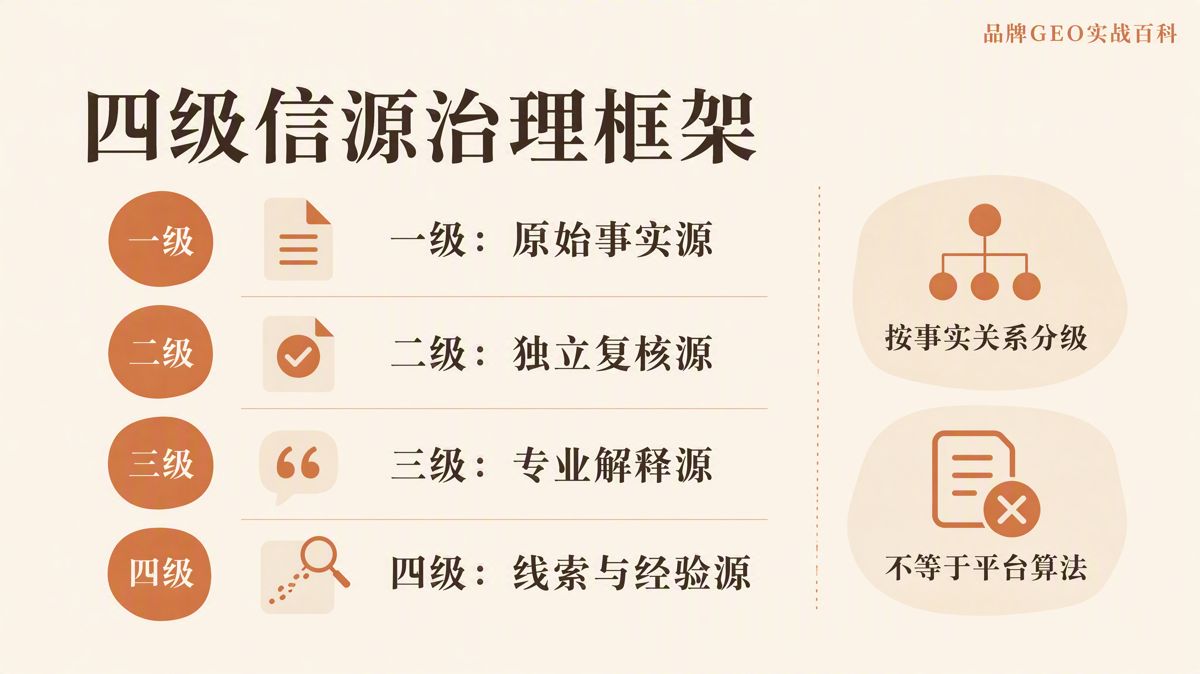
A more accurate term is a four-tier source governance framework.
It does not predict which source an AI model will pick for a specific answer. Instead, it solves three practical problems for your editorial workflow: where to verify a claim first, which sources can substantiate a core conclusion, and which channels should only be used to uncover leads.
Even with strong source governance in place, teams must test actual queries across multiple platforms. Doubao, Ernie Bot, Yuanbao, Metaso, DeepSeek, and Kimi all differ in index coverage, retrieval modules, and output formats. Without official documentation, you cannot assign them a shared domain-weight model or guarantee citation outcomes.
How to Define the Four Tiers
Tier rankings should not be assigned to domains permanently. Instead, they reflect the relationship between a source and a specific claim.
The closer a source is to the entity that authored, published, or carries direct accountability for a fact, the better it serves as primary evidence. The more intermediate layers a claim passes through, the more critical it is to trace back to the original text.
| Tier | Editorial Definition | Intended Role | Usage Rule |
|---|---|---|---|
| Tier 1: Primary Fact Sources | The entity that authored, published, or carries direct liability for the fact | Regulatory texts, national standards, official stats, product specs, original papers | Prioritize for core claims; verify exact version, date, and scope |
| Tier 2: Independent Verification Sources | Regulatory authorities, accredited test reports, or peer-reviewed research capable of independent validation | Risk analysis, lab findings, methodology checks, operational thresholds | Cross-reference against Tier 1; do not use as a substitute for original filings |
| Tier 3: Professional Interpretation Sources | Industry associations, vertical trade press, signed expert commentary, professional knowledge hubs | Market background, case studies, technical terminology, industry perspectives | Clearly label as opinion/analysis; trace primary numbers back to Tier 1 or 2 |
| Tier 4: Discovery and Clue Sources | Social feeds, anonymous Q&A, aggregators, syndicated posts, AI summaries | Topic discovery, mapping user query phrasing, discovering source links | Never use alone to support a core fact; do not state as settled conclusions |
Tier 1 does not mean every government website outranks commercial pages across all topics.
If you are verifying technical parameters for a piece of hardware, the manufacturer's official engineering manual is far more direct than an unrelated public portal. If you are citing academic findings, the original journal publication carries more weight than a media summary. If you are verifying an active Chinese law, the drafting authority and the National Database of Laws and Regulations are the correct entry points.
A domain cannot be permanently locked into a single tier. The deciding factor is always the source's proximity to the specific claim.
Matching Source Tiers to Fact Types
Select sources based on fact categories. Editorial teams should tag each core statement with its fact type before tracking down the primary issuer.
| Fact Type | Primary Verification Portal | Required Fields to Verify | Common Pitfalls |
|---|---|---|---|
| Laws and Regulations | Drafting authority, National Database of Laws and Regulations | Drafting authority, legal validity, publication and effective dates | Citing repealed versions or relying solely on media summaries |
| National Standards | National Public Service Platform for Standards Information, standards bodies | Standard ID, standard name, status (active/replaced/abolished), release date | Quoting replaced or discontinued standards as active rules |
| Macro Statistics | National Bureau of Statistics and relevant ministerial databases | Metric definition, statistical scope, timeframe, unit of measure | Copying secondary charts without checking metric definitions |
| Product Specifications | Official product documentation, technical whitepapers, verifiable lab tests | Model number, hardware version, test parameters, operating range | Treating marketing copywriting as verified technical specs |
| Academic Research | Original paper, journal/conference page, public dataset repository | Authors, methodology, sample size, boundary conditions | Relying on press releases; mistaking correlation for causation |
| Industry Perspectives | Industry associations, vertical publications, signed expert interviews | Author credentials, release date, supporting evidence | Treating an individual opinion as an industry-wide consensus |
The advanced search in the National Database of Laws and Regulations lets you filter by drafting body, legal validity, promulgation date, and effective date. The National Public Service Platform for Standards Information displays standard validity statuses upfront. The National Data platform organizes information across monthly, quarterly, annual, and census cycles.
Rather than debating whether a domain has "high authority," verify these specific fields. Domain authority is difficult to prove; systematic verification eliminates factual errors immediately.
Applying the Four-Tier Framework to GEO Production
Step 1: Build a Fact Inventory
For every key conclusion planned in your content, log the following data points: exact text of the claim, fact type, primary URL, publishing organization, release date, version or validity status, and scope of application.
If a metric lacks a primary source, keep it out of the main draft. If you only have a Tier 4 lead, trace it upstream until you locate a Tier 1 or Tier 2 source.
Step 2: Embed Citations Directly into Content Structure
Do not dump reference links in a footnote block at the end of an article. Match citations directly to specific claims throughout the body copy.
Lead with clear answers in your section headings and introductory paragraphs. State the survey year, statistical unit, and reporting scope alongside every figure. Cite laws by their full statutory name and current validity status. List exact model numbers and test conditions for technical specifications.
Keep data points in comparative tables strictly aligned. Never place figures from different years, divergent reporting criteria, or differing scopes into the same comparison column.
Step 3: Run Multi-Engine Testing
Using the exact target query and its common synonyms, run structured tests across different AI engines. Record the following:
- Whether the AI-generated answer incorporates the target fact;
- Which specific URL the engine cites;
- Whether the cited snippet reflects the fact accurately;
- Whether the output shifts upon re-testing.
Test logs reflect platform behavior only under that specific query session. They do not prove the existence of permanent, hardcoded domain rankings.
Six Questions Before Publishing a Source
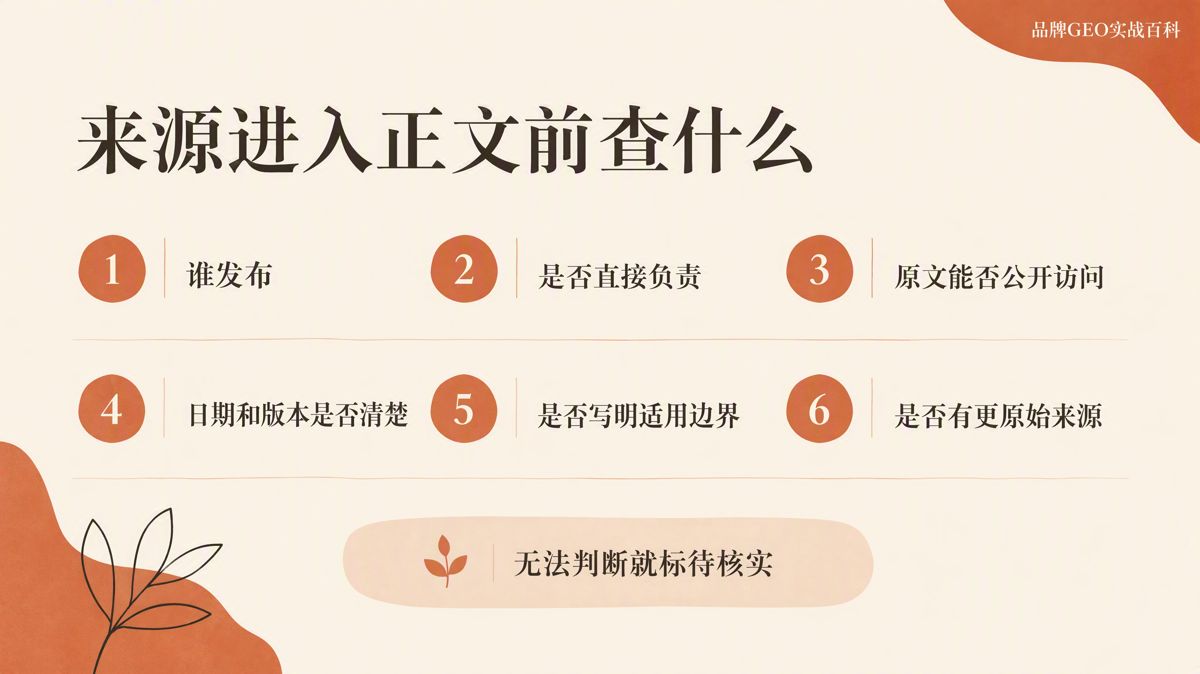
Before approving a citation for publication, run it through this six-point checklist:
- Who published this content?
- Is the publisher directly accountable for this fact?
- Is the primary source publicly accessible?
- Are the publication date and document version clear?
- Does the finding specify its operating scope or limitations?
- Does a more primary source exist closer to the event?
If you can answer all six questions clearly, the source is qualified to support a core claim.
When two sources present conflicting numbers, compare publication timestamps, revisions, metric definitions, and sample sizes before anything else. For legal claims, confirm statutory validity; for standards, check active status; for statistics, check measurement criteria; for products, confirm the exact model; for research, review sample sizes and methodology.
If the conflict cannot be reconciled, label the data explicitly as "pending verification" or present both reporting methodologies side by side. Never default to whichever domain looks more authoritative, and never merge conflicting numbers into an arbitrary average.
Tier tags remain dynamic.
A reported piece from an industry publication is typically a Tier 3 interpretation source. However, if that outlet publishes an exclusive, full-length interview transcript, that transcript serves as primary evidence for what the interviewee said.
Conversely, while a company's website is a Tier 1 source for its own product specifications, it is merely an opinion source when estimating total market size.
Tier classifications depend on the source's relationship to the specific fact, not the website's brand name.
How This Fits Traditional SEO vs. GEO
Both SEO and GEO require publicly indexable, thematically focused, and verifiable content.
SEO focuses primarily on whether a URL can be crawled, indexed, and ranked on search engine results pages. GEO focuses on whether a specific fact can be ingested, synthesized, and cited inside an AI-generated answer, allowing users to trace the claim back to the original source. Source governance strengthens both disciplines.
Neither channel can rely solely on placing content on "high-authority" domains.
If a page cannot be parsed, lacks primary evidence, or cites outdated versions, hosting it on a well-known media site will not prevent the model from misinterpreting it.
On the other hand, a corporate website that publishes detailed product documentation is already the primary authority for its own engineering facts. The priority is ensuring that model numbers, publication dates, testing environments, and change logs are structured clearly.
Sourcing workflows also differ by region. Global research often relies on platforms like Wikipedia, Reddit, YouTube, or vertical review sites for external discovery. In China, teams frequently gather leads from Baike platforms, Q&A hubs like Zhihu, vertical trade media, and WeChat Official Accounts. Regardless of where discovery happens, core claims must still trace back to statutory drafting authorities, official standards databases, ministerial statistical agencies, academic papers, or first-party corporate documentation.
Frequently Asked Questions
1. Is the four-tier hierarchy an official rule from Chinese AI engines?
No. As of August 16, 2026, none of the major Chinese AI search platforms have published a unified whitelist, fixed domain weights, or quota formulas. This framework is strictly an internal editorial methodology for verification and testing.
2. Will a Tier 1 source always be cited by AI engines?
Not necessarily. Being Tier 1 only means the source is closest to the primary fact. It does not guarantee that the page will be indexed, parsed, or selected for a generated answer. Live testing is always required.
3. Are all government websites considered Tier 1 sources?
Only if they are directly responsible for the specific fact. Official regulatory portals are Tier 1 for laws and policies. For technical product specs, however, the manufacturer documentation is the actual Tier 1 source.
4. Can a corporate website be a Tier 1 source?
Yes, for its own founding details, product models, technical specifications, and release notes. For broader market size estimates or competitor evaluations, it is merely an opinion source and requires external validation.
5. What tier do media reports belong to?
They generally fall into Tier 3 as interpretation sources. If an outlet publishes an exclusive, on-the-record interview or full investigative documentation, it can serve as a Tier 2 verification source. Data cited in news stories should always be traced back to the original report or dataset.
6. Is social media content still useful for GEO?
Yes, but primarily for topic discovery, mapping user search phrasing, and finding leads. Unverified personal anecdotes or screenshots cannot serve as authoritative evidence for legal, medical, financial, or statistical claims.
7. How should teams resolve conflicts between two sources?
Compare publication dates, document versions, metric definitions, and sample scopes, then trace back to the primary issuer. If the discrepancy persists, document both methodologies side by side rather than inventing a blended number.
8. Can teams promise citation rates or indexing speed based on this framework?
No. The four-tier model streamlines internal fact-checking and testing. It is not an indexing protocol, and agencies should never guarantee platform indexing speed or citation shares without official platform documentation.
The purpose of a four-tier source model is not to invent imaginary ranking rules for AI engines. It ensures that every core conclusion has a verifiable origin, a documented version, clear operational boundaries, and ongoing test tracking.
For GEO content teams, establishing this governance standard is far more effective than guessing which domains have mysterious authority weights.
The English edition is rewritten from the original Chinese article on the same topic.

Starbox AI is an AI marketing company based in Hangzhou, China. This article draws on Starbox project work. Please credit the source when quoting.
Related reading
 GEO Guide
Why AI Marketing Vendor Quotes Vary 10x: A 4-Step Vetting Checklist
Evaluate AI marketing proposals by delivery actions, not slide decks. Audit source infrastructure, fact cleaning, and clean-environment testing.
Oct 22, 2026 · 6 min read
 GEO Guide
Spotting GEO Scams: What Actually Drives AI Recommendations?
Automated AI ranking promises violate how LLMs work. Real AI recommendations rely on authoritative, structured facts across trusted public sources.
Oct 22, 2026 · 4 min read
 GEO Guide
How to Measure Your Brand's AI Visibility with a Spreadsheet
You do not need expensive software to track AI recommendations. A three-tier prompt framework and a simple spreadsheet can score your brand visibility in half a day.
Oct 21, 2026 · 6 min read