
What Content Does Metaso AI Search Prefer to Cite?

The short answer
Publicly accessible pages with direct answers and verifiable evidence are most likely to be cited by Metaso AI Search.
Key Facts
- Metaso officially defines its platform as an "intelligent retrieval service." It automatically retrieves third-party web links through public channels and also indexes content uploaded by users. See the Metaso AI Search User Agreement.
- The official platform currently offers at least three search scopes: "Entire Web," "Document Library," and "Academic." This means the same query can be searched across distinct resource pools. See the Metaso AI Search Official Website.
- Academic search offers filtering options such as Chinese databases, English databases, PubMed, Peking University Core Journals (PKU Core), Chinese Academy of Sciences (CAS) Journal Rankings, and JCR (Journal Citation Reports), making it suitable for research papers, medical queries, and scientific topics. See the Metaso AI Search Official Website.
- The user agreement explicitly notes that Metaso does not control, edit, or modify retrieved third-party information. Consequently, the quality and accessibility of the source page itself are critical. See the Metaso AI Search User Agreement.
- The platform also clarifies that search results are generated by probabilistic models. Numbers, timestamps, and factual statements are not guaranteed to be accurate, and users must verify them independently. See the Metaso AI Search User Agreement.
- As of August 2026, Metaso has not published any fixed domain whitelist, quantitative weighting formulas, crawling schedules, or rules stating that meeting specific criteria guarantees citation. Any claims of guaranteed citation should not be treated as official fact.
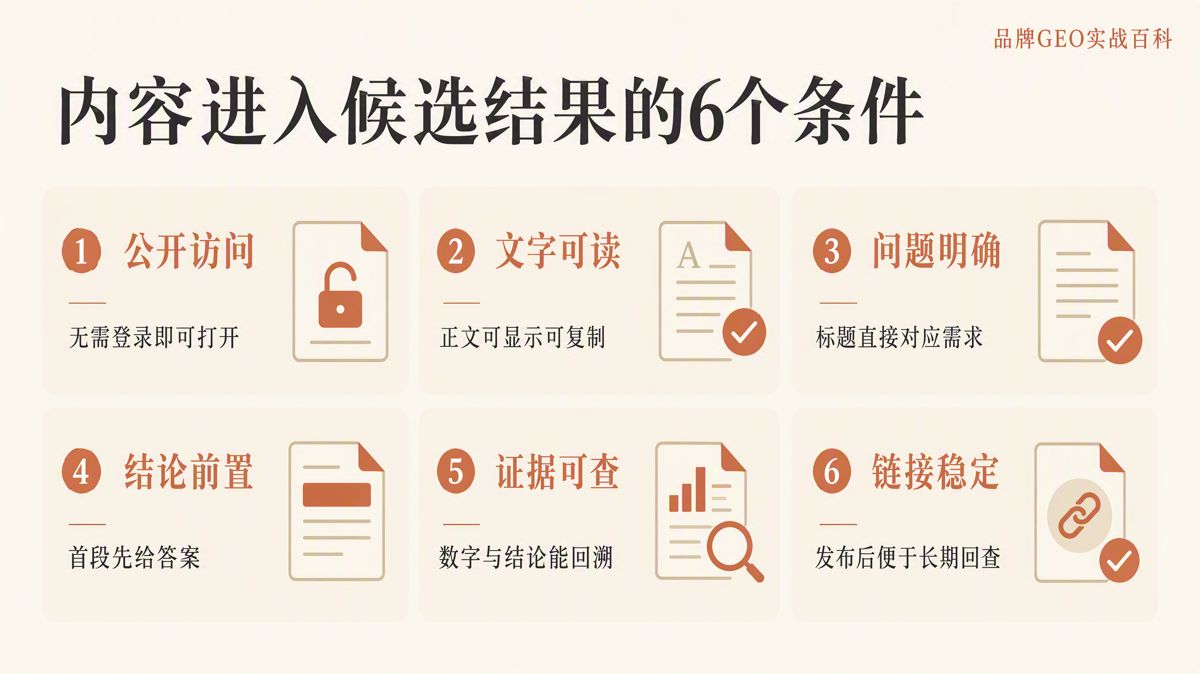
Where Does Metaso Retrieve Information?
Metaso discloses two primary data intake channels: third-party web pages available via public channels and user-uploaded files. The platform further divides search scopes into the Entire Web, Document Library, and Academic repositories.
When creating content, your first decision is choosing the right format: a standard web page, an uploaded document, or an academic paper.
- For Entire Web search: Pages should load normally without requiring login. The main body text should display directly, rather than locking critical information behind images, downloads, or complex interactive scripts.
- For Document Library search: The file name, executive summary, table of contents, and body text must correspond directly with each other.
- For Academic search: The material should clearly state authors, affiliated institutions, publication dates, research subjects, methodologies, and findings.
It is important to distinguish official facts from practical execution. Metaso has disclosed its retrieval points and search scopes, but it has never published its ranking formulas. The optimization methods below reflect how public retrieval mechanisms work, not an official citation guarantee from Metaso.
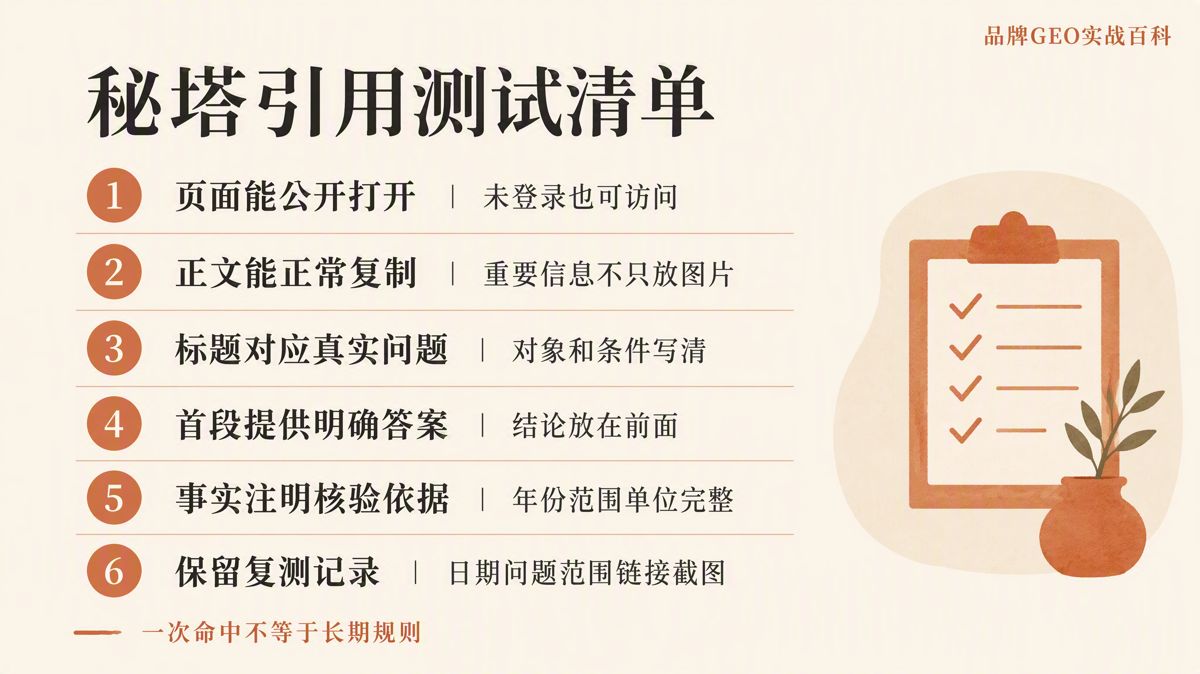
What Content Makes It into Candidate Results?
Based on public retrieval mechanisms, content generally must satisfy three baseline conditions: public accessibility, clear topical focus, and verifiable evidence.
1. Open and Publicly Accessible Pages
If an article on a corporate website requires a login, forces redirects to a mini-program, or requires complex scripts to render text, retrieval systems may fail to capture the complete content.
PDFs are not automatically search-friendly either. White papers, product manuals, and reports can use PDF formats, but they should retain selectable, copyable text, clear headings, a table of contents, page numbers, author attribution, and publication dates. Scanned image-only PDFs make automated parsing significantly harder.
URL stability is equally critical. Frequently changing URLs after publication or allowing original links to break prevents users from verifying source material.
2. Headlines and Openings That Answer the Question Directly
Headings should explicitly name the subject, the problem, and any necessary preconditions. The first paragraph should provide the core conclusion upfront before elaborating on the supporting rationale.
For example, if an article addresses whether a specific material withstands high temperatures, the opening should state the test conditions, temperature range, and applicable standards immediately, rather than opening with paragraphs of corporate history.
A single paragraph should ideally address one specific point. Mixing multiple conclusions, scenarios, and topics into one block increases extraction and citation difficulty for AI models.
3. Traceable, Verifiable Conclusions
Numerical data should specify the year, statistical scope, measurement units, and original source. Policies should state the full official title, issuing agency, and implementation date. Product specifications should align with official manuals or inspection reports. Professional opinions should credit the author and publication date.
Metaso's platform messaging highlights making "every viewpoint traceable." Content that connects back to primary sources naturally fits this retrieval model.
At the same time, remember that Metaso does not edit or verify third-party information, and answers are generated probabilistically. Even when an answer provides a citation, users must still check the original source.
Does Metaso Favor Specific Websites?
There is no official evidence that Metaso uses a fixed, public domain whitelist.
Its academic search allows users to filter by PubMed, PKU Core, CAS Journal Rankings, and JCR, which lets users restrict their query to vetted scientific literature. However, for general web search, Metaso has not published fixed weights for government websites, mainstream media, corporate sites, or any other category, nor has it disclosed source citation ratios.
Instead of guessing which domain carries higher arbitrary weight, align your source format with the query:
- For legal and regulatory queries: Use current statutory texts and official regulatory releases.
- For medical queries: Prioritize clinical papers, practice guidelines, and authoritative institutional releases.
- For product specifications: Rely on official technical manuals and reproducible test reports.
- For industry perspectives: Combine published market reports, media interviews, and primary operating data.
Domain reputation cannot substitute for evidence quality. Whether a source is selected depends primarily on how directly and accurately it answers the specific query.
How to Write for Easy Metaso Parsing and Citation
A practical writing structure is straightforward: cover one topic per paragraph, deliver the conclusion in the opening sentence, provide supporting evidence in the body, and close with applicable boundaries or constraints.
Tables work best for comparing options, FAQs help address diverse phrasing, and numbered checklists clarify operational steps. These formats reduce ambiguity, though they cannot replace verified facts.
| Content Element | Recommended Approach | Common Mistake | Revision Priority |
|---|---|---|---|
| Headline | Directly state the user's question | Vague slogans or emotional hooks | Name the subject, conditions, and core query |
| First Paragraph | Provide a direct answer immediately | Long corporate background or filler | Lead with the conclusion, then add evidence |
| Data | Include year, scope, units, and source | Standalone percentages without context | Add source links and parameter boundaries |
| Tables | Compare metrics across a uniform standard | Inconsistent units, dates, or baseline conditions | Standardize comparison criteria |
| FAQ | Answer one concrete question per item | Redundant questions with vague answers | Clarify specific scenarios, limits, and verification paths |
| Revision History | Note update dates and specific changes | Outdated figures left unmanaged | Correct obsolete claims and log revisions |
How Does Traditional SEO Relate to Metaso Citations?
Traditional SEO ensures that search engines can discover, crawl, and index your pages. Because Metaso retrieves third-party web content through public channels, accessible pages, clear titles, complete body text, and stable links remain the foundation for inclusion.
Generative Engine Optimization (GEO) focuses on optimizing content for generative search models. It concentrates on whether a factual passage can be extracted to synthesize an answer, and whether users can follow citation links back to the original source.
The two disciplines are connected, but their end goals differ.
Traditional SEO prioritizes search rankings and organic click-through rates. GEO for engines like Metaso prioritizes extractability, citable authority, and source verifiability.
Repeating keywords does not substitute for primary evidence. Similarly, rewriting a single article and republishing it across multiple platforms does not create independent, credible sources.
GEO strategies in China must also reflect local digital channels. While global SEO discussions focus on standalone domains, Wikipedia, Reddit, and YouTube, optimization in China requires coordinating corporate websites, government and industry association portals, Chinese knowledge platforms, trade media, WeChat Official Accounts, and domestic academic databases.
For Metaso, the officially confirmed mechanism remains automatic retrieval through public channels. Whether your content appears should always be verified through real queries.
How to Test If Your Content Has Citation Potential
To test visibility, prepare a set of queries that prospective buyers actually ask, then evaluate Metaso's synthesized answers and cited sources.
Test queries across these six core categories:
- Brand facts;
- Product specifications;
- Use cases and operational scenarios;
- Product comparisons;
- Risks, trade-offs, and limitations;
- Time-sensitive updates.
Prepare three to five phrasings for each category. Run queries across the Entire Web, Document Library, and Academic scopes, then record:
- Whether your content is cited;
- Which specific landing page Metaso referenced;
- Whether altering the prompt phrasing changes the cited sources;
- Whether the citation remains stable in follow-up tests over subsequent days.
If your content does not appear, review these diagnostic checkpoints:
- Can the page be accessed without a login?
- Does the primary text render properly and allow copying?
- Does the title directly match the search intent?
- Does the opening paragraph provide an unambiguous conclusion?
- Are figures, claims, and data tied to clear sources?
- Is the information outdated?
When making adjustments, change one variable at a time, then test again after a consistent observation window. Because Metaso does not publish its crawl schedules, no one can promise indexing within a set number of days.
Maintain thorough testing logs that document the test date, search scope, exact prompt phrasing, web-search toggle status, cited URLs, and result screenshots.
A single citation confirms only that your page appeared for that specific query at that moment. It does not prove a permanent preference by Metaso, and it should never be framed as guaranteed placement.
Common Practices That Hurt Content Credibility
Fabricating Authoritative Sources
Inventing research bodies, report names, or survey data may look convincing at first glance, but the claims collapse once verified. If an AI or user attempts to trace the reference and finds nothing, overall credibility suffers.
Duplicate Publishing Across Platforms
Taking one article, tweaking the headline, and distributing it across multiple sites adds zero new evidence. In fact, it often creates conflicting versions and cannibalizes source clarity.
Mistaking One-Off Test Results for Official Rules
Just because a page was cited in an isolated test does not mean you have uncovered Metaso's underlying ranking algorithm. Do not generalize temporary retrieval outcomes into rigid rules.
Hiding Important Data Inside Images
Ensure core information remains in selectable, machine-readable text. When infographics or charts are necessary, accompany them with complete text captions and summaries.
Updating Figures Without Maintaining Full Articles
When prices, policies, or technical parameters change, update the entire page—including headlines, summaries, body text, comparison tables, and FAQs. Failing to do so leaves contradictory data on the same page.
Frequently Asked Questions
1. Does publishing content on an official corporate website guarantee citation by Metaso?
No.
A corporate website is simply one type of public web page. Crawlability, topical relevance, evidence quality, and timeliness all dictate whether a page appears in any given query result.
Metaso makes no public commitments that corporate websites will be indexed, nor does it guarantee an indexing timeframe after publication.
2. Are PDFs cited more easily than web pages?
There is no official data supporting this.
PDFs are well-suited for white papers, product manuals, and research reports, provided they contain selectable text, structured headings, page numbers, author credentials, and publication dates. Image-only scans hinder automated extraction.
Standard web pages are easier to update continuously and maintain stable links over time. Depending on your material, offering both a web page and a downloadable PDF is often practical.
3. Does Metaso Academic search only cite formal research papers?
Metaso Academic focuses primarily on academic literature and provides dedicated filters for PubMed, PKU Core, CAS Journal Rankings, and JCR.
Because candidate pools shift depending on the selected scope, test results from Entire Web search and Academic search cannot be used interchangeably.
4. Does publishing multiple similar articles increase citation odds?
No, there is no evidence to support this.
Duplicate content provides no new factual corroboration and can create conflicting signals. A better strategy is to publish distinct pieces that each tackle a specific query: definitions, parameters, use cases, limitations, product comparisons, or common misconceptions.
Every piece should offer distinct primary evidence and define its operational scope.
5. Has Metaso published an official source whitelist?
As of August 2026, Metaso has not published any domain whitelist, quantitative domain weights, or source priority hierarchy.
Industry discussions claiming that certain types of domains carry fixed percentage weights reflect individual testing observations, not official platform rules.
6. How do you verify that a citation actually occurred?
Record the testing date, the exact query string, the chosen search scope, a screenshot of the generated answer, and the clickable source links. Re-run the test using identical and similar phrasings several days later.
These records prove what was retrieved at a specific point in time, but they cannot guarantee identical output in future queries.
7. Do you still need to update content after it has been cited?
Yes.
Regulations, specifications, pricing, and benchmark figures evolve. When real-world facts change, revise your content promptly, noting the revision date and specific updates.
Remove obsolete conclusions directly to avoid hosting conflicting claims on the same page.
8. Can agencies promise clients guaranteed citations on Metaso?
No.
Metaso offers no citation guarantees. Its user agreement explicitly states that it does not guarantee the accuracy, completeness, or ongoing stability of search results.
Agencies can commit to structured content development, technical accessibility audits, and disciplined query testing, but probabilistic AI outputs should never be sold as deterministic deliverables.
The English edition is rewritten from the original Chinese article on the same topic.

Starbox AI is an AI marketing company based in Hangzhou, China. This article draws on Starbox project work. Please credit the source when quoting.
Related reading
 GEO Guide
Why AI Marketing Vendor Quotes Vary 10x: A 4-Step Vetting Checklist
Evaluate AI marketing proposals by delivery actions, not slide decks. Audit source infrastructure, fact cleaning, and clean-environment testing.
Oct 22, 2026 · 6 min read
 GEO Guide
Spotting GEO Scams: What Actually Drives AI Recommendations?
Automated AI ranking promises violate how LLMs work. Real AI recommendations rely on authoritative, structured facts across trusted public sources.
Oct 22, 2026 · 4 min read
 GEO Guide
How to Measure Your Brand's AI Visibility with a Spreadsheet
You do not need expensive software to track AI recommendations. A three-tier prompt framework and a simple spreadsheet can score your brand visibility in half a day.
Oct 21, 2026 · 6 min read