
What Does DeepSeek Cite, and How Can You Verify It?
The short answer
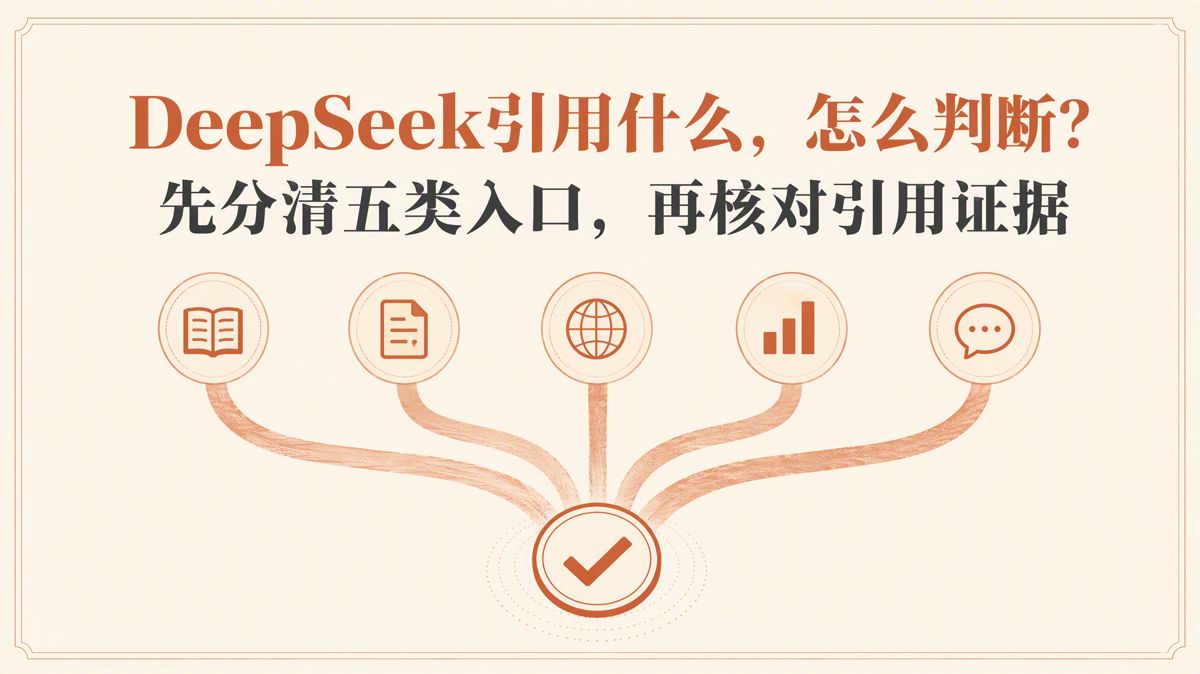
Verify whether the model is searching the web first, then track whether your page is discovered, selected, and shown as a clickable citation.
Key Facts
- On August 13, 2026, DeepSeek officially launched V4-Pro across its web interface, mobile app, and API. While all three entry points use the same underlying model generation, you cannot assume their search tools, candidate pools, or citation displays are identical. Test results must be tracked separately by entry point. See the DeepSeek API updates.
- The official status page monitors the "API Service" and "Web Chat Service" as two distinct components with independent 90-day uptime metrics. This confirms the infrastructure is tracked separately, meaning an API search will not necessarily return the same sources as the consumer web chat. See DeepSeek service status.
- DeepSeek's Responses API supports
web_searchexecuted on the server side. Developers can configuretool_choiceto auto, required, or a specific tool via explicit request parameters. This confirms the API can access the web under explicit configuration, but it does not mean DeepSeek has published a fixed source-ranking index for consumer products. See the Responses API documentation. - For standard Chat Completions, Tool Calls are defined and executed by the developer. Official documentation states that the model does not run functions itself; the complete flow requires four steps: user prompt, tool call generation, external function execution, and final answer generation. The search engine, scraper, or knowledge base used by a third-party app is determined entirely by the developer. See the Tool Calls documentation.
- V4-Flash and V4-Pro support a 1-million-token context window with a maximum output of 384,000 tokens, supporting tool calling and the Responses API. A large context window allows the model to process more input data, but it does not prove that a webpage has been crawled, indexed, or cited. Context limits are not source-selection criteria. See the official Models and pricing.
- Official API release notes mentioned Chinese search capability improvements in March 2025 and Search Agent optimizations in September 2025. Both notes described functional capabilities; neither published domain allowlists, source weightings, crawl schedules, citation rates, or consumer citation display rules. See the DeepSeek API updates.
- As of August 15, 2026, verified DeepSeek official sites, API documentation, status pages, and GitHub repositories offer no webmaster submission portal, fixed domain weighting, or citation guarantee. Industry rumors cannot replace verified documentation, and live test results should only be treated as empirical observations. See the DeepSeek official website.
Identify the Entry Point Before Assuming Bias
Seeing a web search result on deepseek.com, receiving an answer with tool calls via the API, or querying a custom knowledge base powered by DeepSeek might all look like "DeepSeek looking up information."
Behind the scenes, however, the candidate content is determined by different systems: consumer-facing product logic, DeepSeek's server-side search, a developer's custom tool, or a private document repository.
Without specifying the exact entry point, asking "what content DeepSeek prefers" is meaningless.
If a third-party application frequently cites an industry portal, it only shows that the application's search configuration retrieves that portal easily. It does not prove that DeepSeek's consumer web chat uses the same index, nor does it mean the model was trained with fixed weight assigned to that site.
Official documentation confirms that DeepSeek operates distinct channels: web, app, and API. The Responses API supports server-side web_search, and standard Tool Calls execute developer-supplied functions. See the DeepSeek official website.
DeepSeek has not published the search index used by its consumer app or the ranking formula for open-web pages.
What Five Entry Points Can and Cannot Prove
| Entry Point | Who Provides Web Access or Data? | What It Confirms | What It Cannot Prove |
|---|---|---|---|
| DeepSeek Web or App | DeepSeek consumer product | Whether a specific answer displays search sources | A permanent site ranking or index preference |
| Responses API | DeepSeek server-side search tool | Whether web_search was triggered in that call |
That the consumer chat uses the same source pool |
| Chat Completions Tool Calls | Developer-defined and executed functions | That the model processed returned tool data | That the search came from DeepSeek's native index |
| Third-Party App or Private RAG | Integration partner's retrieval system | That the app retrieved the document | That the open web indexed the document |
| Self-Hosted Open-Source Model | Local infrastructure team | That the deployment processed the prompt | Built-in official search tools or citation rules |
Official Tool Calls documentation clearly separates the model's responsibility from the developer's: the model generates function arguments, the client executes the call, and the resulting payload is sent back to the model. See the Tool Calls documentation.
When a third-party software vendor claims to "use DeepSeek with live web search," its source selection depends entirely on that vendor's retrieval stack.
The Responses API is different: it executes server-side web_search directly and streams search-call status events. See the Responses API documentation.
This confirms that DeepSeek operates an API-level search tool, but the documentation does not disclose domain whitelists, authority tiers, or ranking formulas.
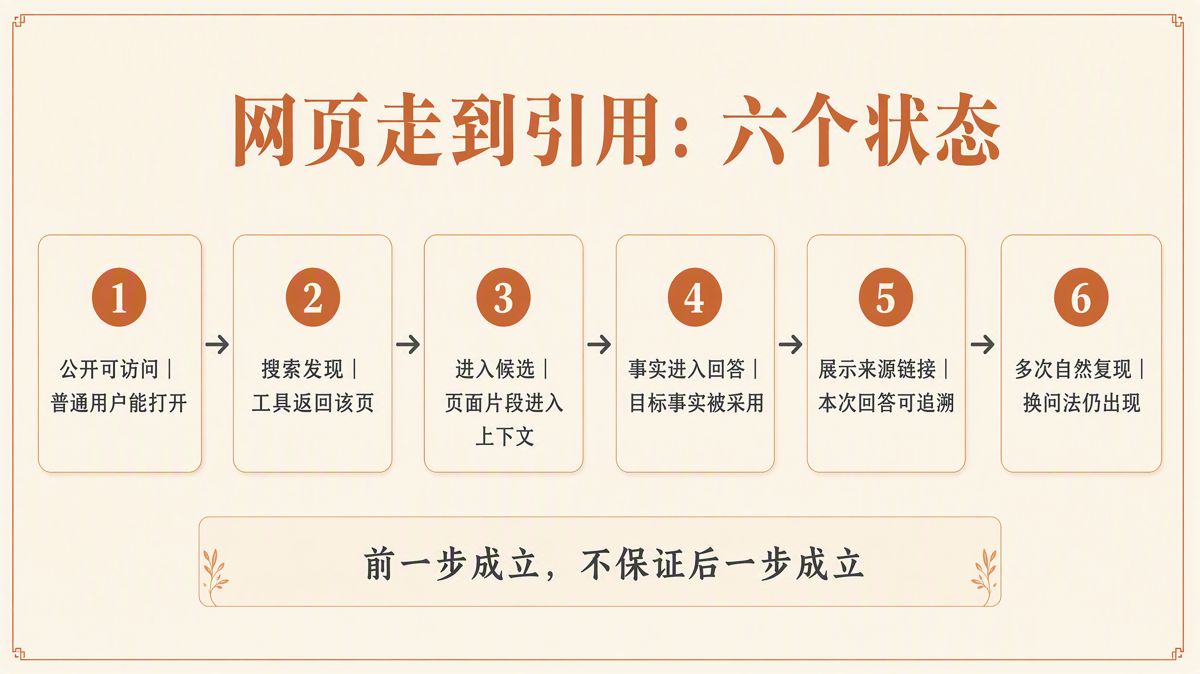
A Webpage Goes Through Six Stages Before Getting Cited
Publishing a public page only proves that the content exists. For a page to become a verifiable citation, it must pass through six distinct stages.
Success at an earlier stage never guarantees progress to the next.
| Stage | What Can Be Verified | What Still Cannot Be Proven |
|---|---|---|
| Publicly Accessible | Users and bots can open the URL | Search engines have discovered the page |
| Search Discovery | A search tool returned the URL in a query | The model will incorporate its text |
| Context Candidate | Excerpts entered the model's prompt | The final answer will display the source |
| Fact Stated in Answer | The target fact appears in the answer | The fact was pulled from this specific page |
| Source Link Displayed | The answer displays a clickable source | The page will be cited for future queries |
| Multi-Query Reproduction | The citation appears across variations | The site holds a permanent ranking weight |
The hardest scenario to evaluate is when an answer contains your exact fact but provides no source link.
The model could have pulled that fact from its pre-training weights, a search snippet, or the user's prompt. Without an explicit search log or a clickable link, you can only log that "the target fact appeared," not that your page was cited.
What Content Deserves Priority?
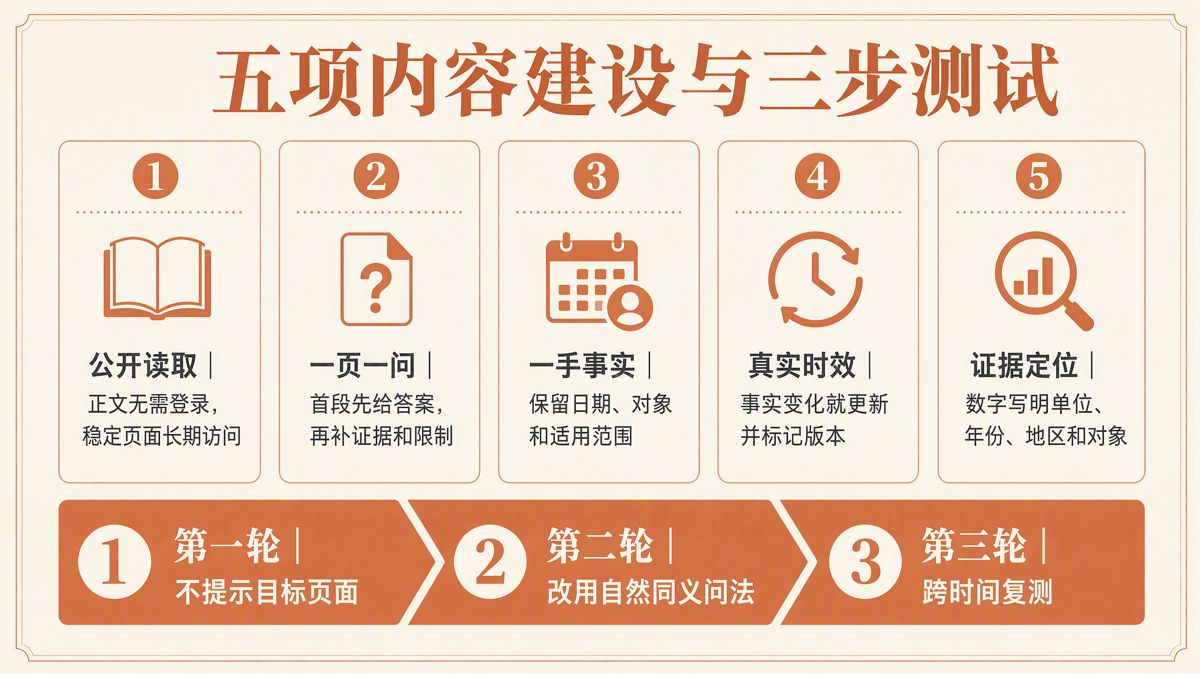
DeepSeek has not published a content-scoring rubric. The following five content engineering practices reduce discovery failures, query mismatches, missing evidence, and stale data in automated retrieval pipelines.
They are not official DeepSeek ranking rules, and they cannot guarantee citation inclusion.
1. Ensure the Page Is Publicly Accessible
Core content should not require a login or complex client-side interactions, and canonical URLs must remain stable. Keep key facts in indexable HTML text; use images and file downloads only as supplementary material.
If your content lives behind private accounts, open search crawlers cannot reliably read it.
2. Answer One Core Question Per Page
State the subject, action, and scope clearly in the page title, introductory paragraph, and subheadings. Deliver the direct answer in the first paragraph, then follow with supporting data and operational limits.
If company history, product catalogs, and press releases are grouped onto a single page, search pipelines struggle to extract isolated facts for specific queries.
3. Publish Primary Source Facts
Product capabilities should be defined by the vendor, policy changes should cite statutory text, data points should link to the original collector, and research should link to formal whitepapers.
When referencing third-party insights, preserve the source URL, release date, sample parameters, and scope. Avoid multi-hop summaries that strip away context.
4. Maintain Accurate Temporal Context
When pricing, policies, leadership, or product specs change, update the text and increment the visible version history. Changing the published date on a page without updating the underlying facts does not count as fresh content.
When documenting historical data, keep the valid time range explicit so the model does not blend legacy terms with current offerings.
5. Make Supporting Evidence Easy to Locate
Place metrics directly next to their units of measurement, recording year, geographic region, and sample size. Position primary reference links directly next to major conclusions.
This makes it easy for human readers to audit the claim and allows marketing teams to confirm whether an AI-generated answer retained the original context and boundaries.
How Should You Structure and Update Pages?
Build a fact repository before updating web copy.
Every entry in your fact repository should track at least six data points: statement, original source URL, publication date, verification date, applicable scope, and risk classification. Discard numbers that lack verifiable sources. If a fact is only partially confirmed, narrow the claim rather than filling the gap with vague adjectives.
Structure the page using an Answer-Evidence-Boundary hierarchy. Every section should address one verifiable proposition: lead with the direct answer, followed by data sources and operating boundaries.
Organize definition, comparison, operational, and risk queries into distinct pages or clearly labeled H2/H3 sections so a single URL is not overloaded with competing search intents.
From a technical standpoint, satisfy standard web discovery criteria first: clean URLs, server-rendered text, clear header tags, internal linking, and accurate modification timestamps. This aligns with standard SEO fundamentals.
In Generative Engine Optimization (GEO), the extra step is verifying whether standalone page facts make it into synthetic answers, and whether source attributions and operational constraints are preserved when cited.
Because DeepSeek has not introduced a webmaster submission console, proprietary indexing protocol, or guaranteed indexing turnaround, you cannot promise an update will appear within a set number of days. Your goal is to maximize accessibility for open-web crawlers, streamline factual verification, and monitor performance using controlled query sets.
How to Run Verifiable Citation Tests
First, separate consumer test logs from API test logs.
For consumer tests, document the platform (web or app), model or mode selected, search indicator status, output text, and cited URLs. For API tests, log request payloads including tools, tool_choice, server-side search events, and raw response metadata. For third-party software, log the underlying retrieval setup and knowledge base parameters.
Second, design a test matrix across four prompt archetypes for every topic: - Definitional ("What is X?") - Comparative ("How does X differ from Y?") - Procedural ("How do you implement X?") - Risk-focused ("What are the constraints or risks of X?")
Run round one without providing URLs to see if the search tool discovers the page organically. In round two, use natural phrasing variations. In round three, re-test across different dates. Queries where URLs or documents were manually pasted into the prompt must be evaluated in a separate cohort; do not mix them with organic discovery tests.
Third, maintain an eight-point verification record for every run: 1. Timestamp 2. Entry point 3. Model version 4. Search tool status (enabled/disabled) 5. Exact prompt string 6. Target fact retrieved 7. Displayed citation URL 8. Full screenshot
For API runs, append the search tool type and event log.
Without this operational baseline, you cannot distinguish between pre-trained output, native web search retrieval, and private RAG matches.
Classify your findings into three validation tiers: - Visible: The target fact appears in the answer for the first time. - Reproducible: The fact and citation persist across varied query phrasing. - Stable: The fact and citation link hold across test intervals and prompt categories.
This is an internal benchmarking methodology, not an official DeepSeek performance tier.
Claims Lacking Official Evidence
"DeepSeek has a fixed preference for specific publishing platforms"
There is no official documentation supporting this claim.
API release notes only mention iterative enhancements to search and agent capabilities; they do not list preferred domains. Seeing a specific site cited repeatedly reflects real-time search engine results for that query, not a hardcoded model bias.
"Long-form content is always cited more easily"
A 1-million-token context window does not support this conclusion.
Context capacity measures how much input data an API model can ingest during inference. Discovering and retrieving public web pages is handled by a separate search pipeline. Large context processing does not mean search crawlers prioritize long articles over concise, well-structured pages.
"If an API query cites a page, the web chat has indexed it too"
This assumption is incorrect.
The Responses API triggers developer-configured or server-side search routines, standard Tool Calls run client-side functions, and third-party tools connect to private indices. Candidate pools vary by entry point and must be audited independently.
"Uploading content to a private knowledge base makes it citeable publicly"
This confuses private RAG retrieval with public indexing.
Private knowledge bases query documents uploaded by authenticated users within an enterprise boundary. Open-web search indexes public pages via web crawlers. Retrieving an answer from an internal document in a third-party app does not mean DeepSeek's consumer chat can access it.
FAQ
1. Which websites does DeepSeek prioritize?
As of August 15, 2026, DeepSeek has not published a domain whitelist, site tiering system, or fixed source hierarchy.
Seeing a website appear across multiple queries is an empirical observation for that query and time window. To establish an actionable pattern, test identical prompts across controlled entry points over time and archive the citation links.
2. Does publishing on major content platforms guarantee citations?
No.
Publishing on a third-party platform merely hosts the text. The URL must still be crawled, match search intent, be selected by the model, and be rendered as a citation in the UI. DeepSeek has issued no single-platform guarantees, nor has it linked distribution channels directly to citation priority.
3. Can corporate websites earn DeepSeek citations?
Yes, provided empirical testing confirms it.
When corporate sites publish verifiable primary data with clean HTML, clear topic boundaries, and accurate timestamps, search agents can extract and verify that information more easily. Whether it appears in an answer depends on whether the query triggers search and whether the engine surfaces the link.
4. Is there a webmaster portal to submit URLs to DeepSeek?
As of our verification date, DeepSeek's official site, API documentation, status page, and open repositories feature no webmaster console, URL submission interface, crawl frequency guide, or indexing timeline.
Third-party services promising guaranteed or rapid indexing do not reflect official DeepSeek capabilities.
5. What is the optimal word count for getting cited?
DeepSeek has not published word-count targets.
The 1-million-token context window refers to how much input data the API model can handle during a call; it is not a quality metric for ranking web pages. Article length should match the depth of the topic. Focus on isolated facts, explicit operational limits, verifiable sources, and up-to-date data.
6. Does a missing source link mean the model didn't use a webpage?
Not necessarily.
When no link is shown, you can only confirm that the UI did not render an attribution path. The answer could stem from pre-training weights, tool outputs, or system prompts. Without a visible search trace, you cannot confirm that the model extracted the fact from a specific URL.
7. If the Responses API cites a page, will the consumer web chat cite it as well?
There is no guarantee.
The Responses API uses server-side web_search, whereas consumer-facing search triggers and candidate indices are not publicly documented. Even when both products run on the same underlying model generation, you must test and verify their search outputs separately.
8. If a third-party knowledge base retrieves my document, is it indexed by DeepSeek?
No.
A third-party knowledge base relies on an external retrieval architecture, document chunking, and permission layers managed by that integrator; DeepSeek only processes the context passed back to it. A match in a private RAG pipeline proves internal retrieval, not public indexation.
9. Do locally deployed models connect to the web automatically?
No. Deploying an open-source model weights package does not grant access to DeepSeek's proprietary consumer search engine.
Search engines, web crawlers, vector databases, and citation rendering must be built and configured by your deployment team. Open-source repositories confirm that the model runs locally, not that it comes bundled with official search indexes or ranking systems. See the DeepSeek-V3 repository.
10. How long does it take to establish stable citations?
DeepSeek has not published an indexing or citation timeline.
Once a page is published, monitor it using a consistent test battery. Track initial appearance, query repeatability, and persistence across multiple weeks. Until you have consistent longitudinal data, an isolated appearance should be logged as a single sighting rather than permanent indexing.
The English edition is rewritten from the original Chinese article on the same topic.

Starbox AI is an AI marketing company based in Hangzhou, China. This article draws on Starbox project work. Please credit the source when quoting.
Related reading
 GEO Guide
Why AI Marketing Vendor Quotes Vary 10x: A 4-Step Vetting Checklist
Evaluate AI marketing proposals by delivery actions, not slide decks. Audit source infrastructure, fact cleaning, and clean-environment testing.
Oct 22, 2026 · 6 min read
 GEO Guide
Spotting GEO Scams: What Actually Drives AI Recommendations?
Automated AI ranking promises violate how LLMs work. Real AI recommendations rely on authoritative, structured facts across trusted public sources.
Oct 22, 2026 · 4 min read
 GEO Guide
How to Measure Your Brand's AI Visibility with a Spreadsheet
You do not need expensive software to track AI recommendations. A three-tier prompt framework and a simple spreadsheet can score your brand visibility in half a day.
Oct 21, 2026 · 6 min read