
What Content Does Kimi Cite?
The short answer
Kimi publishes its screening criteria, not site rankings or citation guarantees. Here is how its search works and how to optimize for it.
What Kimi Has Actually Made Public
Whether your content gets cited by Kimi (the AI assistant developed by Moonshot AI) cannot be determined simply by where it is published. Kimi has officially shared its source screening dimensions and search mechanisms, not a fixed domain ranking list.
Here is what is officially confirmed:
- Kimi marked the launch of its exploratory search in October 2024, combining semantic understanding with real-time retrieval. Its agentic search autonomously decides when to search, which tools to call, and whether to adjust strategies. However, this does not mean every query triggers a search. See the Kimi Agentic Search Overview.
- According to official documentation, web search covers more than 100 verified trusted sources. Every answer grounded in web search includes reference links. Queries that do not trigger search cannot be judged by this rule. See the Kimi Agentic Search Overview.
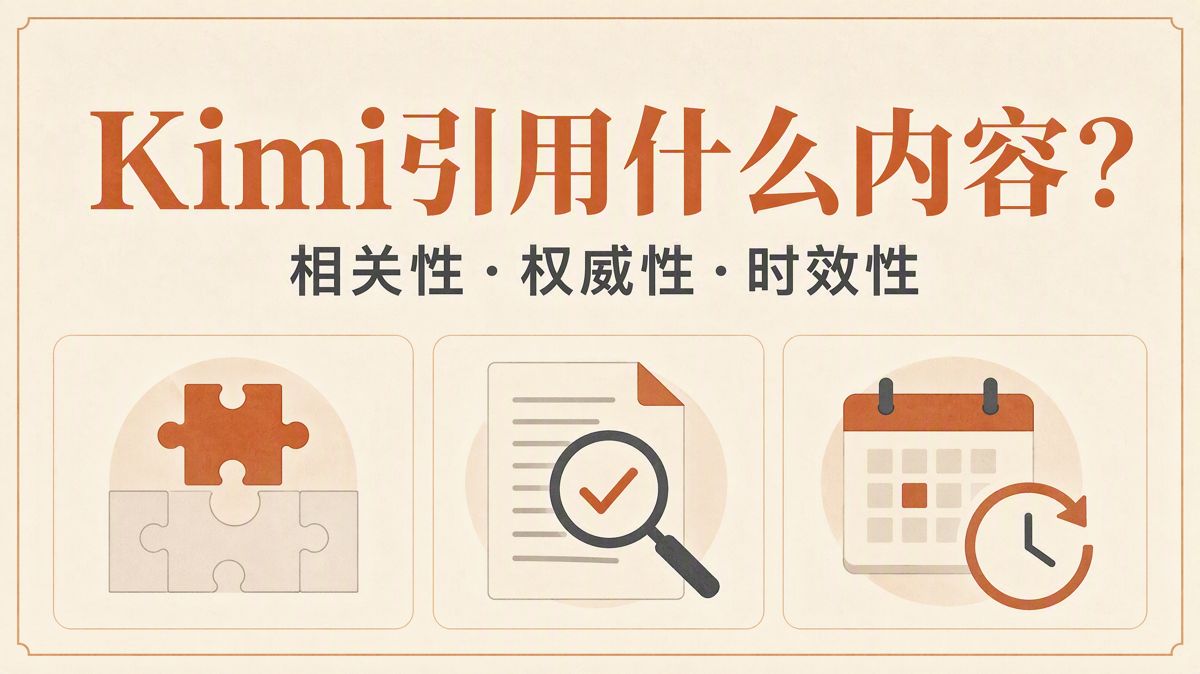
- Kimi explicitly defines three screening dimensions—relevance, authority, and timeliness—and highlights four prioritized source types: government websites, authoritative news media, academic journals, and official financial disclosures. See the Kimi Agentic Search Overview.
- For Kimi Projects, individual files cannot exceed 100 MB, with a limit of 50 files per project, retrieved on demand by the model. A match inside a project only means private documentation entered that specific session's context; it does not mean the material is indexed in public search. See the Kimi Project Feature Guide.
- Web search via the Kimi API follows a four-step sequence: retrieving tool declarations, model-initiated calls, executing the search, and returning results (currently using the Formula pipeline). This developer workflow cannot be treated as a fixed rule for consumer-facing search. See the Kimi API Official Tools Documentation.
- File-based Q&A via the Kimi API also follows four steps: upload, extraction, injecting the extracted body into the context, and running the query. A single user can store up to 1,000 uploaded files. What actually enters the context is the extracted plain text, not the file ID. See the Kimi API File-Based Q&A Documentation.
These facts show that while Kimi has disclosed its content preferences, those preferences focus on content quality and query relevance. No single platform holds an inherent, guaranteed citation advantage.
The Three Official Screening Dimensions
Kimi summarizes its source selection criteria into relevance, authority, and timeliness. It also explicitly filters out low-quality content aggregators, unverified social media accounts, and outdated cached pages, while prioritizing four types of trusted sources. See the Kimi Agentic Search Overview.
These criteria offer clear direction for content creation, but they do not translate into fixed domain authority rankings. Kimi has never published domain weight scores, word-count thresholds, keyword-density targets, crawl frequencies, or baseline citation rates.
Even a page on a government portal can lose ground if its information is outdated. Conversely, primary data published on a corporate website can become the preferred citation if it directly answers the user's question with verifiable dates, methodologies, and original context.
Whether content gets cited depends less on where you post it and more on whether it directly resolves a specific question with fresh, verifiable information.
From Web Page to Displayed Citation: Understanding the Gap
When web search is enabled, Kimi first determines whether the prompt requires real-time information. If it does, it calls search engines or vertical databases to retrieve and synthesize data. Answers based on this retrieval display reference links. See the Kimi Agentic Search Overview.
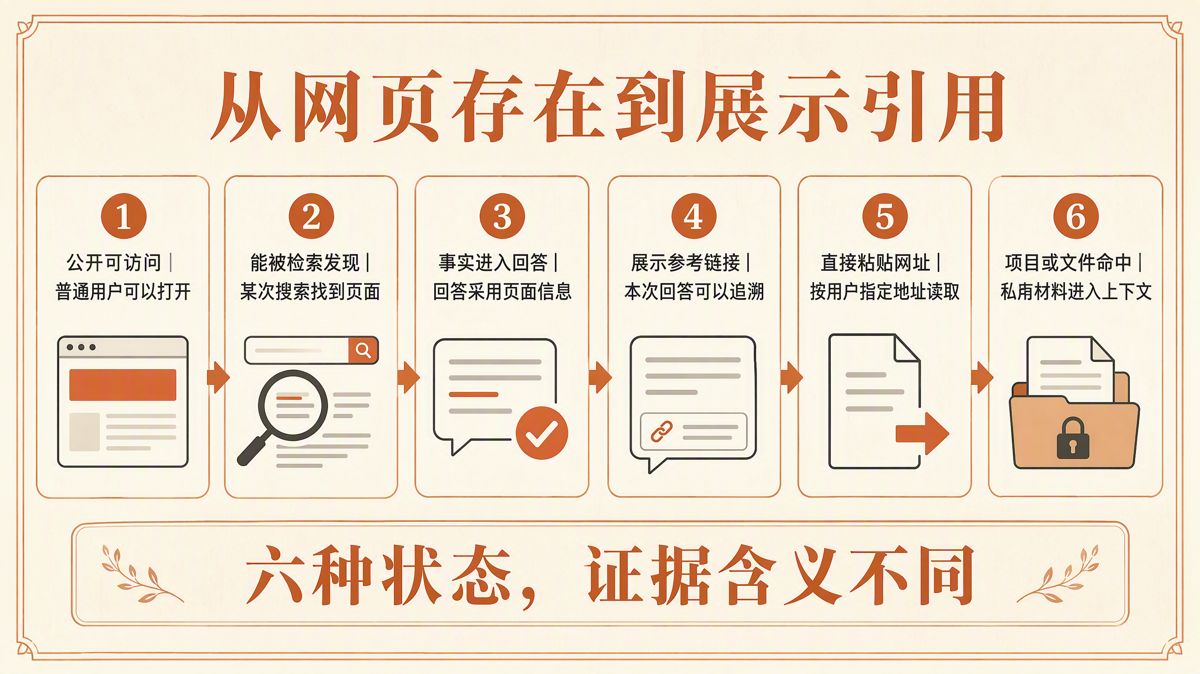
A live web page and a displayed citation link are two completely different states.
| Status | What It Confirms | What It Does Not Confirm |
|---|---|---|
| Publicly accessible | Users can open the URL | The page is in the search candidate pool |
| Retrievable by search | A specific query located the page | The page will be selected for the final answer |
| Facts included in answer | The answer used facts from the page | Future answers will use the same source |
| Reference link displayed | This specific answer cites the URL | The domain has long-term citation priority |
| Direct URL pasted by user | Kimi read a user-provided link | Kimi can find the page via natural search |
| Project or file matched | Private files entered session context | The open web index includes the content |
Pasting a URL directly into Kimi is the most common source of false assumptions. Kimi can visit specific URLs provided by users to summarize articles, read financial filings, or review policy documents. See the Kimi Agentic Search Overview.
This only proves that Kimi can parse a designated page. Because the user supplied the location directly, the model did not need to discover or filter it through search. You cannot use this test to determine whether the page would ever appear in organic AI search results.
What Content Aligns Best with Kimi's Preferences?
1. Relevance: Answer One Specific Question Directly
Each page should focus on resolving a real, well-defined user query. Use clear, standardized entity names and terminology across the title, opening paragraph, and subheadings. Deliver a direct answer first, followed by supporting evidence, applicable boundaries, and exceptions.
This structure reflects Kimi's stated emphasis on relevance, rather than an arbitrary formatting score.
2. Authority: Stick as Close to Primary Sources as Possible
For regulations, quote the official legal text. For product features, cite official technical documentation. For data, point to the original publisher. For research, cite the peer-reviewed paper or formal report.
Syndication can expand reach, but you should never strip out original source attributions, publication dates, measurement methodologies, or target scopes. The easier it is to trace an assertion back to its originator, the easier it is for the engine to verify.
3. Timeliness: Keep Dates Aligned with Real Updates
Policies, pricing, product capabilities, and leadership teams change. Web pages must display publication dates, last-updated timestamps, and applicable version numbers. When reality changes, update the content itself.
Kimi explicitly filters out outdated cached pages. Simply refreshing a timestamp without updating the underlying facts does not solve the timeliness requirement.
4. Verifiability: Make Evidence Easy to Validate
While verifiability is not listed as an independent fourth pillar in Kimi's documentation, search-grounded answers must supply source links. Your page must make checking the original material seamless.
Place units, benchmark years, regions, and sample criteria next to key metrics. Attach source links next to major conclusions. Avoid locking critical data inside uncopyable images or behind mandatory login walls.
How to Optimize Your Pages for Kimi Citations
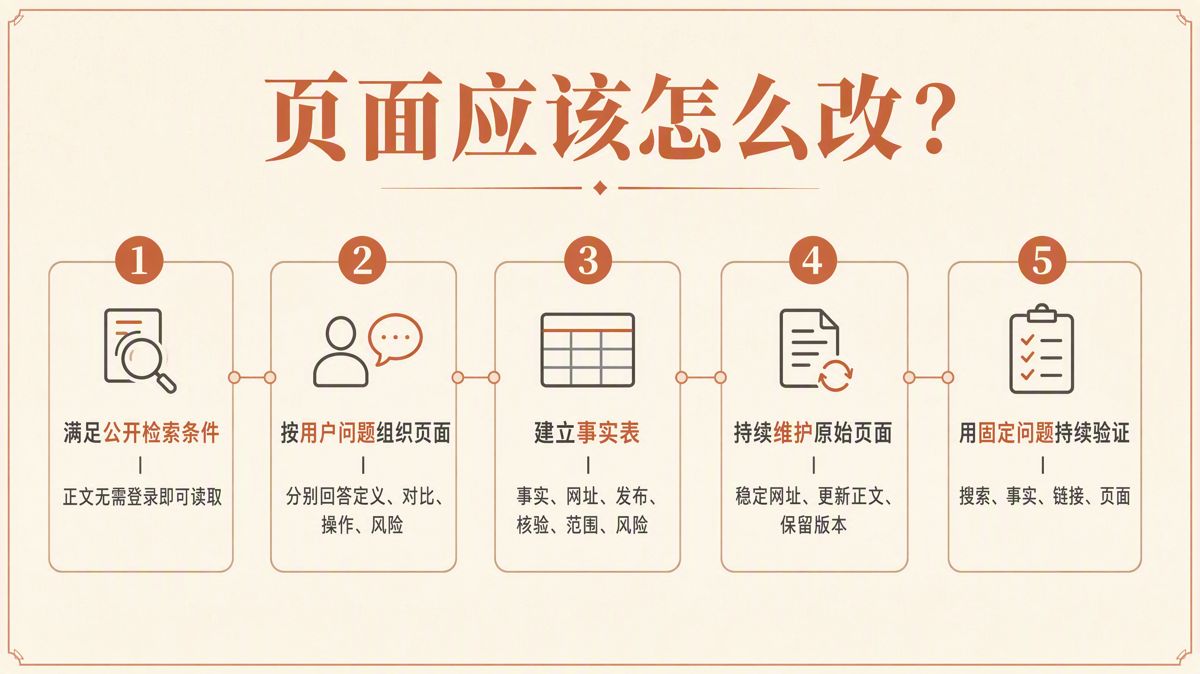
Step 1: Ensure Frictionless Crawling
Make core body text accessible without logins. Keep titles and main content elements stable over time, and ensure key facts exist as plain HTML text.
Kimi does not provide a webmaster submission portal, nor does it publish crawl schedules or indexing SLAs. Any third-party claim that content will be indexed within a guaranteed number of days is unfounded.
Step 2: Organize Content Around User Questions
Instead of burying everything inside an exhaustive, generic company profile, build dedicated pages that address specific definitions, comparisons, workflows, and risk factors.
For instance, when explaining who a service is designed for, clearly detail eligible audiences, prerequisite conditions, disqualifying scenarios, and validation methods, rather than relying on marketing slogans. Concrete details align directly with Kimi's relevance filters.
Step 3: Maintain a Fact Inventory
Track at least six fields for every critical business fact you publish:
- Fact summary
- Original source URL
- Publication date
- Last verification date
- Scope of applicability
- Risk or limitation level
Structure content in a clear sequence: Answer, Evidence, Boundaries. If supporting data is incomplete, narrow your claim rather than filling gaps with unsourced figures.
Step 4: Update Canonical Pages Continuously
When facts change, revise the text on the same permanent URL and maintain version change notes. If you syndicate content across external channels, link back to the canonical source page.
Kimi filters duplicate, syndicated content from identical sources. Maintaining a clear canonical URL reduces the risk of your content being screened out as redundant noise. See the Kimi Agentic Search Overview.
Step 5: Test Regularly with a Fixed Prompt Set
Build a standardized prompt set and test it repeatedly using the same entry point around the same time of day. Document four key signals:
- Did the query trigger a web search?
- Did the target fact appear in the answer?
- Did Kimi provide a reference link?
- Which specific URL did the link point to?
A single citation match only proves that Kimi used the page for that specific query. It does not establish permanent indexing or an ongoing preference.
Distinguishing Long-Context, Project Files, and the API
Kimi can process long context windows and read project files on demand. Current official guidelines cap project files at 100 MB each and 50 files per project, with the files only affecting sessions within that project. See the Kimi Project Feature Guide.
Supplying context directly to a project is entirely different from open web retrieval.
The open API platform represents yet another environment. By default, Kimi models do not directly access the public internet or external databases. Developers must connect official or custom search tools to enable live web retrieval. The API also differs commercially and architecturally from consumer memberships and enterprise web editions. See the Kimi API Product Overview.
The API's official web search tool runs in four steps, and developers can swap in their own search and crawling providers. See the Kimi API Web Search Guide. Because different search tools return different candidate sets to the model, an API integration that cites a web page does not guarantee the consumer app will cite it too.
Similarly, file-based Q&A via API does not equal public web indexing. The workflow uploads and parses a document, then injects its text into the session prompt. See the Kimi API File-Based Q&A Documentation. Getting an internal document cited inside a custom enterprise app proves only that the application used the file you fed it. It does not mean the public Kimi search engine has discovered the document.
When evaluating Kimi citations, always document four variables: the product interface used, the specific model or mode, whether web search was active, and whether the source came from open search, a pasted URL, or an uploaded file.
How to Test Citation Stability
Design at least four types of questions for every key topic:
- Definition queries: Check whether entities and concepts are explained accurately.
- Comparison queries: Check whether prerequisites, limits, and trade-offs remain intact.
- Process queries: Check whether step-by-step procedures are fully represented.
- Risk queries: Check whether caveats and boundary conditions are retained.
Phrase prompts naturally. Do not artificially pack brand keywords into every sentence just to force a match.
Log six data points for every test: date, interface, model/mode, web search status, target facts cited, and reference links returned. If you pasted a URL or uploaded a document, log that separately so it is never confused with autonomous search performance.
Always record the destination URL and full response text alongside screenshots.
Evaluate results across three tiers:
- Visible: The target fact appears for the first time.
- Reproducible: The target fact appears again under rephrased natural prompts, citing the same source URL.
- Relatively Stable: The target fact and reference link persist across different dates and question variations.
These three tiers represent an internal evaluation framework for content teams, not an official scoring rubric from Kimi.
Common Assumptions That Do Not Hold Up
"Publishing on government portals or mainstream news outlets guarantees citations."
Kimi explicitly prioritizes these categories, but it offers no guarantee that any individual page will be cited.
"Longer articles get cited more often."
Kimi's ability to process long context windows does not mean its search algorithms favor higher word counts. There is no evidence of an optimal article length for public search.
"Higher keyword density boosts your domain weight."
Kimi has never published domain authority scores based on keywords. Relevance depends on directly answering the user's question; keyword stuffing cannot replace primary facts and verifiable sources.
"Uploading files to a Project counts as indexing."
This confuses private context with open-web crawling. Their data pipelines, access controls, and validation methods are entirely separate.
"If the API retrieves a page, the consumer version will too."
The API requires developers to configure search tools, which can be swapped out for proprietary retrieval systems. The consumer platform autonomously determines whether to search and which tools to deploy. Even if both return similar answers, candidate sources, ranking logic, and citation displays can differ completely.
FAQ
Which websites does Kimi prefer most?
Kimi publishes source categories and screening criteria rather than specific domain rankings. Government websites, authoritative media, academic journals, and official financial disclosures are prioritized, but selection always depends on relevance, authority, and timeliness.
Can corporate websites get cited by Kimi?
Yes, but there are no guarantees. If a corporate site provides primary facts, is publicly accessible, directly answers the prompt, and clearly states dates and scope, it fits Kimi's screening criteria. Inclusion must still be verified through natural-query testing and reviewing the reference links provided.
Is there an official submission portal for Kimi?
As of August 15, 2026, verified official documentation from Kimi and Moonshot AI provides no webmaster submission portal, crawl schedule, indexing turnaround, or citation SLA. The practical path is making pages publicly accessible, optimizing them for search engines, and tracking real citation results over time.
How long should an article be to get cited?
Kimi has not published an optimal word count. Article length should reflect the complexity of the topic. What matters most is making individual facts easy to check: match headings to user questions, put direct answers in the opening lines, add units and benchmark years to metrics, and state applicable boundaries. Long articles full of filler are less likely to satisfy relevance criteria.
If an answer has no reference links, did Kimi not use web pages?
Kimi states that all search-grounded answers include reference links. If no links appear, the result should not be logged as a search citation. You should verify whether search was triggered, which product interface was used, and the version active at the time. Similar phrasing alone does not prove Kimi retrieved a specific page.
If Kimi summarizes a pasted URL, does that count as a citation?
No. That only proves Kimi can read a targeted URL supplied by a user. Because the system was given the destination, it did not need to discover or evaluate it via search. To test organic citation, open a new session without providing the URL, run a natural query, and verify whether Kimi finds and links to the page on its own.
Does uploading a file or adding it to a Project mean it is indexed publicly?
No. Project files are uploaded by users and read strictly within that project. Similarly, API document Q&A parses files and injects their text into the API request context. These mechanisms confirm only that private material was used in that specific session, not that public search has indexed it.
How long does it take to see stable citations?
Kimi has not published an indexing timeline. Once a page is published, test it against a consistent prompt set over time. Track initial visibility, reproducibility, and longitudinal performance. Without repeated verification across time, a single citation is just an isolated data point, not proof of stable inclusion.
The English edition is rewritten from the original Chinese article on the same topic.

Starbox AI is an AI marketing company based in Hangzhou, China. This article draws on Starbox project work. Please credit the source when quoting.
Related reading
 GEO Guide
Why AI Marketing Vendor Quotes Vary 10x: A 4-Step Vetting Checklist
Evaluate AI marketing proposals by delivery actions, not slide decks. Audit source infrastructure, fact cleaning, and clean-environment testing.
Oct 22, 2026 · 6 min read
 GEO Guide
Spotting GEO Scams: What Actually Drives AI Recommendations?
Automated AI ranking promises violate how LLMs work. Real AI recommendations rely on authoritative, structured facts across trusted public sources.
Oct 22, 2026 · 4 min read
 GEO Guide
How to Measure Your Brand's AI Visibility with a Spreadsheet
You do not need expensive software to track AI recommendations. A three-tier prompt framework and a simple spreadsheet can score your brand visibility in half a day.
Oct 21, 2026 · 6 min read