
What Do China's Top 5 AI Search Engines Prefer to Cite?
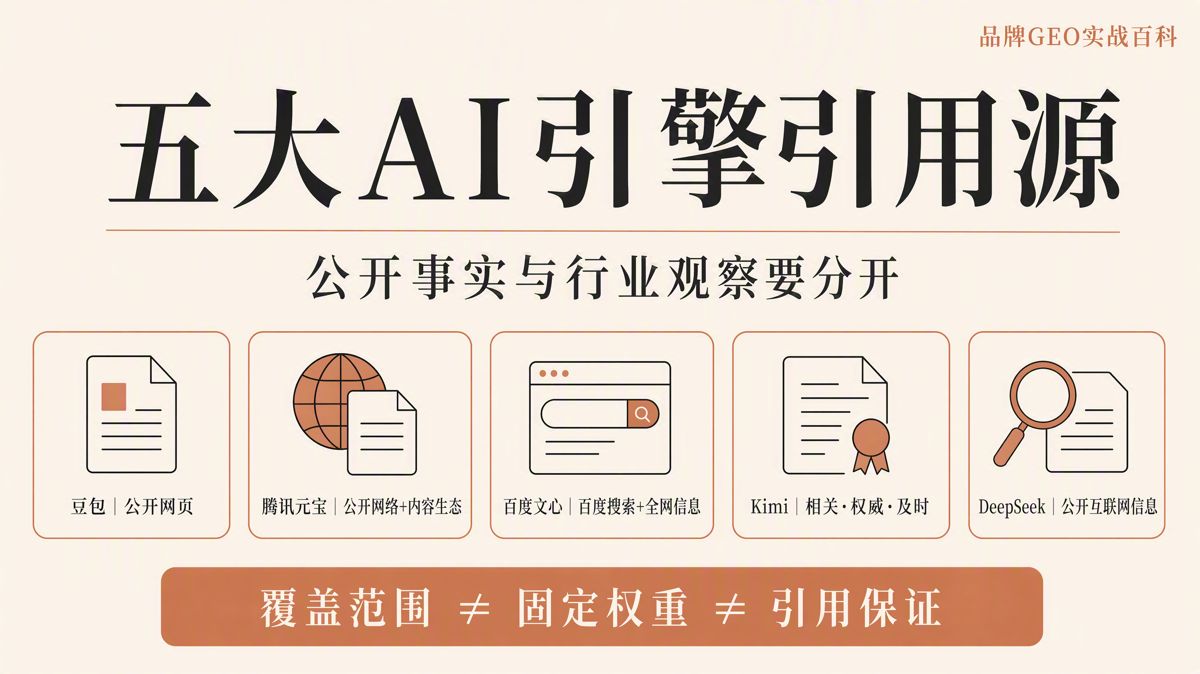
The short answer
Are China's AI engines biased toward their own ecosystems? Here is what official documentation and reproducible tests actually tell us.
"Yuanbao prefers WeChat, ERNIE prefers Baijiahao, Doubao favors Douyin, and DeepSeek relies on Zhihu and CSDN."
You hear these claims constantly in China's Generative Engine Optimization (GEO) circles. GEO refers to the practice of structuring and publishing content so AI engines can easily discover, understand, and cite your brand. But claims about channel bias usually conflate three very different things: officially disclosed index scopes, frequent sources observed in a single snapshot test, and permanent algorithmic weighting.
The first two can be verified. The third cannot be treated as fact without official disclosure or reproducible experimental data.
As of August 14, 2026, Doubao, Tencent Yuanbao, Baidu ERNIE, Kimi, and DeepSeek all support live web search. Yet only Kimi has publicly detailed its source evaluation criteria. None of the official documentation proves that simply posting on a specific channel guarantees AI citations.
Why Study These Five AI Engines?
We look at these five platforms to examine different public search architectures and content ecosystems, not to rank them against each other:
- Doubao (ByteDance's AI assistant), Tencent Yuanbao (Tencent's AI assistant), and Baidu ERNIE (Baidu's AI search platform) represent the three major Chinese tech ecosystems: ByteDance, Tencent, and Baidu.
- Kimi (Moonshot AI's assistant) has published the clearest technical criteria for source filtering.
- DeepSeek discloses that it searches the open web, offering a clear baseline for open-retrieval AI.
Other tools like Alibaba's Tongyi, Quark, and Metaso are omitted purely for brevity. When auditing your brand's AI presence, choose the platforms your actual buyers use and calibrate your test list regularly.
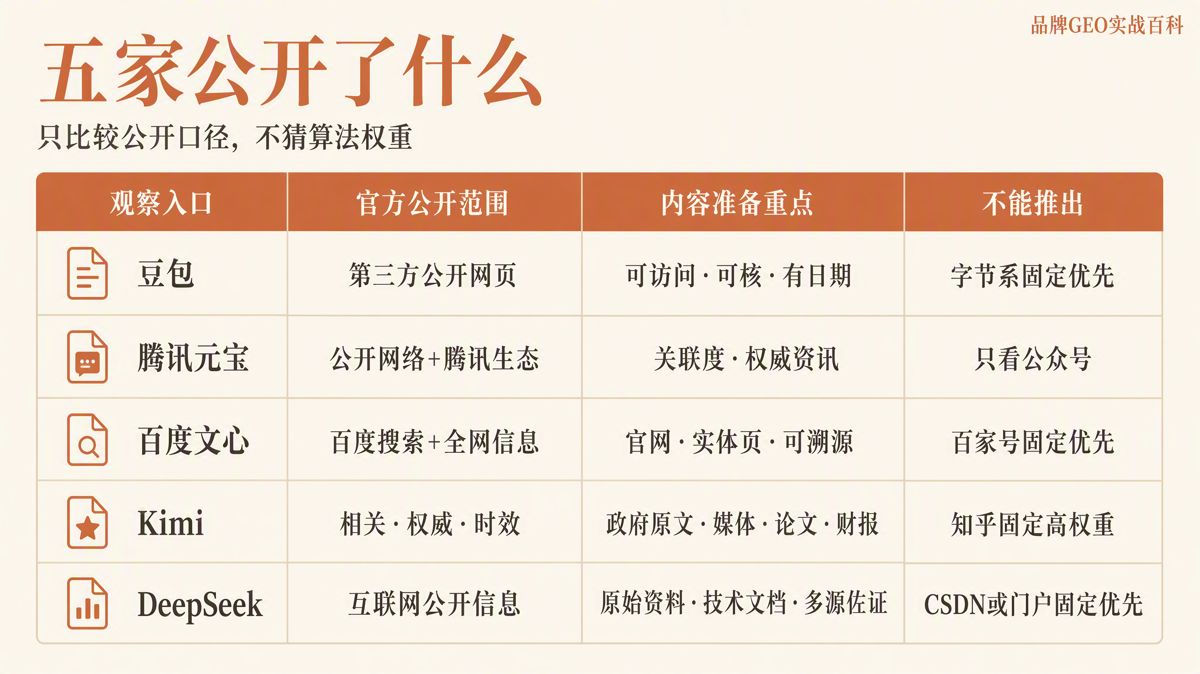
Separate Claims into Three Levels of Evidence
Before assuming an AI engine has a platform bias, separate your findings into three distinct categories:
| Level of Evidence | What It Answers | How to State It | What Not to Claim |
|---|---|---|---|
| Official Disclosures | Web access, index scope, citation display | "The official documentation states it crawls public web pages." | "The platform gives permanent high algorithmic weight to Site X." |
| Empirical Observations | Which sources appeared frequently in a specific test | "In this benchmark run, Source Y appeared with high frequency." | "The platform permanently prefers Source Y." |
| Algorithmic Weight | Whether a source enjoys an architectural ranking boost | Only state this with official disclosure or reproducible test data. | "A few screenshots prove how the algorithm ranks sources." |
Standard chat, live web search, and deep research modes often process sources differently. User accounts, geographic location, prompt wording, and test timing can also alter citations.
Seeing a WeChat Official Account in an answer does not mean WeChat enjoys an algorithmic boost. Conversely, failing to see your official website cited once does not mean it was permanently excluded from the retrieval pool.
Any benchmark report must record the test date, user account status, test location, search mode, and toggles used. Otherwise, comparing results is meaningless.
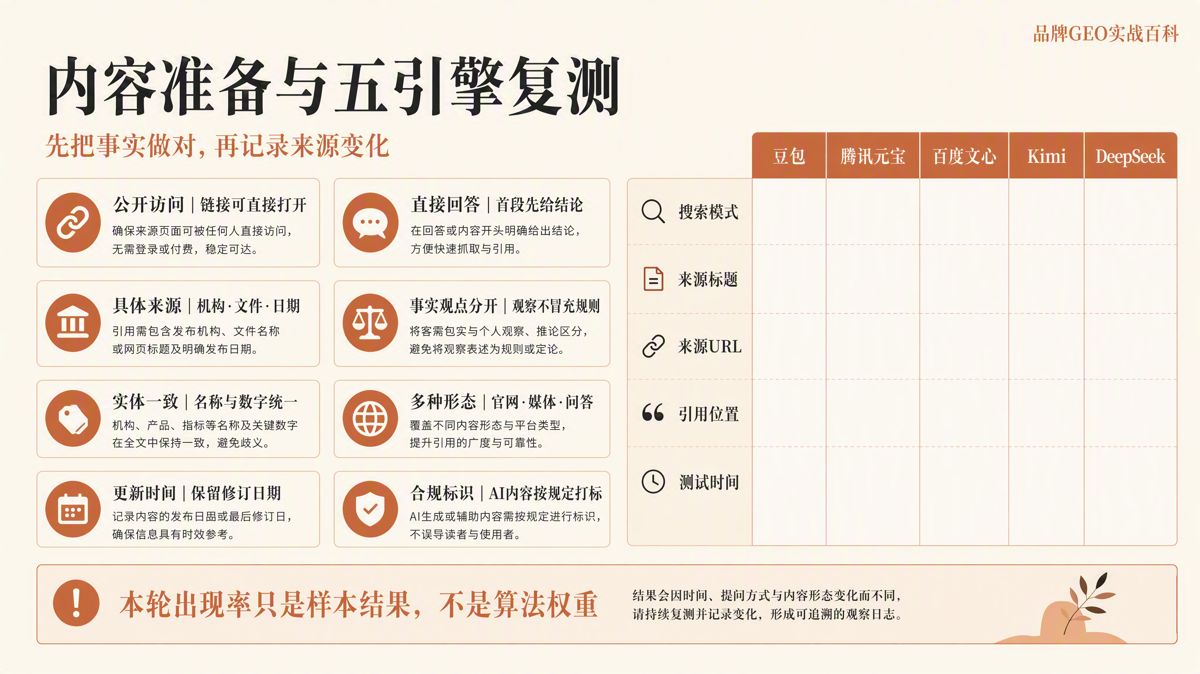
What Each AI Engine Officially Discloses
Doubao: Open Web Retrieval Confirmed, No Disclosed Bias for ByteDance Ecosystem
The Doubao User Agreement states that when the system detects search intent or the user selects AI search, it retrieves public information from third-party web pages and displays citation sources above the answer. Source: Doubao User Agreement, effective June 1, 2026
The agreement explicitly notes that displaying a citation does not mean the platform endorses its factual accuracy. Doubao has never publicly stated that Douyin (TikTok's Chinese sister platform), Toutiao (ByteDance's news app), or Baike (ByteDance's encyclopedia) receive fixed algorithmic priority.
To optimize for Doubao, ensure your web pages are publicly accessible without login walls. Use descriptive headings, answer the core query directly in the opening paragraph, date all metrics, and make sure every claim traces back to primary source documentation. After publishing, check that citation URLs resolve cleanly.
Testing ByteDance-owned channels is a sensible operational tactic, but claiming that publishing in ByteDance's ecosystem guarantees priority citation is unfounded.
Tencent Yuanbao: Covers Tencent Channels, but Far Beyond WeChat
Tencent Cloud's Web Search API documentation states that its retrieval engine builds on public internet resources while integrating the Tencent content ecosystem. Listed ecosystem resources include Tencent News, Sogou Baike (Tencent's Sogou Encyclopedia), and Qiehao (Penguin Accounts, Tencent's media platform), but no fixed weighting is mentioned for WeChat Official Accounts or any single property. Source: Tencent Cloud Web Search API Product Page
The head of Tencent Hunyuan noted in an interview that Yuanbao covers Tencent ecosystem information like WeChat Official Accounts alongside Sogou and Tencent News, selecting content primarily based on relevance to the user's intent. Source: Tencent Hunyuan Executive Interview
Do not confuse the consumer-facing Yuanbao app with the enterprise Tencent Cloud Web Search API. Tencent Cloud's official FAQ states that its API does not currently support WeChat Official Account content due to copyright considerations. Source: Tencent Cloud Web Search API FAQ
This proves that even within the same parent company, different products operate under different retrieval scopes. WeChat Official Accounts are worth testing, but they are not the sole channel, and publishing there does not guarantee citation.
Baidu ERNIE: Covers Baidu Ecosystem, but Does Not Solely Favor Baijiahao
Baidu AI Search documentation explains that it builds on Baidu's core search engine, indexing government portals, official brand websites, user-generated web content, and Baidu Baike (Baidu Encyclopedia). Search responses can return the source site name, page title, URL, and raw text snippets. Source: Baidu AI Cloud AI Search Product Page
While this confirms search scope and source tracing capabilities, it does not prove that Baidu ecosystem pages take precedence over the open web. Baidu has never published rules giving Baijiahao (Baidu's content platform) or Baidu Baike permanent ranking weight.
In practice, use Baidu Baike to establish baseline entity facts (company name, founding date, registered business scope), use Baijiahao for distribution within Baidu's feed ecosystem, and use your official website as the primary repository of authoritative records. Each asset serves a different purpose. Track empirical frequency in tests, but do not mistake frequent citations for an official algorithmic guarantee.
Kimi: Explicitly Discloses Relevance, Authority, and Timeliness
Kimi's official help documentation states three explicit source selection criteria: relevance, authority, and timeliness.
According to the documentation, Kimi's agentic search queries search engines and vertical databases, appending reference links to answers. It actively filters out low-quality content farms, unverified self-media accounts, and stale cache files, prioritizing government portals, authoritative news media, peer-reviewed academic journals, and official financial reports. Source: Kimi Agentic Search Overview
"Prioritizing" does not mean every query pulls from these elite sources, nor does it justify market claims like "70% of citations are user-generated content" or "Zhihu has fixed priority."
For policy, financial, technical, and corporate facts, anchor your content directly to official filings, white papers, and your primary website. User-generated content (UGC) provides conversational phrasing and user experience context, but cannot replace primary source evidence.
DeepSeek: Confirms Public Web Indexing, Discloses No Domain-Level Weights
DeepSeek's User Agreement only specifies that when web access is enabled, the system retrieves publicly available internet information before generating a response. Source: DeepSeek Terms of Use, effective September 5, 2025
DeepSeek has not disclosed any preferential weighting for Zhihu (China's largest Q&A platform), CSDN (China's leading developer community), or mainstream news portals. Nor does it promise uniform citation interfaces across all entry points.
If an independent test reveals frequent citations from specific developer forums, it simply means those URLs satisfied the retrieval model for those specific queries, user settings, and timeframes.
For technical B2B topics, publish documentation across official developer docs, open-source repositories, developer forums, and your website. For commercial topics, balance your website with industry trade publications and Q&A platforms. Validate your reach with continuous, controlled testing.
Summary of Official Positions
| Platform | Confirmed Retrieval Scope | Content Strategy Focus | Claims to Avoid |
|---|---|---|---|
| Doubao | Public third-party web pages; displays citation sources. | Open, indexable pages; clear headers; verifiable facts; explicit dates. | ByteDance properties (Douyin/Toutiao) receive automatic priority. |
| Tencent Yuanbao | Open web plus Tencent ecosystem; matches on intent relevance. | Maintain authoritative website pages alongside Tencent ecosystem syndication. | Exclusively checks WeChat, or WeChat always ranks first. |
| Baidu ERNIE | Government sites, corporate sites, open web, Baidu Baike. | Searchable corporate domains, encyclopedia entity entries, Baidu syndication. | Baijiahao is permanently hardcoded as the primary source. |
| Kimi | Evaluates relevance, authority, timeliness; appends links. | Government sources, tier-one media, papers, financial reports, official sites. | Zhihu or UGC platforms occupy a fixed citation quota. |
| DeepSeek | Retrieves publicly accessible internet information when web search is enabled. | Public web pages, primary technical documentation, cross-verified sources. | Zhihu, CSDN, or news portals receive structural priority. |
Use this comparison to structure your editorial workflow. Do not use it to promise that posting an article on Platform X will automatically trigger AI citations.
What Makes Content Discoverable by AI Engines?
While these five engines do not share a single public algorithm, they share consistent information retrieval principles. Follow these seven operational guidelines:
1. Keep Content Open and Accessible
Host critical facts on public URLs that do not require logins or heavy dynamic scripts. Avoid locking core information inside image banners or downloadable posters without accompanying live text. If an engine cannot crawl the text directly, it cannot index the information.
2. Answer the Core Question in the First Paragraph
For regulatory topics, lead with the publication date, issuing body, and scope. For comparative queries, state the core differentiators immediately. Under every heading, provide a complete, direct summary sentence before unpacking nuances and constraints.
3. Attribute Every Claim to a Primary Document
Cite specific organizations, document titles, release dates, clauses, or page numbers, accompanied by stable source links. Avoid vague phrases like "according to public reports." Trace claims back to original policies, financial filings, academic papers, or official release notes.
4. Separate Facts from Observations
Clearly distinguish between officially documented features and empirical benchmark results. When sources report conflicting numbers, clarify the testing dates, sample sizes, and metric definitions instead of glossing over discrepancies.
5. Keep Corporate Entity Facts Consistent
Maintain identical records across your official website, corporate encyclopedias, and press materials for your legal name, founding year, core offerings, and product naming conventions. Conflicting numbers across channels weaken entity recognition. Correct legacy errors publicly.
6. Diversify Distribution Around a Single Fact Sheet
Your official domain houses the canonical record; media outlets provide third-party validation; Q&A platforms answer conversational queries; and platform feeds manage ecosystem distribution. Channels like WeChat, Baijiahao, Douyin, and Zhihu can adapt tone and style, but they should all anchor back to the same verified source material.
7. Date Everything and Update Outdated Material
State the publication date and last updated date on every reference page. Phrases like "recently" or "currently" must be tied to a specific calendar month and year. When past product specs or regulatory conclusions change, update the page and include a visible revision note.
How to Audit AI Citations in Your Industry
Do not rely on benchmarks run in unrelated industries. Run clean, controlled tests across your own category:
- Build a Real-World Query Set: Collect actual questions from sales conversations, customer support tickets, and organic search logs. Include definitions, vendor comparisons, technical specs, pricing models, implementation risks, case studies, and compliance questions.
- Standardize Test Parameters: Query all five engines on the exact same day. Log the account type, IP location, timestamp, search mode, and functional toggles. Never mix standard chat, live web search, and deep research modes into the same analysis row.
- Capture Comprehensive Trace Data: Repeat each query multiple times. Save the generated text, citation titles, target URLs, root domains, and in-text citation placements. Flag answers that produce no citations separately—never guess where a model pulled an unreferenced claim.
- Categorize Source Types Without Bias: Group citation domains into neutral categories: government/industry associations, corporate domains, mainstream press, platform self-media, technical communities, and open UGC.
- Calculate Citation Share: Divide the number of citations from a specific source category by the total number of cited sources in that test set. This metric measures your current benchmark snapshot, not an immutable algorithm rule.
- Re-Test After Publishing: When you update or release new collateral, re-run the benchmark under identical conditions. Track newly cited URLs, lost citations, and answers that skipped search. Only controlled conditions make performance shifts actionable.
Frequently Asked Questions
1. Are official company websites still relevant for AI search in China?
Yes. All five engines index the public open web. Your corporate website should clearly state your legal entity name, product definitions, technical parameters, compliance certifications, and revision dates. It serves as the primary canonical source that other platforms and citation links point back to.
2. Does publishing on a WeChat Official Account guarantee citations in Yuanbao?
No. Yuanbao searches the broader open web in addition to Tencent's content ecosystem, and its product leadership stresses query relevance. Testing WeChat is a standard best practice, but ecosystem coverage does not equal an automatic algorithmic boost.
3. Should a brand prioritize Baidu Baike or Baijiahao?
You need both, along with your official site. Baidu Baike anchors verifiable entity facts (founding dates, legal registrations), Baijiahao handles distribution across Baidu's content feed, and your official domain stores primary technical and product documentation. They fulfill different functions in the search supply chain.
4. Why do benchmark tests cite Zhihu and CSDN so often?
Platforms like Zhihu and CSDN rank well because their community threads match the exact conversational queries users type into search engines. However, neither Kimi nor DeepSeek has disclosed a permanent algorithmic quota for either community. Citation distribution shifts depending on the industry, query phrasing, mode, and timing.
5. Can a single piece of content serve all five AI engines?
Use one canonical fact sheet, but do not post identical copy everywhere. Keep core metrics, definitions, and source links uniform, but adapt your editorial presentation to match how users search on each specific platform. Always benchmark performance across the five engines independently.
6. Will AI engines cite AI-generated content?
AI search engines cite content based on crawlability, relevance, and factual authority, not on whether a human or an AI wrote the draft.
However, content creators in China must comply with disclosure laws. China's Measures for the Labeling of AI-Generated Synthetic Content and mandatory national standard GB 45438—2025 took effect on September 1, 2025, governing both explicit and implicit content labeling. Source: Ministry of Industry and Information Technology
7. Is tracking brand mentions enough when benchmarking AI search?
No. You need to record whether your brand appears in the body copy, whether the response provides clickable source links, whether the facts are accurate, and whether the same citations appear across multiple engines. Tracking brand mentions alone fails to distinguish between parametric model memory and live web retrieval.
8. Which AI engine should our team optimize for first?
Start with the platform your enterprise buyers actually consult and where your current category coverage shows the widest factual gaps. Establish a clean benchmark using real-world customer prompts before allocating optimization resources.
The Bottom Line
There is no officially confirmed "platform preference list" for China's major AI engines.
Public documentation confirms retrieval reach and citation display formats. Frequent sources within an industry can only be verified through controlled, snapshot testing. Permanent algorithmic weights should never be assumed based on a handful of screenshots or anecdotal claims.
Before incorporating any channel advice into your execution roadmap, verify three things: Is there official product documentation? Can the test conditions be reproduced? Can the results be updated regularly? If any of these are missing, treat the claim as an empirical observation, not an algorithmic rule.
Build your GEO operations on clear fundamentals: ensure your facts are accurate, keep your pages indexable, cite primary sources, and run continuous, controlled benchmarks across every platform that matters to your business.
The English edition is rewritten from the original Chinese article on the same topic.

Starbox AI is an AI marketing company based in Hangzhou, China. This article draws on Starbox project work. Please credit the source when quoting.
Related reading
 GEO Guide
Why AI Marketing Vendor Quotes Vary 10x: A 4-Step Vetting Checklist
Evaluate AI marketing proposals by delivery actions, not slide decks. Audit source infrastructure, fact cleaning, and clean-environment testing.
Oct 22, 2026 · 6 min read
 GEO Guide
Spotting GEO Scams: What Actually Drives AI Recommendations?
Automated AI ranking promises violate how LLMs work. Real AI recommendations rely on authoritative, structured facts across trusted public sources.
Oct 22, 2026 · 4 min read
 GEO Guide
How to Measure Your Brand's AI Visibility with a Spreadsheet
You do not need expensive software to track AI recommendations. A three-tier prompt framework and a simple spreadsheet can score your brand visibility in half a day.
Oct 21, 2026 · 6 min read