
How to Build an International GEO Testing Matrix

The short answer
A reliable GEO testing matrix runs 30 prompts across 5 AI engines 3 times to produce 450 verified observations across four core visibility metrics.
Generative Engine Optimization (GEO) focuses on whether your brand and content appear in AI-generated answers, vendor shortlists, and citations. The most common mistake teams make when testing overseas AI engines is asking five platforms a single question, taking a few screenshots, and assuming they understand their brand visibility.
A single response only shows how one AI engine answered a specific prompt at one moment, from one user account, in one operational mode. It does not prove that your brand is consistently mentioned or that your domain will be cited repeatedly.
A reliable testing matrix combines standardized prompts, specific AI access points, and repeated test runs into an experiment you can reproduce and compare over time. A prompt is the exact query submitted to the AI; an access point is the specific AI product or search-enabled interface; a shortlist is an explicit vendor or brand recommendation in the response; and a source domain is the root domain of a cited link.
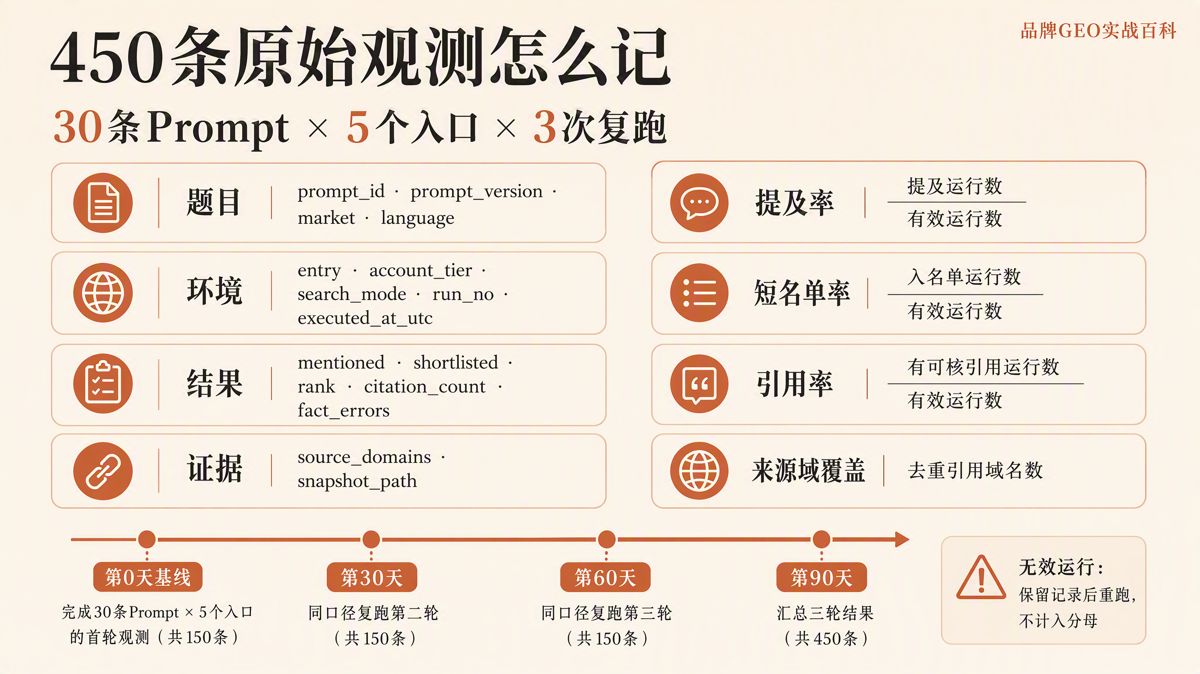
A practical starting baseline uses 30 prompts tested across 5 international AI engines, with each prompt executed independently 3 times. This produces 450 raw observations. Every response counts as one observation, providing the statistical foundation to calculate mention rates, shortlist rates, citation rates, and source domain coverage.
Lock In the Testing Protocol First
Before launching the initial test cycle, document these six rules in your testing protocol:
- Use 30 prompts across 5 international AI access points, running each prompt independently 3 times to produce 450 raw observations.
- Record every individual run as a separate row across at least 16 data fields, while saving full answer text and screenshots in an external archive.
- Official 2026 documentation shows that major AI engines handle web search toggles, citation panels, and query rewrites differently. Confirm web search is active and citations are viewable before recording data.
- Track four core outcomes: whether the target brand is mentioned, whether it is shortlisted, whether a verifiable citation appears, and which domains provide those citations.
- Treat every response as a single observation. Prompts require at least 3 independent runs to distinguish one-off hallucinations from repeatable visibility patterns.
- Traditional SEO (Search Engine Optimization) and GEO rely on the same foundation of crawlable, indexable, factually consistent content. However, they measure different outcomes: SEO tracks page rankings, impressions, and clicks, whereas GEO measures mentions, shortlists, and citations in generative responses.
Once finalized, do not change prompt wording, swap user accounts, turn off web search, or switch competitor benchmarks during an active run. Changing conditions mid-cycle invalidates historical comparisons.
Step 1: Fix Your Test Variables
Before drafting prompts, define five variable groups in a shared reference sheet:
- Brand entity (the specific company or brand under evaluation)
- Product category
- Target market
- Procurement scenario
- Operational constraints
Record official legal entities, public brand names, and regional product names in your variable table. All 30 prompts must pull values exclusively from this sheet; testers cannot improvise alternative phrasing during execution.
Prepare at least three naming variations for the target company: the full legal name, the primary public English brand name, and the core product or category name. These address three distinct questions:
- Does the AI recognize the company entity?
- Does the AI associate the company with its specific category?
- Does the AI recommend the company during buying scenarios?
Define target markets by specific countries or language regions. Labeling a market vaguely as "overseas" conflates differing local languages, compliance rules, and supply constraints. Start with one primary market and one language to establish your baseline before scaling across other regions.
Assign every prompt a version number. If you modify word order, budget limits, year parameters, currency, or certification requirements, increment the version number while archiving the original. Preserving the exact query text is the only way to determine whether a change in visibility stems from your content optimization or the prompt rewrite.
Step 2: Divide 30 Prompts into Six Functional Groups
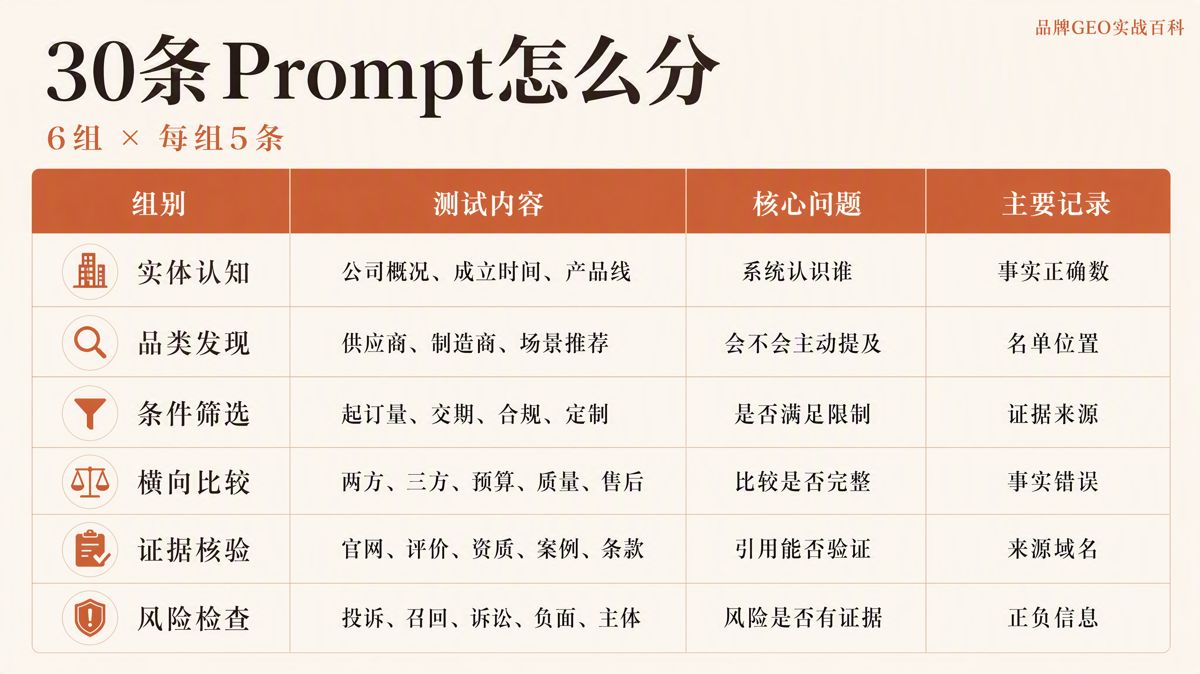
Organize your 30 prompts into 6 groups of 5 prompts each: Entity Awareness, Category Discovery, Constraint Screening, Direct Comparison, Evidence Verification, and Risk Assessment.
| Group | Evaluation Focus | English Prompt Template | Primary Tracking Fields |
|---|---|---|---|
| Entity Awareness | Corporate overview, founding date, leadership, product lines, service regions | What do you know about [company legal name]? |
Factual accuracy, source links |
| Category Discovery | Supplier lists, manufacturers, scenario recommendations, regional picks, alternatives | Recommend suppliers for [category] in [market]. |
Brand mention (yes/no), list position |
| Constraint Screening | Minimum order quantity (MOQ), lead times, compliance standards, custom capabilities, delivery regions | Recommend vendors that meet [constraint]. |
Constraint matching, evidence sources |
| Direct Comparison | 2-way comparisons, 3-way comparisons, budget, build quality, post-sale support | Compare [company A], [company B] and [company C]. |
Inclusion status, comparison criteria, factual errors |
| Evidence Verification | Official website claims, third-party reviews, certifications, case studies, terms of service | Which sources support claims about [company]? |
Citation volume, cited domains |
| Risk Assessment | Complaints, recalls, litigation, negative sentiment, corporate legitimacy | Are there verifiable risks associated with [company]? |
Sentiment polarity, verifiable evidence |
Each group serves a distinct operational purpose.
Entity Awareness checks basic retrieval and recognition. Category Discovery tests whether the engine surfaces your brand without direct user prompting. Constraint Screening and Direct Comparison evaluate whether your brand survives realistic commercial filtering. Evidence Verification and Risk Assessment confirm whether external claims can be traced to verifiable source material.
Ensure all quantities, regions, and constraints match real-world procurement requirements. Never test compliance claims, delivery speeds, or case studies that do not exist publicly on the web. Otherwise, you cannot tell whether the engine failed to retrieve the information or if the data simply did not exist.
For Direct Comparison prompts, lock in a fixed set of three competitor benchmarks and record the rationale for their selection. Do not switch competitors across test cycles. If you want to evaluate additional competitors, create new prompt versions while preserving the original baseline.
For Risk Assessment prompts, distinguish between verifiable risks backed by active, accessible links and AI-generated assertions unsupported by functional sources. Unsubstantiated claims cannot be logged as verified facts. Similarly, a clean result with zero negative mentions does not prove that operational risks do not exist.
Step 3: Standardize Operating Conditions Across Five Engines
Different generative engines handle web retrieval, source panels, and query rewrites in distinct ways. In this guide, they are labeled Engine A through E; in your internal testing sheets, record the exact commercial product and subscription tier.
| Engine | Documented Search and Source Behavior | Pre-Run Verification |
|---|---|---|
| Engine A | May trigger web search automatically or require manual search mode; citations display inline or in a side drawer | Ensure web search is explicitly enabled; archive source panel |
| Engine B | Executes real-time web search; displays citations with direct URLs | Confirm cited links resolve; record search parameters |
| Engine C | Answers may surface inline citations or source buttons, but display varies by query | Record when source buttons do not appear; do not default to zero citations |
| Engine D | Requires web search mode; provides direct inline citations when browsing is active | Verify search mode is active to prevent fallback to internal weights |
| Engine E | Rewrites prompts into shorter web queries; shows search terms and sources in a dedicated panel | Record both rewritten queries and source lists |
A citation panel is the dedicated interface element where an engine consolidates source links. Query rewriting is the engine's internal process of converting a long prompt into shorter keyword searches.
This table reflects documented technical behavior rather than algorithmic preference. Frequent citations from a specific domain during a test run represent sample data, not definitive proof of platform bias.
Submit identical prompt text across all five engines using English or the target market's primary language. Run the engines within a tight time window, logging timestamps in both local time and UTC (Coordinated Universal Time). Consistent timekeeping prevents routine news updates, pricing adjustments, or site changes from muddying comparative runs across time zones.
If a run fails due to search errors, network timeouts, session expirations, or missing citation drawers, mark that row as an "Invalid Run." Never delete failed entries, and do not log a failed run as an unmentioned brand outcome. Rerun the query under identical test conditions.
Why Every Prompt Needs Three Independent Runs
Executing a prompt once does not prove result stability. A brand may appear in an AI shortlist during one run and vanish during the next; a cited link might reflect a transient search index rather than an authoritative source.
The core unit of observation is:
Prompt × Engine × Run Number
Running 30 prompts across 5 engines 3 times yields:
30 × 5 × 3 = 450 raw observations
These 450 observations form the baseline for all aggregate metrics. A single screenshot showing your brand is an anecdote, not evidence of consistent visibility.
Always open a fresh conversation thread for each run. Never ask follow-up questions within an existing session. Conversational context causes the AI to inherit prior vendor lists, conversational tone, and assumptions, violating testing isolation.
Record the execution timestamp, language, target region, account tier, and search mode for every run. Free, paid, and enterprise accounts often differ in model routing, retrieval limits, and citation interfaces, making account tier a mandatory field.
Record at Least 16 Fields per Run
A standardized logging sheet requires these 16 fields:
| Field Name | Description |
|---|---|
prompt_id |
Unique prompt identifier |
prompt_version |
Prompt version number |
market |
Target country or region |
language |
Testing language |
entry |
AI platform or engine tested |
account_tier |
Subscription or access level |
search_mode |
Active search or browsing configuration |
run_no |
Run iteration (1, 2, or 3) |
executed_at_utc |
Execution timestamp in UTC |
mentioned |
Target entity mentioned (1 or 0) |
shortlisted |
Target entity included in explicit shortlist (1 or 0) |
rank |
Position in shortlist (if applicable) |
citation_count |
Number of functional, verifiable citations |
source_domains |
Deduplicated cited root domains |
fact_errors |
Confirmed factual inaccuracies |
snapshot_path |
File path to full answer text and screenshot |
These fields fall into three operational buckets:
- Prompt Identity:
prompt_id,prompt_version - Test Environment:
market,language,entry,account_tier,search_mode,run_no,executed_at_utc - Test Outcome:
mentioned,shortlisted,rank,citation_count,source_domains,fact_errors,snapshot_path
Enforce clear logging definitions across several easily confused fields:
mentioned: Enter 1 if the target brand appears anywhere in the response; otherwise 0. Multiple mentions within one response still equal 1.shortlisted: Enter 1 only if the entity appears in an explicit vendor shortlist or recommendation table. A passing reference in body copy equals 0.rank: Record the numerical display position in the recommendation list. Leave blank if the engine provides an unranked list; do not assign arbitrary ranks.citation_count: Track total functional links and distinguish between external third-party citations and your owned digital properties. A link that resolves confirms page existence, but you must still verify whether the page content supports the engine's statement.source_domains: Record deduplicated root domains. Five distinct links from the same domain count as 1 source domain.fact_errors: Check claims against a pre-verified corporate fact sheet. Track errors across founding dates, corporate entities, product categories, operating regions, and certification statuses. Never log an error based on impression; rely strictly on documented evidence.snapshot_path: Store a complete record including the full text, citation drawer, execution timestamp, and active search status. Connect each snapshot to its data row using a unique execution ID.
Data tables enable statistical analysis; full snapshots enable qualitative verification. Without raw snapshots, you cannot later verify how mentions, citations, or factual errors were audited.
How to Calculate the Four Core Metrics
1. Mention Rate
Measures how frequently the target brand appears across all valid runs:
Mention Rate = Valid Runs with Target Mention ÷ Total Valid Runs
Multiple brand mentions within a single response count as one mention.
2. Shortlist Rate
Measures how often the target brand is selected as an explicit candidate in procurement-focused answers:
Shortlist Rate = Valid Runs with Shortlist Inclusion ÷ Total Valid Runs
Incidental mentions in the text do not qualify as shortlist selections.
3. Citation Rate
Measures how often a valid run produces at least one accessible citation supporting the AI's answer:
Citation Rate = Valid Runs with ≥1 Verifiable Citation ÷ Total Valid Runs
Document in your notes when citations lead to broken links, irrelevant redirects, or pages that do not support the text.
4. Source Domain Coverage
Calculates the total number of unique, deduplicated root domains cited across an entire testing period.
This metric monitors source diversity. A higher domain count reflects broader distribution, though domain quantity does not automatically equal domain authority.
| Metric | Formula | Common Pitfall |
|---|---|---|
| Mention Rate | Mentioned Runs ÷ Total Valid Runs | Counting multiple mentions in one answer as separate hits |
| Shortlist Rate | Shortlisted Runs ÷ Total Valid Runs | Counting passing mentions in body copy as shortlist inclusions |
| Citation Rate | Runs with Valid Citations ÷ Total Valid Runs | Counting links without verifying that the content supports the claims |
| Source Domain Coverage | Count of Unique Cited Domains | Equating high domain volume with authoritative sourcing |
When evaluating Share of Voice (SOV) against competitors, establish consistent units of measurement. Limit each named competitor to a maximum of 1 hit per response. Divide your brand's total mentions by the sum of all competitor mentions. This prevents long, repetitive answers from skewing competitive visibility.
Keep these four metrics separate in your baseline analysis. Avoid combining them into a weighted composite score too early. Each metric diagnoses a distinct structural issue:
- Low mention rate indicates missing or weak entity-level facts across public databases.
- Low shortlist rate indicates poor association with key product categories and buyer procurement scenarios.
- Low citation rate points to technical crawl blocks, unindexed pages, or unsupported claims.
- Narrow source domain coverage signals over-reliance on limited PR distribution or a weak digital footprint.
A premature composite score hides the root causes of underperformance.
How to Connect SEO and GEO Data
SEO evaluates keywords, ranking URLs, impressions, clicks, and indexing status. GEO evaluates prompts, generated answers, brand mentions, vendor shortlists, citations, and source domains.
Both channels depend on three core technical foundations:
- Pages are technically accessible, fast, and indexable.
- Entity names and commercial information remain consistent across all digital touchpoints.
- Core business claims feature verifiable citations and clear provenance.
If a page fails to load or hides critical specifications behind client-side rendering scripts, fix basic technical accessibility before analyzing generative AI answers.
Maintain separate tracking sheets for SEO and GEO. Keep SEO metrics (keywords, SERP positions, clicks) in one database and GEO metrics (prompts, responses, shortlists, citations) in another. Join the datasets monthly using target landing page URLs.
If an authoritative page ranks high in traditional search but never surfaces in AI answers, audit whether the page provides direct answers to common procurement questions, structured data tables, or easily citable factual blocks.
If an AI engine cites a page that receives negligible organic search clicks, the page is functioning well as an AI reference source despite lower direct traffic. Neither channel should be dismissed as ineffective.
Adapting the Matrix Between Markets
The 30-prompt framework, three-run execution cycle, and 16-field logging sheet can be adapted across different international markets, but the specific AI platforms must change.
When evaluating China's AI ecosystem, for instance, replace international engines with domestic platforms while continuing to log subscription tiers, search modes, citation styles, and execution times. Do not assume specific platforms will exclusively favor their own affiliated ecosystems; verify actual citation distribution through empirical data.
Record real domain URLs, content formats, and link health across at least three continuous testing cycles before identifying algorithmic citation patterns.
The external information channels commonly referenced by international AI engines—encyclopedic resources, community forums, video libraries, professional reviews, and B2B directories—have direct domestic equivalents. Focus on matching the functional role of the content source rather than searching for identical platform architectures.
Tracking Progress at Day 0, 30, 60, and 90
Run your baseline test on Day 0 and lock your prompt library alongside your verified entity fact sheet.
From Day 1 to Day 30, focus entirely on resolving root-cause vulnerabilities surfaced during the baseline run: missing corporate records, uncrawlable URLs, thin supporting evidence, or content gaps around critical buyer criteria. Do not rewrite prompts to artificially inflate scores.
Re-test your visibility at Day 30, Day 60, and Day 90 using the original prompt versions. If business requirements demand new test questions, assign them new IDs rather than overwriting historical baselines. Archive four core deliverables after every cycle:
- The raw observation log
- The aggregate metric summary
- The source domain trend report
- The factual error log
Require at least two consecutive testing cycles to confirm a trend. A single visibility jump in one engine during one cycle is an isolated observation. Only sustained, parallel movements across multiple engines and prompt categories justify strategic adjustments to your content roadmap.
Even when clear trends emerge, report them as observed correlations within the dataset rather than claiming direct algorithmic causation.
Measure Evidence, Not Vanity Scores
An effective international GEO testing matrix does not depend on overly complex spreadsheets or isolated screenshots of positive brand mentions. It depends on consistent test conditions, disciplined data logging, verifiable citations, and unwavering version control.
Establish your 30 prompts across 5 AI engines, run each query independently 3 times, and evaluate your baseline across the resulting 450 observations. By archiving full answer snapshots and re-testing against identical prompts at Day 30, Day 60, and Day 90, you replace guesswork with repeatable, verifiable data.
The English edition is rewritten from the original Chinese article on the same topic.

Starbox AI is an AI marketing company based in Hangzhou, China. This article draws on Starbox project work. Please credit the source when quoting.
Related reading
 GEO Guide
Why AI Marketing Vendor Quotes Vary 10x: A 4-Step Vetting Checklist
Evaluate AI marketing proposals by delivery actions, not slide decks. Audit source infrastructure, fact cleaning, and clean-environment testing.
Oct 22, 2026 · 6 min read
 GEO Guide
Spotting GEO Scams: What Actually Drives AI Recommendations?
Automated AI ranking promises violate how LLMs work. Real AI recommendations rely on authoritative, structured facts across trusted public sources.
Oct 22, 2026 · 4 min read
 GEO Guide
How to Measure Your Brand's AI Visibility with a Spreadsheet
You do not need expensive software to track AI recommendations. A three-tier prompt framework and a simple spreadsheet can score your brand visibility in half a day.
Oct 21, 2026 · 6 min read