
How to Build a GEO Testing Matrix for China's AI Engines
The short answer
A reliable GEO test requires controlled prompts, fixed variables, and structured rounds. Here is how to build a 300-response testing matrix.
Generative Engine Optimization (GEO) focuses on whether your brand appears in AI-generated answers, whether it earns a spot on vendor recommendation shortlists, whether responses link back to your sources, and whether the cited facts are accurate.
Evaluating these outcomes requires more than saving a few positive screenshots. A handful of captures only proves your brand appeared once, in one product, at one specific moment. It tells you nothing about whether that presence is stable, nor does it reveal whether variations stem from prompt wording, live web retrieval status, account settings, or inherent model drift.
To produce audit-ready, recalculable, and comparable benchmarks, you need a standardized prompt matrix: a fixed battery of structured prompts executed repeatedly under identical test conditions.
Why a 300-Response Matrix Is the Baseline
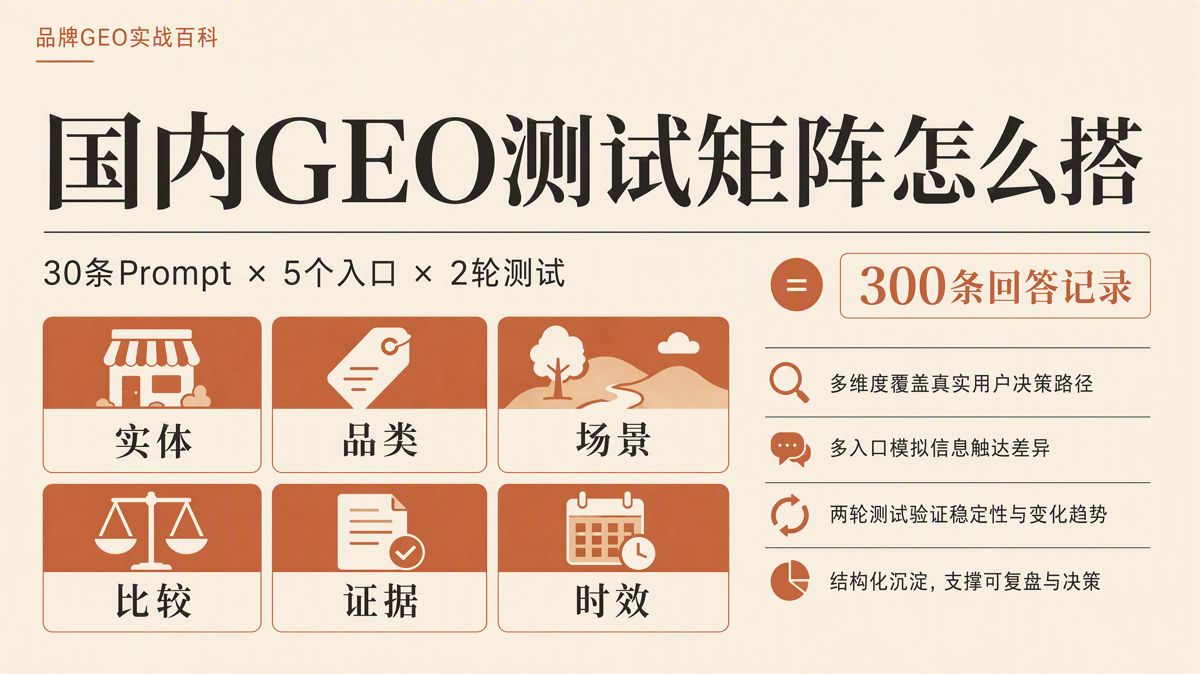
A solid starting framework runs on a simple formula: 30 prompts × 5 Chinese AI platforms × 2 independent rounds, producing an initial dataset of 300 responses.
In this context, an "AI platform" refers to the user-facing web or mobile interface of a major generative search tool. The 30 prompts are organized into six distinct functional clusters of five prompts each, targeting brand recognition, category discovery, business use cases, vendor comparisons, source verification, and timeliness.
Each prompt runs once per platform per round. We recommend running the second round after a seven-day interval. This seven-day gap is not an industry rule; it simply provides a practical execution cadence to monitor answer drift. Both rounds must start inside completely fresh chat sessions rather than building on prior dialogue history.
Every individual response record must capture at least five core variables:
- Whether the target brand was mentioned.
- The brand's position in any recommendation shortlist.
- Whether clickable citation links were provided.
- Whether core company facts were accurate.
- Whether the result remained stable across both rounds.
As of August 2026, mainstream Chinese AI platforms maintain native web search, live retrieval, or deep research capabilities. While all of these functions retrieve public web data before drafting an answer, the specific toggle names, trigger mechanics, and citation formats vary by platform. Always log the exact interface state on the day of the test.
Why Benchmark Before Optimizing Content?
A prompt matrix is not designed to tell you how to edit an article right away. Its primary job is to establish an uncorrupted historical baseline.
Before changing a single line of web copy, this baseline must answer:
- Which queries reliably trigger your brand?
- Which queries leave your brand completely absent?
- Which specific web pages does the AI cite as sources?
- Which competitors dominate the recommendation shortlists?
- Does the same query yield consistent results across two separate rounds?
Without this initial baseline, you will never know whether an answer change three months later was caused by your content updates, a platform algorithm shift, or variations in your own testing process.
GEO testing measures the synthesized answer itself: mentions, rank order, citations, and factual integrity. While technical SEO checks and GEO share data on indexing and page health, an organic search ranking cannot substitute for an AI answer benchmark.
Structuring the 30-Prompt Library
Thirty prompts should not be 30 variations of the same sentence. Each group must address a distinct stage of the enterprise discovery journey, moving from identifying an organization to vetting vendors.
We organize these into six groups (P1 through P6), with five prompts per group. Each prompt should test one primary intent. Do not combine brand names, categories, geographies, certifications, and pricing into a single prompt; compounding variables makes it impossible to isolate what triggered the answer.
| Group | Testing Objective | 5-Prompt Template |
|---|---|---|
| P1: Entity Existence | Can the AI identify the specific company? | "Introduce [Full Legal Company Name]" / "When was [Full Legal Company Name] founded?" / "What are the primary services of [Full Legal Company Name]?" / "Which regions does [Full Legal Company Name] operate in?" / "What public certifications does [Full Legal Company Name] hold?" |
| P2: Category Discovery | Does the brand appear unprompted in generic category searches? | "What are the top [Category] companies in China?" / "Recommend 5 service providers for [Category]" / "Which [Category] vendors operate in [Region]?" / "Which firms can handle [Specific Task]?" / "Which [Category] providers fit mid-sized enterprises?" |
| P3: Scenario-Based Needs | Do specific business problems trigger brand mentions? | "How do manufacturing firms solve [Specific Problem]?" / "How can retail chains accomplish [Operational Task]?" / "What is the best first step for [Task] on a limited budget?" / "How should technical teams verify vendor capability in [Domain]?" / "How should marketing teams compare solutions for [Initiative]?" |
| P4: Comparison & Selection | Where does the brand sit when evaluated against competitors? | "How to choose between [Brand A] and [Brand B]?" / "Compare 5 leading [Category] platforms" / "Compare [Category] providers by scope of delivery" / "Compare solutions based on target enterprise scale" / "Compare vendors based on verifiable public evidence" |
| P5: Evidence Verification | Are citations valid and facts verifiable? | "What public case studies exist for [Full Legal Company Name]?" / "Where can I verify the credentials of [Full Legal Company Name]?" / "What third-party sources cover [Full Legal Company Name]?" / "What are the service boundaries of [Full Legal Company Name]?" / "What accessible sources exist regarding [Full Legal Company Name]?" |
| P6: Temporal Recency | Does recent information surface in responses? | "What recent developments have occurred in [Category]?" / "Which [Category] companies should we watch in 2026?" / "What research on [Topic] was published recently?" / "What are this month's updates in [Region] for [Category]?" / "What public disclosures emerged in [Category] over the last 90 days?" |
Each prompt group follows strict operational constraints:
- Entity Existence (P1) must use the full, legally registered company name to verify whether the AI has indexed the business entity.
- Category Discovery (P2) and Scenario-Based Needs (P3) must strictly exclude your brand name to test spontaneous brand retrieval.
- Comparison & Selection (P4) includes specific brand names, but the comparative order and competitor names must remain static across both test rounds.
- Evidence Verification (P5) checks whether source URLs exist, open properly, and directly support the text.
- Temporal Recency (P6) must only reference timeframes that are verifiable on the day of testing.
Because each group has a different objective, never merge them into a single generic "brand visibility rate." Branded and unbranded prompts must always be analyzed separately.
Standardize Your Runtime Conditions
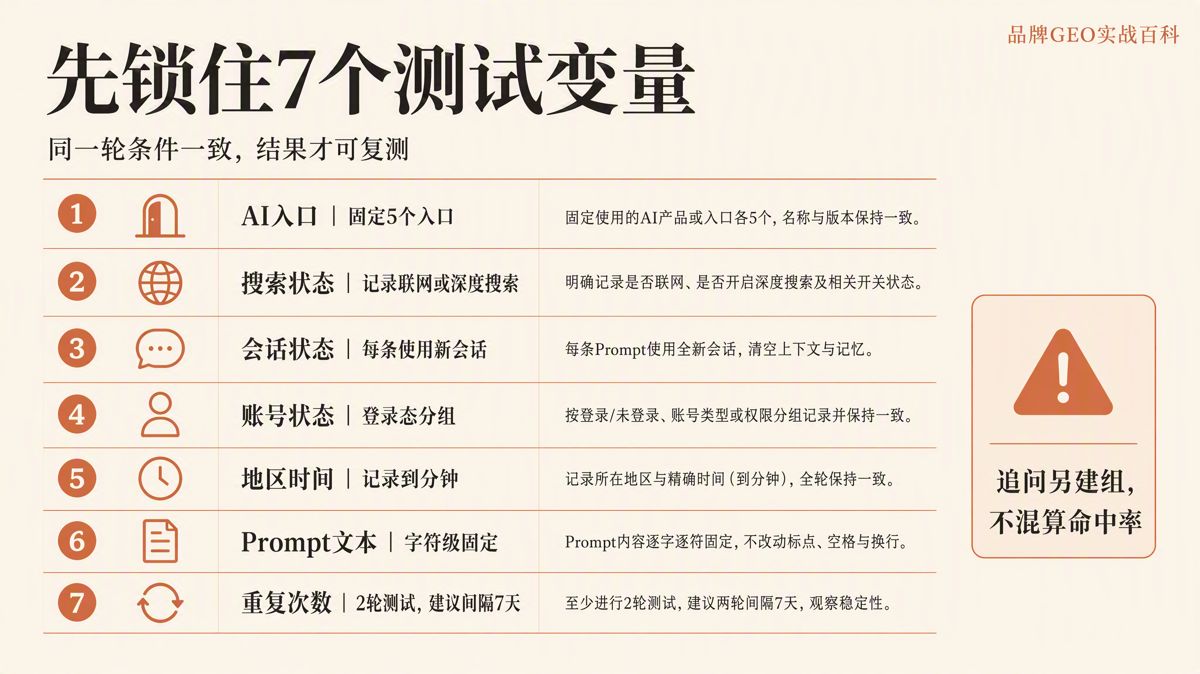
Chinese AI interfaces, search toggles, and citation layouts evolve rapidly. Before launching a round, establish a standardized runtime protocol.
Every prompt in a given round should run on the same device type, from the same network region, under identical account authorization levels and search modes. If an AI tool lacks a specific setting, mark it as "Not Applicable" rather than substituting an alternative.
| Variable | Protocol Rule | Logging Method |
|---|---|---|
| AI Platform | Select 5 accessible, mainstream Chinese AI search tools. | Record official product name and version date; anonymize as Engines A–E for external reports. |
| Search State | Default to live web search, search mode, or deep search toggles. | Record the exact toggle label; if absent, log as "No independent interface toggle." |
| Session State | Open a brand-new chat session for every single prompt. | Save session timestamp and an uncropped full-response screenshot. |
| Account State | Maintain uniform login status (logged in vs. anonymous, free vs. premium). | Keep account types consistent; never mix free-tier and paid-tier responses in one batch. |
| Location & Time | Lock test city, date, and execution window. | Log time to the exact minute, including timezone. |
| Prompt Text | Ensure character-for-character consistency. Do not rephrase or prompt follow-ups. | Assign an immutable unique ID to every prompt. |
| Run Cadence | Run each prompt once per engine per round across 2 rounds. | Keep a recommended 7-day interval between rounds. |
The most common execution mistake is submitting follow-up prompts.
If an AI fails to mention your company, an operator might be tempted to ask, "What about [Brand]?" While the AI may then talk about your brand, that response no longer tests unprompted retrieval. Follow-up investigations require their own isolated test track and must never be mixed into baseline hit rates.
The Six-Step Execution Workflow
Step 1: Freeze the Prompt Library
Assign unique IDs from P1-01 through P6-05. Store the exact prompt strings along with the standardized replacement rules for brand names, target categories, geographic markers, and certifications. Use the official legal entity name found in regulatory filings or corporate websites. Never mix colloquial names, legacy brands, or abbreviations within the same round.
Step 2: Complete Pre-Flight Platform Checks
Verify that each platform is accessible, search toggles function properly, source citations appear, and destination URLs can be copied. Pre-flight checks only confirm technical readiness and are excluded from sample data. If a platform experiences an outage, log it as "Execution Failure." Re-run the prompt once service is restored; never count a technical error as an unbranded omission.
Step 3: Execute in Sequence
Run all 30 prompts sequentially through Engine A before moving to Engine B. This reduces configuration errors caused by jumping between interfaces. Open a new chat session for every query. Do not follow up, edit prompts, upvote responses, or adjust Round 2 phrasing based on Round 1 findings.
Step 4: Archive Raw Evidence
Every record must capture the platform name, prompt ID, complete response text, cited URLs, timestamp, search toggle state, and an uncropped screenshot. Simply clipping a brand mention loses context, while screenshots alone make quantitative analysis difficult. Store clean text, image assets, and original URLs side by side.
Step 5: Manually Audit Facts
Cross-reference core factual claims—founding year, primary product lines, active certifications, client case studies, and cited domains—against first-party corporate documentation. If an AI mentions your company but misstates its fundamental business model, that is not a successful outcome. Flag it explicitly as "Mentioned with Factual Error."
Step 6: Run Round 2 Under Identical Parameters
After seven days, re-run the entire test without altering the prompt library or competitor sets. If a prompt needs adjustments, freeze Version 1.0, duplicate it as Version 2.0, and start a fresh benchmark. Overwriting an active prompt library makes it impossible to know whether rate changes stem from content optimization or question design.
Designing the Data Schema
Your results table must serve two purposes: quick mathematical aggregation and rapid drill-down into source evidence. Every row must represent exactly one prompt executed once on one engine. Never combine multiple engines into a single table cell.
A standard 300-row baseline allows you to filter immediately for edge cases such as "Unmentioned and Uncited" or "Mentioned with Factual Error."
| Field | Definition and Logging Rules |
|---|---|
run_id |
Batch ID combining execution date and round (e.g., 20260813-R1). |
engine_id |
Identifier for the platform (A, B, C, D, E), mapped to actual platforms in a separate index. |
prompt_id |
Unique question code (P1-01 through P6-05). |
search_mode |
Search state (Web Search, Deep Search, Default, or N/A). |
brand_mentioned |
Binary indicator: 1 if the brand appears, 0 if absent. |
shortlist_position |
Numerical rank within a recommendation list; leave blank if omitted. |
citation_url |
Clickable original destination URL; enter 0 if no citation appears. |
citation_domain |
Root domain extracted from citation URL, used to track source distribution. |
fact_accuracy |
Classification: Accurate, Partially Accurate, Inaccurate, or Unverifiable. |
competitor_mentions |
Total count of competing corporate entities named in the response. |
raw_evidence |
File paths to raw text file and timestamped screenshot. |
operator_note |
Operational exceptions (timeouts, interface warnings, broken source links). |
stability_status |
Two-round consolidated status: Stable, Volatile, or Absent. |
Keep Unverifiable and Inaccurate clearly separated. Unverifiable means sufficient public data is missing to confirm the claim. Inaccurate means reliable first-party records directly contradict the AI's output. Blending these two categories obscures whether your problem is an information vacuum or outdated public copy.
Calculating Core GEO Metrics
Exclude technical outages and generation errors before running calculations. All normal, fully rendered responses count as valid responses.
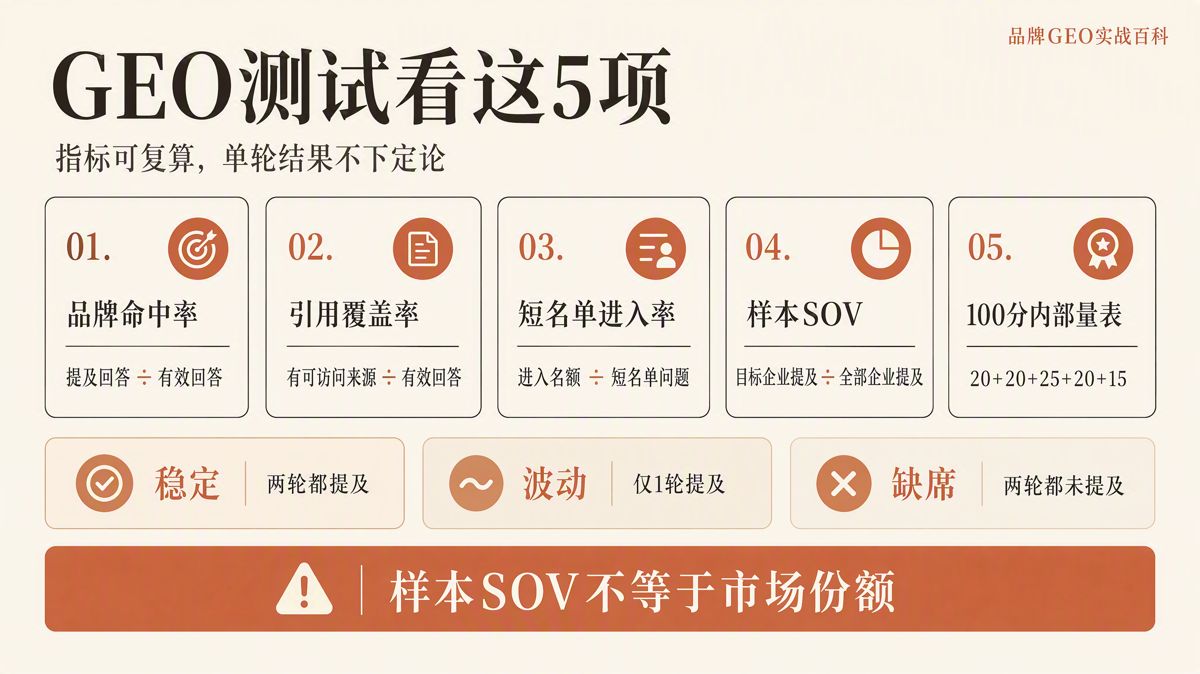
- Brand Hit Rate = Valid responses mentioning target brand ÷ Total valid responses
- Citation Coverage Rate = Valid responses providing at least one accessible source URL ÷ Total valid responses
- Shortlist Inclusion Rate = Responses placing the brand in a requested shortlist ÷ Valid responses with shortlist prompts
- Sample Share of Voice (Sample SOV) = Target brand mentions ÷ Total brand mentions across the cohort
Sample SOV reflects brand presence strictly inside your specific prompt library, engine selection, and testing window. It does not measure true market share, sales volume, or total user preference. Label it clearly as "Sample SOV" in all stakeholder reporting.
Stability is assessed by comparing identical prompts across Rounds 1 and 2:
- Stable: The brand appears in both rounds.
- Volatile: The brand appears in only one round.
- Absent: The brand appears in neither round.
If a single-round hit rate climbs while your stable hit rate remains flat, your brand is simply caught in algorithmic variance. Expand observation rounds before assuming recent content updates were the cause.
For internal reporting, teams often apply a 100-point composite scoring model:
- Brand Mention: 20 points
- Shortlist Position: 20 points
- Accessible Citation: 25 points
- Factual Accuracy: 20 points
- Two-Round Stability: 15 points
This composite index is an internal governance tool, not an industry standard. Keep the scoring weights consistent throughout the entire audit cycle.
Connecting SEO Audits to GEO Diagnostics
SEO tracks indexation, keyword rankings, and organic click-throughs. GEO evaluates how generative engines digest, synthesize, and cite that indexed information.
When an AI query fails to mention your company, first verify that relevant web pages exist, load properly, and clearly display your legal name and core facts. Then confirm traditional search crawlers can locate them. If the underlying pages are missing or unindexed, a prompt matrix can identify the blind spot, but it cannot fix basic web distribution.
| Diagnostic Pattern | Primary Investigation | Premature Conclusion to Avoid |
|---|---|---|
| Indexed in search, omitted by AI | Review on-page schema, structured facts, entity names, and external citations. | "This platform has deliberately blacklisted our brand." |
| Mentioned by AI, but lacks citation | Cross-check facts against public records; monitor stability in Round 2. | "Our brand is permanently secured in the model's knowledge base." |
| AI cites source, but claims are wrong | Audit the cited URL for outdated information or conflicting copy. | "If an AI generates a citation, the underlying content is correct." |
| Present in one engine, absent in others | Map citation sources and search modes engine by engine. | "All Chinese AI engines draw from the same primary sources." |
| High divergence between rounds | Add a third test round; audit search toggles and runtime variables. | "Our latest content revision worked instantly." |
Diagnose performance across four structured layers:
- Entity baseline: Do the company and its core facts exist in accessible public records?
- Spontaneous retrieval: Do unprompted category and scenario queries surface the brand?
- Citation health: Are cited links live, relevant, and supportive of generated facts?
- Consistency: Are brand appearances stable across repeat test cycles?
Working through these layers in order stops teams from writing new articles every time a single query misses the brand.
Frequently Asked Questions
Can we test just one AI platform?
One platform works for initial setup checks, but it cannot represent China's AI search landscape. Chinese generative platforms use different retrieval models, ranking algorithms, and source weighting systems. While a starter matrix uses five engines, resource-constrained teams should test at least three platforms and clearly document the scope.
How many times should each prompt run?
Run each prompt once per engine per round across two rounds spaced seven days apart. If answers show wide variance, add a third round. Remember that adding rounds increases manual verification work. Prioritize strict condition controls and complete evidence archives over sheer sample size.
Can different team members split up the testing?
Yes, provided every operator uses the same frozen prompt library, environmental rules, and validation criteria. Run a three-prompt calibration test across all operators first. Ensure everyone categorizes mentions, citations, factual errors, and run failures the exact same way before distributing the full workload.
Should prompts include the brand name?
It depends on the prompt group. Entity Existence (P1) and Evidence Verification (P5) must include the full legal company name to test brand comprehension. Category Discovery (P2) and Scenario-Based Needs (P3) must omit the brand name to measure unassisted retrieval. Never mix these two categories into one blended hit rate.
What should we do if a citation link is broken?
Log the original URL, page title, test time, and HTTP status code, then tag the record as "Citation Inaccessible." Do not substitute a generic search results page or an alternative domain. Re-check the link in the next round to see if the source was restored or replaced.
When can we confirm an optimization worked?
You can confirm optimization success only when four conditions are met at the same time: the prompt library remains unchanged, runtime conditions stay identical, target prompt groups improve across two consecutive rounds, and citation quality or factual accuracy improves alongside visibility. If visibility increases in only one round or only on branded queries, record it as an observed variance rather than a confirmed gain.
The Four Mandatory Test Artifacts
A rigorous GEO prompt test must produce four permanent, audit-ready deliverables:
- A frozen, version-controlled prompt library.
- A runtime condition log detailing dates, platforms, toggles, and accounts.
- A raw evidence archive storing clean text, full-page screenshots, and citation URLs.
- A centralized dataset built to recalculate core metrics from raw values.
When planning future optimizations, adjust only one variable at a time before re-testing under identical conditions. Maintaining these four deliverables ensures you can always determine whether your next step should be adding first-party facts, updating existing web assets, or simply observing model behavior over time.
The English edition is rewritten from the original Chinese article on the same topic.

Starbox AI is an AI marketing company based in Hangzhou, China. This article draws on Starbox project work. Please credit the source when quoting.
Related reading
 GEO Guide
Why AI Marketing Vendor Quotes Vary 10x: A 4-Step Vetting Checklist
Evaluate AI marketing proposals by delivery actions, not slide decks. Audit source infrastructure, fact cleaning, and clean-environment testing.
Oct 22, 2026 · 6 min read
 GEO Guide
Spotting GEO Scams: What Actually Drives AI Recommendations?
Automated AI ranking promises violate how LLMs work. Real AI recommendations rely on authoritative, structured facts across trusted public sources.
Oct 22, 2026 · 4 min read
 GEO Guide
How to Measure Your Brand's AI Visibility with a Spreadsheet
You do not need expensive software to track AI recommendations. A three-tier prompt framework and a simple spreadsheet can score your brand visibility in half a day.
Oct 21, 2026 · 6 min read