
Baidu and WeChat Search: The 5 States of Content Indexing
The short answer
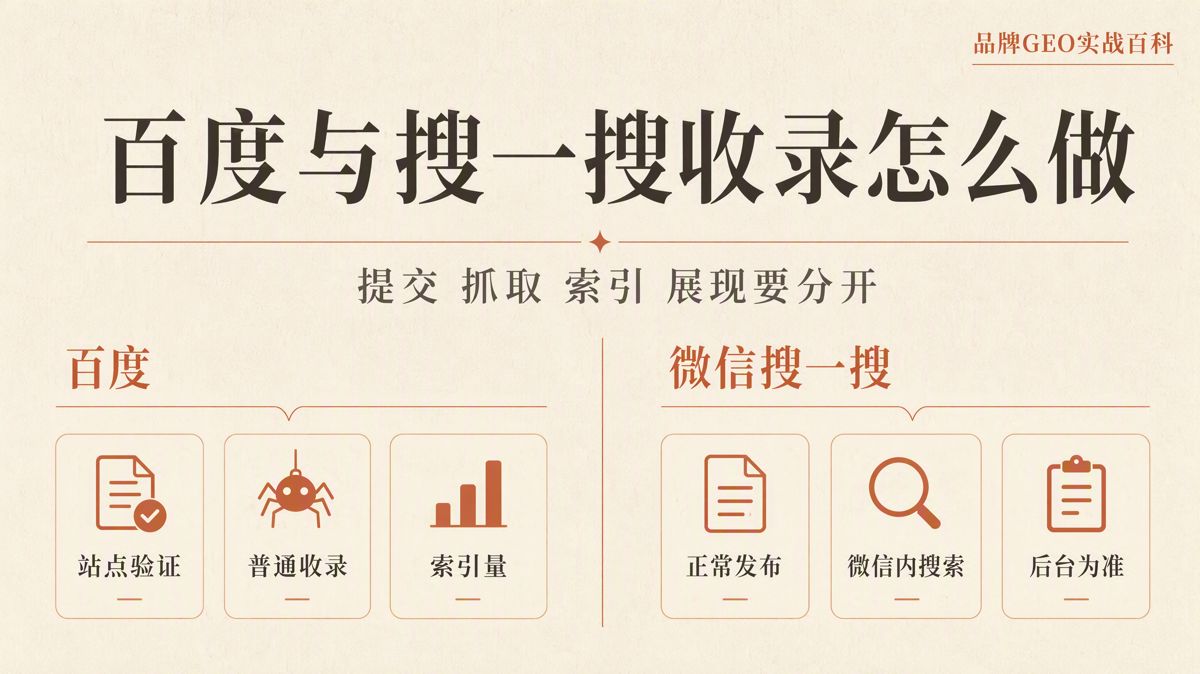
Publishing a page or submitting a link does not mean you are indexed. Understand the 5 distinct states across Baidu and WeChat Search.
A new web page is live, but it does not show up on Baidu. An article is published on a WeChat Official Account, but searching inside WeChat Search yields zero results.
When this happens, many teams rush to rewrite titles, stuff keywords, or repeatedly submit the exact same URL.
These actions rarely solve the underlying problem. A published page is not automatically discovered by a search engine. A submitted URL is not automatically crawled. A crawled page is not automatically indexed.
In search architecture, "indexed" means a page has entered the search engine's database and qualified as a candidate result. It is not the same thing as "ranking" or "being visible."
To locate where a bottleneck exists, you must distinguish between five technical states:
- Published: The page is live and accessible online.
- Submitted: The platform or intake interface has received the URL.
- Crawled: The search engine crawler has visited and fetched the page.
- Indexed: The processed page meets quality filters and is stored as a candidate result.
- Displayed: The page actively appears in search results for a specific query.
Keep three conclusions in mind before troubleshooting:
- Baidu provides webmasters with public tools via its Search Resource Platform (Baidu's webmaster console)—including site verification, link submission, crawl diagnostics, and index volume tracking—allowing you to inspect each processing stage sequentially.
- As of August 12, 2026, across Tencent's official product pages, WeChat Official Accounts Platform, and open documentation, there is no public unified URL submission tool for WeChat articles, nor is there any official guarantee that published articles will be indexed.
- On both Baidu and WeChat Search (WeChat's built-in search engine), completing a process action does not prove that content has been indexed or is discoverable. Each milestone requires separate verification.
Why a Successful Submission Still May Not Rank
Baidu divides its search pipeline into four stages: crawling, filtering, indexing, and outputting results.
Submitting a URL only notifies Baidu that a link exists. Baidu must still fetch the page, parse its content, and run quality filters before adding it to the index. Even once indexed, the page will not necessarily rank for every target query.
Source: Baidu Search Engine Fundamentals
The table below outlines what each state proves—and what it does not prove:
| State | What It Proves | What It Does Not Prove |
|---|---|---|
| Published | The page is live and accessible to users | Baidu knows this URL exists |
| Submitted | Baidu or its API received the URL record | The page has been crawled or indexed |
| Crawled | Baiduspider has visited the page | The page passed filters and entered the index |
| Indexed | The page qualifies as a candidate search result | The page will rank for target keywords |
| Displayed | The page appears for a specific test query | The page will maintain rankings or be cited by generative AI |
Two misinterpretations are especially common in Chinese search marketing.
The first is assuming that an API 200 OK response means Baidu has indexed the page. An API success code only confirms that Baidu received the submission request.
The second is assuming that seeing Baiduspider in server logs means the page is indexed. Baiduspider is Baidu's automated web crawler. Its visit proves Baidu accessed your server, not that your content passed Baidu's quality thresholds.
Submission success, crawler visits, and actual search visibility are three independent milestones. Each must be tracked separately.
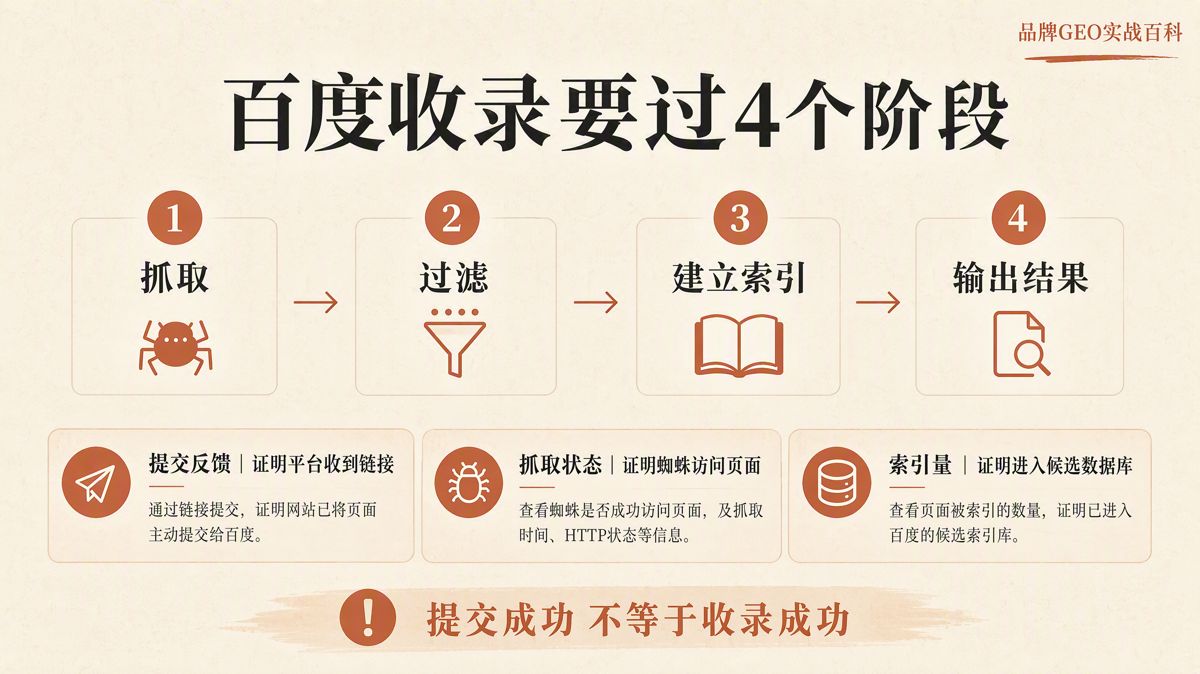
Baidu Indexing: A 4-Step Process with 4 Verification Points
Step 1: Add and Verify Your Site
Before using the Baidu Search Resource Platform, you must add your domain and complete site verification to prove ownership.
Baidu provides three standard verification methods:
- File verification: Upload a verification file provided by Baidu to your root directory.
- HTML tag verification: Insert a designated meta tag into your homepage code.
- CNAME verification: Point a designated DNS record to Baidu's target address.
Once verified, never delete the verification file, meta tag, or DNS record. Removing them can revoke verification status and disable downstream tools.
Source: Baidu Search Resource Platform User Guide
Step 2: Choose the Right Submission Channel
Baidu Regular Indexing supports three link submission methods:
- API Push: Your CMS or backend automatically posts newly published URLs to Baidu via an API endpoint.
- Sitemap: You submit an XML sitemap listing your site's URLs for periodic harvesting.
- Manual Submission: Site managers paste individual URLs or small batches into the webmaster console.
All three channels serve the same purpose: helping Baidu discover URLs faster. None of them guarantee that a page will enter the index.
Baidu explicitly states that regular submission accelerates discovery time for crawlers, but it does not determine indexing decisions, and submitted links are not guaranteed to be indexed.
Source: Baidu Regular Indexing
| Method | Best Use Case | Records to Keep |
|---|---|---|
| API Push | Sites publishing regular daily updates | Timestamp, submitted URL, API response payload |
| Sitemap | Sites with large URL volumes requiring ongoing sync | Sitemap URL, last-modified timestamp, console status |
| Manual | Low page volume or one-off submissions | Submitted URL, submission time, console response |
If your website publishes new pages daily, connect the API endpoint. If you maintain a large directory of stable, evergreen content, use a sitemap. For a handful of landing pages, manual submission is sufficient.
Always pull your API endpoint, token, and quota directly from your authenticated Baidu webmaster console. A token is a private credential; do not copy outdated tokens from public forums.
Do not submit the same batch of URLs across all three channels simultaneously. Duplicate submissions do not speed up crawling, and they cannot compensate for low content quality.
Step 3: Verify That Baidu Can Fetch the Page
If Baiduspider cannot fetch your page, further submissions are pointless.
Check for these common crawling barriers:
- HTTP status codes: Ensure the URL returns a clean
200status rather than404,403, a login wall, an anti-bot CAPTCHA, or a security block page. - Robots.txt rules: Confirm that your
robots.txtconfiguration does not unintentionally disallow target directories. - Canonical URLs: Check that the canonical tag matches the URL you submitted.
- Rendered body text: Confirm that primary content can be read in plain HTML without relying entirely on client-side JavaScript execution.
- Internal linking: Ensure target pages receive internal links and are not orphaned.
- Content substance: Check that the content is not duplicated, overly thin, or mechanically scraped, and that it directly addresses the query implied by the title.
The fact that a page opens in your browser only proves it is accessible to you. CDN rules, geo-blocking, user login states, and dynamic rendering can cause Baiduspider to see something completely different.
Use your server access logs alongside Baidu's Crawl Diagnostics tool. Server logs confirm when Baiduspider requested a page and what HTTP status code your server returned. Crawl Diagnostics shows how Baidu's crawler parsed the page content.
Step 4: Record Submission, Crawling, Indexing, and Search Visibility
A rigorous technical verification workflow should log three categories of proof:
- Submission proof: Webmaster console confirmation or API JSON response.
- Crawling proof: Server access logs, Crawl Diagnostics outputs, and crawl error reports.
- Outcome proof: Changes in Indexed Pages reports and actual rankings for target queries.
The Indexed Pages report tracks the number of URLs from your site that qualify as candidate results on Baidu. Baidu updates this metric between once a day and once a week.
This aggregate index metric is useful for observing site-level trends, but it does not equal impressions, clicks, or organic traffic.
Source: Baidu Indexed Pages Tool
Do not rely solely on the site: search operator to evaluate indexation. While site:yourdomain.com offers a rough reference, it is an approximate search filter, not an audit tool. It cannot replace webmaster data or direct query testing.
Follow this audit sequence:
- Check submission response logs.
- Verify that Baiduspider crawled the page cleanly.
- Monitor the aggregate index count in the Baidu console.
- Test target keywords to see if the page displays in search results.
Separating these checkpoints lets you identify whether a failure happened during submission, crawling, indexing, or ranking.
WeChat Search: Verifying Published Status vs. Search Outcomes
WeChat Search requires a different verification approach than Baidu.
Tencent's official product overview notes that WeChat Search connects users to content and services across the WeChat ecosystem. However, it does not provide an open webmaster portal or a public URL submission API for WeChat Official Account articles.
Source: Tencent WeChat Search
As of August 12, 2026, Tencent's public documentation and WeChat Official Accounts platform do not offer:
- A unified manual or API submission portal for account articles.
- Publicly stated indexing timeframes.
- Any guarantee that published articles will appear in search results.
Available account features must be checked directly within your WeChat Official Account admin backend.
To audit WeChat article discoverability, follow these steps:
- Confirm the article is live, the URL opens normally within WeChat, and it has not been flagged or restricted.
- In WeChat Search, run test queries using the exact title, core keywords, and a unique sentence from the body text.
- Document the account name, article title, search query, test timestamp, and visibility status.
- If an article does not surface after a reasonable window, review the content for compliance and submit an inquiry through WeChat's official customer support channels.
If an article does not appear in WeChat Search, record its status as "Published; pending search visibility" or "Not visible in current query test." Never label it as "Submitted for indexing."
Be skeptical of third-party vendors claiming "guaranteed WeChat Search inclusion" or "expedited indexing APIs." Unless backed by official Tencent documentation, these claims do not reflect platform capabilities.
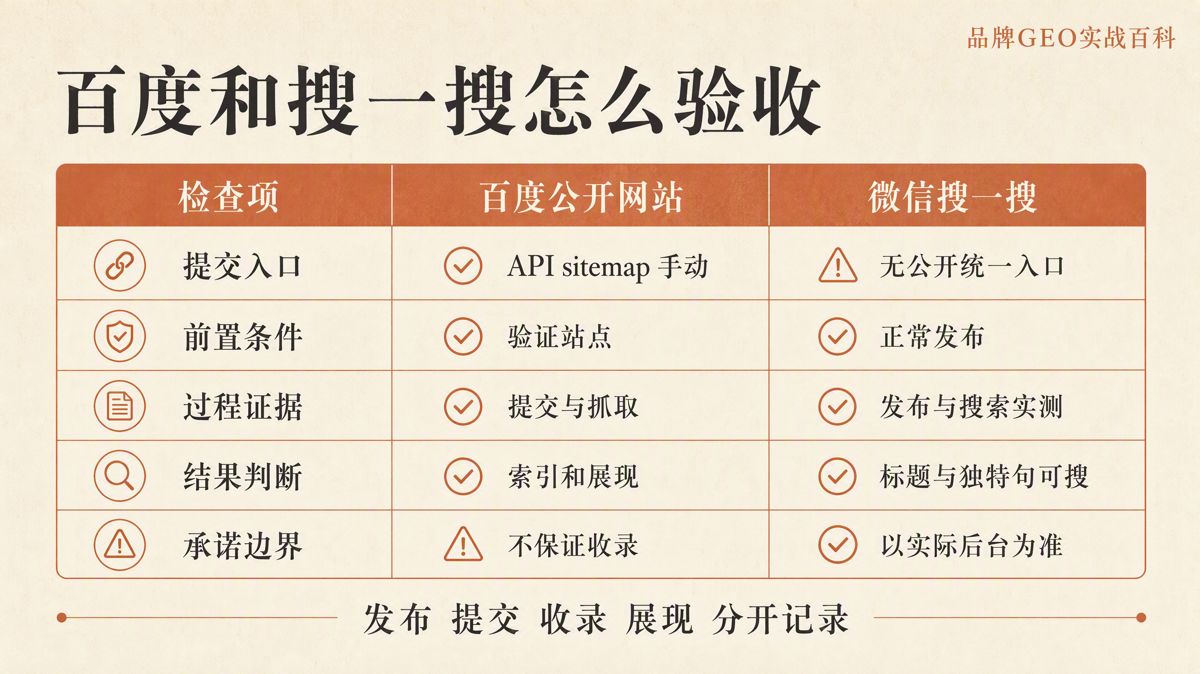
Comparing Baidu and WeChat Search Verification
| Dimension | Baidu (Websites) | WeChat Search (Official Account Articles) |
|---|---|---|
| Public Submission Tools | Yes: API push, sitemaps, and manual forms | None publicly available as of August 2026 |
| Prerequisites | Add and verify site ownership | Publish via an active WeChat Official Account |
| Process Evidence | API responses, server logs, crawl diagnostics | Published status, account backend notifications |
| Outcome Evidence | Indexed Pages metric, query impressions, traffic | Query tests by title, keyword, and verbatim sentence |
| Scope of Guarantee | Can submit and debug; no guarantee of indexation | Can publish and test; no guarantee of search visibility |
Baidu provides structured webmaster diagnostics that let you isolate issues at each technical stage. WeChat Search lacks an open webmaster layer, requiring teams to rely on publication verification and manual query testing within the app.
In both ecosystems, completing an operational step does not equal achieving the business outcome.
Search Indexing Is Not the Same as AI Citation
Search Engine Optimization (SEO) ensures content can be crawled, indexed, and displayed by search algorithms. Generative Engine Optimization (GEO) focuses on whether that content is retrieved, synthesized, and cited by AI models when answering user questions.
Both disciplines require discoverable, readable content. However, entering an index is not the same as being cited in an AI answer.
A page indexed by Baidu has merely qualified as a search candidate. An article appearing in WeChat Search has merely secured a search impression.
Whether an AI search assistant (such as Baidu's generative features or external LLMs) cites that content depends on topical relevance, authoritative consensus, and retrieval mechanisms. An indexed URL does not guarantee an AI citation.
When reporting search and GEO performance, track five distinct parameters:
- Published: Target URL and publication timestamp.
- Submitted: Platform response payload and submission timestamp.
- Crawled: Server access log entry or crawl diagnostic report.
- Indexed: Webmaster index confirmation and verification timestamp.
- Displayed: Tested query string, SERP screenshot, and test timestamp.
If your scope includes Generative Engine Optimization, record an additional set of data points:
- The specific prompt or query tested in the AI engine.
- The generated response text.
- The sources explicitly cited by the AI model.
- The testing timestamp.
Separating publication, submission, crawling, indexing, search visibility, and AI citation makes it clear where performance bottlenecks lie—and provides clear, verifiable status updates to stakeholders.
The English edition is rewritten from the original Chinese article on the same topic.

Starbox AI is an AI marketing company based in Hangzhou, China. This article draws on Starbox project work. Please credit the source when quoting.
Related reading
 GEO Guide
Why AI Marketing Vendor Quotes Vary 10x: A 4-Step Vetting Checklist
Evaluate AI marketing proposals by delivery actions, not slide decks. Audit source infrastructure, fact cleaning, and clean-environment testing.
Oct 22, 2026 · 6 min read
 GEO Guide
Spotting GEO Scams: What Actually Drives AI Recommendations?
Automated AI ranking promises violate how LLMs work. Real AI recommendations rely on authoritative, structured facts across trusted public sources.
Oct 22, 2026 · 4 min read
 GEO Guide
How to Measure Your Brand's AI Visibility with a Spreadsheet
You do not need expensive software to track AI recommendations. A three-tier prompt framework and a simple spreadsheet can score your brand visibility in half a day.
Oct 21, 2026 · 6 min read