
GEO Competitor Benchmarking: A 10-Point Pre-Publish Checklist

The short answer
Why do competitors appear in AI answers while your brand is missing? Audit prompts, citations, and outcome states before publishing your findings.
Why do competitors frequently appear in AI answers while your brand rarely gets mentioned? Here, AI refers to generative engines that retrieve, synthesize, and cite web pages to answer user prompts.
Generative Engine Optimization (GEO) improves your content, factual accuracy, supporting evidence, and site accessibility so AI systems can easily discover, understand, and cite your brand. Benchmarking competitors in GEO is not about tallying raw mentions. It is about identifying specific gaps in prompt coverage, source citations, and downstream user access.
When teams see competitors dominating AI responses, they tend to make two common mistakes: copying the competitor's content immediately, or collapsing every query result into a single "visibility score." Neither approach answers the operational questions that matter:
- Why did the competitor appear?
- Was it an offhand mention, a candidate on a shortlist, or an explicit recommendation?
- Which page did the engine rely on?
- Does that page actually support the engine's claims?
- Are the factual claims accurate?
- Can a prospective buyer click through to an accessible page to learn more?
To answer these questions, you must test your brand against competitors under identical queries, platforms, and testing parameters.
The first standardized test establishes your baseline—the historical benchmark you compare against. Running the exact same test after updating your content is a re-test. Comparing the results before and after to pinpoint what caused the shift is attribution.
An actionable competitive report never stops at who ranked higher. It must clarify four things:
- Which specific prompt triggered the gap
- Which platform generated the answer
- Which outcome state your brand achieved
- Which piece of supporting evidence was missing
Six Things to Verify Before You Start
- Match competitors to the specific decision context. The companies you compete with on pricing may not be the ones you compete with on enterprise delivery, regional support, or technical integration.
- Lock the test prompt versions. If you change the phrasing, language, region, timeframe, or constraints between tests, the outputs cannot be compared.
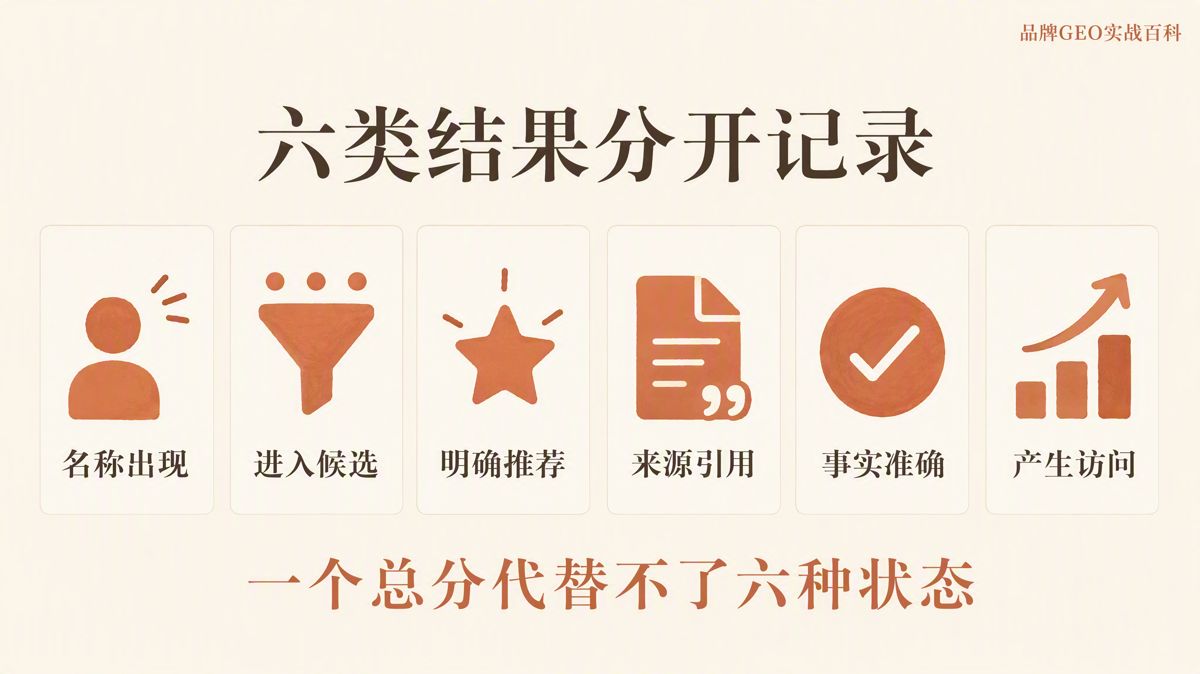
- Track six outcome states separately. Brand mentions, shortlist inclusion, explicit recommendations, citation sourcing, factual accuracy, and downstream clicks represent entirely different outcomes.
- Inspect every cited link. A competitor page cited in an answer does not mean the page actually supports everything the AI asserted.
- Do not blend platform-native metrics with third-party estimates. Google's official guidelines note that you should use Google Search Console to monitor native search performance. Third-party tools cannot access Google's internal ranking models or AI evaluation systems.
- Remember that referral traffic tells only half the story. OpenAI's official publisher FAQ confirms that referral links from ChatGPT Search carry
utm_source=chatgpt.com. However, in-app interactions or sessions where referrers are stripped may not be captured, meaning analytics data alone cannot quantify your total AI exposure.
Before publishing or acting on competitive GEO findings, audit your methodology against the 10 checks below.
| # | Check Item | Passing Criteria | Common Error |
|---|---|---|---|
| 1 | Benchmark Targets | Each prompt maps to directly comparable peers | Treating every industry giant as a competitor |
| 2 | Prompt Matrix | Covers awareness, comparison, selection, and validation | Only searching for branded terms |
| 3 | Prompt Versioning | Phrasing, regions, and constraints are fixed | Rewording prompts on the fly during testing |
| 4 | Reproducibility | Platform, date, region, and account status are logged | Comparing outputs from different environments |
| 5 | Outcome States | Six distinct outcome states are tracked independently | Blending everything into a single score |
| 6 | Fact Verification | Brand names, specs, and partnerships are verified | Accepting AI statements as verified facts |
| 7 | Citation Analysis | URLs, source roles, and supporting content are mapped | Counting link quantities without checking context |
| 8 | Gap Attribution | Gaps are mapped to a specific technical or content stage | Rewriting an entire site after one poor result |
| 9 | Action Mapping | Every proposed edit targets a concrete missing proof point | Copying a competitor's page layout and claims |
| 10 | Re-test Ledger | Historical versions and test conditions can be audited | Keeping only the latest screenshot |
1. Are Benchmark Targets Tied to the Same Decision Context?
Determine what specific problem the user is trying to solve before choosing which companies to compare.
When a buyer asks, "Which platform is best for a small team launching quickly?", the competitors must share similar budgets, implementation timelines, and feature scopes. When the prompt asks, "Who has on-premise deployment and local technical support?", the peer group shifts entirely.
If you compile your list based on general brand fame, you will benchmark tools with fundamentally different delivery models and pricing tiers against each other. Even if your data collection is flawless, the conclusions will be useless for positioning.
Track three distinct groups for each prompt:
- Direct competitors: Providers solving the same problem with a similar delivery model.
- Alternative solutions: Tools solving the problem through a different approach.
- Emerging contenders: Newer players appearing frequently in AI answers that warrant monitoring.
Track these groups simultaneously, but analyze them separately. Blending them hides whether you are losing ground to a direct rival or an alternative delivery model.
2. Does the Prompt Matrix Cover the Full Decision Journey?
A prompt matrix organizes real buyer queries across decision stages. A solid GEO benchmark requires at least four query categories:
- Awareness queries: What options exist in the market?
- Comparison queries: What are the differences between Provider A and Provider B?
- Selection queries: Which vendor fits specific budget, scale, or deployment constraints?
- Validation queries: Are the company's compliance claims, technical specifications, and SLA terms verified?
Testing only your company's name checks whether the model recognizes your brand entity. It tells you nothing about whether you enter the buyer's evaluation shortlist.
Your matrix should also span three query layers:
- Brand queries: Verify that core specs, entity relationships, and pricing tiers are reported accurately.
- Category queries: Evaluate whether your brand appears on the shortlist for your product category.
- Scenario queries: Test how well your solutions map to specific industry constraints or team structures.
Every prompt must define the target user, their operational problem, and the evidence they expect. That way, re-tests will clearly show whether a gap stems from poor technical indexing, thin content, missing citations, or confusing site architecture.
3. Are the Prompt Versions Locked?
Slight variations in phrasing can trigger entirely different retrieval passes and citation sets.
Before logging data, assign a unique ID to every test query and document:
- The exact prompt text
- The query language
- The target geographic location
- Timeframe constraints
- Acceptable dynamic variables
Never overwrite a prompt once you establish a baseline. If you need to refine a query, assign it a new version number and test both versions side by side for a period. This preserves your historical baseline while showing how the new phrasing shifts AI behavior.
Subjective phrases like "best," "most reliable," or "most cost-effective" require explicit criteria. Without clear constraints on budget, team size, deployment type, and geography, the engine will assume its own context, making results difficult to analyze.
Replace subjective phrasing with verifiable criteria:
- What is the typical implementation timeline?
- Does the product hold ISO 27001 or SOC 2 certifications?
- What is the minimum contract commitment?
- Which regions have local deployment nodes?
- What is the billing model (usage-based vs. flat fee)?
- What customer size is the solution architected for?
Clearer prompts produce answers that are easier to verify and compare across test runs.
4. Are the Test Conditions Reproducible?
Every benchmark run must log:
- The platform and interface used (e.g., ChatGPT Search, Perplexity, Google Gemini)
- Date and time of testing
- Language and regional IP
- Account tier (free vs. paid)
- Authentication state (logged in vs. logged out)
- Session history (always use a fresh, isolated chat session)
- Full output link or screenshot
If the platform supports features like live web search, deep research modes, or toggling between underlying models, record the exact configuration used.
If test conditions vary, archive the data for context, but do not use it to measure incremental change.
Generative engine answers fluctuate based on dynamic retrieval indices, platform updates, and session memory. A single positive mention is an observation, not proof of sustained visibility. Only repeated runs under identical conditions confirm whether a competitive gap is real.
5. Are the Six Outcome States Tracked Separately?
Avoid reducing benchmark results to an arbitrary "visibility score." Track six distinct states for every prompt:
| Outcome State | What to Log | What It Does NOT Prove |
|---|---|---|
| Brand Mention | Is the brand name included in the response? | That the brand is recommended |
| Shortlist Inclusion | Is the brand framed as a viable contender? | That the brand ranks above peers |
| Explicit Recommendation | What specific value prop is endorsed and under what conditions? | That every buyer will receive the same advice |
| Citation Source | Which exact URL is linked and what claim does it support? | That the whole website is trusted |
| Factual Accuracy | Are names, tiers, integrations, and limits correct? | That readers will click through |
| Downstream Traffic | Referrals, landing pages, and user paths | That visits will convert to sales |
Log your brand and your competitors side by side for each prompt. When a competitor appears and your brand does not, document:
- Which exact sentence features the competitor
- Which URL the engine cited for that claim
- What operational criteria justified the mention
- What specific feature or capability was highlighted
Granular logs make it much easier to tie gaps to specific content updates.
6. Are Competitor Claims Verified Line by Line?
AI engines frequently hallucinate competitor capabilities, cite outdated pricing, or drop critical usage limitations.
Check stated prices, tier limits, certifications, client rosters, and founding dates against the competitor's official documentation or reliable third-party sources. Log the date you verified each claim. Mark unconfirmed details as "unverified" rather than accepting them as fact.
Compare what the AI claims against what the cited source actually says:
| What the AI Response Claims | What the Source Actually Proves |
|---|---|
| The specific conclusion or feature claimed in the response | The exact factual statement supported by the target URL |
If a source lists service availability in a region, it does not prove the vendor maintains a local engineering team there. If a source details a technical feature, it does not prove "industry leadership."
Fact verification is not just about finding a related webpage. It is about confirming whether that page actually proves the specific claim. Never assume an engine's summary is completely accurate.
7. Do Citation Gaps Differentiate Source Authority?
Two brands with three citations each do not necessarily have equal evidentiary support.
Group citation sources into five distinct categories:
- First-party domain facts: Technical docs, pricing tables, and SLA policies.
- Third-party expert evaluations: Independent industry benchmarks and analyst reports.
- Customer and community feedback: Forum discussions and user reviews that reflect real-world usage without replacing technical specs.
- Directory and platform profiles: Standardized corporate listings, software registries, and category catalogs.
- Syndicated and aggregated content: Reposted articles that must be traced back to the primary source.
For every cited link, log:
- Source category
- Publish or last-modified date
- Author or publisher entity
- The specific fact supported
- Independence from the reviewed vendor
- Accessibility (is the link live, indexable, and free of crawl blocks?)
If you only count raw links, you will treat thin syndication, broken redirects, and low-quality scraper sites as meaningful brand evidence.
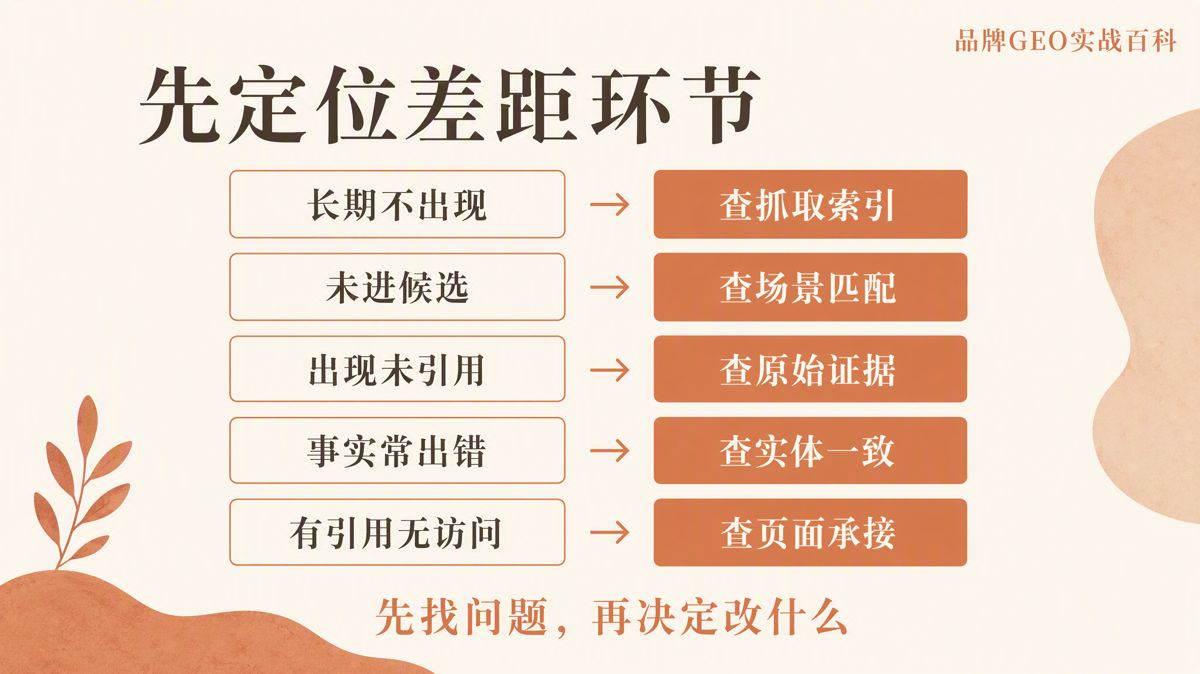
8. Is the Gap Attributed to the Correct Stage?
When a competitor outperforms your brand, the issue could stem from several distinct stages:
- Search crawlers cannot access or parse your page (crawl issue)
- The page is not indexed by the search engine (indexing issue)
- The page is indexed, but its content fails to answer the prompt directly (relevance issue)
- The claim is on the page, but lacks verifiable primary proof (evidence issue)
- Brand metadata and product specs conflict across directories (entity consistency issue)
- The brand appears in the answer, but the linked landing page is broken, slow, or confusing (conversion path issue)
Identify the operational stage that failed before deciding whether to fix site infrastructure, expand content, publish proof points, or improve the landing page experience.
| Observed Gap | Primary Investigation | What NOT to Do |
|---|---|---|
| Brand never appears across repeated tests | Check page accessibility, crawlability, indexation status, and basic topic coverage | Publish dozens of thin, generic articles |
| Competitor makes the shortlist, but your brand is missing | Review intent matching, direct answer formatting, and clear structured data | Copy competitor marketing copy |
| Brand is mentioned, but never cited as a primary source | Audit original data, structured evidence, schema, and page load reliability | Add vague marketing buzzwords |
| Core brand facts are consistently misstated | Clean up brand schema, deprecate legacy pages, and ensure cross-platform consistency | Simply swap out a marketing screenshot |
| Brand is cited, but drives zero downstream traffic | Review page relevance, call-to-action placement, readability, and mobile rendering | Obsess over chasing more top-of-funnel mentions |
A meaningful competitive insight identifies the query, the platform, the outcome state, and the missing piece of evidence. Concluding that "the competitor has better content" means you have not diagnosed the problem.
9. Does Every Proposed Action Address a Specific Gap?
Address technical and content deficiencies in order:
- If pages are blocked from crawling, resolve technical accessibility first.
- If pages are indexed but fail to match user intent, add clear, direct answers.
- If claims lack supporting evidence, update your primary documentation.
- If third-party validation is weak, focus on external industry coverage and verifiable customer references.
If you change your page titles, rewrite copy, redesign layouts, and update external directory listings all at once, you will not be able to identify which change drove results during your re-test.
Competitor pages can reveal the questions buyers ask, the data points they care about, and the page formats search engines favor. They should not be used as copy to duplicate.
The Google Generative AI Search Guide stresses that content must be original, reliable, and created for people, rather than repeating claims already circulating online.
Competitive benchmarking should result in your own backlog of missing facts and technical improvements, not a generic rewrite of competitor pages.
10. Do You Maintain a Complete Re-test Ledger?
A re-test ledger is a historical log that tracks content updates alongside repeated test results. For every change, document:
- The exact page URL updated
- The specific data points, copy, or schema adjusted
- Team member responsible
- Deployment date
- The previous content version
- The prompt IDs expected to shift
When re-testing, replicate your baseline test conditions and archive the new responses, cited URLs, and search analytics.
When outputs shift, rule out search platform updates, prompt changes, and regional test variances before attributing the improvement to your work. A single positive result does not prove causality; verify the trend across repeated runs over several weeks.
Maintain two working views:
- Current snapshot: Identifies unresolved visibility and evidence gaps for the current sprint.
- Historical ledger: Shows which problems persist over time, which citations are unstable, and which optimizations failed to move the needle.
If you discard historical tests and keep only the latest screenshots, your team will eventually repeat optimizations that have already proven ineffective.
Readiness Scorecard: Red, Yellow, Green
| Status | Assessment | Next Steps |
|---|---|---|
| Red | Peer sets are misaligned, prompts lack version control, or competitor claims were not verified | Halt publication of conclusions; fix test parameters |
| Yellow | Baseline is captured, but test environments are partially logged or attribution lacks stage mapping | Backfill missing test parameters and complete a clean re-test run |
| Green | Peers, prompts, testing environments, outcome states, facts, citations, and version logs are verified | Proceed with targeted content updates and monitor results |
Public Reference Documentation
The English edition is rewritten from the original Chinese article on the same topic.

Starbox AI is an AI marketing company based in Hangzhou, China. This article draws on Starbox project work. Please credit the source when quoting.
Related reading
 GEO Guide
Why AI Marketing Vendor Quotes Vary 10x: A 4-Step Vetting Checklist
Evaluate AI marketing proposals by delivery actions, not slide decks. Audit source infrastructure, fact cleaning, and clean-environment testing.
Oct 22, 2026 · 6 min read
 GEO Guide
Spotting GEO Scams: What Actually Drives AI Recommendations?
Automated AI ranking promises violate how LLMs work. Real AI recommendations rely on authoritative, structured facts across trusted public sources.
Oct 22, 2026 · 4 min read
 GEO Guide
How to Measure Your Brand's AI Visibility with a Spreadsheet
You do not need expensive software to track AI recommendations. A three-tier prompt framework and a simple spreadsheet can score your brand visibility in half a day.
Oct 21, 2026 · 6 min read