
12 Pre-Launch Checks for Multi-Source GEO Coverage
The short answer
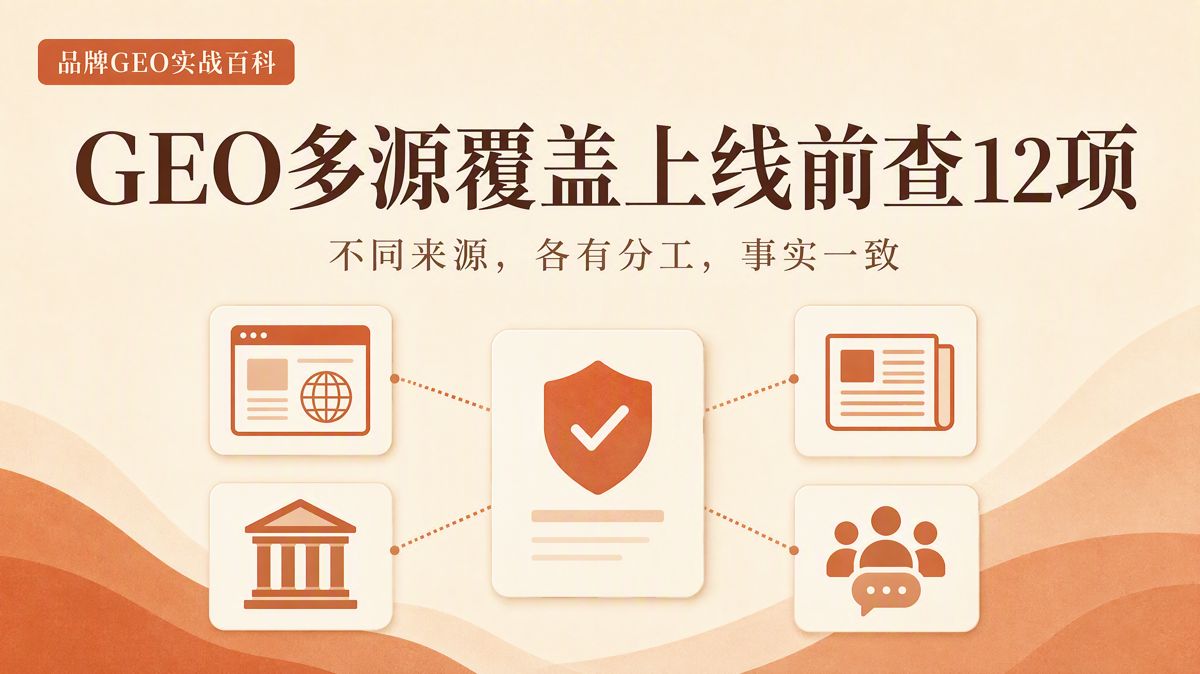
Publishing the same article across ten platforms is not multi-source GEO coverage. Use this 12-point checklist to verify consistency, access, and citations.
Generative Engine Optimization (GEO) focuses on structuring brand information so generative AI search and answer engines can easily surface, understand, and verify it. It solves a fundamental problem: when users ask questions, can AI systems find, parse, and validate your information?
Publishing the same piece of content across ten different channels does not create ten independent sources. It creates ten duplicates. You increase platform count, but add zero new facts, perspectives, authors, or supporting evidence. That is the most common mistake in multi-source GEO strategy.
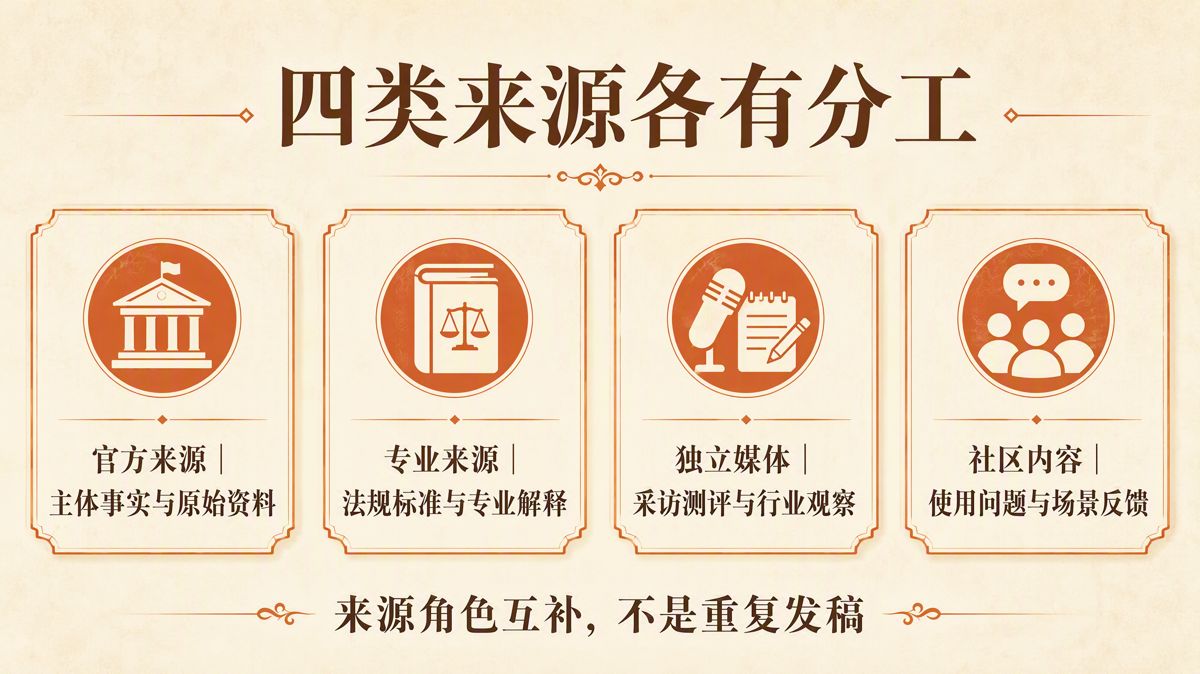
True multi-source coverage requires different publishers, formats, and functional roles to deliver complementary information:
- Official websites provide core corporate entities, technical specs, and primary documentation.
- Industry bodies and standards organizations supply regulations, benchmark criteria, and authoritative definitions.
- Media outlets contribute interviews, product reviews, and objective analysis.
- Community forums supply real-world Q&As and direct user experiences.
- Video platforms convert visual demonstrations into crawlable text through titles, descriptions, and transcripts.
You cannot evaluate multi-source coverage by counting how many articles you posted or how many platforms you signed up for. The real test is simple:
When a prospective buyer asks an AI engine a question, can it find consistent, cross-verifiable answers across distinct roles, formats, and publishers?
Why "Published" Does Not Mean "Covered"
Google notes in its generative AI search documentation that its AI experiences rely on foundational search systems to discover, crawl, and index web pages. Pages must also be eligible for standard search result snippets.
Google also emphasizes that its systems evaluate a wide range of sources. Content that offers first-hand experience, original perspective, or primary research provides far greater value than repetitive summaries of existing web pages. Read the full documentation in the Google Search Central AI Optimization Guide.
The Bing Webmaster Guidelines similarly highlight discovery, crawling, indexing, URL architecture, structured data, and authority signals as the shared foundation for both standard search results and AI-generated answers. Bing recommends using XML sitemaps, crawlable internal links, external links from relevant sites, and IndexNow to assist search bots. Crucially, Bing notes that these technical measures improve discovery but never guarantee inclusion or ranking. For official guidance, see the Bing Webmaster Guidelines.
Hitting "publish" is just the start. Before taking any multi-source GEO program live, run through these 12 checks.
| # | Inspection Item | Passing State | Common Mistake |
|---|---|---|---|
| 1 | Question Scope | Every core query maps to a primary source | Listing target platforms without mapping user questions |
| 2 | Canonical Baseline | Company facts live on a stable, updateable canonical page | Relying solely on social accounts with no official baseline |
| 3 | Source Diversity | Clear separation between official, expert, media, and community roles | Distributing identical promotional copy across every channel |
| 4 | Editorial Independence | Third-party content features original reporting, testing, or analysis | Counting syndication and paid press reprints as independent proof |
| 5 | Entity Consistency | Names, products, addresses, and contacts align across platforms | Mixing acronyms, obsolete branding, and new trading names |
| 6 | Claim Consistency | Core specs, metrics, and claims match everywhere | Quoting conflicting performance figures on different channels |
| 7 | Verifiability | Key claims link directly to original primary evidence | Relying on vague claims like "studies show" without citations |
| 8 | Public Accessibility | Pages are free from logins, paywalls, and aggressive bot blocks | Gating key content inside native mobile apps or behind forms |
| 9 | Machine Readability | Text is extractable from body copy, tables, subtitles, and alt tags | Locking crucial specs inside static images or flattened graphics |
| 10 | Discovery Pipeline | Links, sitemaps, and indexation status are verified | Assuming a published URL is immediately indexed without tracking |
| 11 | Version Synchronization | Deprecations, updates, and corrections sync across all assets | Leaving outdated specs live on external websites |
| 12 | Monitoring Ledger | URLs, crawl status, owners, and review cycles are logged | Checking an AI prompt once and assuming coverage is permanent |
1. Map User Questions Before Assigning Distribution Channels
Your unit of planning in GEO is not the platform. It is the buyer question.
Start by listing the specific questions prospects ask AI engines:
- What does this company do, and who is behind it?
- Which specific use cases does this product support?
- What methodology supports these performance claims?
- Are there verified customer case studies?
- What are the service level agreements and support policies?
Every question needs at least one primary source. High-priority questions require complementary sources for independent verification.
If your launch plan simply lists channels—such as the official website, WeChat Official Accounts, WeChat Channels (Tencent's video platform), and industry Q&A forums—your team will fall back on spray-and-pray syndication. A platform list tells you where text was posted. It does not tell you if a buyer's question was answered, or if the answer carries sufficient proof.
A single channel can answer multiple questions, and a single question often needs multiple sources. Map the questions first, then choose your channels. This reveals whether your actual gap is information, technical explanation, or independent evidence.
2. Secure a Stable Canonical Baseline
Foundational corporate facts must reside on a permanent, updateable official page.
Your legal corporate name, brand relationships, product names, service scopes, contact details, formal policies, technical parameters, and publication dates should all be documented on your official domain.
This baseline is the anchor for external verification. When a third-party review, forum thread, or video references obsolete specs, AI engines and users need a canonical page to cross-check. When product specs change, you update the baseline first, then push updates to external channels.
Without a stable canonical page, expanding external content only multiplies version conflicts.
An acceptable canonical baseline meets three criteria:
- It is fully accessible to the public without gates.
- It can be updated continuously.
- Its URL structure remains stable over time.
If your core data lives only on ephemeral campaign landing pages, private chat threads, or social posts that might be deleted tomorrow, it cannot serve as a reliable baseline.
3. Verify Distinct Roles for Different Sources
Different types of content serve different evidentiary purposes. They cannot substitute for one another.
| Source Role | Best Suited For | Cannot Prove on Its Own |
|---|---|---|
| Official Properties | Entity info, technical specs, policies, primary data | Objective industry rankings or competitive standing |
| Professional & Technical | Industry standards, regulatory analysis, methodologies | Unverified proprietary corporate claims |
| Independent Media | Executive interviews, product teardowns, market analysis | Editorial neutrality of paid syndication packages |
| User Communities | Operational troubleshooting, edge cases, user sentiment | Universal performance guarantees or macro statistics |
Your website proves what your company claims. It cannot independently prove market adoption. Conversely, a single user review demonstrates an individual experience, but cannot prove widespread reliability.
If all your distribution channels repeat the exact same marketing narrative, you only have one source role, regardless of URL count. That setup broadens surface distribution, but fails when AI engines attempt to validate claims through multiple lenses.
4. Audit Third-Party Content for Editorial Independence
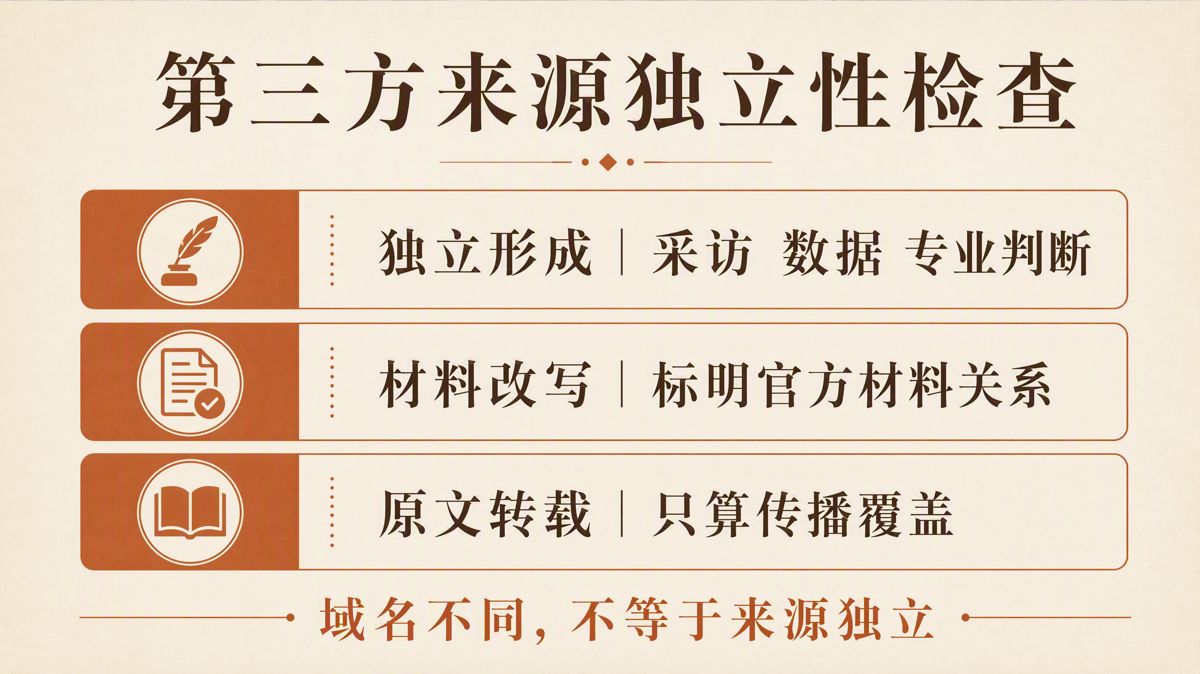
Publishing across different domain names does not make content independent. A domain shows where content is hosted, not how it was created.
Before launch, audit your third-party assets:
- Who authored the piece?
- Where did the source material come from?
- Is the content based on original interviews, product testing, or proprietary data?
- Is the article a copy-pasted corporate press release?
- Was it syndicated in bulk by a single distribution agency?
A press release syndicated across twenty news portals counts as broad distribution. In an evidence ledger, it counts as one single claim.
Tag every external asset based on its relationship to your official material:
- Independently Produced: Contains original interviews, hands-on tests, or independent evaluations.
- Synthesized from Official Data: Built from primary company documents, but independently organized and explained.
- Syndicated / Direct Repost: Direct or near-direct republication of company-provided text.
All three tiers have promotional value, but they carry different evidentiary weight. Categorizing them accurately prevents your team from confusing widespread republication with genuine external validation.
5. Audit Brand, Entity, and Product Consistency
Entity data confirms the foundational identity of your company, product lines, and leadership.
Check every channel for consistency:
- Registered corporate name vs. common brand name.
- Legacy brand names vs. current rebranding.
- Exact product naming and tier designations.
- Primary web domain.
- Official addresses and corporate phone numbers.
- Publicly named executives and contact persons.
You may need shorter names due to platform character limits, but the relationship to the primary entity must remain clear.
Common errors include: an official site displays a new brand name while recent media profiles still use the old one; disparate social handles refer to the same software package by different names; corporate headquarters and regional branch addresses are conflated.
Do not leave these details to individual writers. Build a centralized Master Entity Record before launch that defines active names, addresses, product labels, and contact channels. All distribution teams must pull from this single source of truth.
6. Eliminate Contradictions in Core Claims
Scrutinize pricing, technical specs, service scopes, target segments, compliance certifications, benchmark figures, and effective dates across all content.
Whenever performance metrics appear on external channels, include the required context:
- Units of measurement.
- Reporting period.
- Sample size and test environment.
- Calculation methodology.
- Applicable constraints and system prerequisites.
Writers can edit copy for brevity, but they must never remove constraints that alter the meaning of the claim.
For example, if your website states that a performance benchmark applies only to a specific server configuration over a 30-day window, external articles cannot strip those caveats and present the figure as an unconditional standard.
If you discover conflicting figures between channels, do not pick the version that sounds best and keep publishing. Identify the accurate data, update the canonical baseline, and add corrections, redirects, or takedowns to outdated secondary pages.
7. Tie Every Key Claim to Primary Evidence
Every claim must link back to an authoritative primary source:
- Legal assertions link to official statutory text.
- Technical benchmarks link to standards bodies.
- Research insights link to published papers or data reports.
- Product capabilities link to official product documentation.
- Customer ROI metrics link to verified case studies.
Secondary summaries help readers grasp complex topics, but before citing them, verify that they accurately reflect the primary documentation.
Maintain an evidence ledger tracking:
- The exact claim.
- The canonical URL or source document.
- The publishing organization.
- The publication date.
- The date last verified.
- Scope and limitations.
- The internal owner responsible for accuracy.
A working hyperlink does not automatically equal valid evidence. If the linked page fails to substantiate your specific assertion, the check fails.
8. Test Public Accessibility and Bot Permissions
Do not inspect pages using an internal office computer where you are already logged into administrative accounts. Run audits using clean, unauthenticated browser profiles across public mobile connections.
Watch out for common accessibility blockers:
- Forced account logins or gated access.
- Content locked within native mobile apps.
- Aggressive CAPTCHA challenges.
- Geoblocking or regional IP filters.
- Overly strict Web Application Firewall (WAF) bot rules.
- Infinite redirect loops.
- Intermittent server errors (5xx responses).
For content you want surfaced in ChatGPT search results and citations, OpenAI documentation states that site owners should ensure OAI-SearchBot can access their pages. OAI-SearchBot is used specifically to crawl and display web search results. In contrast, GPTBot crawls content for foundation model training. The two user agents serve different functions and should be managed independently in your robots.txt configuration. See the official OpenAI Publishers and Developers FAQ.
Permitting bot access is a prerequisite for discovery, but it does not guarantee that your page will be crawled, indexed, or cited. It is simply an essential technical baseline.
9. Ensure Crucial Information Is Machine-Readable
A page can return a 200 OK status code and still be unreadable to AI engines.
Before launch, verify that:
- Embedded videos include clear titles, text summaries, and accurate closed captions or full transcripts.
- Charts and infographics feature detailed descriptive text in the article body or rich
altattributes. - Downloadable PDF assets contain selectable, indexable text rather than flattened image scans.
- Data tables are coded in clean HTML rather than inserted as cropped screenshots.
- Primary page copy is visible in the raw HTML rather than gated behind client-side JavaScript that requires post-login interaction.
Descriptive alt text and text summaries allow screen readers and automated parsers to comprehend visual assets.
Text summaries must also align with visual graphics. Never let an infographic show one metric while the surrounding body copy cites another. If critical specifications exist only inside images, video frames, or locked PDFs, AI parsers will fail to extract and cite them.
10. Track Publishing, Crawling, Indexing, and Citations Separately
Publishing an official page is step one. You still need to audit internal links, canonical tags, XML sitemaps, and crawl states.
A canonical URL tells search engines which URL represents the master copy when multiple URLs contain identical or overlapping content.
An XML sitemap lists a site’s essential URLs to help search engines discover and crawl them systematically.
Bing documentation advises webmasters to include only canonical URLs in sitemaps and to keep the lastmod (last modified) attribute accurate whenever content changes.
IndexNow provides an automated protocol for notifying participating search engines immediately when a URL is created, updated, or removed. Read the official guidance in the Bing Sitemaps Overview and the IndexNow Overview.
Submitting a sitemap or pinging IndexNow simply sends a crawl request. It does not mean the URL has been indexed, let alone cited.
Track these four stages separately in your operations ledger:
- Published: The page is live and accessible on the web.
- Crawlable: Automated engines can fetch the page without encountering errors or blockers.
- Indexed: The URL has entered the search engine's searchable index.
- Cited: The URL is referenced as an authoritative source in search results or AI-generated responses.
Collapsing these stages into a single "complete" status leaves you blind when an asset fails. You won't know whether the failure happened during publication, crawling, indexation, or citation selection.
11. Establish Update and Deprecation Protocols
Multi-source coverage typically breaks down when products and policies evolve.
When a product is sunset, pricing changes, a compliance certificate expires, a spokesperson leaves, or a client revokes case-study approval, the official website might get updated while external profiles and syndicated posts continue circulating outdated claims.
Assign a designated owner and review cadence to every critical claim before launch. When facts change, execute updates in this order:
- Update the official canonical baseline page.
- Update all owned and controlled brand channels.
- Contact third-party publishers to request corrections or add updated editor notes.
If an older external article cannot be revised, add a prominent update notice on your official baseline page clarifying the latest status. This mitigates the risk of search engines treating stale external data as current truth.
Version synchronization is not an afterthought. It is the operational discipline that keeps multi-source GEO reliable over time.
12. Distinguish Between Brand Mentions and URL Citations
When monitoring AI engines, run standardized prompts and systematically log the timestamp, interface, logged-in status, geographic location, response text, cited links, and screenshots.
Track performance across four distinct scenarios:
- The page is indexed, but not surfaced in the generated answer.
- The brand is mentioned in the answer, but no clickable link or source citation is provided.
- The page URL is explicitly cited as an authoritative source in the answer.
- The answer cites obsolete, conflicting, or inaccurate information.
A single prompt query that fails to show your brand does not prove your coverage failed. Similarly, appearing once does not mean your work is done. Variations in user prompt phrasing, interface versions, user history, geographic location, and model updates can shift the output.
The goal of monitoring is to spot systematic visibility gaps and correct specific source assets, not to celebrate vanity brand mentions.
Launch Decision: Red, Yellow, or Green?
| Status | Assessment | Action Required |
|---|---|---|
| Red | Conflicting entity details, contradictory specs, fabricated proof, crawl-blocked URLs, or unapproved assets. | Halt the launch. Correct the canonical baseline and resolve contradictions before proceeding. |
| Yellow | Homogeneous source roles, unverified third-party independence, missing video transcripts, or broken tracking fields. | Address the gaps and re-audit. Do not count these channels toward complete coverage yet. |
| Green | Core questions map to sources, facts align, claims link to primary evidence, pages are crawlable, and ongoing review owners are assigned. | Approve for launch. Begin regular tracking and audits against the operations ledger. |
Red flags take precedence over content volume and distribution schedules. If entity names, performance metrics, or licensing permissions are compromised, stop the rollout immediately.
A yellow flag indicates that while content is published, it does not yet provide reliable evidentiary coverage. Only mark a program green when questions, roles, facts, proofs, machine-readable pages, and review responsibilities are fully validated.
Frequently Asked Questions
1. Does syndicating the same article across multiple platforms help our GEO?
It expands top-of-funnel reach, but it does not create multiple independent sources for AI systems. Clearly identify syndicated content in your internal tracking so your team does not mistake republished promotional copy for external validation.
2. Is an official company website mandatory for multi-source GEO?
Not every organization requires an expansive, complex web portal, but every organization needs a stable, updateable canonical location for its core entity facts.
If you rely on a platform profile or social page to serve this purpose, ensure that the URL is publicly accessible without a login, can be updated over time, and uses a permanent, stable link.
3. Do paid third-party articles count as independent sources?
It depends on how the content was produced.
If the article is a paid republication of your company press release, treat it as sponsored distribution. If the publisher conducted original testing, ran independent interviews, or applied objective editorial analysis, it can carry higher evidentiary weight. Do not mistake a different domain name for genuine editorial independence.
4. Does publishing on more platforms automatically improve GEO performance?
No.
Platform volume does not equal information quality. Distributing contradictory, redundant, or uncrawlable pages increases maintenance costs and creates conflicting signals for AI engines. Prioritize mapping core buyer questions to the right source roles before expanding your channel footprint.
5. If our robots.txt file permits bot access, will our pages definitely be cited?
No.
A robots.txt file specifies which URLs automated web crawlers are allowed or forbidden to access. Allowing access is merely a technical prerequisite. Whether a search or answer engine crawls, indexes, displays, or cites a URL depends on the engine's evaluation of content quality, query relevance, site architecture, and user context.
6. How often should we audit our multi-source GEO assets?
Review cycles depend on how frequently your information changes.
Volatile data—such as pricing, product inventory, executive staffing, and commercial policies—requires frequent audits. Static corporate background information should be re-verified whenever internal reorganizations or brand updates occur.
Final Thoughts
The point of multi-source GEO coverage is not to flood the internet with duplicate marketing copy. It is to place verified facts into the right functional sources, ensure they stay consistent, and make them simple for AI engines to validate independently.
Passing these 12 checks ensures search and AI engines can discover, parse, and verify your content. It does not guarantee that every engine will index, recommend, or cite your brand on every query.
Map user questions first, clarify the relationship between your sources, tie every assertion to primary evidence, and assign clear operational owners. That is how you build a resilient, sustainable GEO footprint.
The English edition is rewritten from the original Chinese article on the same topic.

Starbox AI is an AI marketing company based in Hangzhou, China. This article draws on Starbox project work. Please credit the source when quoting.
Related reading
 GEO Guide
Why AI Marketing Vendor Quotes Vary 10x: A 4-Step Vetting Checklist
Evaluate AI marketing proposals by delivery actions, not slide decks. Audit source infrastructure, fact cleaning, and clean-environment testing.
Oct 22, 2026 · 6 min read
 GEO Guide
Spotting GEO Scams: What Actually Drives AI Recommendations?
Automated AI ranking promises violate how LLMs work. Real AI recommendations rely on authoritative, structured facts across trusted public sources.
Oct 22, 2026 · 4 min read
 GEO Guide
How to Measure Your Brand's AI Visibility with a Spreadsheet
You do not need expensive software to track AI recommendations. A three-tier prompt framework and a simple spreadsheet can score your brand visibility in half a day.
Oct 21, 2026 · 6 min read