
GEO Entity Modeling: A 7-Step Pre-Launch Checklist
The short answer
Before deploying Schema markup or launching citations, run this 7-step entity modeling audit to ensure AI search engines interpret your brand facts accurately.
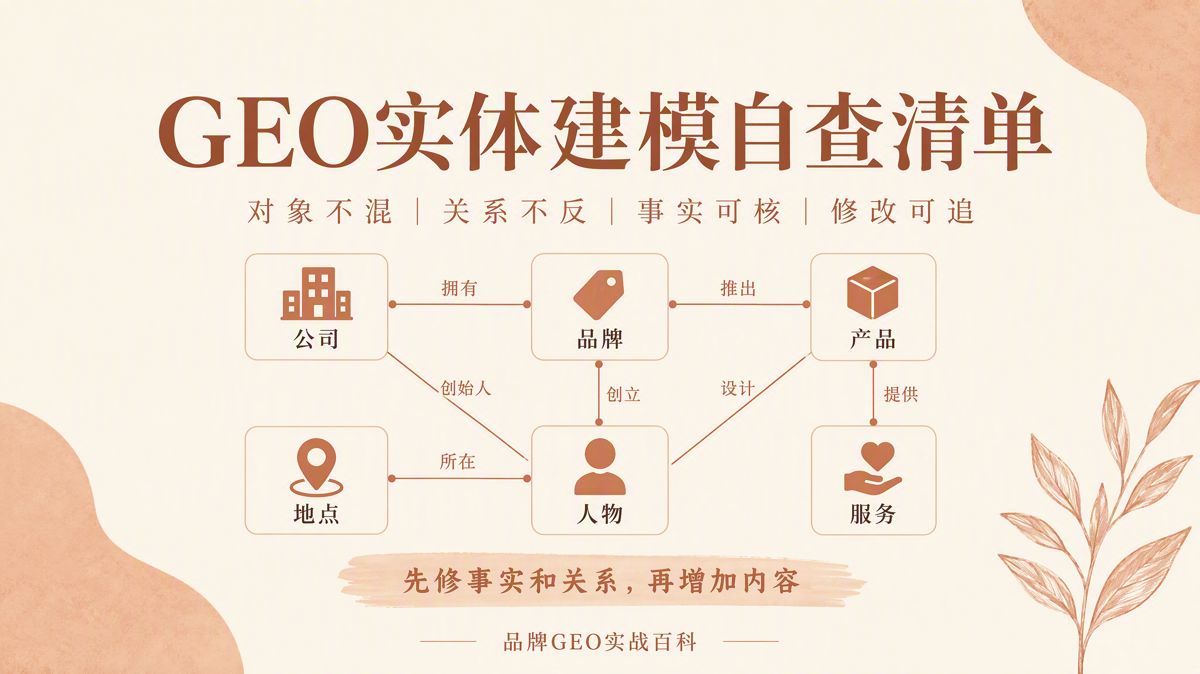
Generative Engine Optimization (GEO) helps generative AI search and answer engines understand public brand information accurately. Entity modeling within GEO means defining companies, brands, products, services, executives, and physical locations as distinct entities and clearly mapping their real-world relationships.
In this context, an "entity" is any object that can be uniquely identified. A corporation is one entity, its commercial brands are separate entities, and specific products, leadership figures, and office locations should each be identified individually.
When entity modeling fails, the breakdown rarely stems from syntax errors in code. It almost always stems from inconsistent baseline facts:
- Conflating registered legal company names with commercial brand names.
- Referring to the same product by two different names across different pages.
- Merging the founder, managing director, and content author into a single persona.
- Inverting the ownership hierarchy between companies, brands, and products.
- Declaring an attribute in structured data that does not exist in the visible page copy.
Pushing more content or adding Schema tags before resolving these discrepancies only scales the errors across search engine knowledge graphs.
Before drafting knowledge base entries or injecting structured data into your site, confirm whether your entities can be reliably parsed as distinct objects. Define their boundaries, verify their relationships, and ensure every core claim is backed by accessible evidence.
Run through this 7-step checklist before pushing entity updates live.
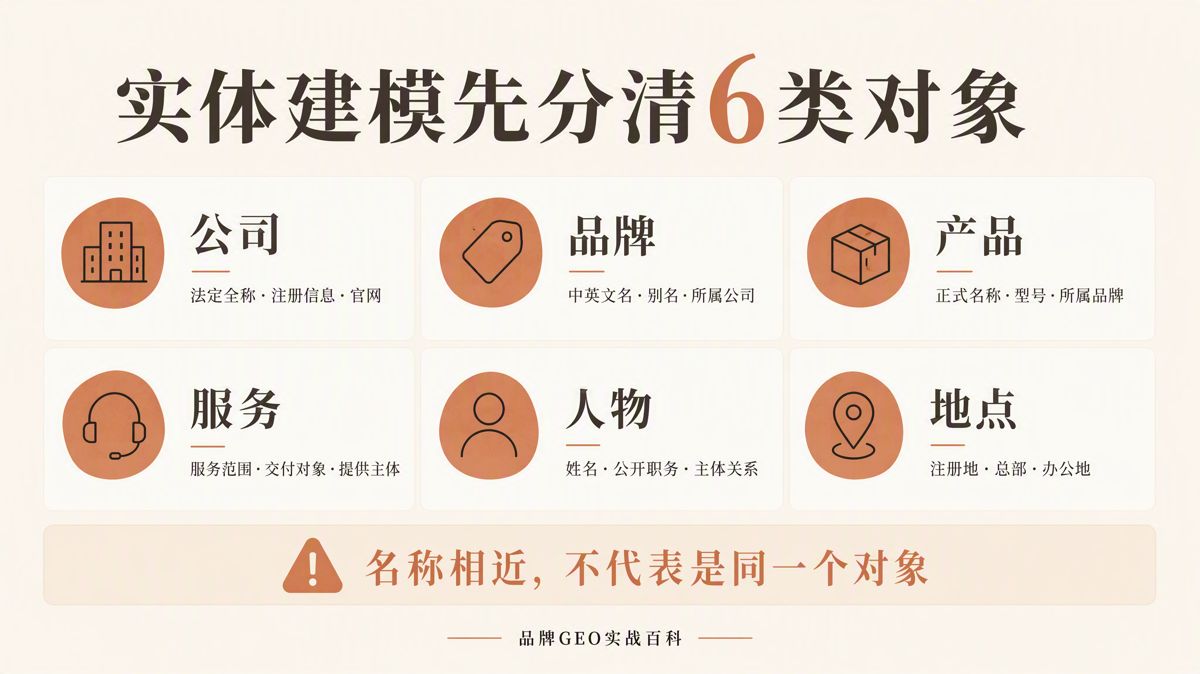
1. Catalog Companies, Brands, and Products Separately
Entity modeling begins by establishing distinct objects before defining how they connect.
| Entity Type | Core Data to Record | Common Confusion |
|---|---|---|
| Company | Legal name, corporate registration, founding date, HQ, official website | Treating a colloquial brand name as the legal corporate entity |
| Brand | Commercial name, international name, aliases, parent company, verified accounts | Treating the parent company and the brand as a single entity |
| Product | Official product name, model number, version, parent brand, target audience | Mixing up a broad product line with a specific model |
| Service | Service title, scope of delivery, target client, service provider entity | Presenting marketing promises or service guarantees as product specs |
| Person | Full legal/public name, official title, documented relationship to company/brand | Merging founder, operating executive, and blog author into one profile |
| Location | Legal incorporation address, operational HQ, branch offices, service regions | Listing a registered mailbox address as the primary operating facility |
A single company can manage multiple brands, and a single brand can offer multiple products. Even when names overlap, systems cannot treat them as identical objects.
Conversely, a single entity often carries abbreviations, historical names, and international variants. Do not split these into separate entities. Group them as aliases mapped to the same canonical object.
Check two points: - Have distinct objects been recorded separately? - Have alternate names and historical identifiers been mapped back to the correct parent entity?
2. Build a Canonical Fact Sheet for Every Core Entity
Every primary entity requires an internally maintained canonical fact sheet. This document is not promotional copywriting. It is a source-of-truth record used to align facts, resolve discrepancies, and verify sources.
A complete fact sheet should include:
- Primary Name: The current, standardized external brand or entity name.
- Legal Name: Registered legal corporate name, kept separate from brand assets.
- Aliases: Common acronyms, legacy names, international spellings, and standard variations.
- Canonical Entry Point: The official domain or permanent URL for the entity.
- Core Scope: What the entity does, what it does not do, and who it serves.
- Key Relationships: Exact connections to companies, brands, products, executives, and facilities.
- Factual Evidence: Public URLs or official documentation validating each claim.
- Current Status: Active, Pending Review, or Deprecated.
- Audit Metadata: Assigned owner and the date of the most recent verification.
Subjective claims like "market-leading," "expert," or "trusted" do not establish identity or clarify relationships. Keep them out of the fact sheet.
To pass this check, the document must provide unambiguous answers to six questions:
- What is it called?
- Who owns it?
- What does it do?
- When was it established?
- Where is it located?
- Where is the public proof?
If any answer is missing or contradictory, do not publish these attributes to your website, platform bios, or structured data.
3. Standardize Names, Aliases, and Identity Signals
Inconsistent naming is the most common reason AI models misidentify entities.
Identity signals are the fixed data points external crawlers use to determine entity uniqueness: official legal names, primary domains, model numbers, and verified profile handles.
Audit your homepage, About page, product sheets, verified social channels, press kits, and codebase against these criteria:
- Does the legal company name match character-for-character across all documentation?
- Are brand names spelled and capitalized consistently in every market?
- Are all trade abbreviations formally mapped under their primary entity name?
- Do retired entity names include clear deprecation dates and successor links?
- Are product codes, hyphens, spaces, and version numbers standardized?
- Do all digital assets link exclusively to canonical URLs rather than legacy redirects?
- Are contact details, physical addresses, and executive titles identical across all profiles?
The goal is to align underlying facts, not force identical word counts. Introductions can vary in length to fit different platform character limits, but entity relationships, scope, founding dates, and naming conventions must remain stable.
4. Verify the Direction of Entity Relationships
Entity modeling must define both the existence of objects and the exact hierarchy connecting them.
Verify the following relationship directions:
- Which company owns and operates which brand?
- Which brand houses which products or services?
- Who manufactures or provides the product, and for whom is it intended?
- What exact public role does an individual hold within the organization?
- How are parent corporations, holding groups, and subsidiaries linked?
- Do specific patents, certifications, awards, and case studies belong to the corporation, the brand, or a single product?
Pay close attention: associated with does not mean owned by.
A partner agency is not a subsidiary, a distributor does not own the brand, and a corporate founder is not automatically the direct author of every whitepaper. If a compliance certificate was issued to the corporate entity, do not claim the certificate belongs directly to a standalone product line.
Once an incorrect relationship is published, search engines will parse that error across multiple downstream profiles. Validate directional accuracy before expanding relationship volume.
5. Back Every Core Fact with Verifiable Evidence
Internal consensus or verbal agreements are not valid entity verification. Every critical attribute must trace back to an accessible, authoritative source.
Acceptable proof includes:
- Canonical pages on the official corporate domain.
- Government registry or regulatory filings.
- Publicly verifiable compliance and accreditation certificates.
- Published technical documentation and product manuals.
- Independent media coverage from reputable publications.
Audit your supporting proof against four questions:
- Does the cited source explicitly support the exact claim being made?
- Does the source describe this specific entity, rather than an affiliate or competitor?
- Is the destination publicly accessible, dated, and version-controlled?
- If the source URL goes offline, is there a secondary archive or an assigned team member to update it?
A link is not proof unless the content on that page directly validates the fact in question.
Syndicated press releases paid for by the company cannot serve as independent citations for one another. Never invent awards, establishment dates, or technical metrics to fill out a profile. If an attribute lacks reliable proof, mark it as "Pending Review" and leave it out of public entity feeds.
6. Align On-Page Copy with Structured Data
Structured data is machine-readable code embedded in a webpage to help search engines understand page subjects. It allows crawlers to confirm whether a page represents an organization, a brand, or a product.
Schema.org provides the vocabulary for these definitions. Sites commonly use Organization to represent corporate bodies and Product to describe distinct commercial offerings. Select types and properties based strictly on what the page actually covers—bloating a page with irrelevant Schema types creates entity noise.
The Schema.org Organization vocabulary includes standard properties such as:
legalName: Registered corporate name.url: Canonical website URL.logo: Official brand mark asset.founder: Corporate founder(s).foundingDate: Formal date of incorporation.brand: Brands owned or maintained by the organization.contactPoint: Official communication channels.
The sameAs property is specifically designed to reference external web pages that clearly verify the exact same entity. It is not a general link directory. Linking to business partners, distribution channels, or broad press coverage via sameAs breaks identity resolution.
When deploying JSON-LD markup, verify that the code syntax is clean and that the data points match the visible text on the page.
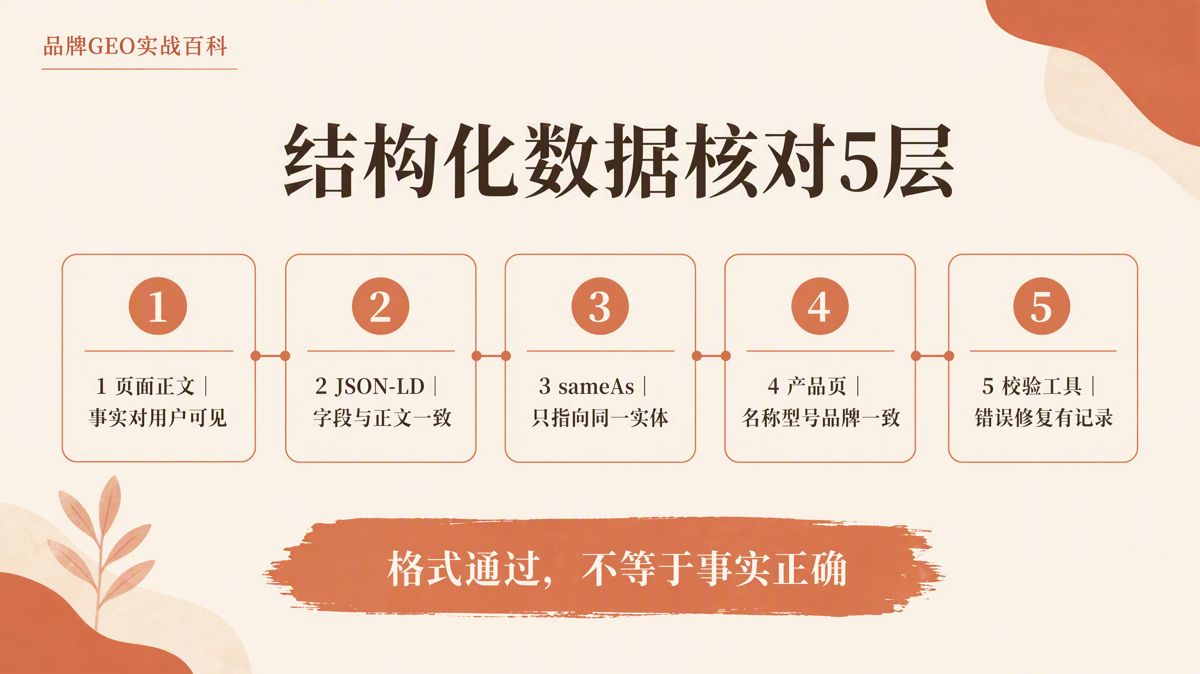
Audit these five layers before deploying:
| Audit Layer | Scope of Check | Pass Criteria |
|---|---|---|
| Visible Page Copy | Names, descriptions, executives, products, addresses | Users can clearly see and read every stated fact on the page |
| JSON-LD Markup | Schema types and properties match the primary subject | Markup aligns with visible copy; no hidden facts declared solely in code |
sameAs Links |
External links confirm the exact same entity | Points to owned profiles and authoritative directories, not partners or press |
| Product Pages | Product markup represents the specific item on display |
Name, SKU, brand, and specifications match page copy exactly |
| Syntax Validators | Structural errors, missing required fields, schema warnings | Zero critical errors; all warnings evaluated and documented |
Google's Structured Data General Guidelines state that markup must accurately represent the primary topic of the page and correspond directly to user-visible content. Valid syntax alone does not guarantee special search displays or knowledge panel inclusion.
Passing a syntax check only confirms that your code is formatted correctly. It does not prove your brand facts are true, nor does it force an AI search engine to cite your content.
Reference documentation:
7. Audit Retrieval Results Across AI Search Engines
After completing internal audits, test how third-party AI search engines and answer engines currently parse your entity.
Run a standardized set of test prompts across major AI engines:
- What is the registered legal name of [Company]?
- Who owns [Brand]?
- What are the core products or services offered by [Brand]?
- Who is the founder or public executive of [Company]?
- What is the headquarters location, founding year, and official website for [Brand]?
- How is [Product] related to [Brand] and [Company]?
Log the exact prompt, platform, date, generated output, cited URLs, and any factual errors. Classify results into four states:
- Accurate: Entity identity, core facts, and relationships contain no meaningful errors.
- Missing: The engine retrieves no relevant information or claims the entity does not exist.
- Confused: The engine conflates distinct brands, subsidiaries, founders, or competing products.
- Outdated: The engine generates deprecated names, legacy office locations, or discontinued offerings.
When you spot errors, do not just tweak your test prompts. Trace the failure back to its source:
- Is the fact sheet missing canonical data?
- Do different subpages on your domain present conflicting claims?
- Are authoritative third-party directories hosting obsolete records?
- Did your structured data invert parent-child entity relationships?
- Has the AI engine simply not refreshed its index since your updates?
One accurate response does not guarantee long-term stability. Whenever your leadership, product lineup, or corporate structure shifts, re-run this audit.
Red Flags: When to Pause Your Launch
If any of the following issues remain unresolved, halt your deployment:
- Boundaries between company, brand, and product lines are blurred or undocumented.
- The same entity uses different naming conventions across core pages without an alias mapping.
- Ownership structures, leadership roles, or product hierarchies contradict each other.
- Key claims lack verifiable source links, or the cited source references a different entity.
- Structured data contains claims not visible in the page copy.
sameAsreferences point to external pages that do not verify the exact same entity.- The entity record lacks an assigned owner, revision history, or verification date.
Halting a launch costs far less than cleaning up systemic errors later. Once corrupt entity data distributes across external knowledge graphs, tracing and reversing the bad facts takes months.
Frequently Asked Questions
1. If our company name and brand name are identical, should they still be cataloged separately?
Yes. They share a name, but the company is a legal entity, while the brand is a commercial identity facing the market. Separating them before linking them hierarchically prevents products, certifications, and social accounts from mapping to the wrong entity layer.
2. Must brand bios match word-for-word across all platforms?
No. Bios can vary in length and tone depending on the channel. However, underlying facts—such as legal name, brand name, product scope, ownership, and founding year—must stay completely consistent.
3. Should we add as many sameAs links as possible?
No. Every link must point to a canonical profile that clearly verifies the exact same entity. Never add partner websites, standard press releases, or ambiguous accounts just to inflate link counts.
4. Does passing Schema validation mean our entity modeling is complete?
No. Schema validators only check code syntax and field requirements. They cannot verify whether relationships are directionally accurate, whether claims match page copy, or whether facts are supported by evidence.
5. What should we do if we lack independent third-party sources?
Focus on publishing verifiable documentation and clear entity profiles on your official domain first, then build legitimate third-party coverage over time. Never fabricate reviews or create unsupported directory entries. Mark unverified claims as pending.
6. How often should an entity master record be updated?
Update it immediately whenever a company renames, releases new product lines, changes executives, or moves offices. Otherwise, review it on a fixed recurring schedule, documenting every revision date and owner.
Final Note
A pre-launch GEO entity modeling audit is not about filling out every optional field in a Schema template. It comes down to four fundamentals:
- Core entities are not conflated.
- Relationship directions are accurate.
- Every key fact is supported by evidence.
- Every revision can be traced to a source and an owner.
Passing all seven checks does not guarantee that every AI engine will immediately index, cite, or feature your brand. But it eliminates self-inflicted indexing ambiguities, ensuring your public brand presence remains clear, coherent, and verifiable.
Validating your facts before release is always faster than fixing tangled knowledge graphs after the fact.
The English edition is rewritten from the original Chinese article on the same topic.

Starbox AI is an AI marketing company based in Hangzhou, China. This article draws on Starbox project work. Please credit the source when quoting.
Related reading
 GEO Guide
Why AI Marketing Vendor Quotes Vary 10x: A 4-Step Vetting Checklist
Evaluate AI marketing proposals by delivery actions, not slide decks. Audit source infrastructure, fact cleaning, and clean-environment testing.
Oct 22, 2026 · 6 min read
 GEO Guide
Spotting GEO Scams: What Actually Drives AI Recommendations?
Automated AI ranking promises violate how LLMs work. Real AI recommendations rely on authoritative, structured facts across trusted public sources.
Oct 22, 2026 · 4 min read
 GEO Guide
How to Measure Your Brand's AI Visibility with a Spreadsheet
You do not need expensive software to track AI recommendations. A three-tier prompt framework and a simple spreadsheet can score your brand visibility in half a day.
Oct 21, 2026 · 6 min read