
7 Mandatory Checks Before Launching Your GEO Campaign

The short answer
Before publishing content for AI search engines, run these 7 pre-launch checks to ensure brand consistency, crawler readability, and factual accuracy.
Generative Engine Optimization (GEO) is the practice of structuring brand facts, digital assets, and web pages so that generative AI search engines can easily find, understand, and cite them. In this context, AI search refers to conversational queries where an AI model synthesizes a direct answer, and "launching" means publishing a batch of content or pages to the public web. The ultimate goal of GEO is to help AI models accurately identify your brand, understand your business, and cite verifiable proof.
When marketing teams prepare a GEO release, they often focus entirely on content volume and whether draft articles are completed. In doing so, they miss conflicting details across touchpoints: using a legal entity name on the official website while using an unverified abbreviation on social media; stating strong conclusions without citing sources; or serving pages that render fine in desktop browsers but return empty HTML to search engine bots. When errors surface post-launch, nobody knows which previous version to roll back to.
Individually, these issues seem minor. Combined, they undermine three foundations: brand credibility, crawler accessibility, and operational reversibility.
A pre-launch review must look beyond word counts. It needs to evaluate core brand facts, test prompts, primary evidence, technical rendering, multi-source consistency, compliance, and post-launch monitoring. A failure in any critical category should pause the entire rollout.
Lock Down Three Boundaries Before You Start
Before testing individual pages, answer three operational questions: What are you auditing? Which prompts are you testing? Which release batch does this audit apply to?
- Audit Scope: List every specific page, social account, structured data schema, and third-party channel included in this release. Do not expand the scope midway through testing.
- Benchmark Prompt Set: Finalize the exact set of user queries used to evaluate how AI models interpret your brand. Once locked, do not alter prompt wording during the current testing cycle.
- Release Batch: Document the project owner, review date, asset version numbers, and target publication date. Every test result must map to a specific asset version.
Without fixing these boundaries, audit findings cannot be reproduced. If you evaluate one set of pages today, change the prompts tomorrow, and still treat yesterday's "Pass" as valid, your historical data becomes useless.
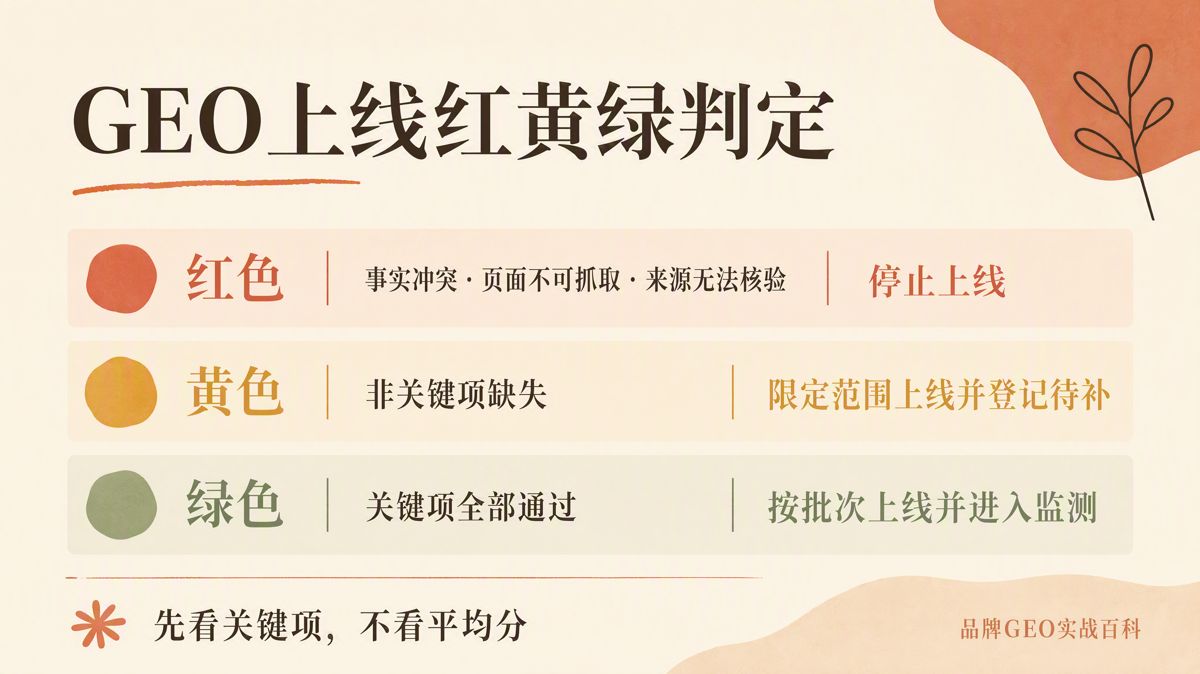
Classify audit findings into three actionable statuses:
| Status | Criteria | Action |
|---|---|---|
| Red | Factual conflicts, unindexable pages, unverifiable claims, or clear compliance risks | Halt deployment. Fix issues and rerun the full check. |
| Yellow | Non-critical omissions that do not compromise brand identity or factual truth | Release with limited scope. Assign an owner and a hard fix deadline. |
| Green | All critical checks pass; non-critical items have assigned owners | Proceed with phased rollout and enter ongoing monitoring. |
1. Are There Conflicting Versions of Brand Facts?
Your brand review must answer two foundational questions: Who is this company, and what products or services does it offer?
Different pages may use formal legal names, registered brand names, or shorter taglines. Sentence structures will vary. However, core business facts must never contradict each other. Company names, founding dates, locations, and service parameters must align across every channel.
Audit the following items line by line:
- Do legal entity names, primary brand names, English names, and former trade names match across channels?
- Are foundational facts—founding year, headquarters location, founders, and executive leadership—backed by verifiable sources?
- Are core product names, SKUs, target audiences, and service scopes standardized?
- Do website footers, "About Us" pages, product specifications, and public social profiles align without contradictions?
- Have retired product lines, legacy addresses, and deprecated contact details been completely removed or marked as historical?
- Does the metadata in your page source match what real users see on the screen?
The last item involves structured data. Structured data consists of standardized tags added to your page code to help search crawlers and AI bots interpret content. For instance, schema markup categorizes brand details under Organization and product specs under Product. While human visitors do not see this code, the entity names, URLs, and feature specs inside your schema must match your visible body copy.
2. Are Your Test Prompts Reusable?
You cannot measure GEO performance by gut feeling. Before deployment, build a standardized, reusable prompt set and record baseline answers using a fixed methodology.
Your test prompts should cover these categories:
- Entity recognition: What is the brand, what does it do, and who is it built for?
- Problem-solution fit: Which product should a buyer choose for a specific use case?
- Competitive differentiation: How does the brand compare to primary alternatives?
- Commercial trust: Inquiries regarding certifications, pricing models, delivery terms, and customer support.
- Colloquial robustness: Can the AI engine resolve brand identity when users type abbreviations, typos, or conversational language?
Number each prompt and lock the version. For every test run, log:
- The target AI platform tested;
- The exact prompt text entered;
- Test execution date;
- Whether the generated response mentions the brand;
- Which specific URLs the model cites as sources;
- Any factual inaccuracies present in the generated answer.
Run a comprehensive baseline test before publishing. Baseline testing captures the exact answers AI engines generate prior to your content release. After launch, rerun the identical prompts across the same engines using the same recording standards.
If you change your test prompts and target platforms at the same time, you cannot determine whether answer variations stem from your new content or from altered testing conditions.
3. Can Every Key Claim Be Traced to Proof?
Reviewing content is not just about checking spelling and grammar. You must verify whether every central claim can be independently audited.
For each piece of content scheduled for release, verify:
- Does the headline directly address a real customer query?
- Does the opening paragraph state the conclusion first before presenting supporting arguments?
- Can critical statistics, industry credentials, case studies, and regulatory claims be traced to accessible sources?
- Does each cited source directly support the specific claim made, rather than merely sharing a general topic?
- Are time-sensitive data points labeled with clear publication dates or version numbers?
- Does the article contradict itself across different sections?
- Are multiple assets just identical copy republished under slightly altered headlines?
- Have unverifiable marketing claims (e.g., "guaranteed results" or "instant indexing") been deleted?
Content volume is not a KPI for deployment readiness. Ten well-researched, fact-checked articles with transparent citations provide more AI visibility value than one hundred duplicative, unsourced, or conflicting pages. When issues arise, a leaner, high-integrity content footprint makes root-cause tracing far easier.
4. The Page Loads, but Can Web Crawlers Read the Body Text?
A page loading smoothly in your browser only proves that human visitors can see it. It does not prove that search engine bots and AI web crawlers can extract your body copy.
Many modern websites rely on client-side scripts—code that executes inside the user's browser after the initial page request. If your web server delivers a blank HTML shell that relies entirely on client-side rendering to populate text, certain AI crawlers will miss your content entirely.
Your technical readiness check must confirm:
- Public URLs load without requiring account logins, CAPTCHAs, or geo-restricted IP access.
- Inspecting the raw HTML source code reveals the title, complete body text, and core links.
- Critical content does not depend entirely on client-side script execution to render.
- The
robots.txtfile does not accidentally block AI crawlers you intend to welcome. - The XML
sitemapincludes all newly deployed URLs using your canonical production domain. - Canonical tags (
rel="canonical") point to the intended primary URL. - Structured data markup validates through standard schema testing tools without syntax errors or content discrepancies.
- Mobile rendering displays cleanly without overlapping UI elements, broken tables, or hidden text.
- Page update timestamps, author attribution, publishing organization, and contact paths are visibly displayed.
Never deploy a generic robots.txt template that blindly allows or blocks all user-agents. Review the official documentation for the crawlers associated with your target AI engines. Identify the specific User-Agent strings used by those crawlers, then configure access rules that align with your data governance, copyright, and server infrastructure policies.
5. Do Multiple Public Sources Corroborate Each Other?
Your corporate website acts as the primary record for your brand facts. However, AI models build conviction by cross-referencing industry publications, verified platform accounts, discussion forums, technical documentation, and customer reviews.
A multi-source check is not about tallying how many social profiles your team owns. It is about checking whether independent digital touchpoints consistently corroborate the same reality.
Verify the following before release:
- Do your primary website and your verified corporate social channels present identical core company facts?
- Have outdated product details, legacy addresses, and deprecated pricing been purged from secondary channels?
- Are major certifications, industry awards, and customer case studies supported by accessible, downloadable assets or independent coverage?
- Do external profiles publish unique, context-specific insights rather than verbatim copy pasted from your website?
- Have you avoided creating fake user accounts to publish manufactured reviews?
- Have you avoided publishing self-serving encyclopedia or wiki entries that lack independent citations?
- If third-party directories contain inaccurate corporate data, have you logged correction requests and tracked their resolution?
Multiple public sources should support a unified truth from distinct operational angles, not amplify the exact same marketing slogan across twenty channels.
6. Are Content Compliance and Asset Licenses in Order?
Factual accuracy does not automatically make content safe to publish. Commercial claims, regulatory requirements, AI-generated disclosures, data privacy, and media licenses require explicit review.
Run compliance audits across four areas:
- Advertising Language: Remove absolute, unprovable claims such as "the best," "industry-first," or "guaranteed outcome."
- Regulated Verticals: In sectors like healthcare, financial services, legal, or food safety, verify that content meets governing marketing guidelines and includes mandatory disclaimers.
- AI Content Labeling: Comply with platform guidelines regarding explicit disclosures (informing readers that content was AI-assisted) or implicit metadata labeling.
- Data Privacy: Ensure that screenshots, customer quotes, support workflows, and order references do not expose unauthorized personal names, phone numbers, email addresses, or proprietary customer data.
Finally, verify commercial licenses for all images, typography, research charts, and third-party data sets. Having accurate facts in an article does not grant the right to use copyrighted assets without permission.
7. Who Owns Monitoring, and Which Version Can You Roll Back To?
Hitting "Publish" is not the end of the GEO process. Before deploying, determine who owns the rollout, when re-testing occurs, and how to revert changes if errors emerge.
Document these operational details in advance:
- Clear ownership for every published URL and channel;
- The exact dates for the initial post-launch spot check and the first full evaluation cycle;
- Defined responsibilities for verifying reported inaccuracies and executing fixes;
- The storage location for original copy drafts, production assets, and changelogs;
- Pre-launch records containing page screenshots, URLs, timestamps, and baseline AI engine responses;
- A tested rollback plan to take an errant batch offline and restore the previous stable version immediately;
- Confirmation that post-launch audits will use the exact same prompts, platforms, and evaluation criteria as the pre-launch baseline.
Without clear owners and version histories, teams waste days debating who authorized an edit and what changed. That delay prolongs exposure to factual errors and invalidates longitudinal testing.
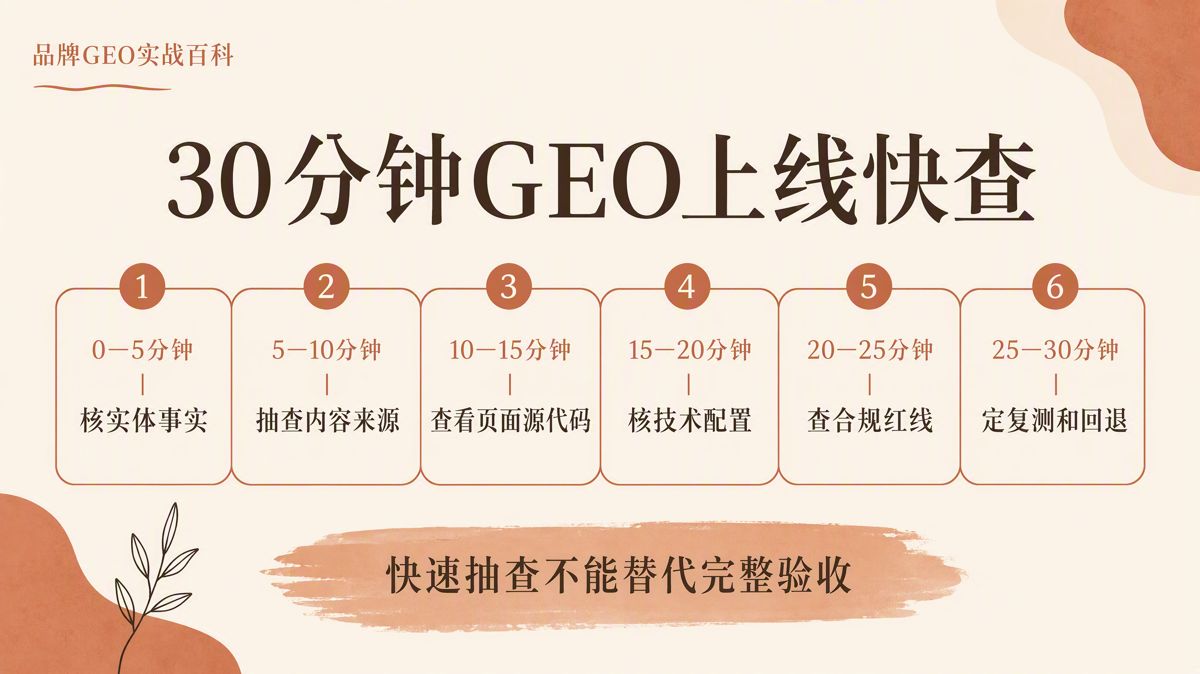
Only Have 30 Minutes? Run This 6-Point Triage
When deadlines leave no room for a comprehensive audit, execute this rapid 30-minute triage:
| Time | Audit Focus | Pass Standard |
|---|---|---|
| Min 0–5 | Brand, entity, product names, and contact data | Zero contradictions across primary pages and profiles |
| Min 5–10 | Spot-check three random articles for citations | Every core claim traces directly to accessible proof |
| Min 10–15 | Inspect raw HTML source code on three key pages | Title and body text are fully visible without login |
| Min 15–20 | Review robots.txt, sitemaps, canonicals, schema |
No unintentional crawler blocks, 404s, or schema mismatches |
| Min 20–25 | Scan for absolute claims, sector rules, and private data | Zero high-risk compliance or copyright exposures |
| Min 25–30 | Confirm baseline data, owners, audit dates, and backup | All four operational records are documented |
This rapid check does not replace a full review, but it flags critical blockers that warrant halting a release.
Deciding to Launch: Priority Items Come First
Do not score a GEO checklist by averaging all items together.
Missing an optional metadata property in your schema is not equivalent to publishing conflicting company names or serving empty HTML to web crawlers. The former can be scheduled for a fast follow-up; the latter directly breaks AI comprehension and indexing.
Establish a clear boundary between non-negotiable prerequisites and non-critical optimizations. Assign owners and firm delivery dates to non-critical items.
Halt your release immediately if any of the following occur:
- Core brand facts present conflicting records across channels;
- Primary pages cannot be crawled publicly, or body copy is missing from raw server-rendered HTML;
- Major claims cite unverifiable figures, customer credentials, or awards;
- Content carries clear legal, copyright, or platform compliance violations;
- The team has not established a pre-launch baseline or a functional rollback version.
The goal of a pre-launch GEO check is not to achieve an arbitrary score. It is to confirm four fundamental truths: your brand facts are uniform, your claims are verifiable, your content is accessible to web crawlers, and your team has the governance in place to catch errors and roll back changes instantly.
Frequently Asked Questions
1. Is a longer GEO checklist always better?
No. A checklist must cover major risks, but distinguishing critical blockers from non-critical follow-ups is far more important. A checklist that adds items without defining pass/fail criteria cannot support launch decisions.
2. Can we run checks on social platforms if we don't have an official website?
Yes, but you must first establish a single brand master record—a verified source of truth for brand facts. Without one, adding more accounts only increases the risk of factual contradictions.
3. If robots.txt allows access, does that guarantee AI crawlers will index our pages?
No. You still need to verify HTTP status codes, whether body copy is accessible in raw HTML source code, internal link visibility, server response times, and individual crawler behaviors. Permission to crawl does not guarantee indexing or citation.
4. Can we go live once our structured data passes schema validation?
No. Schema validators only verify syntax and standard field requirements. They do not verify whether facts are true, compliant, or consistent across different public channels.
5. How often should we re-test AI search responses after launching?
Set a recurring cadence based on your content publishing schedule and platform algorithm updates. Run spot checks immediately after a rollout, then switch to weekly or monthly benchmarks using the exact same prompt set.
6. Does passing every checklist item guarantee that AI search engines will recommend our brand?
No. Pre-launch checks eliminate controllable errors in facts, content, technical infrastructure, and operations. They cannot force any platform to cite or recommend your brand, but they ensure your performance can be tracked, measured, and reviewed.
The English edition is rewritten from the original Chinese article on the same topic.

Starbox AI is an AI marketing company based in Hangzhou, China. This article draws on Starbox project work. Please credit the source when quoting.
Related reading
 GEO Guide
Why AI Marketing Vendor Quotes Vary 10x: A 4-Step Vetting Checklist
Evaluate AI marketing proposals by delivery actions, not slide decks. Audit source infrastructure, fact cleaning, and clean-environment testing.
Oct 22, 2026 · 6 min read
 GEO Guide
Spotting GEO Scams: What Actually Drives AI Recommendations?
Automated AI ranking promises violate how LLMs work. Real AI recommendations rely on authoritative, structured facts across trusted public sources.
Oct 22, 2026 · 4 min read
 GEO Guide
How to Measure Your Brand's AI Visibility with a Spreadsheet
You do not need expensive software to track AI recommendations. A three-tier prompt framework and a simple spreadsheet can score your brand visibility in half a day.
Oct 21, 2026 · 6 min read