
How to Choose GEO Tools in China: 5 Layers and a 7-Day Pilot
The short answer
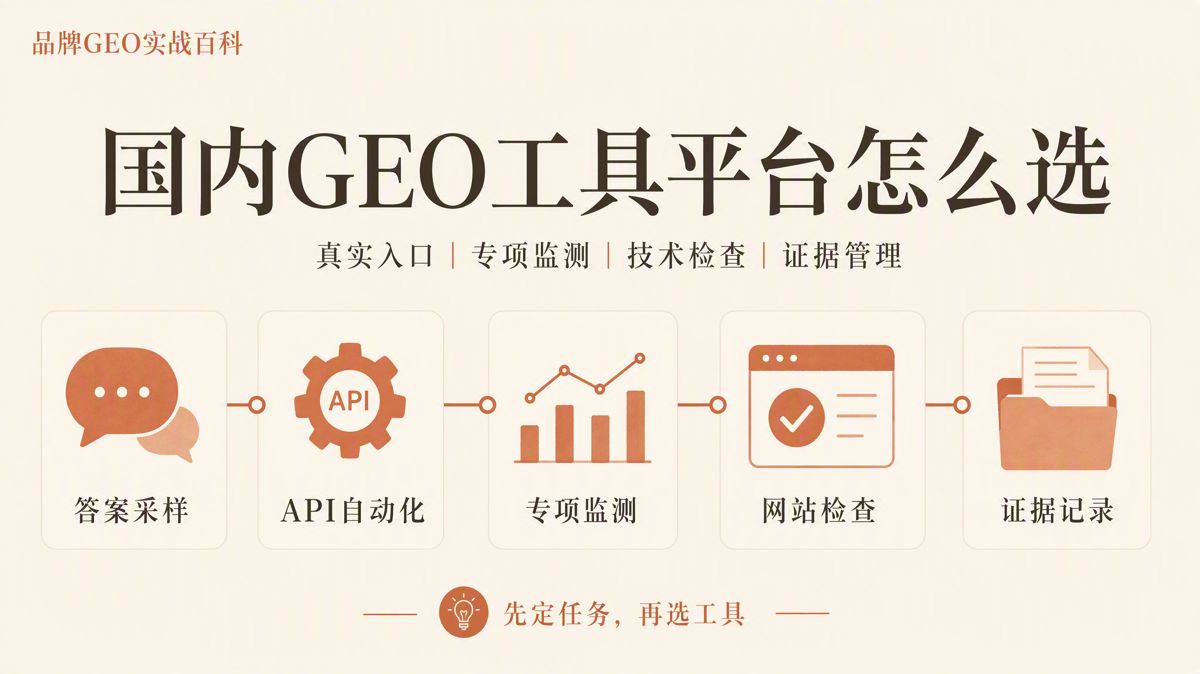
Evaluate Chinese GEO tools across five distinct capability layers and run a 7-day pilot to ensure your AI search monitoring delivers verifiable results.
Generative Engine Optimization (GEO) is an ongoing operational workflow built around AI engine responses: checking whether your brand appears, where it ranks, whether the stated facts are accurate, which sources are cited, and then correcting issues and retesting under identical conditions.
GEO is not a software license you purchase once or an aggregate dashboard score you check occasionally. A complete workflow requires at least four operational stages: querying live AI platforms, capturing auditable raw text and screenshots, auditing website and content bottlenecks, and retesting under controlled conditions.
No single tool currently handles all of these steps on its own. Before evaluating software, you do not need to ask which product has the longest feature list. You need to answer two operational questions:
- Which capability layer is your team currently missing?
- Can the results generated by this tool be independently audited?
Every software purchasing decision comes down to three criteria: whether raw outputs can be audited, whether test conditions and statistical definitions remain consistent, and whether your team can retest remediated assets under identical conditions.
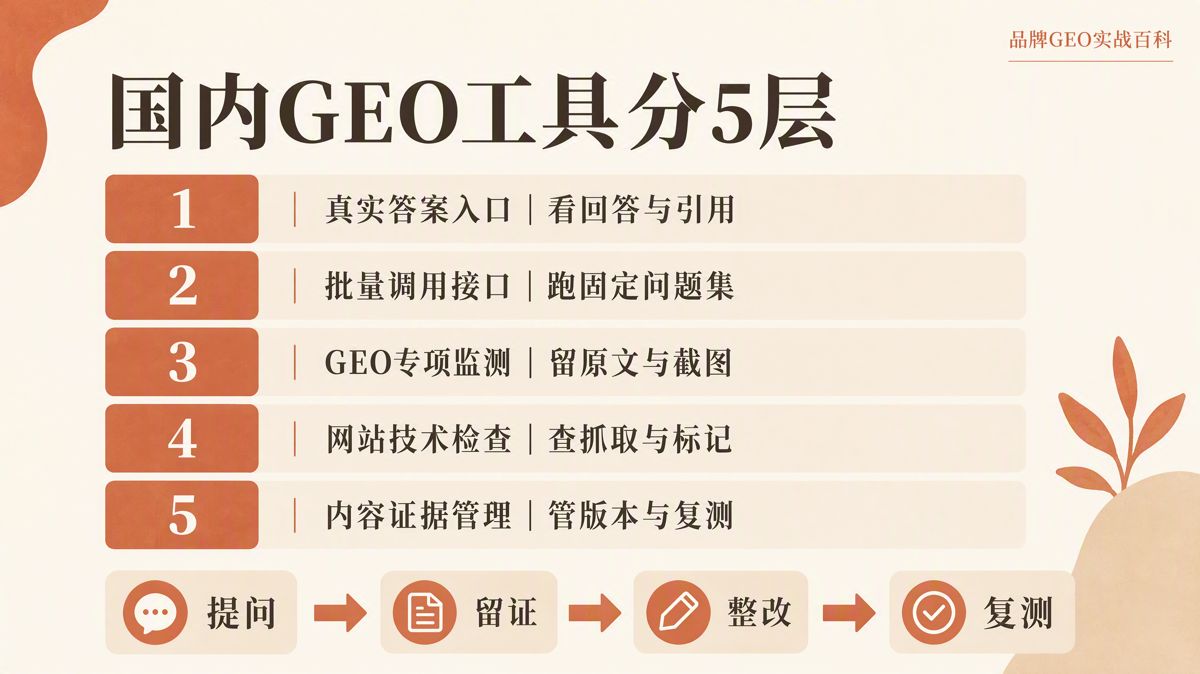
1. Classify GEO Tools into Five Functional Layers
Different software vendors use interchangeable terms like "monitoring," "diagnostics," "optimization," and "indexing," yet they solve entirely different technical problems.
Before reviewing vendors, group your tool stack into five functional layers. In this breakdown, an API (Application Programming Interface) allows systems to submit batched prompts and log responses programmatically according to preset rules. A CMS (Content Management System) manages published website pages and articles.
| Tool Layer | Representative Tools / Platforms | Primary Purpose | What It Cannot Replace |
|---|---|---|---|
| Consumer Endpoints | Doubao (ByteDance's AI assistant), Tongyi Qianwen (Alibaba's AI assistant), DeepSeek, Tencent Yuanbao, Kimi (Moonshot AI's assistant), ERNIE Bot (Baidu's AI assistant) | View answers, ranking order, and citations as prospective buyers see them | Cannot automatically aggregate long-term historical trends |
| Batch APIs & Automation | Volcengine Ark web search, DeepSeek API, custom enterprise scripts | Run automated batch queries, parse responses into standardized schemas, and run initial text classification | Cannot directly mirror consumer web or mobile app outputs |
| Dedicated GEO Monitoring | Jiasou GEO, Gongfengyun | Query multiple platforms, calculate brand visibility, rank positions, and competitor share of voice while saving screenshots or raw text | Cannot guarantee that any platform will recommend your brand |
| Website Technical Audits | Baidu Search Resource Platform, Schema.org Markup Validator, general web crawlers | Verify whether crawlers can render pages, check indexation, review access directives, audit sitemaps, and validate structured data | Cannot replace content accuracy or third-party authoritative references |
| Content & Evidence Management | Spreadsheets, relational databases, CMS, version control repositories | Maintain standardized prompt banks, verified brand facts, content revision logs, task ownership, and retest results | Cannot substitute for real-world platform verification |
Here, a "prompt bank" refers to a fixed, versioned set of benchmark questions. "Structured data" refers to standardized code that labels entities such as brands, products, and organizations to help machines parse page contents. A "version control repository" logs every revision made to underlying files.
These five layers address five distinct operational problems. Buying software in just one layer will leave gaps in the core loop: prompt, capture, remediate, and retest.
Product names, pricing tiers, and packaging will change, but the underlying work remains consistent. Map your missing layer first, then evaluate software built specifically for that task.
2. Why Evaluating GEO Tools Feels Confusing
The difficulty in selecting tools is rarely a shortage of options. It stems from vendors using identical marketing terms to describe completely different software capabilities.
Some platforms specialize in querying multiple AI engines simultaneously. Others focus on taking screenshots, aggregating mention rates, and compiling reports. Some audit technical website infrastructure, while others emphasize automated content generation and media syndication.
Without clear internal scoping, buyers easily mistake these distinct features for an integrated workflow.
During a sales demonstration, an aggregate visibility score might look like it covers diagnosis, remediation, and retesting. In practice, teams discover after purchase that the score cannot be traced back to raw AI text, prompt banks cannot be exported, model checkpoints are unrecorded, or technical site errors cannot be routed to webmasters as discrete tasks.
Before evaluating any vendor, answer five scoping questions:
- Which specific prompts do you need to monitor?
- Which AI platforms and consumer-facing endpoints must be tested?
- How will you log raw responses, screenshots, and source citations?
- When inaccuracies are discovered, what assets need to be updated?
- Once assets are updated, how will you retest under identical conditions?
Software is valuable only if it removes manual friction from these five steps. If your team does not currently need a specific feature, do not pay for it simply because the vendor dashboard looks comprehensive.
3. Keep Consumer AI Endpoints as Your Final Acceptance Gate
Consumer-facing product endpoints are where users actually read AI-generated answers. They remain the final environment where GEO performance must be verified.
A prospective buyer might open the Doubao mobile app, the Tongyi Qianwen web interface, or Tencent Yuanbao and ask: "How do I choose an enterprise CRM?" or "Recommend local B2B service providers." A single query can return different answers across platforms, across different times of day, and depending on user account status.
While manual testing cannot scale across hundreds of questions, it cannot be eliminated from the workflow. Every test record should document:
- The exact prompt;
- The platform and specific endpoint (web, mobile, or desktop app);
- Timestamp;
- Account login state;
- Web-search toggle state (whether real-time browsing was enabled);
- Full raw answer text;
- Cited URLs;
- Brand recommendation rank;
- Full-screen capture.
High-priority queries should be tested multiple times across several days to avoid mistaking a single non-deterministic output for a permanent trend.
Testing must also separate brand recognition from unprompted brand recommendations.
To evaluate brand recognition, include your brand name directly in the prompt and observe whether the engine accurately states your corporate entity, product capabilities, and official domain. To evaluate unprompted recommendation, run non-branded category queries to see whether the model selects your brand organically.
These two query types serve completely different diagnostic purposes and must be measured separately. A brand might enjoy a flawless profile when queried by name, yet never appear in unprompted category roundups. Blending both into a single aggregate metric distorts your baseline data.
4. Use Batch APIs for Tracking, Not as Consumer Proxies
APIs excel at high-volume, standardized monitoring. They allow teams to run a frozen prompt set daily, export responses as structured JSON, compute brand mention rates, track which external domains are cited, and generate diff reports across dates.
According to the Volcengine Ark official documentation, tool invocation includes Doubao assistant web-search and private enterprise knowledge-base retrieval. The DeepSeek official API documentation shows that its interface supports standard API request formats compatible with OpenAI and Anthropic SDK patterns.
However, API outputs reflect only that specific endpoint configuration. They do not mirror what an end user sees inside consumer web browsers or mobile apps.
A variety of parameters influence outputs: base model versions, web-search tools, system instructions, server regions, request timestamps, and temperature parameters. System instructions are baseline behavioral rules injected by the platform before user input. Even with an identical prompt, an API call and a consumer app session can produce entirely different answers.
When evaluating API-driven monitoring tools, clarify these operational details:
- Does the tool call official enterprise APIs, or does it automate consumer web sessions?
- Are raw request payloads and raw response bodies preserved?
- Does the system log the specific model identifier and runtime parameters?
- How are timed-out or failed requests flagged?
- Are failed queries mistakenly counted as zero-mention responses in aggregate dashboards?
If a vendor cannot answer these questions, its trend charts cannot be audited.
The most reliable approach is to use APIs for broad daily tracking, supplemented by weekly manual spot checks across consumer endpoints for top-tier commercial queries. Never merge these data sources into a single metric; label them clearly as API Samples and Consumer Endpoint Samples.
5. Evaluate Dedicated GEO Platforms Beyond Simple Platform Coverage
China's GEO software market is evolving rapidly. The total number of supported platforms displayed on a vendor landing page shows only claimed surface coverage, not data fidelity or auditability.
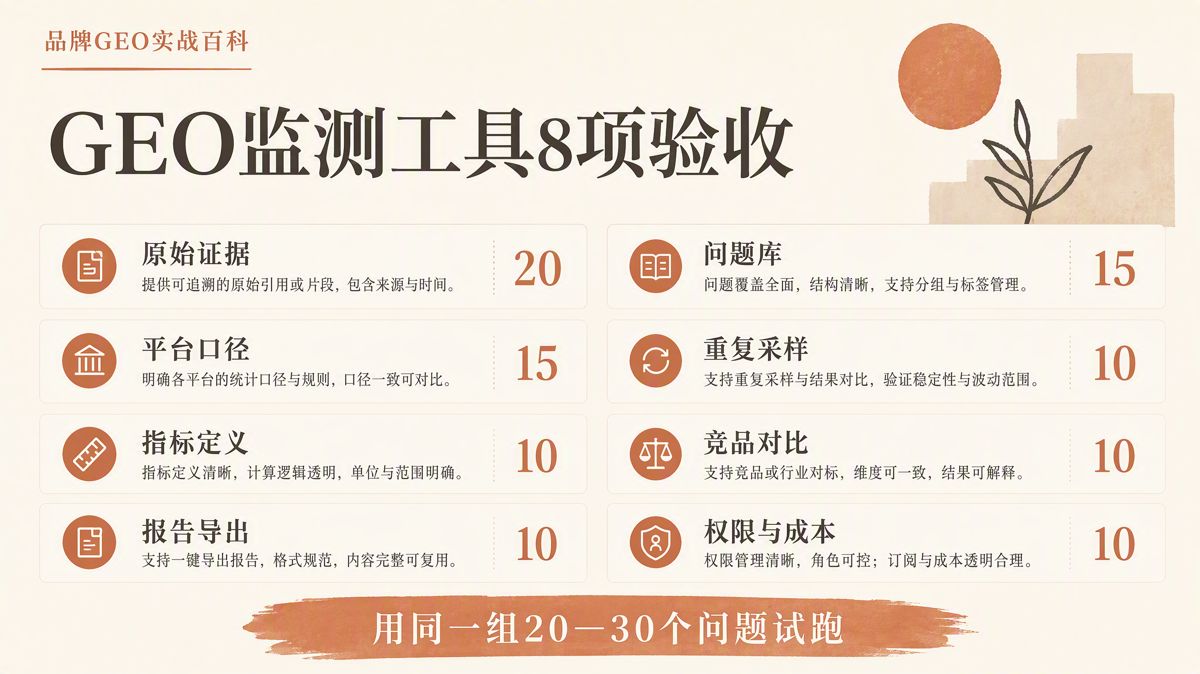
To compare vendors objectively, select a fixed benchmark of 20 to 30 prompts, run them simultaneously across both candidate platforms, and score them against eight operational criteria:
| Evaluation Criteria | What to Verify | Suggested Weight |
|---|---|---|
| Raw Evidence | Full response text, timestamp, full-page screenshot, and all cited URLs captured | 20 |
| Prompt Bank Management | Custom tagging, category grouping, CSV import/export, and version freezing | 15 |
| Endpoint Clarity | Clear distinction between web interfaces, mobile apps, APIs, and real-time search states | 15 |
| Repeated Sampling | Support for running the same query multiple times while logging each discrete iteration | 10 |
| Metric Definitions | Transparent formulas for mention rate, top-rank rate, and recommendation share | 10 |
| Competitor Benchmarking | Competitors evaluated against identical prompts within the exact same time window | 10 |
| Export Fidelity | Full export of raw data per prompt rather than aggregated PDF charts alone | 10 |
| Access & Billing | Clear role-based permissions, data retention windows, query quotas, and overage fees | 10 |
Mention rate generally refers to the percentage of answers that mention your brand, while top-rank rate measures how often your brand is listed first in recommendation lists. However, calculation rules vary between tools, and recommendation rate can carry multiple definitions. Demand exact algorithmic definitions from every vendor.
This rubric is not a rigid industry standard. Its purpose is to anchor sales conversations around auditable features rather than marketing claims.
Public information on the Jiasou GEO product page indicates that its browser extension runs automated tests across authenticated user sessions in Doubao, Tencent Yuanbao, DeepSeek, Tongyi Qianwen, ERNIE Bot, and Kimi, saving screenshots, calculating mention rates, and exporting reports. A browser extension is a local plugin that automates actions inside an active browser profile.
Public information on the Gongfengyun product page shows that its platform provides multi-engine querying, brand citation analysis, and technical audits for robots.txt, sitemaps, and JSON-LD markup:
- robots.txt: A plain text file instructing automated crawlers which parts of a website they can access;
- sitemap: An XML file listing all discoverable URLs on a website;
- JSON-LD: A standardized JavaScript-based format for embedding structured data within web pages.
These two vendors use fundamentally different architectural approaches and serve different team setups. Marketing teams prioritizing consumer-facing visual evidence may lean toward browser-based capture tools, while teams looking to combine answer monitoring with website technical health checks should evaluate platforms with built-in site auditing.
These capabilities reflect public vendor documentation. Before signing a contract, run a pilot using your own brand terms, competitors, and prompt sets rather than treating marketing pages as verified performance.
6. Technical Audits Surface Site Blockers, Not Recommendations
GEO cannot be conducted solely inside AI chat windows. Your technical web infrastructure must be audited alongside external visibility.
If your official website cannot be rendered by search spiders, if core content is trapped behind client-side JavaScript that search crawlers cannot execute, if robots.txt accidentally blocks major bots, or if sitemaps are stale, content updates will fail to influence AI training or retrieval indexes.
According to the Baidu Search Resource Platform documentation, the portal supports site ownership verification, index volume tracking, crawl diagnostics, crawl exception analysis, and manual URL submission. Crawling refers to bots fetching web content, while index volume measures the total number of pages added to the search index. Baidu's documentation explicitly clarifies that index volume does not correlate directly to traffic volume.
The Schema.org Markup Validator checks whether structured data markup complies with official Schema.org syntax. Schema markup provides standardized semantic labels that help machines understand entities on a page.
However, passing validation does not guarantee that search engines or AI assistants will use that structured data. Similarly, ensuring that a website is crawlable does not mean an AI engine will recommend the brand.
Record technical audit results accurately in internal reports:
- Crawl status: Passed;
- Structured data: Validated;
- Index volume: Recorded change.
Never summarize these technical milestones as "Indexed by all Large Language Models."
Whether an AI platform recommends your brand must still be verified by running frozen prompt banks inside real-world AI engines or dedicated GEO monitoring software.
7. Spreadsheets and Databases Enable Long-Term Auditability
GEO is an iterative operational program, not a one-off audit. Benchmark prompts, canonical brand facts, content versions, remediation tickets, and retest data must remain connected over time.
For smaller pilot projects, a clean spreadsheet is sufficient. As your prompt volume, brand portfolio, and testing frequency grow, migrate this data into a relational database, CMS, or version-controlled repository.
Regardless of your software stack, your internal documentation must answer:
- Which prompt bank version was used for this test cycle?
- What platforms and runtime parameters were applied?
- Which specific answer contained factual errors?
- Which web page or content asset was updated to address the error?
- Who owns this remediation ticket?
- What was the completion date?
- How did the retest results change compared to the previous run?
If this information is scattered across unorganized screenshots, chat histories, and desktop files, buying an enterprise dashboard will still leave your team unable to track operational progress.
8. Match Your Tool Stack to Team Scale
Monthly Audits: Start with Manual Workflows
If your team audits AI visibility once a month, you do not need complex enterprise software.
Build a core prompt bank of 30 to 50 high-intent questions. Select three to four consumer AI platforms, submit the queries manually, and log full answers. Use a spreadsheet to track brand appearances, ranking positions, factual errors, and citations. Audit your domain using Baidu Search Resource Platform and the Schema.org Markup Validator.
This setup requires zero incremental software spend. However, it requires a disciplined team member to maintain prompt consistency and record test parameters accurately every month.
Over 100 Prompts: Add Dedicated GEO Monitoring
When your monitoring bank exceeds 100 prompts, covers more than four platforms, or requires monthly executive reporting, integrate dedicated GEO monitoring software.
Prioritize software that offers reliable batch runs, visual screenshot capture, and full raw-data exports. An aggregate visibility index without accessible underlying answers is useless for operational remediation.
Daily Tracking: Integrate APIs and Databases
If your brand requires daily tracking across multiple product lines or regional markets, integrate automated APIs and a relational database.
At this level, you must implement automated error logging, repeated sampling rules, model version tracking, and scheduled manual spot checks. Automation eliminates manual data collection, but it cannot replace human editorial review.
Avoid paying for automated AI copywriting or programmatic content distribution features until your team has assigned dedicated editors to review technical accuracy. Generating high volumes of unverified content without review accountability creates compliance and brand reputation risks.
9. Run a 7-Day Pilot: Skip the Demo, Run Real Workflows
The objective of a software trial is not to click every feature in the interface. It is to verify whether the tool fits directly into your daily operational workflow.
Day 1: Freeze Canonical Baseline Data
Document your official brand entities, primary domains, core product names, competitor lists, and monitoring scope. Keep these variables frozen throughout the pilot so that baseline data remains comparable.
Day 2: Assemble the Benchmark Prompt Bank
Ensure your prompt bank covers five essential intent stages: brand recognition, category recommendations, solution comparisons, trust and compliance verification, and negative risk queries. Assign a version identifier to the prompt bank so every candidate tool evaluates identical inputs.
Day 3: Establish a Manual Consumer Baseline
Run the benchmark prompt bank manually across consumer-facing AI interfaces. Log the platform, interface, timestamp, login state, and web-search state. Archive full raw answers, citations, and full-screen captures.
This manual dataset serves as the benchmark against which vendor platform outputs will be evaluated.
Day 4: Run Candidate Tools
Execute the exact same prompt bank across the candidate GEO platforms. Do not add or remove prompts mid-test, and avoid cherry-picking favorable answers.
Day 5: Audit Raw Data Discrepancies
Compare the candidate software's outputs against your Day 3 manual baseline. Verify raw answer text, source links, calculation formulas, and failed queries. Confirm that every aggregate chart can be drilled down to an exact prompt, timestamp, and parameter set.
Day 6: Test Workflow Collaboration
Have marketing managers, SEO specialists, and technical leads test export options, prompt tagging, and task assignment features. Verify whether diagnostic findings can be handed off seamlessly to technical and editorial teams.
If an exported report cannot be translated into actionable remediation tasks, its real-world utility is limited.
Day 7: Evaluate the Three Core Criteria
- Can the data be independently audited?
- Can the prompt bank be reused and versioned over time?
- Can remediated assets be retested under identical parameters?
If a tool provides only an aggregate score without underlying raw answers and timestamps, do not select it for formal monitoring.
If a tool reliably captures raw answers, timestamps, and cited links, it is worth adopting for long-term operational tracking—even if its dashboard interface appears plain.
10. Five Procurement Mistakes to Avoid
Mistake 1: Treating Platform Count as Monitoring Depth
A tool claiming to cover ten platforms may simply be querying the same underlying API across multiple endpoints without clear documentation. Such data is far less actionable than three auditable tests completed on consumer-facing platforms.
Platform counts are meaningful only when accompanied by transparent endpoint descriptions, runtime conditions, and verifiable raw captures.
Mistake 2: Treating a Single Output as a Permanent Fact
Generative engine outputs fluctuate due to non-deterministic sampling. Always capture multiple samples for critical queries and retest across different dates.
Relying on a single test makes it impossible to determine whether a brand recommendation represents an enduring visibility gain or random token variation.
Mistake 3: Tracking Mention Rates While Ignoring Factual Accuracy
Having your brand mentioned in an answer is not inherently positive. If an AI engine invents false product specifications, quotes incorrect pricing, or points to the wrong domain, that mention represents a factual hallucination that damages your brand.
Brand mentions, recommendation rank, factual accuracy, and source citations must be tracked as independent metrics.
Mistake 4: Buying Automated Content Tools Without a Fact Base
Investing in AI content generation without an approved prompt bank and a verified enterprise fact base prevents you from measuring whether published content moves the needle.
Automated generation speeds up drafting, but it cannot establish testing standards or verify factual accuracy.
Mistake 5: Treating Vendor Claims as Industry Standards
Vendor-reported platform coverage, customer counts, and optimization success metrics must be verified during your pilot. Marketing claims that cannot be reproduced during testing should never be used as the basis for a software procurement decision.
Making the Final Software Decision
Regardless of the features highlighted in vendor presentations, evaluate every GEO purchasing decision against three fundamental operational criteria:
- Can the raw outputs be independently audited?
- Are test parameters and statistical definitions consistent?
- Can you retest remediated assets under identical conditions?
If a tool fails on these three requirements, an expansive dashboard or broad platform coverage will not deliver reliable business insights.
If a tool satisfies these criteria, expand your stack deliberately based on audit frequency, prompt scale, and organizational workflow by adding dedicated monitoring platforms, APIs, and relational databases. You do not need to purchase every tool layer on day one, but every software investment should resolve a specific operational bottleneck and support disciplined remediation and retesting.
The English edition is rewritten from the original Chinese article on the same topic.

Starbox AI is an AI marketing company based in Hangzhou, China. This article draws on Starbox project work. Please credit the source when quoting.
Related reading
 GEO Guide
Why AI Marketing Vendor Quotes Vary 10x: A 4-Step Vetting Checklist
Evaluate AI marketing proposals by delivery actions, not slide decks. Audit source infrastructure, fact cleaning, and clean-environment testing.
Oct 22, 2026 · 6 min read
 GEO Guide
Spotting GEO Scams: What Actually Drives AI Recommendations?
Automated AI ranking promises violate how LLMs work. Real AI recommendations rely on authoritative, structured facts across trusted public sources.
Oct 22, 2026 · 4 min read
 GEO Guide
How to Measure Your Brand's AI Visibility with a Spreadsheet
You do not need expensive software to track AI recommendations. A three-tier prompt framework and a simple spreadsheet can score your brand visibility in half a day.
Oct 21, 2026 · 6 min read