
Brand Name Consistency: Master Records, Fixes, and AI Checks
The short answer
Inconsistent brand names confuse generative AI engines. Here is how to build a master record, fix entity conflicts, and verify answers across platforms.
Your official website displays your full brand name. Your content channels use an informal abbreviation. Your international accounts rely on an alternative English spelling. Deep in your website source code, legacy legal entities and outdated brand names linger.
Viewed in isolation, every variation has an internal justification. Evaluated together by artificial intelligence, they create confusion. Generative search engines struggle to determine whether these records belong to a single brand or multiple unrelated entities.
Generative engines—AI systems that ingest public web data to synthesize answers—do not rely solely on your homepage to understand your business. They pull information from verified social channels, encyclopedias, press coverage, directory listings, and technical web markup.
When names, operating entities, corporate bios, or URLs contradict one another across these sources, AI systems can fragment your brand into separate entities. In worse cases, they mix up your founding date, legal entity, or product categories with another company that shares a similar name. In AI and search architecture, an entity refers to an independently identifiable object, such as a company, brand, or individual.
A brand name consistency audit is not an exercise in forcing identical phrasing across every platform. It ensures that every approved variation explicitly resolves back to the same brand and its legal operating entity—the registered organization legally responsible for the business.
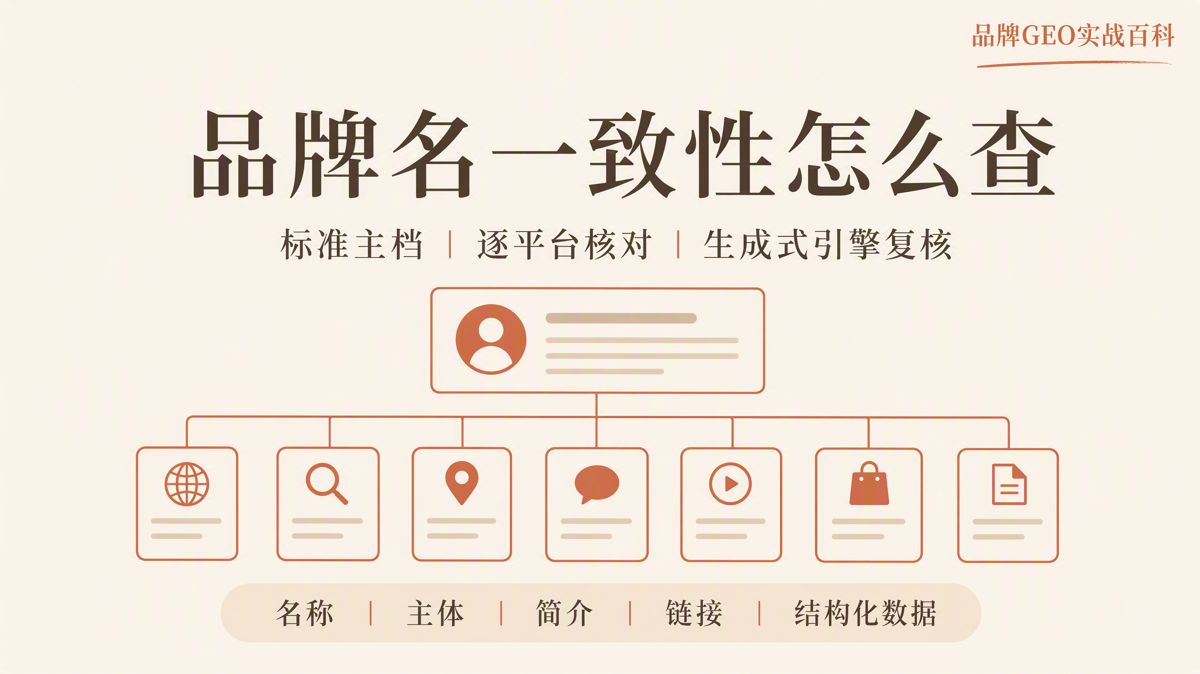
A reliable audit follows a structured workflow: build a standardized brand master record, audit names, entities, bios, URLs, and structured data, resolve conflicts by risk level, and verify results directly within generative engines.
Consistency Does Not Mean Identical Phrasing Everywhere
A full legal brand name, an official abbreviation, a verified English name, and a legacy brand name can easily coexist. The risk is not the number of variations, but whether those variations are formally approved and have clearly documented relationships.
Audits must inspect text at the character level, checking for:
- Dropped, added, or misspelled characters;
- Inconsistent spacing and punctuation;
- Deviations from capitalization guidelines;
- Inconsistencies between full-width and half-width characters (character encodings that often look identical visually in multilingual environments but register as completely different strings in code);
- Unapproved abbreviations, colloquial aliases, and unverified English spellings.
Generative engines analyze relationships across multiple public sources to decide whether two terms represent the same entity. If your website uses your full name, an industry directory omits a character, and an external profile uses an unverified English translation, the engine may split them into separate entities or contaminate your brand overview with third-party details.
Industry data highlights the value of cross-source consistency. In empirical research from seoClarity, total web mentions of a brand correlated with inclusion in AI Overviews at r=0.664, compared to only r=0.218 for backlinks. While correlation does not equal causation, this shows that an engine's ability to reliably identify a brand across multiple web touchpoints matters significantly. Source: seoClarity: AI Overviews Ranking Correlation Study
Search Engine Optimization (SEO) primarily focuses on whether web pages are crawled, indexed, and ranked for specific queries. Generative Engine Optimization (GEO) focuses on whether generative engines accurately understand, synthesize, cite, and recommend your brand in generated answers.
Both disciplines rely on crawlable, verifiable public data. The key difference is that GEO requires active cross-source entity disambiguation—the process of helping algorithms determine whether different names, mentions, and URLs belong to the exact same organization. As a result, auditing brand names requires looking beyond visible page copy to examine operating entities, canonical domains, and structured data markup.
Step 1: Establish a Brand Master Record
Without an internal single source of truth, team members and auditors rely on intuition. Individual channels may look acceptable on their own, but inconsistencies will quietly proliferate across your digital footprint.
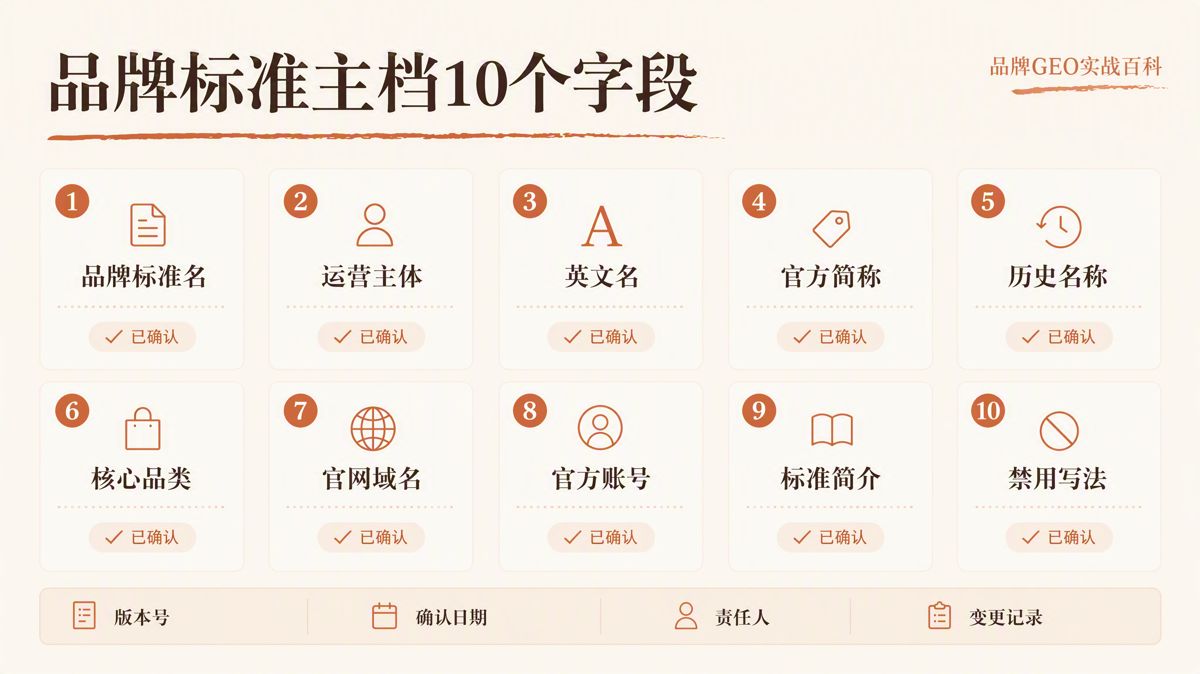
An actionable brand master record covers at least 10 core fields, each formally signed off by internal stakeholders.
| Field | Canonical Content | Permitted Variation | Prohibited Variation |
|---|---|---|---|
| Standard Brand Name | Primary public brand name | None | Dropped characters, typos, unauthorized variants |
| Operating Entity | Registered business license name | May omit corporate suffix on specific pages | Unregistered or subsidiary names used interchangeably |
| English Name | Approved international spelling | Standard capitalization rules | Ad-hoc translations, competing spellings |
| Official Abbreviation | Approved short-form name | Constrained character-limit channels only | Improvised team acronyms |
| Former Names | Previously registered names | Must include "formerly known as" context | Listed alongside current name without explanation |
| Primary Category | Approved top-level category | Optional secondary subcategories | Conflicting industry classifications across platforms |
| Official Domain | Canonical primary domain | Valid regional or localized subdomains | Expired, staging, or unrelated domains |
| Official Accounts | Verified channel handles | Platform-specific handle formats | Duplicate, abandoned, or unauthorized handles |
| Standard Bio | 50-word and 100-word versions | Shortened versions fitting character limits | Inconsistent founding years, entities, or categories |
| Prohibited Terms | Known misspellings and retired names | None | Appearance in newly published assets |
Your master record must also record version numbers, approval dates, and designated owners. When your organization undergoes a corporate restructuring, domain migration, rebranding, or category pivot, update this master record first before deploying changes across channels.
This step helps your team distinguish between two distinct challenges:
- Legacy assets that have not yet been updated;
- Ongoing marketing workflows that continue to generate new inconsistencies.
Legacy errors require a structured cleanup backlog. Ongoing errors require adjustments to your publishing and approval workflows. Treating both as the same issue complicates execution.
Step 2: Map Every Platform That Impacts Entity Recognition
Checking only your website will not give you a true picture of cross-platform consistency.
Research shows that across major generative engines, 86% of top-cited sources do not overlap. Different engines evaluate different third-party sources to understand who you are. Your audit footprint must extend beyond your primary website to encompass content platforms, encyclopedias, business directories, and external press. Source: Ahrefs: Top Cited Sources Are Not Shared Across AI Assistants
Organize your audit across seven platform tiers:
- Official website pages
- Official structured data (schema markup)
- Search engine profiles and webmaster tools
- Social and content channel profiles
- Knowledge bases and encyclopedias
- Third-party business directories
- Press coverage and partner sites
Begin with high-authority pages before moving into legacy archives.
On your website, review the header title tags, global footers, About Us, Contact Us, press releases, author profiles, and downloadable brand assets.
Structured data consists of standardized code placed in your web pages that helps search engines and AI systems extract factual context. When auditing organization schema, check the following properties:
name: Primary public brand name;legalName: Registered corporate entity name;alternateName: Approved abbreviations, English names, or aliases;url: Canonical website address;logo: Direct image URL of the official logo;sameAs: URLs of verified official profiles and authoritative reference pages confirming the entity.
These schema properties help search engines map your entity, but they cannot compensate for uncorrected text on public profiles and third-party pages.
For social channels, audit display names, profile handles, avatars, bios, linked domains, and verification badges. For third-party platforms, prioritize directories and profiles where you have editing access; these are far easier to resolve than legacy press articles.
Do not expect third-party publishers to rewrite historical news articles whenever you rebrand. If your website clearly states the relationship between your current name and former names, mark these external mentions as "Retain and Map." This documents the historical link without treating normal brand evolution as an error.
Platform visibility weightings vary widely by region. Rather than relying on rigid theoretical weighting models, build your audit list directly from the channels your audience and industry actually use.
Step 3: Separate Character Audits from Entity Audits
A character audit asks: Is the text spelled correctly? An entity audit asks: Does this text point to the correct organization? These two checks must be conducted separately.
Automated tools excel at surfacing character-level discrepancies, but they cannot replace human judgment when mapping parent companies, subsidiaries, brands, and product lines.
| Layer | Audit Focus | Automated | Requires Human Review |
|---|---|---|---|
| Raw Characters | Typos, missing letters, spacing, punctuation | Exact-match highlighting | Urgency of remediation |
| Normalized Characters | Encoding, letter casing, multiple spaces | Standardize formats for comparison | Visual brand guideline compliance |
| Name Relationships | Full name, abbreviation, English name, former name | Match against master record | Internal approval status of short forms |
| Entity Relationships | Brand, corporation, subsidiary, product line | Flag mismatches across fields | Verification of legal corporate structure |
| Link Relationships | Canonical site, regional sites, profiles, sameAs |
HTTP status checks, domain matches | Authority and canonical status of links |
| Temporal Relationships | Current vs. historical branding | Sort by publication date | Need for explicit "formerly known as" notes |
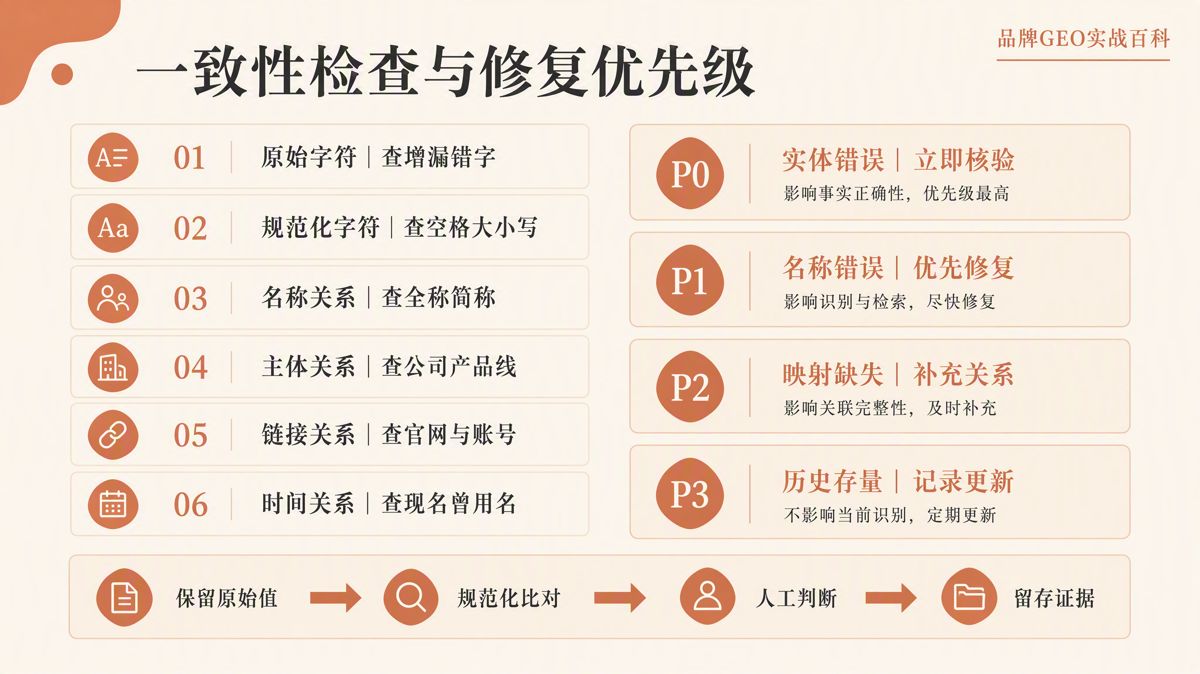
Before running automated comparisons, generate a normalized copy of all collected text. Normalization strips leading and trailing spaces, consolidates whitespace, standardizes character encodings, and applies uniform letter casing.
Always preserve the raw text alongside the normalized version. If you only keep the normalized string, subtle typos and encoding bugs will disappear from your audit logs, leaving live errors unaddressed on your pages.
Keep in mind that identical text does not guarantee entity consistency. If two pages share the same brand name but point to different URLs, legal entities, or product categories, an entity conflict still exists.
Step 4: Run Initial Audits via Spreadsheets or Scripts
You do not need specialized software to run your initial audit. A structured spreadsheet is sufficient.
Include the following columns for every audited URL or channel:
- Platform
- Page URL
- Page Type
- Audit Date
- Raw Brand Name
- Normalized Brand Name
- Operating Entity
- Company Bio
- Official URL
- Status
- Owner
Use exact-match formulas to surface character differences, and use conditional formatting to highlight missing fields, legacy entries, or duplicate profiles.
When reviewing more than 100 pages, use a script to automatically extract page titles, H1 headers, organization schema, and footer copy from public URLs. Treat script outputs as an inspection checklist rather than a finished verdict. Dynamic JavaScript rendering, paywalls, login gates, and text embedded in images often lead to incomplete automated scrapes. Always preserve the crawl timestamp, URL, and raw text snippet for human review.
Assign every reviewed record one of four standard statuses:
- Consistent: Matches the brand master record exactly.
- Permitted Variant: Matches an approved alternate rule in the master record.
- Needs Fix: Contains conflicting names, entities, links, or bios.
- Unverifiable: Lacks sufficient public data to confirm identity.
Avoid ambiguous statuses like "Partially Consistent." Every "Permitted Variant" must tie directly to an approved rule in your master record, such as "English site uses approved international name" or "Careers page uses full legal entity."
Step 5: Prioritize Remediation by Entity Risk
When reviewing your discrepancy log, do not prioritize fixes by page count or convenience. Address conflicts that cause AI engines to split your brand into multiple entities or confuse you with an unrelated company first.
Categorize issues into four priority levels:
- P0 Entity Conflict: The operating entity, official domain, founding year, or category points to the wrong business or overlaps with an unrelated namesake. Remediate immediately.
- P1 Name Conflict: The brand name contains typos, omitted characters, or persistent, unapproved English spellings on owned channels. Prioritize official assets.
- P2 Missing Mapping: An abbreviation, former name, or secondary spelling is valid, but the page provides no context connecting it to the master brand, and structured data lacks corresponding markup.
- P3 Legacy Backlog: Historical news or past event landing pages mention legacy names, while current official channels clearly document the brand evolution. Log the issue and schedule updates based on traffic and authority.
Recommended remediation sequence:
- Primary website and structured schema
- Verified official social profiles
- Encyclopedias and editable industry directories
- Tier-1 press releases and partner profiles
- Archival brand pages
For every remediation, save a before-and-after screenshot, the updated URL, and the completion date. This documentation creates an audit trail and prevents team members from re-flagging intentional variants during future reviews.
Regional Variations: Domestic vs. International Audits
Domestic Brand Presence: Aligning Names, Operating Entities, and Account Verifications
In local ecosystems, marketing teams often mix consumer brand names, corporate operating entities, and channel verification handles interchangeably.
Use consumer brand names for public-facing editorial content, but reserve full legal entity names for transaction, privacy, and regulatory pages. While these names do not need to be identical, your About page, footer, and profile bios must clearly document the legal entity behind the consumer brand.
If other businesses share a similar commercial name, reinforce your primary business category, regional headquarters, and canonical domain across profiles to help search engines differentiate your organization.
International Brand Presence: Standardizing English Spellings and Corporate Hierarchy
In cross-border and international operations, common challenges include competing English transliterations, missing parent-subsidiary disclosures, and outdated domains cited in legacy directories.
Select a single, authoritative English spelling. Local subsidiaries may retain distinct legal corporate titles, but their public bios should explicitly clarify their relationship to the parent brand.
Within your schema markup, reserve sameAs properties for verified, authoritative profiles that represent the exact same entity. Do not bloat sameAs arrays with general PR articles, search results pages, tag feeds, or unmoderated aggregators. The purpose of sameAs is entity disambiguation; accuracy matters far more than link volume.
Step 6: Verify Entity Understanding with Generative Engines
Once technical and profile fixes are live, verify whether generative engines correctly interpret your brand.
Run a standardized query prompt monthly across target engines, covering five core questions:
- What is [Brand Name]?
- Who is the legal operating entity of [Brand Name]?
- When was [Brand Name] founded?
- What is the core business of [Brand Name]?
- What is the official website of [Brand Name]?
When logging engine responses, evaluate:
- Did the engine use the approved brand name?
- Did it conflate the company with an unrelated business?
- Which URLs did it cite as reference sources?
- Did it surface deprecated brand names or outdated legal entities?
Generative engine answers fluctuate. A single correct response does not indicate permanent alignment. Maintain a verification log tracking query dates, prompts, answer screenshots, cited sources, and error classifications.
If an engine consistently repeats a specific factual error, audit the exact source URLs cited in its answer. If an inconsistency appears only once, monitor it over subsequent prompt cycles before making unnecessary edits across your digital footprint.
How Often Should You Audit Brand Consistency?
Run monthly incremental audits on newly published assets and updated profiles. Conduct a full audit across all platforms quarterly.
Trigger an immediate ad-hoc audit when your organization undergoes:
- A corporate rebranding;
- A domain migration;
- A merger or acquisition;
- A primary category pivot;
- A batch rollout of new regional or social handles.
Incorporate name validation checks directly into your content publishing guidelines. Without upfront editorial controls, new inconsistencies will enter your footprint as fast as your team cleans up legacy archives.
A complete audit lifecycle produces five primary records:
- Brand Master Record
- Platform Inventory
- Discrepancy Log
- Remediation Log
- Generative Engine Verification Tracker
When starting a new audit cycle, review open items from your previous remediation log before processing newly crawled URLs. This approach preserves historical context while keeping manual review workloads manageable.
Frequently Asked Questions
1. Do we need to eliminate all brand abbreviations?
No.
Approved abbreviations are completely acceptable on character-constrained channels, provided your official website and authoritative profiles explicitly connect the short-form name to the primary brand entity.
The real risk arises when different teams create informal, unapproved acronyms without documenting their relationship to the core brand.
2. Is inconsistent letter casing always an error?
Not necessarily.
Certain brand names have fixed typographical styling, while certain domain conventions and social platforms enforce lowercase formatting. Record the raw string first, then review your brand master record to determine whether the casing represents an approved variation.
Address casing only when multiple unapproved spellings compete across official channels.
3. Must our operating legal entity match our brand name exactly?
No.
An operating entity is a registered legal corporation, while a brand name is a market-facing commercial identity. They can differ, provided their relationship is explicitly stated.
Use the registered corporate entity name for commercial contracts, privacy policies, terms of service, and regulatory filings. Use the market-facing brand name for content, campaign pages, and general communications.
4. Should we add as many sameAs links to our schema as possible?
No.
The sameAs schema property should link exclusively to authoritative profiles and reference pages that represent your specific entity. Adding general press clippings, internal search URLs, tag archives, or scraper directories increases noise and can confuse entity mapping.
Link volume should never take priority over entity precision.
5. Do we need to update legacy news articles that mention our former name?
No.
Third-party historical news articles can remain unchanged, as long as your current website explicitly documents your corporate naming history (such as noting previous company names on your About page).
Focus your remediation efforts on assets you control, request corrections on high-authority industry directories, and simply document third-party historical mentions in your tracking log.
6. If our brand passes an AI verification check once, is the audit complete?
No.
New social accounts, partner announcements, directory profiles, and outdated page templates can introduce fresh naming conflicts at any time.
Running monthly incremental audits, quarterly comprehensive reviews, and ad-hoc audits following major corporate changes ensures your brand identity remains stable across both traditional search engines and AI assistants.
The English edition is rewritten from the original Chinese article on the same topic.

Starbox AI is an AI marketing company based in Hangzhou, China. This article draws on Starbox project work. Please credit the source when quoting.
Related reading
 GEO Guide
Why AI Marketing Vendor Quotes Vary 10x: A 4-Step Vetting Checklist
Evaluate AI marketing proposals by delivery actions, not slide decks. Audit source infrastructure, fact cleaning, and clean-environment testing.
Oct 22, 2026 · 6 min read
 GEO Guide
Spotting GEO Scams: What Actually Drives AI Recommendations?
Automated AI ranking promises violate how LLMs work. Real AI recommendations rely on authoritative, structured facts across trusted public sources.
Oct 22, 2026 · 4 min read
 GEO Guide
How to Measure Your Brand's AI Visibility with a Spreadsheet
You do not need expensive software to track AI recommendations. A three-tier prompt framework and a simple spreadsheet can score your brand visibility in half a day.
Oct 21, 2026 · 6 min read