
How to Choose an AI Search Monitoring Tool: Build a Baseline First
The short answer
Before paying for GEO monitoring tools, build a manual baseline to define your core prompts, tracked platforms, and post-monitoring workflow.
When evaluating international Generative Engine Optimization (GEO) monitoring tools, your primary question should not be which software is cheapest or covers the most engines. What matters first is knowing which prompts and markets your team needs to track, and how you plan to update your pages and content once you get the data.
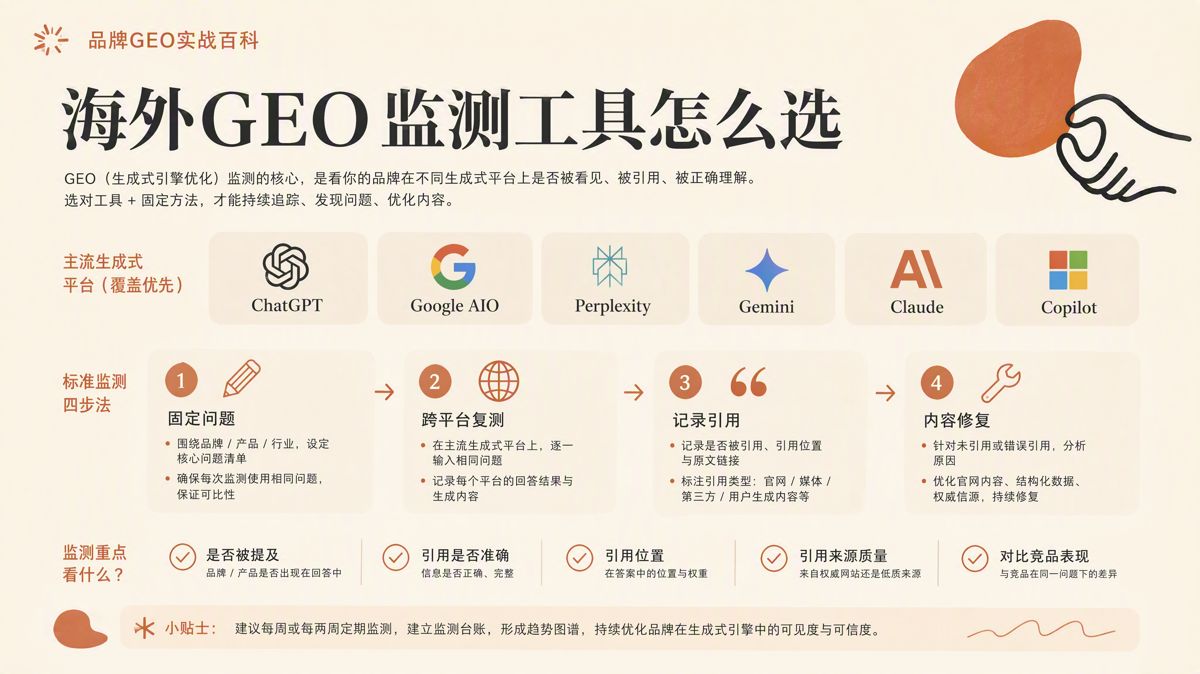
GEO focuses on whether your brand gets mentioned, recommended, and cited in generative search results across platforms like ChatGPT, Google AI Overviews, and Perplexity. Monitoring software tracks these shifts over time, but it cannot substitute for actual content development and technical optimization.
If you have not standardized your test prompts and tracking criteria, the data you pull from a paid tool will be difficult to benchmark over time. You will not be able to tell what needs fixing.
What GEO Monitoring Tools Can and Cannot Do
A GEO tracking tool generally solves four tracking problems:
- Whether your brand appears in generative search responses.
- Which specific queries, platforms, and regional markets surface your brand.
- Which official or third-party URLs the engine cites as sources.
- How your visibility compares against direct competitors over time.
These tools handle tracking and comparison. They cannot create content, ensure search engine indexing, or build authoritative third-party coverage for you.
In its official guidance released in May 2026, Google categorized generative search optimization under core search experience optimization. A page must first be crawled, indexed, and eligible for search snippets before it has any chance of being pulled into a generative response.
International GEO monitoring typically covers:
- ChatGPT
- Google AI Overviews
- Perplexity
- Gemini
- Claude
- Copilot / Bing Chat
By comparison, Chinese AI search engines include Doubao (ByteDance's AI assistant), DeepSeek, Yuanbao (Tencent's AI assistant), ERNIE Bot (Baidu's AI model), Tongyi Qianwen (Alibaba's AI model), and Kimi (Moonshot AI's assistant).
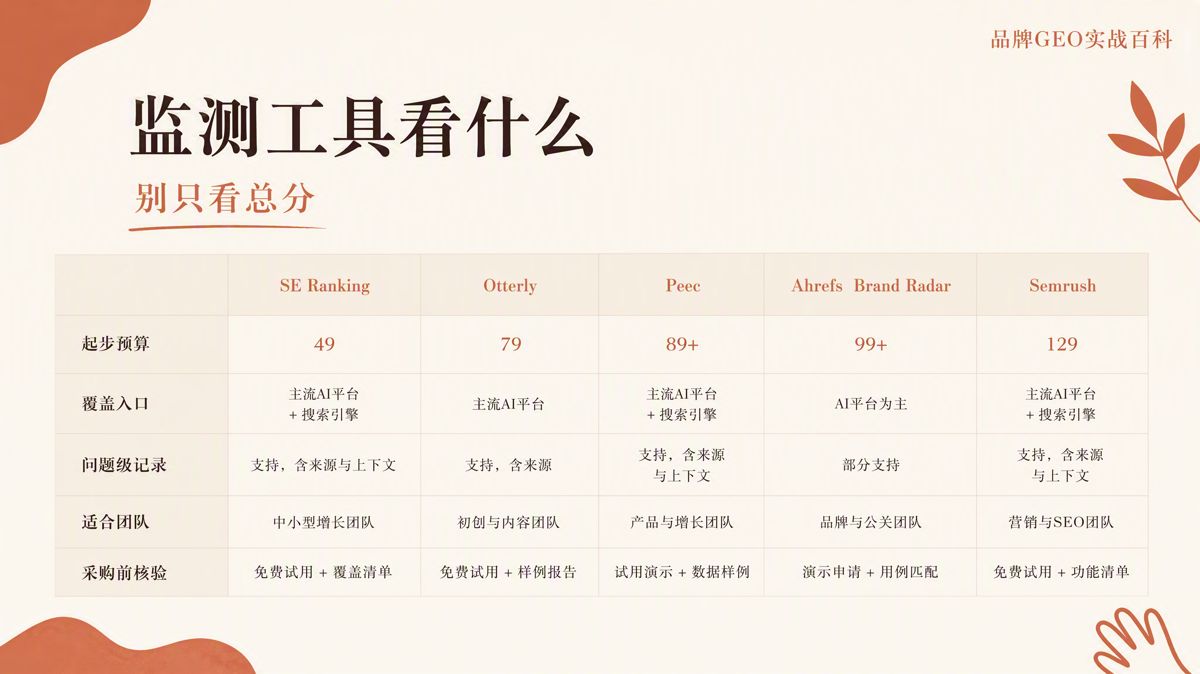
In any market, a single prompt run cannot give you a definitive reading of brand performance. Model updates, index refreshes, and phrasing variations all influence answers. You only get reliable trend data when you retest the same standardized prompt set over time.
Three Settings to Lock Down Before Buying Software
1. Standardize Your Prompt Set
A monitoring baseline is your first comparable data set, produced through a repeatable testing process. Building that baseline starts with fixing your core prompts.
At the beginning, categorize your queries into four groups:
- Brand awareness: When a user asks directly about your brand, does the model identify and describe it accurately?
- Category recommendations: When a user asks for top products in your category, does your brand make the shortlist?
- Scenario-based needs: When a user describes a specific problem or use case, is your brand suggested as a solution?
- Competitor comparisons: When a user compares multiple vendors, how does the engine evaluate each option?
Test every query across all target engines and log the same data points:
- Did your brand appear?
- Was it recommended or shortlisted?
- What sources were cited?
- Which competitors appeared alongside you?
If you change your test prompts every week, you will not know whether a change in visibility came from brand authority or simply from altered query phrasing.
2. Standardize Your Logging Criteria
Counting raw brand mentions is not enough.
Appearing in an AI response can mean three very different things:
- A passing mention in a paragraph.
- An explicit product recommendation.
- Direct citation of your website or a reputable third-party review.
For every single test, keep a record of:
- The exact prompt.
- The platform tested.
- The test date.
- The complete answer text or screenshot.
- All cited URLs.
The more detailed your records, the easier it is to pinpoint issues: Did your brand miss the candidate pool entirely? Were your product specs unclear? Or did the engine cite outdated third-party information?
3. Set a Fixed Retest Cadence
Run your core prompts once a week, and introduce an expanded batch of queries once a month to broaden your coverage.
Visibility fluctuations in software dashboards can stem from model weights, web index updates, or slight query shifts. Instead of obsessing over an aggregate score each morning, retest the same prompt batch consistently and match any score changes against your actual site edits and content updates.
Monitoring is only useful when tied directly to your optimization workflow.
Comparing Popular International GEO Monitoring Tools
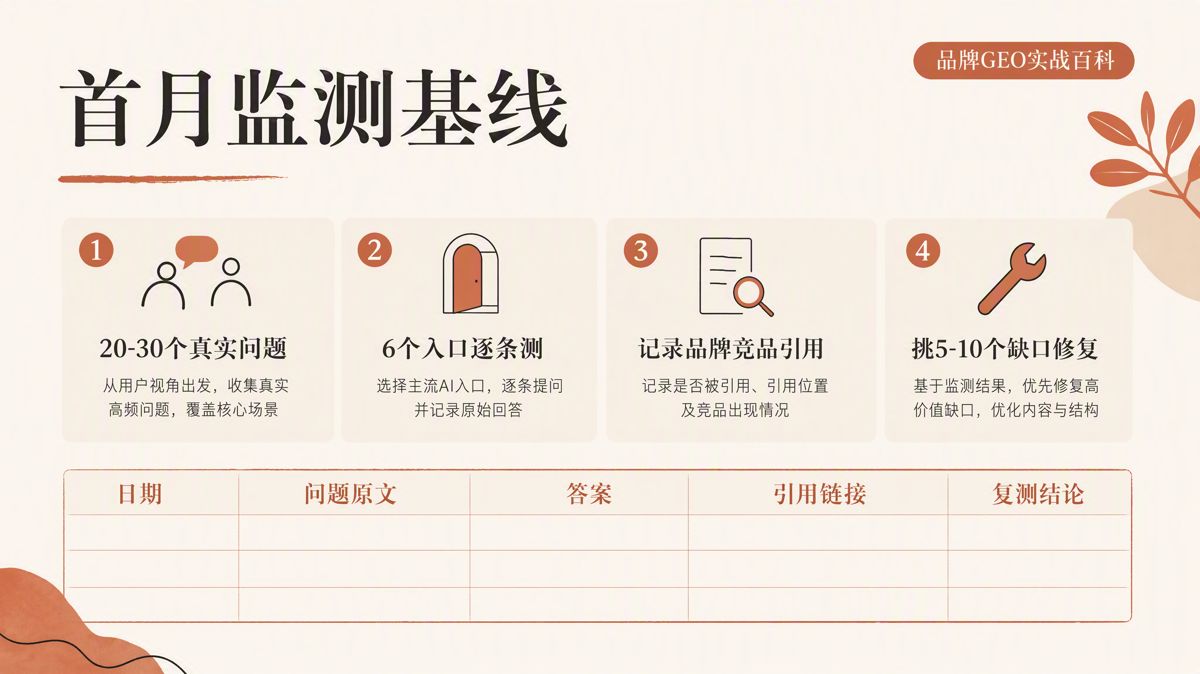
The table below outlines published entry-level pricing and platform coverage based on 2026 industry data. Features, tiers, and regional availability change frequently; use this for initial screening and confirm details directly on each provider's website.
| Tool | Published Entry Price | Coverage and Highlights | Best Suited For |
|---|---|---|---|
| SE Ranking AI Visibility | $49/mo | ChatGPT, Perplexity, Google AI Overviews, Gemini | Small-to-medium export teams |
| Otterly.AI | $79/mo | Covers 5+ platforms | Content teams |
| Peec AI | From $89/mo | ChatGPT, Perplexity, Gemini | Brand teams |
| Ahrefs Brand Radar | From $99/mo | Includes Claude; industry data notes it processes ~370M monthly prompts | Teams already using Ahrefs |
| Semrush AI Toolkit/One | $129/mo | Multi-engine tracking | Teams already using Semrush |
| AthenaHQ | From $200/mo | Multi-engine tracking | Mid-to-large international teams |
| Profound | From $499/mo | Multi-engine tracking and answer-drift tracking | Enterprise teams |
| Manual Spreadsheet | Free | Covers all 6 major engines | Early-stage teams |
When evaluating tools, do not look only at engine counts. Verify four critical functional capabilities:
- Can it accommodate your existing core prompt set?
- Can you export raw records for individual queries?
- Does it save the full generated answer and source citations?
- Can you filter and view results by country, market, and language?
Some platforms compress multiple engines, queries, and responses into a single proprietary "visibility score." If you cannot drill down to the exact query, the full response, and the cited links, your team will have no actionable guidance for page and content updates.
Platform coverage sets the scope of your monitoring, but prompt-level exportability determines whether the data is actually usable.
On a Tight Budget? Build Your Baseline Manually
Industry roundups often suggest a starter stack: ChatGPT Plus, Claude Pro, a grammar checker, one tracking tool, and Bing Webmaster Tools—costing around $104 per month.
That figure reflects 2026 public software pricing, not a mandatory bundle. You do not need to buy everything at once.
If budget is limited, spend your first two weeks running manual tests in a spreadsheet. This clarifies which platforms, queries, and geographic markets require your attention before you commit to monthly software fees.
Use this four-step plan for month one:
- Select 20 to 30 real questions your customers actually ask.
- Run each query across the six major AI engines.
- Record mentions of your brand, your competitors, and all cited sources.
- Identify 5 to 10 high-value queries where your brand is missing or facts are inaccurate.
From there, write the missing information, update your landing pages, and retest the same prompts.
Once you complete this cycle, you will have something far more valuable than a generic visibility score: an actionable list of page and content revisions. When you do decide to evaluate paid tools, you will know exactly which features are worth paying for.
How to Interpret Monitoring Data
No Mentions Does Not Mean "Add More Keywords"
If an AI engine omits your brand, check the fundamentals before touching keywords:
- Do you have an indexed page that clearly explains who you are, what you offer, and verifiable company facts?
- Is your product information specific, accurate, and easy for crawlers to verify?
- Can search engine bots crawl and index the relevant pages?
- Do trusted third-party websites mention or profile your brand?
GEO involves sequential retrieval steps. An engine first pulls a candidate set of entities relevant to the prompt, filters them for relevance and authority, and then formats the answer.
If your brand never makes it into the initial candidate pool, tweaking a few sentences on an existing page will not change the outcome. Focus first on factual completeness, crawlability, and reputable third-party mentions.
Being Mentioned Does Not Mean Your Work Is Done
If an AI engine already cites your brand, inspect the details:
- Where does your brand appear in the response hierarchy?
- Is the model citing your official domain or a third-party source?
- Are the cited facts, pricing, or specifications accurate and up to date?
- Does your brand appear consistently across related prompts?
In Western markets, engines frequently cite Wikipedia, Reddit, and specialized review sites. In China, platforms rely on different source ecosystems: WeChat Official Accounts, Baijiahao (Baidu's content platform), Zhihu (China's largest Q&A platform), Douyin (TikTok's Chinese sister app), or Baidu Baike.
Because Western and Chinese engines crawl entirely different information ecosystems, Western monitoring data cannot indicate how your brand performs inside Chinese AI engines.
Three Common Mistakes in Tool Selection and Usage
Mistake 1: Comparing Aggregate Scores Across Different Tools
Different monitoring platforms rely on different prompt samples, platform weights, and proprietary scoring models.
An aggregate score helps you track directional progress within the same tool over time. It is meaningless for cross-tool comparisons. An 80 in one tool cannot be compared against a 60 in another.
Mistake 2: Testing Only Branded Terms
Searching for your brand name almost always returns existing brand information. But business growth comes from non-branded discovery queries:
- How to choose between specific types of products.
- Recommended vendors for a specific use case.
- Feature and pricing differences between Brand A and Brand B.
If your tracking list contains only your brand name, your dashboard will heavily overestimate your actual visibility during customer purchase decisions.
Mistake 3: Using Monitoring Data as an Automated Publishing Trigger
Monitoring software highlights content gaps, but it cannot verify facts, structure persuasive pages, or conduct compliance reviews.
When you discover poor performance on a specific query, investigate what information users actually need, whether your existing assets provide verified facts, and whether your claims comply with industry regulations. Pumping out low-quality, automated articles with exaggerated claims will not improve your brand standing, regardless of how a monitoring dashboard moves.
Final Recommendations
If your team is new to international GEO, start with a manual spreadsheet and a fixed set of test queries.
Once your prompt volume, target platforms, or geographic markets expand beyond what you can track by hand, invest in dedicated monitoring software. Prioritize platform coverage, prompt limits, citation detail, and CSV export capabilities.
Pricing tells you whether you can afford the software. But getting prompt-level records, full responses, and cited URLs—and using that data to improve your content and web pages—is what determines whether the tool delivers long-term value.
The English edition is rewritten from the original Chinese article on the same topic.

Starbox AI is an AI marketing company based in Hangzhou, China. This article draws on Starbox project work. Please credit the source when quoting.
Related reading
 GEO Guide
Why AI Marketing Vendor Quotes Vary 10x: A 4-Step Vetting Checklist
Evaluate AI marketing proposals by delivery actions, not slide decks. Audit source infrastructure, fact cleaning, and clean-environment testing.
Oct 22, 2026 · 6 min read
 GEO Guide
Spotting GEO Scams: What Actually Drives AI Recommendations?
Automated AI ranking promises violate how LLMs work. Real AI recommendations rely on authoritative, structured facts across trusted public sources.
Oct 22, 2026 · 4 min read
 GEO Guide
How to Measure Your Brand's AI Visibility with a Spreadsheet
You do not need expensive software to track AI recommendations. A three-tier prompt framework and a simple spreadsheet can score your brand visibility in half a day.
Oct 21, 2026 · 6 min read