
How to Monitor GEO in China: A Repeatable Tracking Framework

The short answer
GEO tracking is not a one-time ranking check. Learn a repeatable framework to monitor brand citations, AI answers, and sources across Chinese AI engines.
Generative Engine Optimization (GEO) focuses on what happens when users ask AI engines questions: can your brand's public information be found, how does the AI frame it, is the answer accurate, and which sources are cited?
Monitoring GEO in China is not about checking a ranking once or tracking an indexing rate. Indexing simply means a platform has discovered a page and added it to its searchable pool.
Meaningful GEO tracking must answer four questions:
- Where does your public brand information appear?
- How do AI engines phrase and present that information?
- What information is missing or incorrect?
- Which specific page should you edit or what content should you publish next?
To answer these questions consistently, you do not need expensive software on day one. You need a testing method that is repeatable, comparable over time, and able to trace root causes: lock down your prompt set, log full responses alongside testing parameters, and independently audit your official website, content channels, and AI outputs.
Without this granular record, a single composite score will not tell you what action to take when answers change.
Why an Indexing Rate Does Not Tell the Whole Story
A single GEO audit involves six distinct stages:
- Can the page be accessed normally?
- Has the platform indexed the page?
- Did the AI engine retrieve the content?
- Does the brand appear in the AI response?
- Does the AI recommend the brand or cite it as an authoritative source?
- Is the AI description of the brand factually accurate?
These six stages do not always align.
A WeChat Official Account article discovered by WeChat Search will not necessarily be cited by an AI engine. A brand mentioned in one AI response may not appear if another user asks the same question from a different location, at a different time, or under a different login status.
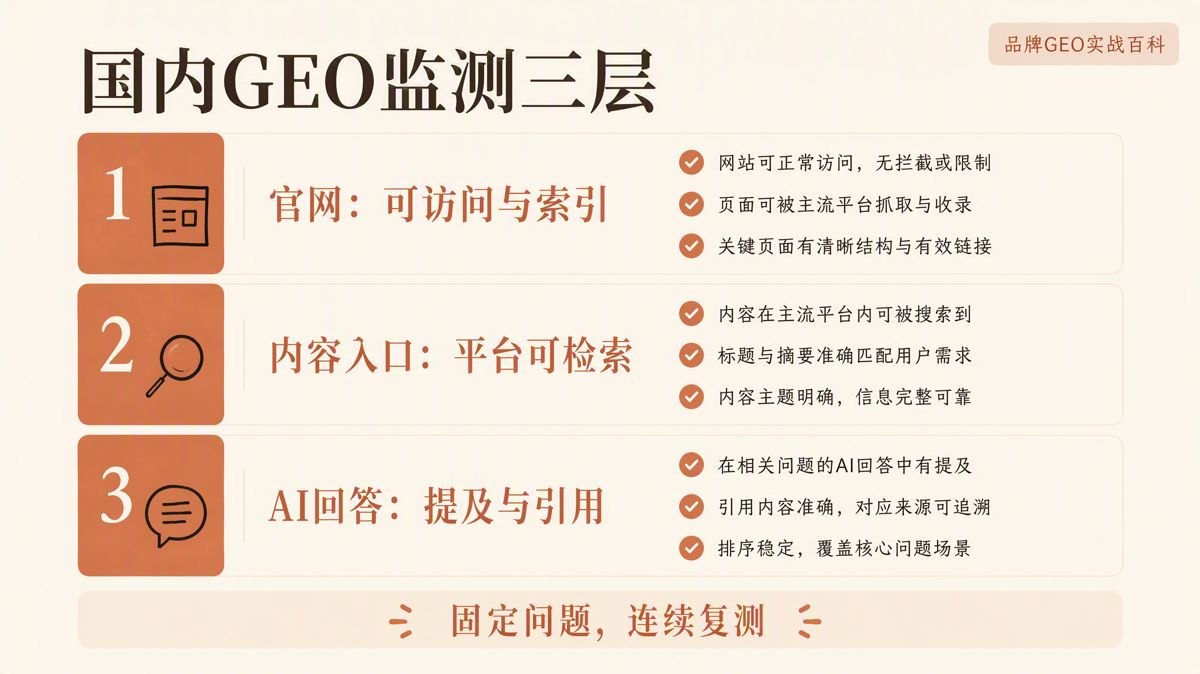
You must audit your official website, third-party content platforms, and AI generated answers separately. Each serves a different diagnostic purpose, and none can substitute for the others.
Lock Down Your Prompts and Test Variables First
The stability of your prompt set determines whether results collected over time can be directly compared.
Write every prompt the way an everyday user would ask it. For example:
- How should a small business in Shanghai choose an accounting service?
- Who is this specific product designed for?
- What is the difference between these two standard solutions?
- What risks should buyers watch out for before purchasing?
Do not test only your brand name. Cover broad category queries, product comparisons, pricing inquiries, risk assessments, after-sales support, and regional needs.
Start with 30 fixed prompts. Test them once a week at a set time, using the same account and recording method. After four consecutive weeks, analyze the trends.
If you change prompts frequently, your historical data loses its comparative value. When new questions arise, add them to the list without altering the phrasing or numbering of your original test set.
Alongside your prompts, keep these testing parameters consistent:
- The specific AI product or search entry point used;
- The date and time of the test;
- The physical location and IP region;
- Whether the test was run logged in or logged out;
- The specific user account used;
- The conversation context (whether prior prompts exist in the same session).
Prior conversation history can shift how an AI model interprets and answers a prompt.
What a Baseline GEO Tracking Sheet Must Include
In the early stages, a structured spreadsheet is all you need. You do not need a complex dashboard.
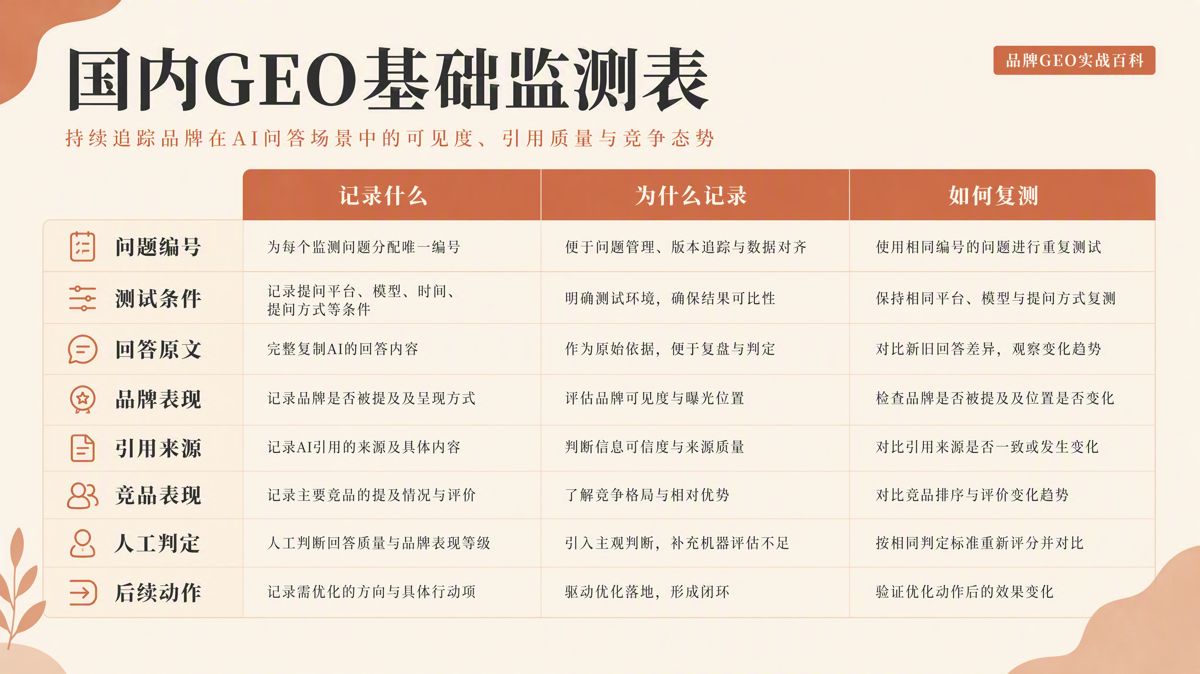
Every test entry must capture six categories of information: the prompt, test conditions, complete response, citation evidence, manual evaluation, and next action.
| Field | What to Record | Purpose |
|---|---|---|
| Prompt ID & Intent | Fixed question and its category type | Ensures historical comparability |
| Test Conditions | Date, AI platform, location, account, login status | Isolates environmental variables |
| Response Evidence | Complete text response, screenshot, or link | Prevents misinterpretation during reviews |
| Brand Presence | Unmentioned, mentioned, recommended, or cited | Differentiates level of brand exposure |
| Cited Sources | Exact URL, platform name, or "No public citation" | Identifies content gaps and source domains |
| Competitor Presence | Competing brands mentioned and AI reasoning | Identifies competitive positioning |
| Manual Evaluation | Accurate, partially accurate, inaccurate, or inconclusive | Standardizes internal quality criteria |
| Next Action | Edit page, add content, retest, or hold | Creates an actionable backlog |
Never skip saving the full text response and testing conditions.
If you only mark a binary "mentioned" or "not mentioned," you will never know whether a shift in answers was caused by content updates, an LLM update, or a change in account history and location.
Layer 1: Verify Your Website and Owned Assets
Start with the public pages you control directly: your website pages, XML sitemaps, robots.txt directives, mobile load performance, and structured data markup.
To clarify these technical components:
- Sitemap: A file listing your site's URLs to help search crawlers discover content.
- Robots.txt: Directives that instruct search crawlers which pages they can access and crawl.
- Structured data: Standardized code that helps search systems parse entities like organizations and products.
- Crawling: The process where search engines visit and read your page content.
Baidu Search Resource Platform (Baidu's webmaster console) helps site owners monitor indexing and crawl status. Cross-reference this platform with server logs, sitemaps, and crawl reports to ensure core pages are fully accessible to search engines.
If your standalone website has technical issues, fix these first:
- Pages that fail to load or load slowly;
- Broken internal or outbound links;
- Disorganized heading hierarchies (H1, H2, H3);
- Inconsistent organization or brand information across pages;
- Key pages blocked from crawler access.
Google Search Console, Bing Webmaster Tools, and Schema.org Validator can help audit technical site health and structured data, but they cannot replace the data dashboards provided by Chinese platforms.
Layer 2: Check Content Findability Across Third-Party Platforms
For content platforms like WeChat Official Accounts, Baijiahao (Baidu's content platform), Douyin (ByteDance's short video platform), Xiaohongshu (RED), and Zhihu (China's largest Q&A platform), the metric is not whether content is published. It is whether users can discover it through in-platform search.
Search for:
- The exact title of your article;
- The core problem the article solves;
- Your brand or corporate entity name;
- Distinct, key passages from the text.
Audit against the live version on the platform, recording publication dates, original URLs, and version histories. This allows you to catch conflicting figures or outdated claims across different platforms.
Baidu Search Resource Platform, WeChat Search, Douyin in-app search, Xiaohongshu in-app search, and their embedded AI search features each operate separate publishing, review, and indexing systems. No single distribution list guarantees simultaneous visibility across all Chinese AI models.
Therefore, record "published," "searchable in-platform," and "cited by AI" as three separate milestones.
Layer 3: Audit Brand Visibility in AI Model Answers
When testing AI assistants such as Doubao (ByteDance's AI assistant), DeepSeek, Kimi (Moonshot AI's assistant), Tencent Yuanbao (Tencent's AI assistant), ERNIE Bot (Baidu's AI assistant), and Tongyi Qianwen (Alibaba's AI assistant), log these points for every query:
- Did the AI answer the question directly?
- Did the brand appear in the response?
- Was the brand merely mentioned, or explicitly recommended?
- Was the brand's owned content cited as a source?
- Are there factual inaccuracies in the answer?
- Did the AI display clickable citations or sources?
An answer to the same prompt can shift based on model versioning, live web-retrieval results, test timing, location, account status, and conversation context. Always save test parameters alongside the output.
Industry observers frequently track ecosystem connections, such as Tencent Yuanbao referencing WeChat Official Accounts, ERNIE Bot citing Baijiahao and Baidu Baike (Baidu's encyclopedia), Doubao drawing from Douyin and Jinri Toutiao (ByteDance's news aggregator), and Kimi or DeepSeek surfacing Zhihu threads. Treat these correlations as test hypotheses, not permanent citation rules.
Because AI providers do not fully disclose their web-retrieval sources, log findings as "Observed in this test" rather than assuming any single platform is a permanent, static data source for an AI model.
Why You Must Evaluate the Three Layers Separately
Websites, third-party platforms, and AI engines serve different functions.
Website monitoring verifies that your foundational information is crawlable and indexed. Platform monitoring verifies that published assets are discoverable via internal search. AI monitoring checks whether your brand surfaces accurately with valid citations.
For example, if an AI quotes inaccurate pricing, office locations, service scopes, or credentials, publishing a new social post will rarely solve the problem. You must first inspect your website and existing high-ranking indexed pages for outdated, incorrect, or conflicting information.
Conversely, if an article is indexed by a platform but an AI model fails to cite it across several test rounds, do not immediately write off the asset.
Evaluate three variables:
- Does the test prompt reflect natural buyer intent?
- Does the page clearly state your official brand and entity name?
- Are critical data points—such as pricing, deliverables, and service scopes—unambiguous and easy for a machine to verify?
How to Prioritize Action Items from Your Audit
GEO monitoring should generate an action list, not just static reports.
Priority 1: Correct Factual Errors, Entity Mix-ups, and Broken Pages
If an AI provides incorrect service scopes, pricing, addresses, or business licenses, immediately cross-check your website and primary indexed pages. Look for outdated text, typos, or brand name confusion with third parties.
Unreachable pages, misspelled entity names, and contradictory claims across platforms must be resolved first.
Priority 2: Fill Gaps for High-Volume Inquiries
Identify the specific requirements users include in their prompts, then build dedicated pages that answer those exact questions directly.
Give clear answers upfront, outlining qualified audiences, prerequisites, known limitations, and verifiable facts. Avoid generic corporate overviews, and address real buyer considerations like pricing, risks, and regional service boundaries.
Priority 3: Address Long-Tail and Specific Use Cases
Once factual errors are resolved and high-frequency questions are addressed, expand your coverage to more specific, lower-frequency search queries.
Keep a changelog for every update: which URL was modified, what source material was used, who approved it, when it went live, and the target re-test date.
Without a change log, you cannot know whether a future shift in AI answers came from your optimizations, an algorithm update, or different testing conditions.
How to Evaluate Paid GEO Monitoring Tools
The feature sets, pricing, and data sources of commercial GEO tracking tools change rapidly. Always request a product trial or live demo before buying.
During a trial, run your 30 fixed prompts across two separate testing rounds. Verify whether the software captures:
- Unabridged AI text responses;
- Visual screenshots or direct citation URLs;
- Exact timestamps for every query;
- The specific AI product or model interface;
- Geographic region and account login state;
- Historical version comparisons;
- Team collaboration features and raw data export capabilities.
If a tool only outputs an aggregate score without revealing the raw response and cited links, it cannot guide your editorial workflow.
Writers will not know what content gaps to fill, and technical teams cannot tell whether an issue stems from page indexing or normal model variance.
A practical enterprise tool must trace every finding back to a specific query, cited source, and URL. The primary value of paid software lies in batch processing, longitudinal tracking, and team workflows—not in replacing core documentation hygiene.
Compliance and Data Governance in GEO
Never input sensitive or unrelated personal data during testing. Customer service logs, personal identification, signed contracts, and private financial records must never be pasted into public-facing AI engines.
Before publishing AI-generated content on public channels, verify all factual claims, avoid fabricated case studies or performance metrics, and disclose AI generation according to platform rules.
China's Measures for the Labeling of AI-Generated and Synthetic Content took effect on September 1, 2025. Ensure your public assets comply with these national regulations and respective platform policies.
In regulated verticals like healthcare, legal, and financial services, certified industry professionals must review public content. GEO is a public-information management discipline; it cannot be used to bypass advertising laws, professional licensing standards, or platform policies.
Frequently Asked Questions
Can we start GEO monitoring without paid software?
Yes.
Start with a spreadsheet, webmaster tools, and native platform search bars using your fixed 30-prompt set. Document raw answers, screenshots, and URLs. Once your recording process runs smoothly, you can assess whether paid tooling is needed to scale batch testing and team collaboration.
What should we do if an AI model provides no citations?
Record it accurately as "No public citation," and save the full answer and timestamp.
Do not guess which platform the AI pulled from. Check your own digital assets to confirm that key pages are publicly indexable, your brand name is clear, and core facts are easy to parse.
Why does an AI give different answers to the exact same prompt from one day to the next?
Model weights, live web-search results, IP locations, login states, and session history all alter responses.
Keeping your testing conditions strictly identical is the only way to separate temporary algorithmic variance from genuine, lasting shifts in brand visibility.
Does a brand mention mean our GEO strategy is working?
Not necessarily.
You must check whether the mention is factually correct, whether it directly answers the user's intent, whether it includes a citation, and whether the brand surfaces reliably across multiple testing cycles.
If an AI mentions your brand with incorrect facts, correcting those public errors is your immediate priority.
How many Chinese AI platforms should we monitor?
Prioritize the engines your target audience actually uses.
Most teams start with 3 to 6 AI platforms and scale up once their logging process is consistent. Whenever you add a new platform, establish a set testing account, testing schedule, and evidence archiving process.
How often should we update our monitoring log?
In the initial stage, run tests once a week. If you update product lines, pricing, licensing, or if platform regulations change, run immediate tests on the affected prompts.
During monthly reviews, only compare records generated under the same prompts and equivalent testing parameters.
Tie GEO Auditing to Clear Actions
GEO monitoring in China should never stop at a brand visibility score. A test result is only actionable when it points back to a specific prompt, an exact citation, and a clear URL.
Locking down prompts allows for fair historical comparisons. Saving unabridged responses shows what the AI actually tells users. Documenting testing parameters isolates environmental variables. Keeping a changelog lets you tie improvements directly to your work.
With stable prompts, unedited response records, and traceable optimizations, you can run a reliable, repeatable GEO monitoring process—with or without paid software.
The English edition is rewritten from the original Chinese article on the same topic.

Starbox AI is an AI marketing company based in Hangzhou, China. This article draws on Starbox project work. Please credit the source when quoting.
Related reading
 GEO Guide
Why AI Marketing Vendor Quotes Vary 10x: A 4-Step Vetting Checklist
Evaluate AI marketing proposals by delivery actions, not slide decks. Audit source infrastructure, fact cleaning, and clean-environment testing.
Oct 22, 2026 · 6 min read
 GEO Guide
Spotting GEO Scams: What Actually Drives AI Recommendations?
Automated AI ranking promises violate how LLMs work. Real AI recommendations rely on authoritative, structured facts across trusted public sources.
Oct 22, 2026 · 4 min read
 GEO Guide
How to Measure Your Brand's AI Visibility with a Spreadsheet
You do not need expensive software to track AI recommendations. A three-tier prompt framework and a simple spreadsheet can score your brand visibility in half a day.
Oct 21, 2026 · 6 min read