
How to Choose the Right GEO Tools

The short answer
Do not judge a GEO tool by feature lists or all-in-one claims. Audit your SEO foundation and run a four-week test loop before subscribing.
Judging whether a Generative Engine Optimization (GEO) tool is worth purchasing should not come down to feature counts or claims of being an "all-in-one" solution.
GEO focuses on optimizing for generative engines—AI systems that synthesize direct answers to user prompts. The practical objective of GEO is to monitor how these models answer user queries, whether they mention your brand, which sources they cite, and whether updating your content influences their outputs over time.
Before shopping for software, clarify three operational realities: whether your audience is inside China or global, what tools your team already uses, and whether you have the bandwidth to execute a four-week "monitor, optimize, retest" cycle.
A functional GEO workflow must answer five fundamental questions:
- What are real users actually asking?
- How do target generative engines respond?
- Does the answer mention your brand or cite your domain?
- What critical information is missing from your existing pages?
- After updating your pages, do responses to the same prompt set change?
Unless your team systematically logs these five data points, content adjustments will be based on guesswork. Without this workflow, adding software often just creates another unused dashboard.
Six Things to Clarify Before Buying a GEO Tool
1. GEO Still Depends on SEO Fundamentals
Search Engine Optimization (SEO) ensures search systems can discover, crawl, and understand your web pages.
GEO focuses on helping your brand, verified facts, and citations enter AI-generated answers. However, generative engines cannot cite pages that traditional search crawlers cannot access. Google Search Central's 2026 documentation explicitly notes that optimizing for generative search experiences remains an extension of standard search optimization.
Crawling, indexing, semantic structure, and content quality remain non-negotiable prerequisites. Crawling refers to a search system fetching your page; indexing means storing and categorizing it in a searchable database. If these technical basics are broken, tweaking copywriting will not move the needle.
2. Content Must Be Discovered Before AI Can Cite It
AI search engines that retrieve live information typically follow a three-step process: find potentially relevant source material, evaluate which sources best answer the prompt, and synthesize the final response.
If a page is not indexed, blocks search crawlers, or lacks clear structure, it never enters the candidate pool. Rewriting headlines or promotional copy will not help if the underlying URL cannot be retrieved.
3. You Can Audit Technical Basics with Free Tools
You do not need an enterprise software subscription to check baseline technical health:
- Schema.org Validator: Verifies structured data formatting for products, organizations, and articles.
- Google Rich Results Test: Checks whether a page qualifies for rich search snippets on Google.
- Google Search Console: Reports on indexing status, crawl errors, and search visibility.
- Bing Webmaster Tools: Monitors indexing health and technical crawl issues on Microsoft Bing.
Confirming that search engines can discover, parse, and interpret your pages first will help you identify what specific operational gap a paid tool needs to fill.
4. Pricing and Platform Coverage Fluctuate Constantly
Platforms like SE Ranking AI Visibility, Otterly.AI, Peec AI, Ahrefs Brand Radar, and Semrush AI Toolkit/One are frequently evaluated for international AI search monitoring.
However, their supported models, monthly query allowances, historical data retention policies, and pricing tiers shift frequently. Always review current vendor pricing pages rather than relying on third-party comparison articles when planning a procurement budget.
5. China Has No Unified "AI Indexing Switch"
In China's digital ecosystem, platforms operate behind separate content gates, moderation systems, and internal search engines. Publishing on one channel does not mean your content is visible to others or picked up by domestic AI engines.
For campaigns targeting mainland China, you must independently verify four milestones: publication success, platform moderation approval, discoverability within in-app search, and eventual citation inside domestic generative engines.
6. Tools Provide Sample Observations, Not Permanent Truths
A user query submitted to an AI model is called a prompt. AI responses vary based on prompt phrasing, geographic IP, language settings, login state, model versions, and query timestamps.
Failing to appear in a single query does not prove your GEO efforts failed; appearing once does not mean your visibility is locked in. Monitoring tools record isolated snapshots. Meaningful analysis requires tracking recurring trends under consistent, controlled conditions.
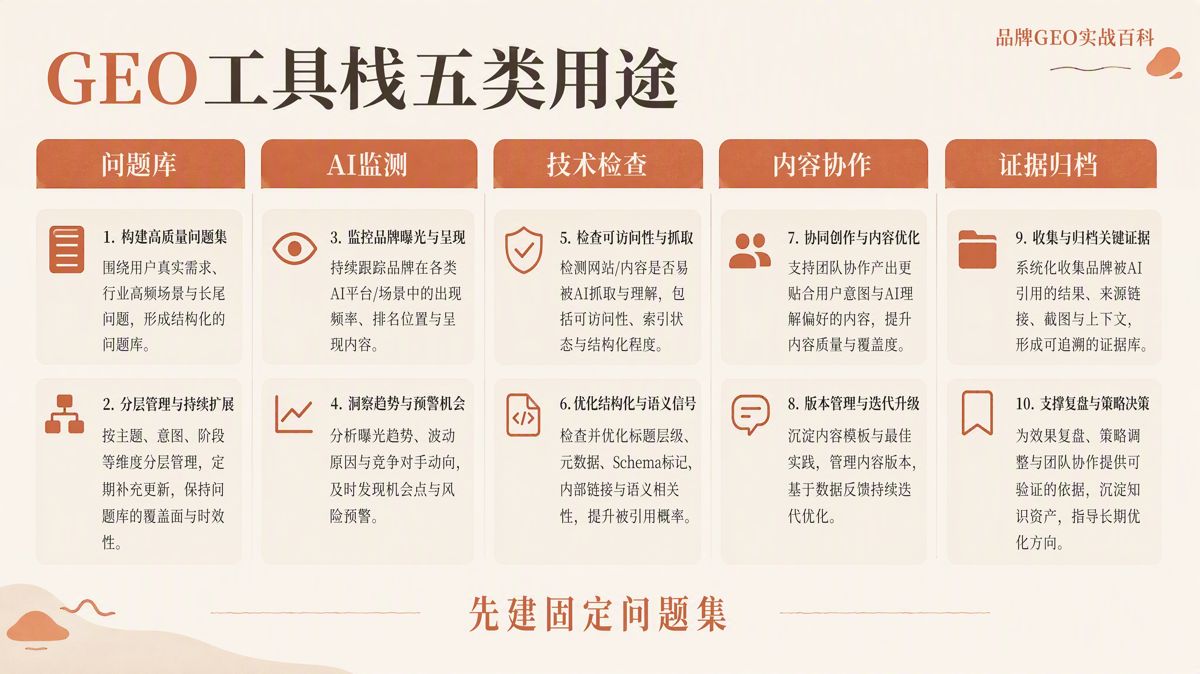
Five Capabilities Needed for a Complete GEO Stack
A reliable GEO process relies on five functional capabilities: building a query repository, monitoring AI responses, auditing technical site health, managing content workflows, and archiving test evidence.
Each capability solves a different problem. Purchasing extra monitoring dashboards will not fix unindexed pages, unverified claims, or a lack of editorial review.
| Category | Primary Task | Key Selection Criteria | Common Pitfall |
|---|---|---|---|
| Query Repository | Collect user prompts, search terms, and customer inquiries | Ability to categorize by product line, use case, and intent | Collecting only broad, generic industry keywords |
| AI Monitoring | Track brand mentions, citations, and competitors against fixed prompts | Capability to retain and export full text responses | Mistaking a single query result for an enduring trend |
| Technical Auditing | Audit robots.txt rules, sitemaps, indexing, schema, and page speed | Clear visibility into crawlability and indexation | Tracking visibility scores while ignoring crawl failures |
| Content Collaboration | Draft, revise, verify, and update factual web content | Audit trails for sources, citations, and editorial sign-offs | Publishing raw, unverified AI outputs directly |
| Evidence Archiving | Record timestamps, prompts, outputs, screenshots, URLs, and versions | Reproducible logs that allow exact retesting | Storing only a high-level composite visibility score |
A robots.txt file instructs search engine robots which pages they can or cannot crawl, while an XML sitemap provides a map of all important pages on your website.
You do not need a single vendor to handle every stage. Identify your team's specific bottlenecks first, then decide whether to use free utilities, repurpose current subscriptions, or buy dedicated software.
A Four-Week Framework to Test Your Process from Scratch
Smaller teams should avoid committing to enterprise contracts immediately. Running a four-week pilot using spreadsheets and free tools provides clarity on what paid features you actually need.
Week 1: Build a Fixed Prompt Set
Curate 20 to 50 real-world customer questions. Group them into categories such as product features, use cases, vendor comparisons, pricing, operational risks, and post-purchase support.
Collect these from customer service tickets, sales calls, and on-site search data, rather than generating variations of broad industry keywords. Once defined, freeze this prompt set for the duration of the pilot.
Week 2: Archive Full Responses from Target Engines
Run each prompt through your target AI engines. Archive the complete answer text, cited links, search date, regional location, and interface language.
Use standardized tracking fields for every query. Consistent documentation is the only way to validate changes during subsequent test cycles.
Week 3: Fix Recurring Gaps Only
Avoid overhauling content based on a single unfavorable response. Focus strictly on recurring information gaps across multiple queries:
- Product specification pages missing key technical parameters.
- Frequently Asked Questions (FAQ) sections omitting qualification criteria.
- Inconsistent corporate credentials across different pages.
- Required factual data points that exist nowhere on your domain.
Document page URLs, specific editorial changes, and publication timestamps so you can attribute future response shifts to concrete site updates.
Week 4: Retest the Exact Same Prompts
Run the frozen prompt set under identical test conditions. Check whether brand mentions, cited domains, or overall context improved.
At this stage, software serves to reduce manual logging and retain data, not to dictate editorial strategy. If prompts, testing locations, or recording formats change between runs, historical comparisons become meaningless.
Once you have completed this four-week cycle, you can evaluate paid software based on clear operational requirements rather than vendor feature matrices.
Audit Your Existing SEO Stack Before Buying New Software
If your team already subscribes to SEO platforms like Ahrefs, Semrush, or SE Ranking, verify whether your current plan includes AI visibility tracking, brand mention alerts, or prompt monitoring features.
Extending existing tools preserves keyword libraries, competitor lists, historical page tracking, and seat permissions, while avoiding data discrepancies between mismatched tracking methodologies.
When evaluating an existing platform's AI capabilities, look at four factors:
- Which specific generative engines are tracked.
- Monthly prompt monitoring quotas.
- Whether complete textual responses and cited URLs are retained.
- Ability to filter and segment data by country, language, and date.
A URL is the distinct address of a specific web page. If a dashboard cannot provide the underlying response text and cited URLs, it functions merely as a reporting widget and will not help your technical or editorial teams prioritize fixes.
Managing China Operations Requires More Than a Single Dashboard
Managing brand presence in mainland China requires coordinating your official website, platform channels, and conversational AI endpoints simultaneously.
- Website Infrastructure: Use Baidu Search Resource Platform (Baidu's webmaster console), server access logs, sitemaps, and HTTP status codes to confirm indexation.
- Content Platforms: Track brand and product discovery across WeChat Official Accounts, Baijiahao (Baidu's content platform), Douyin (ByteDance's short video platform), Xiaohongshu (RED), and Zhihu (China's largest Q&A platform).
- AI Endpoints: Use your fixed prompt set to run manual or semi-automated verification across domestic AI services, including Doubao (ByteDance's AI assistant), DeepSeek, Kimi (Moonshot AI's assistant), Tencent Yuanbao, ERNIE Bot (Baidu's AI chatbot), and Tongyi Qianwen (Alibaba's AI model).
Because these platforms and models do not fully disclose their internal retrieval and ranking algorithms, no third-party tool can guarantee brand inclusion or citation.
Instead of tracking an arbitrary aggregate score, focus on three actionable outputs: which prompt returned what answer, which sources were cited, and what factual data was missing from your assets. Once identified, address these gaps directly on your owned channels.
Run Acceptance Tests with Real Prompts Before Subscribing
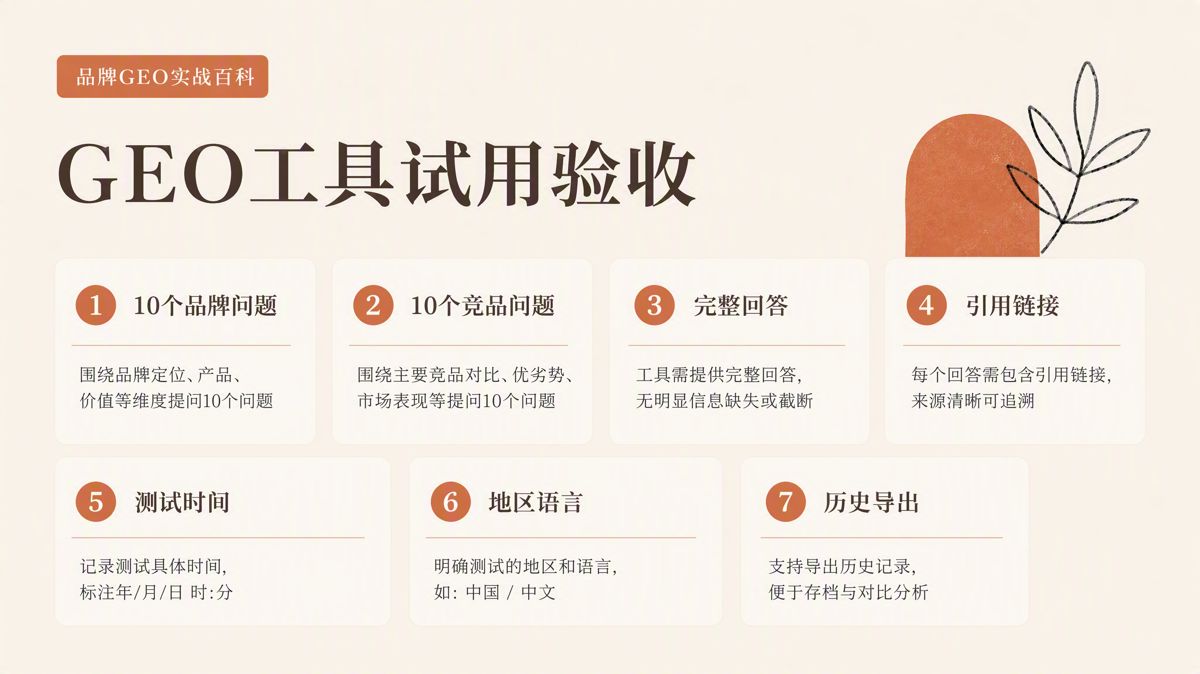
When trialing any software, assemble a benchmark test of 10 brand-focused prompts and 10 competitor-focused prompts to evaluate vendor capabilities under real-world conditions.
Ensure the platform logs and exports the following data fields:
- Query timestamp
- Exact prompt submitted
- Target generative engine and model version
- Geographic region and language parameters
- Full synthesized answer text
- All linked citation sources
- Raw data export options (CSV, JSON, API)
Repeat queries for identical prompts across multiple days to confirm whether the software helps your team differentiate between temporary model output variance and consistent, systemic changes.
Evaluate the true cost of ownership beyond the base subscription price. Vendors often meter prompt volumes, user seats, historical data retention windows, API access, multi-region tracking, and data export bandwidth separately. An API (Application Programming Interface) allows different software applications to exchange data automatically. Account for these variable add-ons to calculate your actual operating costs.
Content Tools Speed Up Drafting, but You Cannot Skip Verification
Content production tools help teams cluster customer questions, transcribe subject-matter expert interviews, ensure headlines directly address user intent, and format complex documentation into scannable layouts.
However, software cannot independently verify regulatory compliance, customer case details, empirical testing figures, or proprietary product specifications. Every metric, external citation, and contractual claim must be checked against primary source materials.
Publicly distributed content should record the author, editorial reviewer, source URLs, and publication dates. For material distributed within mainland China, teams must review compliance obligations under the Measures for the Labeling of Artificial Intelligence Generated and Synthesized Content alongside platform-specific labeling rules.
Automation reduces formatting and synthesis overhead, but human verification of core facts cannot be skipped.
Frequently Asked Questions About Choosing GEO Tools
Should our first paid subscription be a monitoring tool or a content tool?
If your technical indexing and site structure are not yet in order, start with free technical audit tools.
Once your site and content are stable, invest in a monitoring tool that archives full responses, citations, and historical changes. At this stage, your team can clearly assess what operational problem the software solves and measure its ROI.
If our brand does not appear in a test query, does that mean GEO failed?
No. A single response is influenced by prompt wording, model updates, geographic location, and query time.
You need to run recurring tests with a fixed prompt set while verifying whether your pages are properly indexed and supported by third-party sources.
Can we use a single dashboard for both domestic China and global markets?
You can standardize your tracking fields and review workflows, but you cannot assume platform coverage is the same.
Western tools monitor ChatGPT, Perplexity, Google AI Overviews, and Gemini. Google AI Overviews provides AI-generated summaries directly within Google search results. In China, you must separately track Baidu, WeChat, and domestic content platforms.
Can software replace manual testing entirely?
No. Tools excel at logging batch results, but human reviewers must evaluate whether an AI misunderstood the prompt, cited relevant context, stayed compliant, and genuinely met user intent.
Can tool visibility scores serve as a primary business KPI?
Avoid relying on a single composite score. Combine brand mentions, citations, referral traffic from AI engines, page indexation, and lead quality. Always understand how a score is calculated before tying it to performance metrics.
Key Performance Indicators (KPIs) measure progress toward business goals. Regardless of the metric used, ensure it ties directly to tangible business outcomes.
How often should a team review its GEO performance?
In the early stages, check your prompt set and technical health weekly, and conduct a deeper thematic and citation review monthly. Update relevant web pages immediately whenever regulations, pricing, or product specs change.
The Bottom Line: Complete One Test Cycle Before Committing
There is no universal GEO procurement list that suits every organization. Target geography, current SEO software investments, and technical site health dictate the right approach.
Adopt a disciplined sequence: build a fixed prompt set, log baseline AI answers, fix recurring technical and content gaps, and retest under identical parameters.
Completing one structured optimization cycle will show your team exactly what capabilities are missing—and whether an ongoing software subscription is justified.
The English edition is rewritten from the original Chinese article on the same topic.

Starbox AI is an AI marketing company based in Hangzhou, China. This article draws on Starbox project work. Please credit the source when quoting.
Related reading
 GEO Guide
Why AI Marketing Vendor Quotes Vary 10x: A 4-Step Vetting Checklist
Evaluate AI marketing proposals by delivery actions, not slide decks. Audit source infrastructure, fact cleaning, and clean-environment testing.
Oct 22, 2026 · 6 min read
 GEO Guide
Spotting GEO Scams: What Actually Drives AI Recommendations?
Automated AI ranking promises violate how LLMs work. Real AI recommendations rely on authoritative, structured facts across trusted public sources.
Oct 22, 2026 · 4 min read
 GEO Guide
How to Measure Your Brand's AI Visibility with a Spreadsheet
You do not need expensive software to track AI recommendations. A three-tier prompt framework and a simple spreadsheet can score your brand visibility in half a day.
Oct 21, 2026 · 6 min read