
How Law Firms Should Approach Generative Engine Optimization

The short answer
When clients face legal issues, they want clear answers for their situation. Law firm GEO succeeds through accurate, verifiable answers, not article volume.
When someone runs into a legal issue, they rarely care which law firm has published the most blog posts. They want to know what to do about their specific situation.
Someone facing an employment dispute wants to know how years of service, the termination method, and existing documentation will affect their outcome. A founder in an equity dispute needs to check the articles of association, capital contributions, and corporate filings. Someone dealing with a criminal investigation needs to know what procedural stage the case has reached.
These questions involve specific conditions and defined legal boundaries. Clients need an explanation they can understand: what steps they can take under which conditions, what evidence to gather, what procedures follow, and what risks lie ahead.
Generative search delivers answers by synthesizing public information through artificial intelligence (AI) in response to user queries. Generative Engine Optimization (GEO) is the practice of structuring and phrasing public content so AI search engines can easily discover, understand, and accurately cite it.
For law firms, GEO is not about publishing more articles. It is about answering individual legal questions with precision. Content must be easy for machines to index and understand, while also withstanding legal verification, advertising compliance, and client privacy reviews.
What GEO Can Improve—and What It Cannot Guarantee
GEO does not replace traditional search fundamentals.
Search Engine Optimization (SEO) improves website content and architecture so search engines can discover, crawl, and understand web pages. Generative search engines also need to access web content first. If a crawler cannot fetch your page and add it to its index, that page cannot be cited in an AI response.
Google's guidance for website owners published in 2026 makes clear that optimizing for generative search remains part of overall search experience optimization. Meeting technical guidelines does not guarantee that a page will be crawled, indexed, or cited.
A GEO study first released in 2023 by researchers at Princeton University and other institutions showed that citing sources, tone, and structural organization influence whether a website gets cited in generative answers. However, results vary significantly across industries, and no technique guarantees citation.
For law firms, GEO can improve the clarity, completeness, and verifiability of public resources. It cannot replace a lawyer evaluating an actual case. Without complete facts, evidence, and procedural records, public content serves only as general legal education and preliminary guidance—never as formal legal advice.
Compliance Must Come First
Legal content carries a far higher risk of misinterpretation than standard product descriptions.
Whether a regulation remains in effect, which jurisdiction it covers, and what conditions must be met all affect the reader's judgment. Generative search engines also tend to extract snippets and recombine them into new answers. If your original text does not state its conditions and exceptions clearly, isolated snippets can easily mislead users.
Before publishing, law firms must verify compliance across key legal standards:
- The Lawyers Law of the People's Republic of China requires lawyers to protect legitimate client interests, uphold the correct application of law, and safeguard social fairness and justice. Public content must not turn an analysis of a specific case into a universal rule.
- The Measures for the Administration of Law Firms require law firms to operate lawfully and standardize professional conduct. Local justice bureaus and bar associations often impose specific rules on marketing, fee disclosures, and public notices.
- The Advertising Law of the People's Republic of China prohibits false or misleading claims and bars absolute language such as "national-level," "highest," or "best." Comparative claims such as "number one" require verifiable proof and strict contextual review.
- The Measures for the Labeling of Artificial Intelligence-Generated and Synthesized Content, effective September 1, 2025, require creators to declare AI-generated content using platform labeling tools. Service providers and platforms must also label synthesized content accordingly.
Fact-checking, preventing misleading claims, and protecting privacy are standard requirements across all professional services, including tax, accounting, consulting, intellectual property, and compliance.
Instead of repeating vague claims about "experienced teams" or "leading expertise," document the target audience, qualifying conditions, required materials, procedural steps, and scope boundaries. Slogans cannot be verified. Operational criteria can.

Turn Real Consultations into Questions, Not Slogans
Start by reviewing anonymized intake records. Anonymization means removing or masking names, contact details, identification numbers, and any other details that could identify the parties involved.
Identify recurring questions from these records. Then create dedicated pages organized around a consistent sequence: question, qualifying conditions, required documentation, procedural steps, and risk warnings. For example:
- What evidence does an employee need to claim unpaid overtime?
- What corporate filings should shareholders inspect first during a board deadlock?
Titles should include the specific scenario and prerequisites. A query such as "which law firm is best for legal advice" lacks a defined scope, invites unsubstantiated comparisons, and creates inappropriate expectations. It makes a poor topic for informative content.
Structure each topic page around what the reader actually needs:
- State clearly who this page applies to, followed by a bounded conclusion.
- Detail the eligibility requirements, common misconceptions, necessary documentation, and next steps.
- Note the date of the latest update, relevant jurisdiction, and governing legal framework.
- Remind readers that specific matters always depend on the facts and evidence at hand.
These are not just disclaimers. They help readers evaluate whether the guidance applies to them, and they reduce the chance that generative engines misapply narrow rules to unrelated cases.
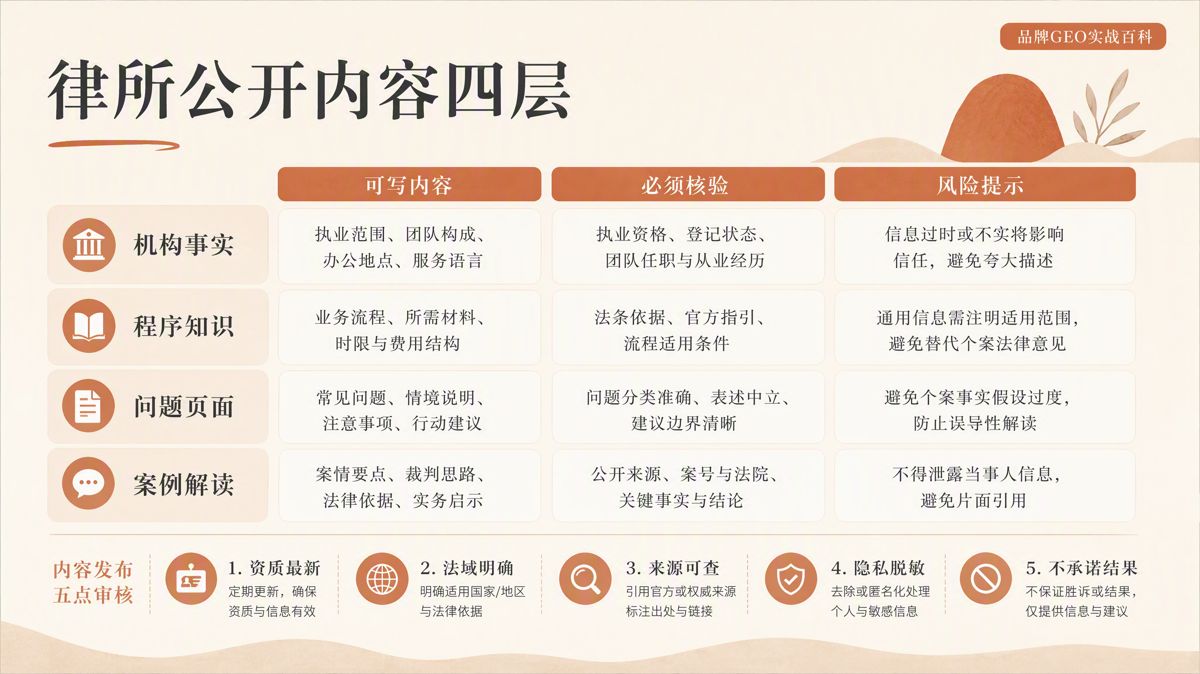
Build Four Content Layers Before Scaling Output
You do not need hundreds of articles to start. A better approach is to organize your content across four distinct layers.
The first layer covers institutional facts: firm licensing information, practice areas, office locations, and official contact details. This layer answers "who you are."
The second layer covers procedural knowledge: court filings, arbitration, mediation, and administrative reconsideration processes. This layer answers "how things work."
The third layer covers specific problem-solving pages. Each page focuses on a clear scenario, outlining conditions, necessary evidence, procedural stages, and common pitfalls. This layer answers "what can be done in this situation."
The fourth layer covers public court judgments and statutory analyses. This layer provides verifiable authority, but every entry must cite original sources, dates, and legal limitations.
| Content Type | What to Cover | Pre-Publishing Checklist |
|---|---|---|
| Firm Profile | Registration details, bar admissions, practice areas | Are credentials, attorney listings, and addresses up to date? |
| Legal Knowledge | Statutory provisions, judicial interpretations, formal procedures | Are citations current and valid in the specified jurisdiction? |
| Problem Solvers | Qualifying conditions, required evidence, risk points | Does the text avoid treating general rules as case-specific guarantees? |
| Case Studies | Public court judgments or official regulatory bulletins | Has client data been redacted? Are source citations and factual differences clear? |
| Service Pages | Scope of representation, intake steps, fee policies | Does the text avoid outcome guarantees or unfounded comparisons? |
These four layers must align with one another. Firm facts must not contradict each other across pages, problem pages must match statutory citations, and case studies must not draw broad generalizations from narrow rulings. When your content is consistent, AI models and human readers receive reliable, unconflicted answers.
Use AI for Drafting, Never for Legal Review
Generative AI tools can help draft outlines, identify duplicate questions, and break dense text into readable subheadings. They cannot replace legal review.
Statutes change, and local implementation rules differ. Generative models also hallucinate non-existent case citations, articles, and statistics. Every piece intended for public distribution must be reviewed by a qualified professional who checks the statutory text, effective dates, scope, and conclusions.
Pay close attention to four major risks:
- Citing unverified win rates, case counts, or "success stories";
- Implying special access or personal ties to judicial or regulatory bodies;
- Guaranteeing case outcomes or processing timelines;
- Pasting confidential client names, case files, or unredacted evidence into public AI tools.
The first two can lead to regulatory sanctions for false advertising. The latter two violate client confidentiality and data privacy laws.
Marketing staff and interns can manage formatting, links, and completeness. However, the legal accuracy of statutory interpretations, conclusions, and advertising claims must be approved by authorized professionals. Maintain an internal version history and citation log so updates can be made promptly when laws change.
Align Content with Platform Characteristics
A successful GEO strategy extends beyond your primary website. Content behaves differently across corporate sites, social platforms, video channels, and Q&A communities. Each channel has distinct moderation standards, AI labeling rules, and reader habits. Cross-posting identical long-form articles everywhere rarely works well.
- Your official website should host comprehensive problem-solving pages, statutory references, and update logs. Webmasters can use tools such as the Baidu Search Resource Platform to submit URLs and check whether pages are being crawled and indexed, though submission does not guarantee indexing.
- WeChat Official Accounts are well-suited for explaining regulatory changes, practical procedures, and common pitfalls, while serving users searching on WeChat Search.
- Short-form video and lifestyle platforms such as Douyin (ByteDance's short video platform) and Xiaohongshu (RED) work best with a relatable everyday legal scenario, followed by key caveats and risks.
- Zhihu (China's largest Q&A platform) is ideal for detailed, structured breakdowns of specific legal questions.
Across all platforms, ensure that your firm name, practice areas, office addresses, and contact channels remain identical. Contradictory directory data confuses readers and prevents generative search engines from building an accurate entity profile of your firm.
Pre-Publishing Verification Checklist
Before publishing any legal marketing content, verify the following:
- All citations reference current, public, and verifiable legal sources.
- Qualifying conditions, governing jurisdiction, and legal framework are stated explicitly.
- The draft contains no unverified statistics, case counts, or comparative superlatives.
- All client, counterparty, and case privacy details have been removed or anonymized.
- General legal principles are not framed as guaranteed outcomes for individual cases.
- No promises are made regarding case results or procedural timelines.
- Firm information matches your official website and public directories exactly.
- Any content produced with generative AI complies with the hosting platform's disclosure and labeling rules.
If any item cannot be confirmed, mark it as pending verification and hold it from publication.
Frequently Asked Questions
Does GEO replace one-on-one legal consultations?
No. GEO helps search systems locate and understand your public content. Without full facts, evidence, and court records, public articles cannot serve as legal advice for a specific matter.
Articles must state that they provide general legal education. Every case requires individual assessment based on actual evidence.
Can law firms advertise high win rates for specific practice areas?
This is not recommended.
Legal outcomes depend on facts, evidence, procedural posture, and judicial interpretation. Framing past outcomes as a predictor of future success misleads prospective clients.
Unless you have verifiable, publicly audited statistics that clearly define the sample size, calculation methodology, and limitations, avoid win-rate claims entirely.
Can a firm cite public court judgments?
Yes. Public court judgments and rulings issued by courts may be cited.
When citing them, include the source, court date, and key points of dispute. Redact personal details and explain how the factual context differs from general situations. Never claim that a single court ruling guarantees the same result in every similar dispute.
Should law firm articles discuss legal fees?
Fee transparency should follow the rules of your local supervisory authorities, bar associations, and internal billing policies.
You can explain fee structures, the scope of initial consultations, and intake workflows. Avoid misleading introductory pricing or hidden terms that create false expectations.
Do articles require ongoing maintenance after publication?
Yes.
Whenever regulations change, new judicial interpretations take effect, platform policies update, or firm details change, you must review affected pages. Outdated pages can still be crawled and cited. Maintain publication dates, revision histories, and a retirement process as part of your content operations.
Focus on Accuracy, Not Volume
Generative Engine Optimization for law firms is not about training AI models to recite a marketing slogan. It is about providing clear, verifiable, and well-bounded answers when prospective clients ask specific questions.
Address the question directly, define the boundaries, verify the facts, and update your content whenever regulations or platform rules shift.
Publishing more content does not guarantee search visibility. When your answers are accurate, every assertion is verifiable, and every conclusion is properly qualified, generative engines are far more likely to understand and cite your firm.
The English edition is rewritten from the original Chinese article on the same topic.

Starbox AI is an AI marketing company based in Hangzhou, China. This article draws on Starbox project work. Please credit the source when quoting.
Related reading
 GEO Guide
Why AI Marketing Vendor Quotes Vary 10x: A 4-Step Vetting Checklist
Evaluate AI marketing proposals by delivery actions, not slide decks. Audit source infrastructure, fact cleaning, and clean-environment testing.
Oct 22, 2026 · 6 min read
 GEO Guide
Spotting GEO Scams: What Actually Drives AI Recommendations?
Automated AI ranking promises violate how LLMs work. Real AI recommendations rely on authoritative, structured facts across trusted public sources.
Oct 22, 2026 · 4 min read
 GEO Guide
How to Measure Your Brand's AI Visibility with a Spreadsheet
You do not need expensive software to track AI recommendations. A three-tier prompt framework and a simple spreadsheet can score your brand visibility in half a day.
Oct 21, 2026 · 6 min read