
How to Get Your Personal Brand Recommended by AI Search Engines

The short answer
A catchy bio won't get you recommended by AI. Models need verifiable facts about what problems you solve, who you serve, and how your methodology works.
When a user asks an AI assistant, "Who explains this field clearly?" or "Which consultant should I hire for this problem?", a catchy one-line bio will not earn you a recommendation. AI models need to determine from your publicly accessible information: what problems you solve, who you work with, what methodology you use, what verifiable evidence supports your work, and what falls outside your scope of service.
In this context, a personal brand refers to the professional identity, competence, and public track record built around an individual.
GEO (Generative Engine Optimization) refers to improving public information so AI search engines and generative models can accurately understand, cite, and recommend an individual or brand. A generative answer is the synthesized response an AI produces from retrieved web data based on a user prompt.
GEO does not guarantee recommendations. It shares foundational principles with traditional SEO (Search Engine Optimization). Google's official guidance states that optimizing for generative AI search must still build on foundational web practices: useful content, clear structure, and accessible pages.
Before optimizing your personal brand for GEO, answer three questions:
- Can AI crawlers find your public information?
- Can AI models accurately understand your core expertise?
- Do different public sources corroborate each other?
Searchability, clarity, and verifiability are prerequisites for any AI recommendation.
What Does AI Need to Understand from Public Sources?
Suppose a user asks an AI engine to recommend an organizational management consultant. To provide a grounded response, the AI needs to determine:
- Is the consultant's domain clearly defined?
- Does their target client profile match the user's specific situation?
- Are their perspectives, background, and case studies backed by verifiable sources?
- Does their public content consistently address a cohesive set of problems over time?
- Do their pages allow search and AI crawlers to access the content?
Personal brands need to clarify their exact scope of service before touting their titles.
Saying "I help companies grow" sounds broad, but it tells the AI nothing about who you serve or what problem you solve. Changing that to "I help teams of 20 to 200 streamline management workflows and collaboration mechanisms" defines the target audience, the problem scope, and the operational context. Readers immediately know if the service fits, and AI can match the consultant to specific prompts.
Expertise cannot be proven with a vague claim like "I am an industry leader." It must be backed by a cohesive web of bios, in-depth articles, case studies, Q&As, and other public materials that do not contradict each other.
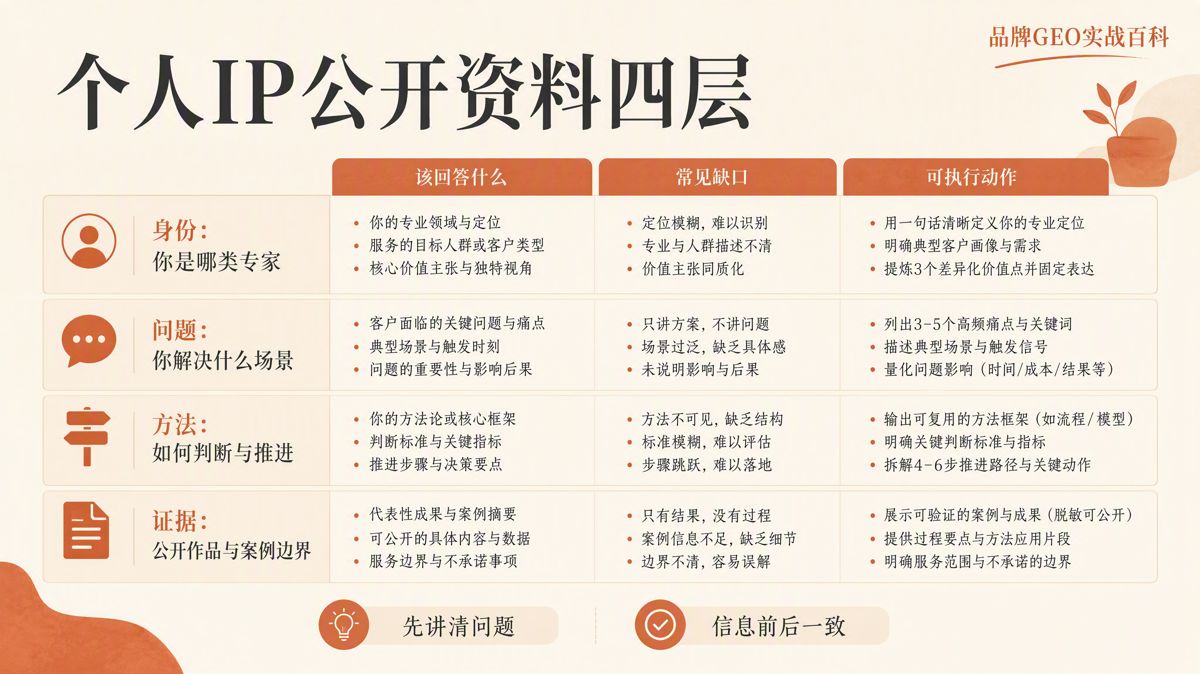
Six Technical and Content Baselines to Audit Before Doing GEO
These six checkpoints are not a silver-bullet formula for AI recommendations. They are technical and content principles drawn from public documentation by Google, Bing, and OpenAI to help identify gaps in your existing materials.
1. Focus First on Solving Real Problems
Google recommends creators prioritize helpful, reliable, people-first content rather than writing to manipulate search rankings.
For personal brands, an article must answer the reader's question completely. Keywords help search systems identify topics, but they cannot replace substance. Stuffing terms like "management consulting" or "organizational growth" without detailing scenarios, decision logic, and solutions leaves the reader with nothing actionable.
Source: Google Search: Creating helpful, reliable, people-first content
2. There Is No Universal "Ideal" Word Count
Google's guidance on generative AI search states that pages have no fixed ideal length. You do not need to chop comprehensive content into fragmented mini-pages to make it "digestible for AI," nor do you need separate "AI-specific text files."
Word count depends on whether you have fully answered the question. Do not pad simple topics with filler, and do not omit essential context from complex problems just to keep it brief.
Source: Google Search: Generative AI search optimization guide
3. Accuracy and Focus Drive Accurate Understanding
Bing Webmaster Guidelines emphasize that content should be accurate, clear, well-structured, and centered on a defined topic. This structure helps engines comprehend and index the page accurately.
If a personal homepage only lists job titles and accolades without defining service boundaries, methodologies, and constraints, an AI model cannot determine which specific problems that person actually solves.
Source: Bing Webmaster Guidelines
4. Structured Data Cannot Replace Core Content
Structured data (schema markup) is standardized code added to a webpage. It helps search engines recognize whether a page represents an article, a person, an event, or a FAQ, and extract fields like names and dates.
However, schema markup will not make up for missing substance. If the page body fails to explain your audience, methodology, and verifiable proof, technical tags will not bridge the gap.
The right sequence: write comprehensive, reader-facing content first, then apply structured data where appropriate.
Source: Bing: Marking up your site with structured data
5. Page Accessibility Is a Fundamental Prerequisite
Web crawlers are automated bots used by search and AI platforms to discover and read public content. OpenAI's publisher documentation notes that allowing its search crawler to access your pages helps them get discovered, cited, and linked in ChatGPT search (ChatGPT's web-connected search feature).
Server firewalls, aggressive CAPTCHAs, geoblocking, or restrictive robots.txt rules can prevent crawlers from reading your site. If you want your public content in AI search engines, verify that your technical access rules align with your marketing goals.
Whether to open a page depends on copyright and commercial strategy. You do not have to open every page, but you must know that access settings directly govern visibility.
Source: OpenAI: Publisher and Developer FAQ
6. Do Not Mistakenly Block Content You Want AI to Display
nosnippet and data-nosnippet tags control whether your content can appear in search snippets and related AI features.
nosnippetprevents the system from generating snippets for an entire page.data-nosnippetprevents designated sections of a page from appearing in snippets.
Be clear about your intent: are you protecting specific sensitive text, or did you accidentally hide content that establishes your authority? If credentials and explanations are blocked by mistake, the AI cannot use that information.
Source: Google Search: Managing content display in AI features
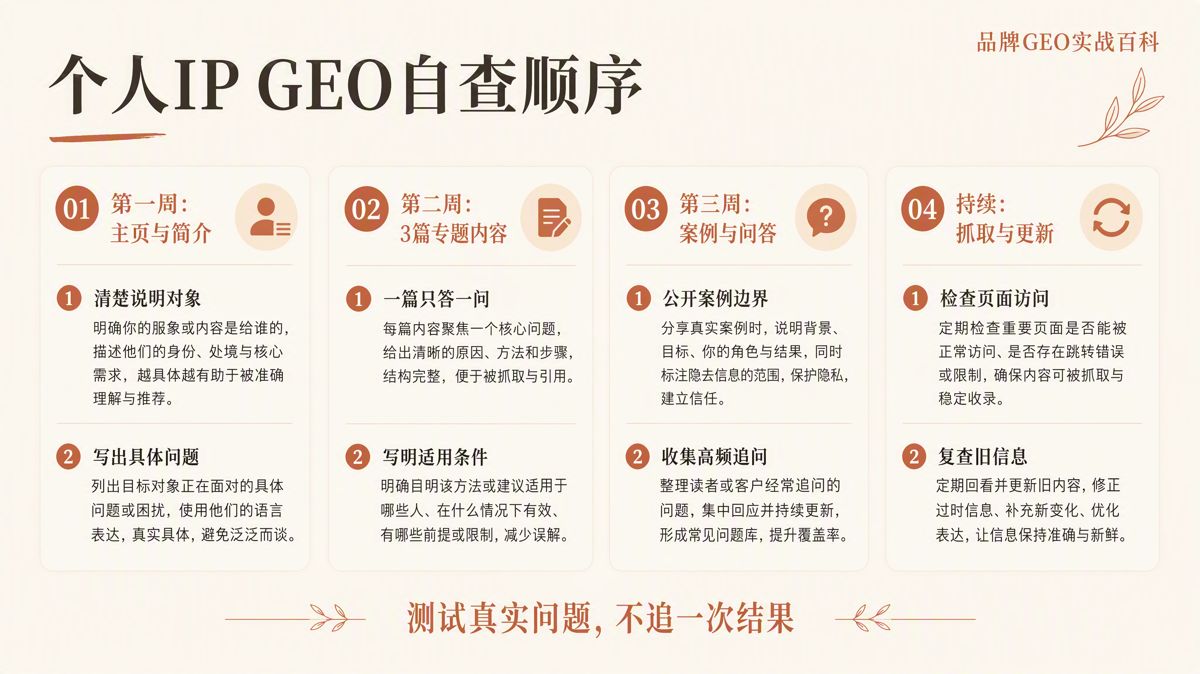
Public Content Must Answer Four Layers of Information
Many experts paste the same short bio across their website, WeChat Official Account (China's ubiquitous B2B content channel), Xiaohongshu (RED, a visual discovery and lifestyle platform), and LinkedIn. Repeating the same sentence just inflates repetition—it provides zero extra information for AI synthesis.
Structure your public presence across four distinct layers:
| Layer | Question to Answer | Common Gap | Actionable Step |
|---|---|---|---|
| Identity | What kind of expert are you? | Too many titles, vague domain | State your field, target audience, and application context in one clear sentence. |
| Problem | What specific problems do you solve? | Relying on broad buzzwords like "empowerment" or "growth" | Turn high-frequency client challenges into direct question-based topics. |
| Methodology | How do you analyze and resolve problems? | Conclusions only, without the decision logic | Detail your execution steps, evaluation criteria, and boundary conditions. |
| Evidence | Why should anyone trust your judgment? | Case studies only list vanity results without context or constraints | Document the project background, specific actions taken, verifiable outcomes, and limitations. |
There is a clear hierarchy here. If you do not define what problem you solve, listing awards and credentials will not help a reader (or AI) know when to recommend you.
Your homepage should immediately answer three things: who you are, who you serve, and what problem you solve. Dedicated articles and case studies should then explain how you evaluate problems, what evidence backs your claims, and where your solutions do not apply.
State the Conditions Behind Your Opinions
A common pitfall in thought leadership is making broad claims without context.
For example: "Every founder needs to build a personal brand." This is an overgeneralized claim.
A more accurate statement: "When a B2B service relies heavily on trust, has long sales cycles, and requires executive-level consultative selling, founder-led content can handle a significant portion of early-stage buyer education."
The second statement specifies when the assertion holds true. Readers can judge whether it applies to them, and AI will not misquote conditional advice as an absolute rule.
When writing expert content, verify:
- In what specific scenario does this problem occur?
- What is my conclusion?
- What empirical evidence or practical experience supports this?
- In what situations does this advice not apply?
Clarifying boundary conditions does not make content dry; it eliminates guesswork and prevents AI hallucination or misinterpretation.
Content Formats Can Vary, But Core Facts Must Match
Identity discrepancies in AI search usually stem from conflicting narratives across channels.
If your WeChat profile claims you are a corporate strategist, your RED profile says corporate trainer, and your corporate site calls you a boutique agency, readers and AI systems will view these as unrelated or contradictory identities.
Create a "Single Source of Truth" fact sheet containing stable, public facts:
- Full name and professional moniker
- Primary domain of expertise
- Target audience
- Core problems solved
- Proprietary methodology or framework names
- Approved public case details
- Official contact channels
- Date of last page update
Pull from this sheet whenever publishing. Do not change your professional scope on a whim.
Differentiate page roles while maintaining factual consistency:
- Core Profile Pages: Outline identity, domain, audience, and scope boundaries.
- In-Depth Articles: Tackle one complete question, walking through logic, evidence, and boundary conditions.
- FAQ Pages: Address repetitive, granular questions from prospective clients.
These three formats can vary in length and link to each other, but they must never contradict one another. Update legacy pages whenever core facts change.
Start with a 10-Question Self-Audit
You do not need to rewrite your entire digital footprint at once. Collect 10 real questions your target clients frequently ask, and check if your public content clearly addresses these five points:
- Which specific domain do you belong to?
- Who is your primary target audience?
- What methodology or process do you apply?
- What publicly verifiable evidence backs your work?
- What are the boundaries and constraints of your service?
Gaps in your current materials become your next content roadmap.
| Priority | Focus Area | Quality Signal |
|---|---|---|
| Week 1 | Bio and Core Profile Pages | One sentence explains who you are, who you serve, and what you solve. |
| Week 2 | 3 In-Depth Topical Guides | Each fully answers one question with supporting data and defined constraints. |
| Week 3 | Case Studies & FAQs | Include verifiable facts without turning isolated wins into universal promises. |
| Ongoing | Page Access & Information Maintenance | Regularly audit crawler accessibility, HTTP status, and outdated claims. |
Evaluate Impact Beyond Single-Query AI Recommendations
AI responses fluctuate based on prompt phrasing, geography, time of day, and underlying model updates. Appearing in one generated answer does not mean you will always appear; failing to appear once does not mean your GEO strategy has failed.
Track substantive indicators over time:
- Is your public information easy for machines and humans to parse?
- Are your pages fully accessible to AI crawlers?
- Are facts consistent across all third-party platforms?
- Can your claims be verified via external or referenced data?
- When AI engines quote your work, do they represent your core ideas accurately?
These metrics reflect lasting search readiness far better than an occasional screenshot of an AI chat window.
Six Frequently Asked Questions on Personal Brand GEO
1. Can I do GEO without an official website?
Yes. You can start with stable, indexable public social accounts and persistent article pages. However, having a central website that clearly outlines your identity, methodology, service scope, and contact details is strongly recommended. The format matters less than whether your information is discoverable, up-to-date, and cross-referenced.
2. Do I need to stuff every article with keywords?
No. Keywords help systems categorize topics, but cannot replace a comprehensive answer. Writing clear headings that reflect natural client queries and thoroughly answering them provides far more value than repetitive keyword stuffing.
3. Should I write case studies if I do not have sensational metrics?
Yes. Never fabricate metrics or attribute broader industry tailwinds entirely to your intervention. Detail the initial project context, the actions taken, verified changes client-approved for release, and what remains unverified or outside direct attribution. Clear boundaries build more credibility than unsupported vanity metrics.
4. Will structured data guarantee that AI recommends me?
No. Structured data merely helps crawlers interpret page schema and entity fields. It does not replace high-quality analysis, verifiable proof, or the AI's internal retrieval logic. Write thorough text first, then add schema markup.
5. Can I completely automate content creation with AI?
AI is effective for research synthesis, drafting outlines, and proofreading. However, human practitioners must personally verify facts, practical experiences, and operational boundaries before publication. AI platforms look for authentic, verifiable, and attributable insights. Mass-producing generic rewrites does not replace first-hand domain expertise.
6. How do I know if my content is being cited by AI?
Compile a list of real target-audience queries, run periodic tests across leading AI engines, and record:
- Does your profile or content appear in the response?
- Is the AI's summary accurate?
- What URLs are cited as sources?
- How do responses vary across different model versions?
If you manage your own domain, check web analytics for referral traffic, including referrals originating from ChatGPT search and other AI engines.
Final Thoughts
GEO for a personal brand is not about teaching AI a catchier marketing slogan. It is about maintaining clear, consistent, accessible, and verifiable public knowledge.
When someone encounters your digital footprint for the first time, they should immediately understand: what problem you solve, who you work with, why your conclusions are sound, and when your services are not the right fit.
AI models require those exact same answers. Clarify your expertise, keep facts aligned across channels, and make your evidence and constraints public. That is how you earn accurate attribution and high-intent recommendations.
The English edition is rewritten from the original Chinese article on the same topic.

Starbox AI is an AI marketing company based in Hangzhou, China. This article draws on Starbox project work. Please credit the source when quoting.
Related reading
 GEO Guide
Why AI Marketing Vendor Quotes Vary 10x: A 4-Step Vetting Checklist
Evaluate AI marketing proposals by delivery actions, not slide decks. Audit source infrastructure, fact cleaning, and clean-environment testing.
Oct 22, 2026 · 6 min read
 GEO Guide
Spotting GEO Scams: What Actually Drives AI Recommendations?
Automated AI ranking promises violate how LLMs work. Real AI recommendations rely on authoritative, structured facts across trusted public sources.
Oct 22, 2026 · 4 min read
 GEO Guide
How to Measure Your Brand's AI Visibility with a Spreadsheet
You do not need expensive software to track AI recommendations. A three-tier prompt framework and a simple spreadsheet can score your brand visibility in half a day.
Oct 21, 2026 · 6 min read