
5 SaaS Buyer Decision Scenarios That Define Your GEO Strategy
The short answer
Before publishing more content, SaaS teams doing GEO must align standalone pages to the five specific decisions buyers make during evaluation.
When SaaS teams decide to invest in Generative Engine Optimization (GEO), the default instinct is usually to rewrite the homepage, pack it with category keywords, and churn out generic articles like "What is [Category] Software?"
These efforts have some value, but the sequence is backwards.
GEO aims to make your brand's information easily understood, extracted, and cited by generative AI engines. To make this work, the first question is not "What else can we publish?" It is: What judgment is the buyer trying to make right now, and does our site have a single page that directly answers it?
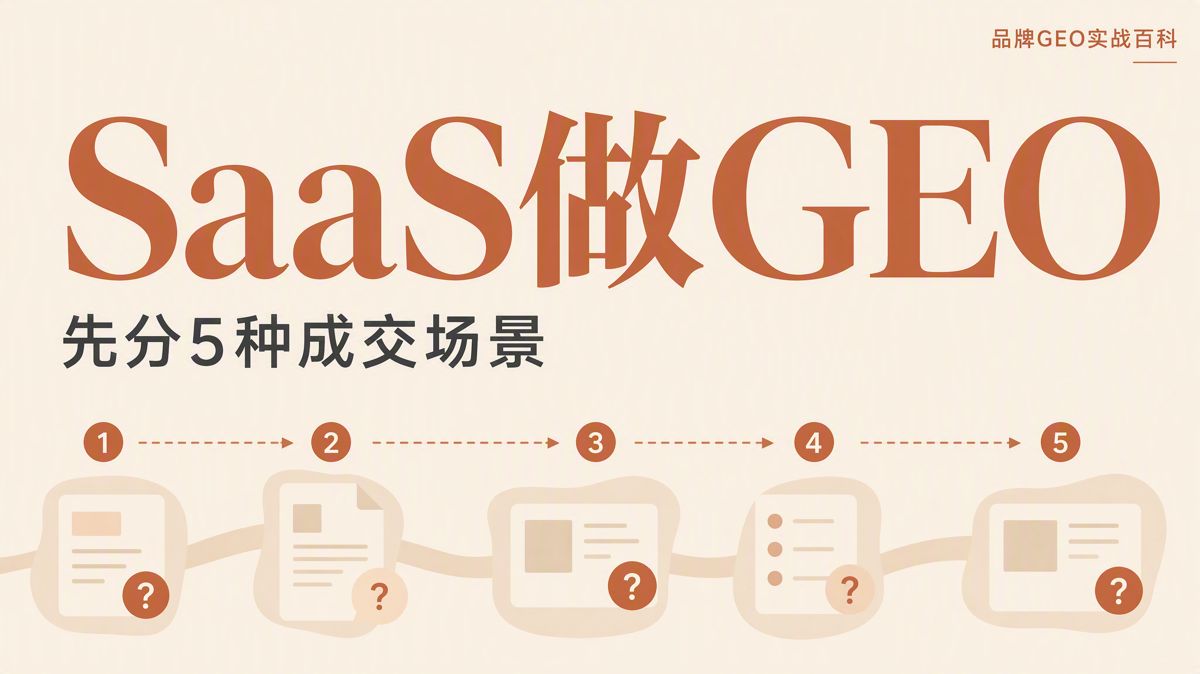
For SaaS buyers, evaluation queries generally fall into five decision scenarios:
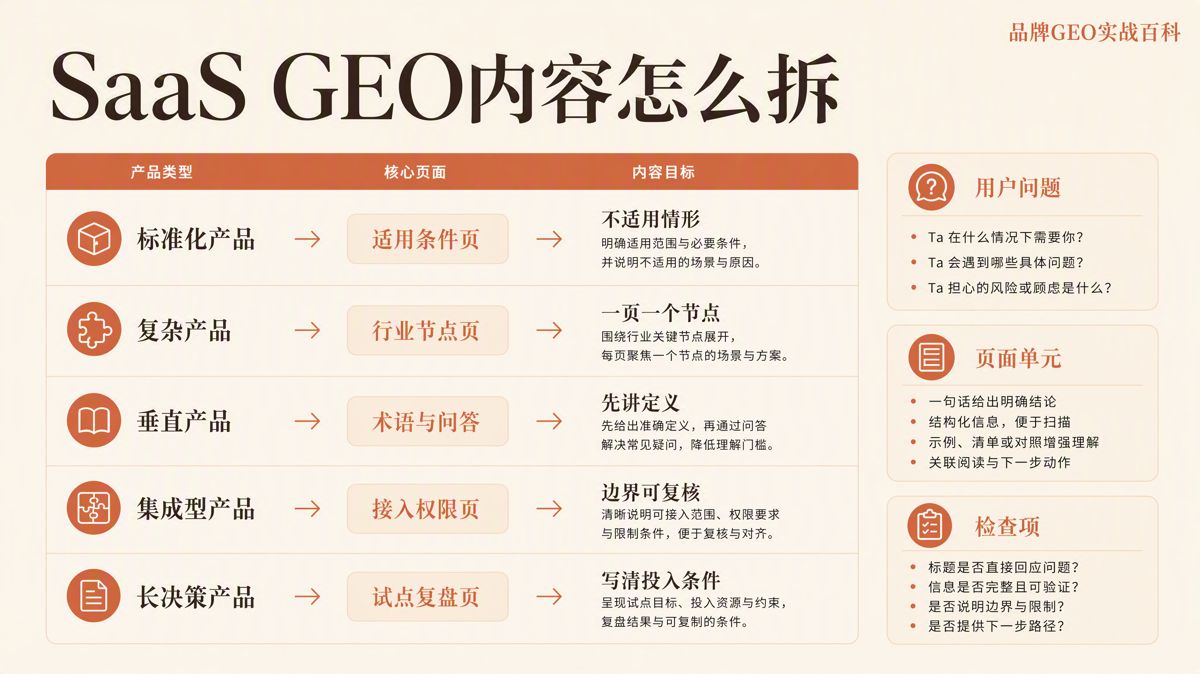
- Standardized products: Is this tool the right fit for me?
- Complex products: Can this handle the realities of my specific industry?
- Vertical products: What do these domain terms and workflows actually mean?
- Integration-heavy products: Can this connect to our existing tech stack?
- Long-cycle enterprise products: What actually happens after we sign and roll this out?
These are not rigid product categories. A single SaaS product may span two or three of these scenarios at once. What matters is identifying the exact evaluation stage the buyer is in at any given moment.
Once you pinpoint that judgment call, you can build a page that is self-contained, easy to verify, and consistently maintained. Getting this sequence right matters far more than filling out a 12-month editorial calendar.
SaaS GEO Is Not About Building a Giant FAQ Dump
Generative search engines generally process queries through three stages:
- Candidate retrieval: Identifying pages and sources that might answer the query.
- Ranking: Assessing which sources are the most relevant, reliable, and authoritative.
- Generation: Extracting modular information blocks, synthesizing an answer, and attaching source citations.
An "information block" is a modular section of content that makes complete sense on its own, even when separated from the broader page context.
Because of this, an all-in-one product page that packs features, target industries, pricing tiers, and case studies into a single URL is often hard for an AI engine to extract cleanly. A focused page explaining "How multi-location retail chains configure role-based access control" has a clear scope and explicit constraints that are much easier to parse and cite.
Your SaaS content architecture should not reflect internal org charts—dividing pages by Marketing, Sales, and Product. It should be structured around buyer evaluation questions.
Buyers do not care which department wrote the page. They only care whether the page helps them make a decision.
The Research Foundations Behind AI Retrieval
Public research and technical evaluations highlight six baseline realities of generative search:
- Generative engines retrieve, rank, and synthesize answers using modular chunks of self-contained information.
- Research indicates that URLs cited by generative search engines are, on average, 25.7% newer than traditional organic search results. One major AI assistant consistently favors pages that are 393 to 458 days newer than traditional organic results.
- In a study analyzing 1.4 million search queries, 67% of the top 1,000 cited pages across a leading AI assistant came from original research, primary data, or academic sources.
- A March 2026 study found that 73% of B2B buyers use AI tools to research vendors; a separate 2025 study reported that 89% of enterprise buyers rank generative AI as their primary self-service research channel during procurement.
- Different search engines and AI assistants have distinct preferences for citation sources—ranging from official corporate documentation and encyclopedias to technical forums and Q&A communities. These platform preferences must be validated through live testing rather than accepted as fixed rules.
- Search engines vary in how effectively they render client-side JavaScript. Delivering critical technical and product information through server-rendered, static HTML remains the most reliable way to ensure AI crawlers capture your content accurately.
These findings point to clear strategic priorities:
- Keep technical and product documentation up to date.
- Back core claims with verifiable facts and primary data.
- Validate your distribution channels through actual search testing.
- Ensure critical pages are crawlable without client-side script execution.
- Ensure every major content block can explain a concept independently.
With these parameters in mind, let us examine the five buyer scenarios.
Scenario 1: Standardized Products — "Is This Right for Me?"
Standardized SaaS products usually have well-defined user personas and clear operational boundaries. These include lightweight collaboration, marketing automation, and productivity tools.
When evaluating these tools, buyers rarely read exhaustive feature lists first. They ask practical qualifying questions:
- Does this make sense for a team of our size?
- Can this specific role use it without engineering support?
- Can it replace our existing workflow?
- What prerequisites are required before onboarding?
For these products, prioritize eligibility and qualification pages. Each page should clearly address four items:
- Which team sizes, roles, or operational workflows the tool fits best.
- Technical and operational prerequisites for adoption.
- A step-by-step walkthrough of a typical core task.
- Explicit scenarios where the product is not recommended.
Many marketing teams hesitate to write "Who this is not for," fearing it will hurt conversion rates. In reality, hiding functional limitations simply pushes friction downstream into sales calls and customer success churn.
Documenting disqualifiers helps buyers rule out bad fits early and saves significant sales capacity.
Scenario 2: Complex Products — "Can It Work in My Industry?"
A frequent misstep with complex SaaS products is dumping multiple roles, enterprise features, and varied workflows into a single generic "Industry Solutions" page.
Buyers finish reading knowing the product claims to do everything, but still have no idea whether it can handle their specific operational bottlenecks.
A better structure follows this sequence: Industry Problem → Operational Workflow Node → Verifiable Outcome.
Instead of claiming broad support for "Retail," break the solution down by distinct operational challenges:
- How store auditing workflows capture data and which roles execute them.
- How loyalty program administration handles data imports and validation.
- How regional management monitors branch performance.
- What technical prerequisites are required prior to deployment.
- How the system audits and verifies final operational results.
Dedicate each page to a single operational node, then connect related nodes using clear internal links.
This is not just breaking long content into smaller pages. It matches each URL to a distinct buyer query, making it easier for human buyers to find exact answers and for AI engines to cite specific operational capabilities.
Scenario 3: Vertical Products — "What Do These Terms and Processes Mean?"
Vertical SaaS serves specialized industries. When buyers search, they combine the industry name with domain-specific terminology, specialized job titles, regulatory requirements, and local compliance standards.
Content opportunities here lie outside generic industry head terms. They live in the precise operational questions practitioners face daily.
Prioritize two content formats:
- Terminology and concept teardowns
- Workflow Q&A pages
Keep terminology definitions concise and objective. Immediately follow the definition with practical context:
- Who this operational standard applies to.
- What data inputs are required.
- What tangible outputs or reports are generated.
- Common operational misconceptions.
- The next step in the implementation process.
Avoid turning terminology pages into sales pitches. If a definition is packed with marketing adjectives like "industry-leading," "seamless," or "revolutionary," buyers still will not understand the concept—and AI engines will struggle to extract it as a credible informational citation.
Explain the operational concept clearly first. Your product's specific role in that workflow should sit in a separate, dedicated section below the definition.
Scenario 4: Integration-Heavy Products — "Can It Connect to Our Existing Systems?"
For mid-market and enterprise buyers, product demos are rarely the first evaluation milestone.
Where data comes from, how permissions are managed, and whether the tool integrates cleanly with the existing stack dictate whether a product even makes the pilot shortlist.
Marketing teams cannot produce this content in isolation. Product, engineering, and implementation specialists must contribute to at least five distinct page types:
- Prerequisites for integration.
- Data scope, schemas, and sync intervals.
- Role-based access control (RBAC) and permission structures.
- API endpoints, webhooks, and manual batch-import options.
- Error-handling protocols and fail-safes.
Every page must state two things clearly: what is currently supported, and what is currently not supported.
Marketing can own the readability and structure, but technical owners must verify all parameters, integration limitations, and data boundaries. The more specific your technical documentation is, the less time your sales engineers spend answering repetitive preliminary questions.
Scenario 5: Long-Cycle Enterprise Products — "What Happens After We Sign?"
In enterprise SaaS deals with long evaluation cycles, buyers evaluate more than software capabilities. They evaluate migration risk, internal change management costs, and accountability when something breaks.
Feature lists cannot answer these concerns. Your content must outline the end-to-end implementation roadmap:
- How pilot scope and success criteria are defined.
- What deliverables are completed during Phase 1.
- Required resource allocation from business and IT teams.
- Clear milestone signals indicating the project is ready to advance.
- Predefined triggers for pausing deployment and reviewing root causes.
Case studies must move beyond vanity metrics. Stating that a client "improved efficiency by 30%" without detailing baseline conditions, implementation hurdles, and resource investments prevents buyers from determining whether that result is replicable.
A credible case study answers three foundational questions: What were the client's baseline technical and operational conditions? What specific implementation steps were taken? What parts of the strategy should not be copied without modification?
Matching SaaS Scenarios to Content Priorities
| SaaS Scenario | Core Buyer Question | Priority Content Assets | Primary Quality Check |
|---|---|---|---|
| Standardized | Is this right for me? | Eligibility pages, disqualification criteria, initial setup flows | Are non-ideal use cases clearly defined? |
| Complex | Can it work in my industry? | Workflow node teardowns, role-specific task pages | Does each page address only one operational workflow? |
| Vertical | What do these terms and processes mean? | Domain glossaries, scenario Q&As, implementation trap teardowns | Is the technical definition free of sales language? |
| Integration-Heavy | Can it connect to our systems? | Integration prerequisites, data specs, RBAC documentation, error handling | Are technical boundaries verified by engineering? |
| Long-Cycle | What happens after rollout? | Pilot frameworks, migration roadmaps, collaboration checklists | Are resource commitments and pause criteria explicit? |
This framework is not meant to force your product into a single box. It helps you identify which content assets to build for specific buyer questions.
A vertical SaaS platform can also be integration-heavy. If so, build distinct pages for both scenarios rather than cramming glossaries, integration specs, and migration paths into an unfocused overview page.
Implementation: Building a Question-to-Page Index
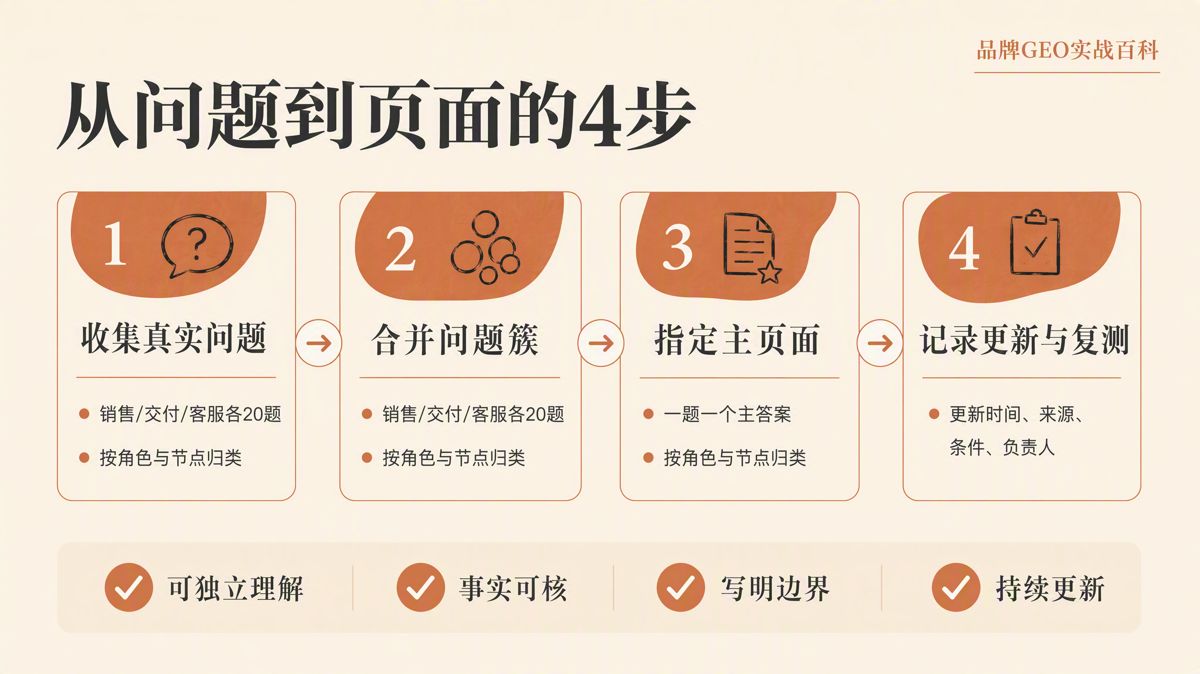
Do not start by filling out a publishing schedule. Start by compiling real questions from real buyers.
Ask your sales, solutions engineering, and customer support teams for the top 20 questions they field during evaluation calls. Consolidate overlapping queries into thematic groups.
Assign each group to a single canonical page. Avoid scattering variations of the same answer across blog posts, press releases, and product pages, which creates conflicting statements and outdated claims across your site.
For each canonical page, maintain four operational records:
- Last reviewed date
- Primary data source or technical reference
- Applicability criteria and constraints
- Internal subject-matter owner
These attributes do not all need to be public-facing, but internal teams must be able to audit them. When a feature changes, an API deprecates, or pricing shifts, your team knows exactly which page requires an update—preventing outdated claims from lingering online.
Once your on-site documentation is solid, consider external syndication.
Because generative engines pull from varied ecosystems, test your core buyer queries across target AI engines periodically. For each test run, document four factors:
- Does the AI engine cite your canonical page?
- Which specific information blocks were extracted?
- Did the synthesized answer omit essential qualifiers or constraints?
- Did recent updates to your page change the generated output?
Use those audit findings to guide your next round of content updates, technical clarifications, and distribution adjustments.
The Bottom Line
Effective GEO for SaaS is not about churning out higher volumes of generic content or packing everything onto a single page.
Success comes from ensuring that every high-stakes decision your buyer makes is answered by a clear, verifiable, and actively maintained page.
Map your content to real evaluation questions, build dedicated pages that answer them directly, and validate AI visibility through systematic testing. When your content helps buyers understand whether your software fits their stack, how it deploys, and where its limits lie, it becomes an active driver of their purchasing decision.
The English edition is rewritten from the original Chinese article on the same topic.

Starbox AI is an AI marketing company based in Hangzhou, China. This article draws on Starbox project work. Please credit the source when quoting.
Related reading
 GEO Guide
Why AI Marketing Vendor Quotes Vary 10x: A 4-Step Vetting Checklist
Evaluate AI marketing proposals by delivery actions, not slide decks. Audit source infrastructure, fact cleaning, and clean-environment testing.
Oct 22, 2026 · 6 min read
 GEO Guide
Spotting GEO Scams: What Actually Drives AI Recommendations?
Automated AI ranking promises violate how LLMs work. Real AI recommendations rely on authoritative, structured facts across trusted public sources.
Oct 22, 2026 · 4 min read
 GEO Guide
How to Measure Your Brand's AI Visibility with a Spreadsheet
You do not need expensive software to track AI recommendations. A three-tier prompt framework and a simple spreadsheet can score your brand visibility in half a day.
Oct 21, 2026 · 6 min read