
Consumer Goods GEO: Align Facts Before Expanding Channels

The short answer
Before expanding overseas channels, consumer brands must unify core product facts so AI engines can find, understand, and cite them accurately.
Generative Engine Optimization (GEO) refers to making brand information easier for artificial intelligence (AI) engines to locate, understand, and accurately cite when generating answers.
When consumer brands expand overseas, the primary bottleneck is rarely a lack of marketing channels. More often, it is that different channels tell contradictory stories about the exact same product.
A direct-to-consumer (DTC) website lists one capacity, while an Amazon listing shows another. A brand landing page highlights target demographics, but review articles omit the necessary operating prerequisites. A warranty or return policy is updated internally, yet distributor portals continue displaying the legacy terms.
When confronted with conflicting details, shoppers cannot tell which source to trust. AI search engines attempting to synthesize these public touchpoints often combine brands, model numbers, technical specs, and customer opinions incorrectly.
Before adding new websites or social profiles, an overseas brand must answer three basic questions: What exactly is this product? Who is it for? Why is it trustworthy?
Your brand website serves as the primary factual record. Retail platforms support purchasing decisions. Independent reviews provide third-party validation. User communities address specific troubleshooting scenarios. Media outlets distribute newsworthy updates. Each channel can adapt its tone, but the underlying product facts must remain consistent.
Five Realities to Confirm Before Launching Channels
First, international shoppers do not rely on your website alone. They compare information across search engines, DTC stores, retail platforms like Amazon, third-party reviews, and community forums. A single site rarely answers every pre-purchase and post-purchase question.
Second, regulatory requirements for ingredients, packaging labels, environmental claims, child safety, and privacy vary by jurisdiction. You must audit information against the legal standards of each target market rather than copying claims from another territory.
Third, customer reviews reflect personal sentiment, not verified performance claims. They cannot substitute for technical testing and must never be repackaged as clinical, functional, or medical guarantees.
Fourth, generative AI answers pull from multiple public sources. If your brand name, product dimensions, usage limitations, and selling points disagree across the web, AI engines will hallucinate composite descriptions.
Fifth, GEO is not bulk backlink acquisition, nor is it pasting the same marketing paragraph onto dozens of low-quality domains. It relies on explicit technical specifications, verifiable brand facts, and corroborating third-party validation.
Step 1: Establish a Master English Fact File
Most cross-border brands do not suffer from a shortage of web pages; they lack a single factual baseline that every channel must follow.
When the same item carries conflicting names, dimensions, materials, or warranty terms across your DTC shop, retail listings, distributor sheets, and press releases, potential buyers get confused before they even evaluate whether the item fits their needs.
Build an approved Master English Fact File before launching external campaigns. At a minimum, this file should contain:
- Official brand name and standard spelling
- Product category
- Model numbers, variants, and colorways
- Technical specifications and standardized units of measurement
- Approved use cases and explicit exclusions
- Pricing guidelines
- Supported shipping destinations
- Return and warranty policies
- Verified contact channels
- Last updated date
A master fact file is a living document. Whenever you launch an iteration, adjust packaging, alter specifications, or revise return policies, update this master record first. Then, propagate those revisions to your DTC storefront, retail listings, dealer portals, and media kits.
You cannot correct inaccurate citations across the web until you establish which version of the truth is definitive.
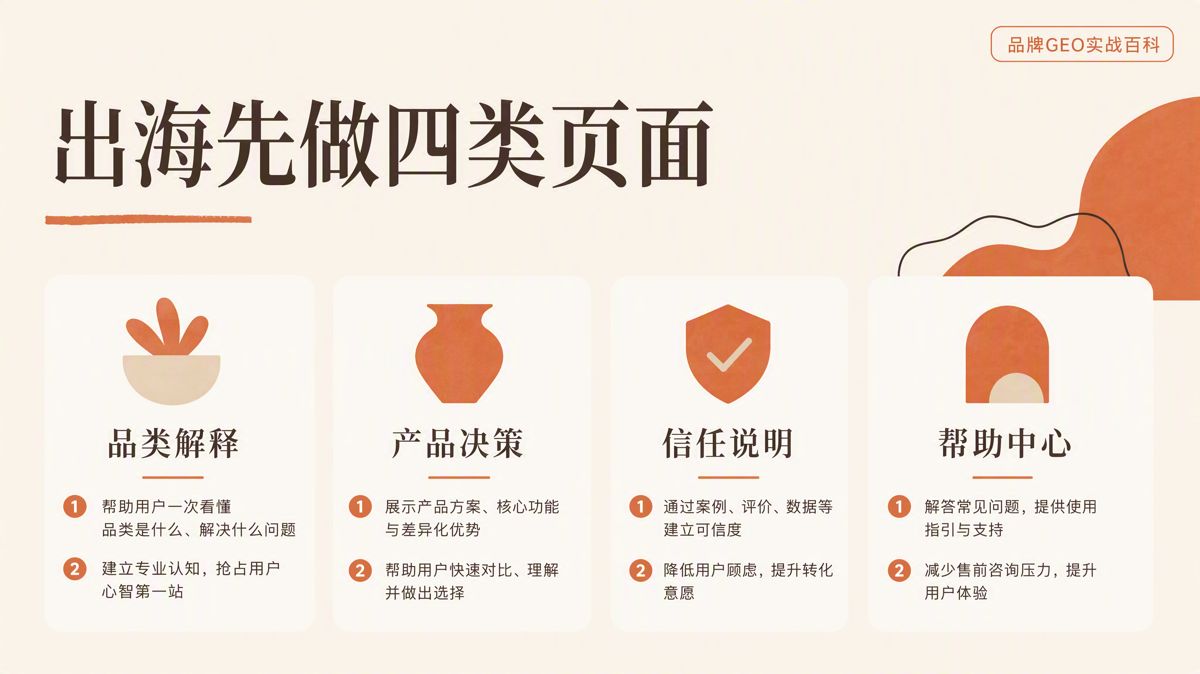
Step 2: Prioritize Four Core Page Types
Do not build hundreds of thin pages on your DTC website. Focus first on the four page types that help buyers understand your product, determine suitability, and solve post-purchase issues.
1. Category Explainer Pages: Teaching Shoppers How to Choose
A category page clarifies the broader product landscape. It answers three questions: What problem does this category solve? What criteria should buyers compare? How do different personal requirements dictate the right choice?
This page does not need to push a specific SKU immediately. Its primary role is to establish a rational evaluation framework for shoppers unfamiliar with the category. Once a buyer understands what parameters matter, they can evaluate whether your model meets their needs.
2. Product Decision Pages: Clarifying Conditions and Boundaries
A decision page explains who a model is built for, how to operate it, and how it differs from adjacent variants.
Do not write purely promotional copy. Detail exact specifications, operational prerequisites, and situations where the item should not be used. Without these boundaries, consumers and AI engines cannot confirm whether the item fits a specific use case.
3. Trust Pages: Defining the Scope of Every Claim
Consolidate materials data, laboratory testing, regulatory certifications, and warranty terms onto dedicated trust pages.
Every claim must specify its geographic jurisdiction, applicable SKUs, and testing scope. If a safety certification only applies to a specific model or a single country, do not present it as a blanket endorsement across your entire product line.
4. Help Centers: Resolving Post-Purchase Inquiries
Your help center should break shipping, returns, assembly, routine maintenance, and troubleshooting into discrete, question-specific entries.
Answers should be concise, structured, and explicit about preconditions. When fulfillment or warranty rules change, update these entries immediately.
| Page Type | Core Question Answered | Required Evidence and Details | Update Trigger |
|---|---|---|---|
| Category Explainer | How should I choose? | Decision criteria, comparison parameters | Category standards evolve |
| Product Decision | Is this product right for me? | Technical specs, limitations, usage guides | New SKU launches or redesigns |
| Trust Page | Can I rely on this data? | Test reports, certifications, warranty bounds | Certification or policy updates |
| Help Center | What happens after I buy? | Shipping, returns, maintenance workflows | Customer service policy updates |
Step 3: Define Clear Roles for Every Channel
The total number of external accounts does not indicate GEO maturity. What matters is whether each channel delivers the specific information consumers look for at that stage of their journey.
- DTC Website: Acts as the single source of truth for brand facts, serving as the baseline for all external syndication.
- Retail Platforms (e.g., Amazon): Focuses on current pricing, stock availability, specifications, fulfillment speeds, and purchase terms.
- Independent Reviews: Provides objective testing methodologies, real-world evaluations, and the defined boundaries of the test.
- Forums and Communities (e.g., Reddit): Addresses practical user scenarios, installation workarounds, and candid troubleshooting.
- Vertical Trade Media: Covers newsworthy product milestones, engineering designs, safety accreditations, and corporate developments.
Factual consistency does not mean publishing identical copy across the internet.
A single fact should be expressed differently depending on the channel's purpose. The DTC site lists full technical parameters, retail pages highlight purchasing essentials, reviews explain sample testing boundaries, and community posts solve individual edge cases.
Keep your naming conventions, dimensions, operational boundaries, certification claims, and warranty terms identical across all touchpoints. Do not copy and paste the same marketing paragraph everywhere; align the underlying data.
This reduces validation friction for consumers and makes it simple for AI engines to reconcile multiple citations into a single, accurate profile.
Customer Reviews Provide Context, Not Proof
Consumer brands rely heavily on word-of-mouth, but you must separate official brand specifications, third-party lab tests, and subjective customer reviews.
Reviews capture individual user sentiment. Professional evaluations detail structured testing parameters and the scope of their conclusions. Official brand pages state verified product capabilities backed by documentation.
"Many customers enjoy this product" does not mean "this product works for everyone." An individual customer's positive experience cannot be repurposed into an official medical, functional, or structural claim. Conflating subjective commentary with product facts degrades brand credibility and introduces regulatory risks under local advertising laws.
Exercise strict discipline in regulated categories such as beauty, maternal care, food, and wellness. Before entering a new country, verify local requirements regarding ingredient disclosures, labeling, and advertising claims. If an authorization or certification does not cover your target market, do not describe it as a universal credential.
How GEO and SEO Work Together
Search Engine Optimization (SEO) helps web pages get discovered, indexed, and ranked for user search queries. GEO builds on this foundation by ensuring AI engines understand, synthesize, and cite that content accurately.
Both disciplines require solid technical and structural hygiene:
- Avoid locking essential product facts inside images, modal popups, or client-side JavaScript that search crawlers and AI scrapers struggle to render.
- Use explicit page titles and maintain permanent, stable URL structures.
- Define the regional and language scope on localized pages to prevent regional cross-contamination.
- Format real customer questions directly as subheadings so readers and models instantly grasp the page topic.
- State conclusions first, followed by necessary conditions, supporting evidence, and exceptions.
This structure allows readers to scan quickly while preventing AI engines from lifting statements out of context.
Brands should also select a recurring sample of frequent customer queries every month to audit AI engine outputs:
- Is the product categorized under the correct industry segment?
- Is the product accurately associated with your brand?
- Are capacities, materials, and physical dimensions correct?
- Are subjective customer reviews being presented as verified product facts?
- Do citation links resolve to active, relevant pages?
When you spot an error in an AI answer, do not simply leave complaints on social media. Trace the public citations referenced by the engine. Determine whether the flaw stems from a name mismatch, outdated specifications, misquoted reviews, or missing prerequisites, and correct the corresponding source page.
AI summaries will only improve after the public web sources they rely on are corrected.
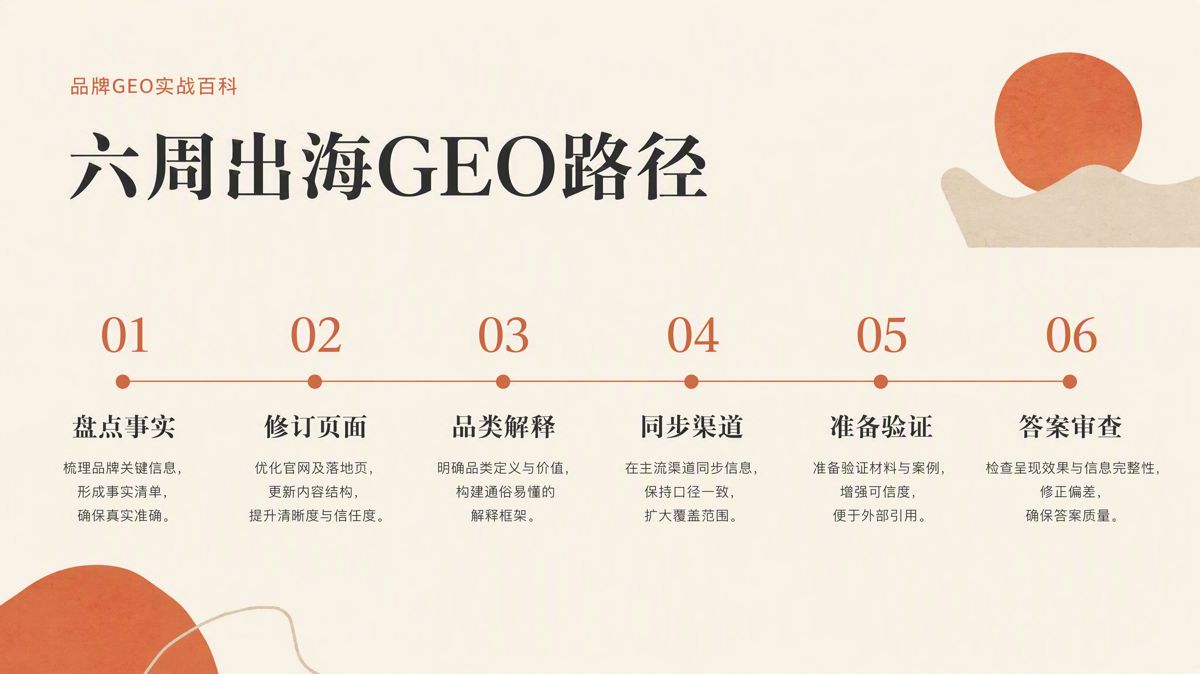
A Practical Six-Week Execution Roadmap
Consumer brands expanding internationally can roll out their GEO framework using this schedule:
| Timeline | Primary Objective |
|---|---|
| Week 1 | Audit master English product facts; review regulatory requirements for target markets. |
| Week 2 | Update core product decision pages and post-purchase help center entries. |
| Week 3 | Build category explainer pages and clear variant comparison guides. |
| Week 4 | Align specifications and terms across retail listings and distributor portals. |
| Week 5 | Prepare public-facing PR, independent review guidelines, and community resources. |
| Week 6 | Audit AI answers using common buyer queries; establish an ongoing error-tracking log. |
When measuring progress, look beyond simple brand mention volumes. Track these four performance metrics:
- Correct Attribution Rate: The percentage of citations where your product, brand name, and category are matched accurately.
- Factual Completeness Rate: The degree to which core specifications, operating limits, and conditions are fully represented.
- Stale Information Rate: The frequency with which retired specifications, old packaging, or obsolete policies appear in generated answers.
- Query Coverage Rate: The share of frequent pre-purchase questions that yield clear, verifiable answers.
Frequent brand mentions do not help your business if the underlying details are wrong; in fact, incorrect specs increase customer support inquiries and return rates. Getting noticed is merely the first step. Being accurately understood is the true objective of GEO.
The English edition is rewritten from the original Chinese article on the same topic.

Starbox AI is an AI marketing company based in Hangzhou, China. This article draws on Starbox project work. Please credit the source when quoting.
Related reading
 GEO Guide
Why AI Marketing Vendor Quotes Vary 10x: A 4-Step Vetting Checklist
Evaluate AI marketing proposals by delivery actions, not slide decks. Audit source infrastructure, fact cleaning, and clean-environment testing.
Oct 22, 2026 · 6 min read
 GEO Guide
Spotting GEO Scams: What Actually Drives AI Recommendations?
Automated AI ranking promises violate how LLMs work. Real AI recommendations rely on authoritative, structured facts across trusted public sources.
Oct 22, 2026 · 4 min read
 GEO Guide
How to Measure Your Brand's AI Visibility with a Spreadsheet
You do not need expensive software to track AI recommendations. A three-tier prompt framework and a simple spreadsheet can score your brand visibility in half a day.
Oct 21, 2026 · 6 min read