
How B2B Industrial Manufacturers Should Approach GEO
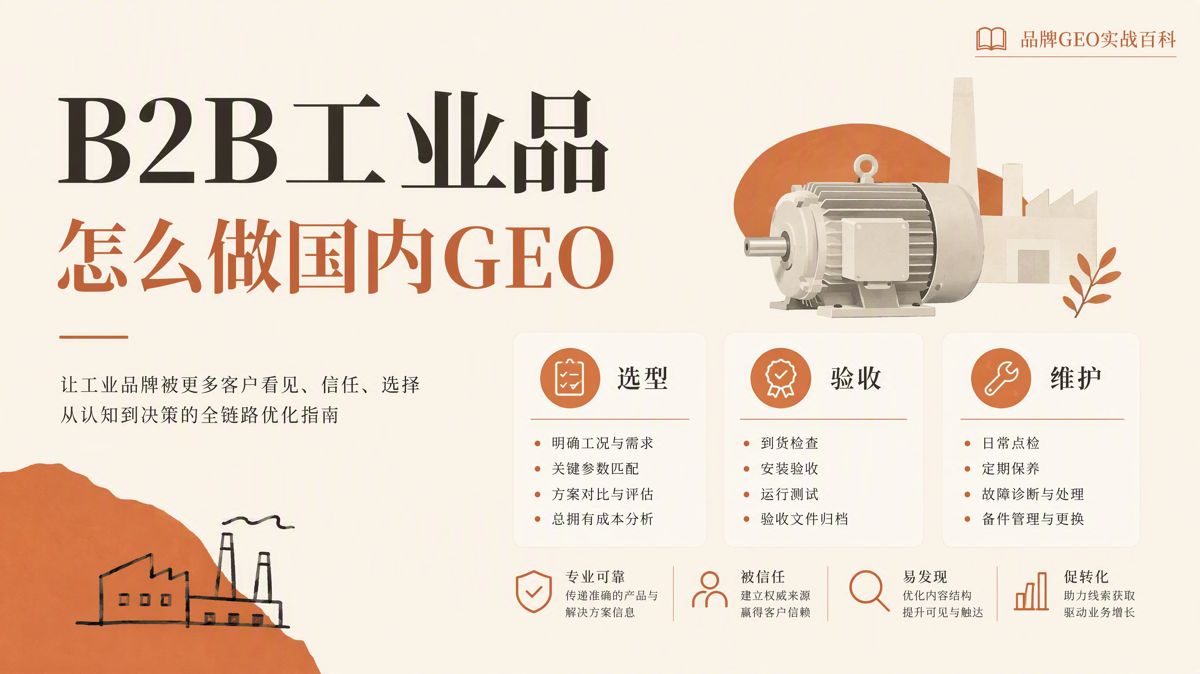
The short answer
Industrial GEO is not about brand hype. It requires turning internal engineering data into structured, verifiable answers for AI search engines.
Industrial procurement rarely starts with a query like "Where is Company X's official website?"
Procurement engineers and plant managers start from operational realities: Which solution fits these specific working conditions? Can this unit connect to our existing piping? What variables affect lead time? What inspection checklist applies upon delivery? If the equipment faults, where do we start troubleshooting?
In industrial sectors, these realities are defined by operating conditions: fluid or gas media, temperature ranges, pressure levels, mechanical loads, ambient environment, and duty cycles. Every procurement question eventually boils down to condition matching, model selection, interface compatibility, acceptance criteria, and long-term maintenance.
This is where Generative Engine Optimization (GEO) begins for industrial manufacturers.
GEO is the practice of organizing, publishing, and updating public information so generative AI search systems can locate, understand, and cite it. When an engineer asks an AI engine a detailed technical question, the system scans public sources to synthesize an answer.
Having spec sheets, case studies, and certificates on your website does not guarantee an AI engine will cite them. If your pages only highlight "corporate strength" and "product superiority" without documenting operating thresholds, selection logic, interface requirements, and failure modes, AI engines have no usable data to synthesize.
Industrial GEO is not a new way to promote products. It is the discipline of structuring existing engineering knowledge into public, verifiable, and machine-readable documentation.
Fix Accuracy Before Chasing Brand Mentions
Industrial manufacturers implementing GEO must solve three problems in order:
- Can the information answering the buyer's technical question be found?
- Can generative engines parse and synthesize that information into answers?
- Does the generated answer accurately describe your product, including where it can and cannot be used?
Obsessing over how many times your brand name appears before solving the first two problems is counterproductive. If an AI engine cites your company but quotes obsolete parameters, or claims your equipment works in operating conditions where it fails, that visibility only introduces procurement risk.
Prioritize five fundamentals:
- Organize content around operating conditions, model selection, mechanical/electrical interfaces, delivery inspection, maintenance protocols, and risk boundaries.
- Provide verifiable evidence for every key claim: industry standards applied, test records, drawing versions, valid operating parameters, and documented case studies.
- Anchor your corporate website, third-party platforms, and sales collateral to a single master set of facts.
- Match content format to distribution channels rather than copy-pasting the same article everywhere.
- Ensure your primary technical pages are indexable, crawlable, and readable without logins or gated barriers.
GEO does not replace search engine optimization (SEO). Traditional SEO ensures your pages can be crawled, indexed, and ranked by search engines. If search engines cannot reliably access your pages, generative models will not be able to retrieve your data.
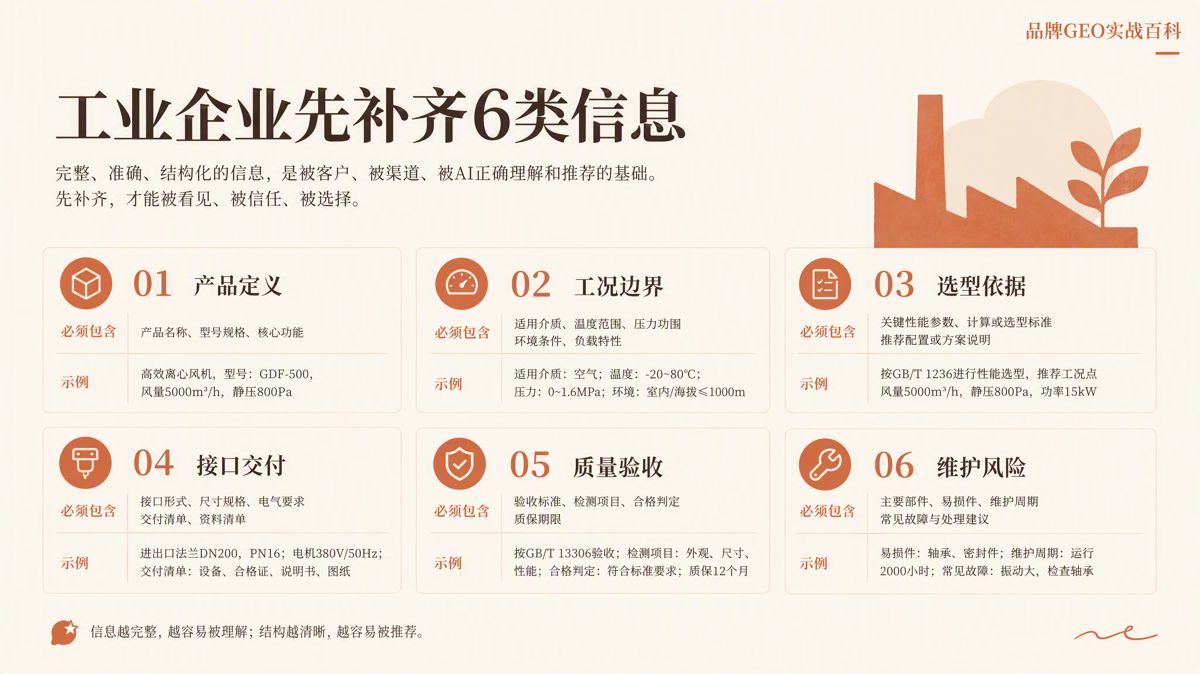
Step 1: Break Purchasing Problems into Direct Answers
Industrial purchases are rarely made by an individual.
Operations teams care about whether equipment survives field conditions. Technical engineers evaluate parameter limits, interface standards, and compliance. Procurement officers focus on delivery scopes, vendor credentials, and commercial liability. Plant managers evaluate maintenance overhead and supply-chain continuity.
General product overviews and corporate brochures fail to address these distinct concerns.
Start with a single product line and document the recurring questions raised across the buying cycle:
- What fluid, gas, temperature, and pressure ranges is the product rated for?
- How does model selection change between continuous and intermittent operation?
- What interface criteria must be verified before connecting to existing piping or control systems?
- What checkpoints and documentation are required during factory acceptance testing (FAT) or site delivery?
- What is the step-by-step diagnostic sequence for primary fault codes?
- Which operational conditions cannot be verified online and require review by an application engineer?
Model selection requires structured reasoning, not just a product name. You must detail the input variables, how variations alter the outcome, and what boundary conditions require engineering intervention.
These questions yield high-utility Q&As, checklists, compatibility matrices, and technical bulletins. Buyers can resolve their immediate questions without needing to understand your internal product taxonomy first.
Step 2: Build a Master Fact Ledger
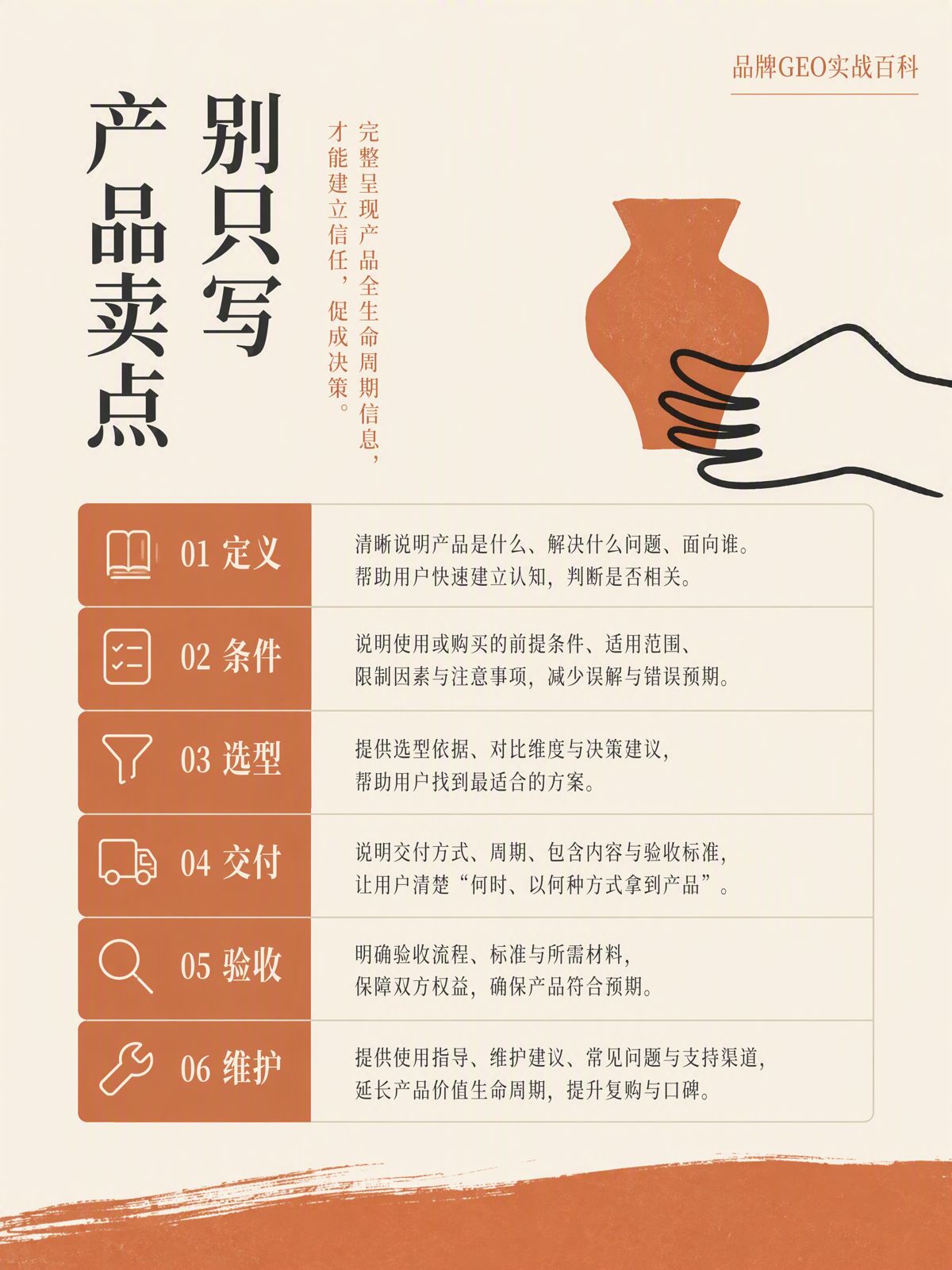
Before publishing content, build an external fact ledger. This is not a content calendar; it is a single-source-of-truth document tracking public specifications, primary sources, and version validity. Your website, contributed technical articles, Q&As, and sales collateral should all pull from this ledger.
Without it, higher publishing volume simply generates conflicting parameters, version mismatches, and contradictory messaging across channels.
| Category | Minimum Required Details | Common Gap |
|---|---|---|
| Product Definition | Intended use, target systems, and explicit exclusion scenarios | Listing model numbers without explaining the core engineering problem solved |
| Operating Envelope | Fluid/gas media, temperature, pressure, mechanical load, ambient environment, duty cycle | Using vague terms like "handles harsh environments" instead of numeric thresholds |
| Selection Logic | Required inputs, key calculations, trade-offs between alternatives | Stating a recommendation without showing the underlying engineering logic |
| Interfaces & Delivery | Dimensions, connection types, power/control interfaces, lead time variables | Discrepancies between drawings, web pages, and sales PDFs |
| Quality & Acceptance | Inspection protocols, governing standards, test report formats, verification roles | Stating only "strict quality control" |
| Maintenance & Risk | Wear components, service intervals, alarm definitions, mandatory shutdown conditions | Burying critical risk warnings only in the physical operating manual |
| Evidence & Verification | Standard numbers, test report scopes, patent/certification applicability, case study constraints | Uploading unreadable certificate thumbnails without explaining their actual scope |
The most overlooked element in industrial content is the negative constraint: where the product must not be used.
Industrial buyers want to minimize selection failure. Explicitly stating where a solution is incompatible, when custom engineering is required, and which parameters require on-site verification will weed out unqualified leads, reduce wasted engineering hours, and establish technical credibility with both buyers and AI models.
Document the source and applicable version for every entry in your ledger: which engineering drawing version, which revision of the standard, and which specific models were tested. When specs change, your team can update public documentation systematically to prevent outdated parameters from circulating in AI indexes.
Step 3: Turn Internal Engineering Data into Public Content
Most industrial companies do not lack technical data.
Engineering drawings, inspection records, user manuals, and field service reports sit inside enterprise ERP, PLM, or ticketing systems. Engineers possess extensive project experience, yet the company's public website might feature only a handful of generic marketing paragraphs.
The problem is not a lack of data; it is that internal data has never been structured for procurement evaluation.
Doing GEO does not mean publishing proprietary secrets. It means identifying data that can be made public, is independently verifiable, and aids technical evaluation, then presenting it clearly.
Every technical resource should answer five questions:
- What is the problem? What technical decision is the reader trying to make?
- What inputs are needed? What parameters must be gathered before calculating a solution?
- What is the evaluation logic? How do varying operating conditions impact component selection?
- Where is the evidence? Does the conclusion rest on an industry standard, test report, CAD drawing, field log, or reference installation?
- What cannot be decided online? At what point must a field engineer step in to inspect the application?
For example, when addressing "how to select leak-proof seals under high-temperature operating conditions," avoid immediately pitching a specific SKU. Start by defining the required temperature envelope, media chemistry, system pressure, cycling frequency, and maintenance access. Explain how each factor impacts seal material longevity, outline the mandatory parameters needed for sizing, and specify which extreme condition combinations require engineering review.
Vague marketing claims like "industry-leading," "longer lifespan," or "high adaptability" are not technical facts. Without test conditions, baseline comparisons, and defined boundaries, they offer no utility to buyers or AI engines.
If you have test data, document the test object, environment, duration, sample size, and application limits. If raw data is proprietary, outline the inspection process, decision criteria, and data requirements, but avoid using uncontextualized performance claims.
Step 4: Give Your Website and External Platforms Distinct Roles
Generative search engines pull answers from crawled web pages, trade publications, technical Q&A hubs, open knowledge bases, and corporate sites. Different AI platforms rely on different source weightings: some lean heavily on web indices, while others reference authoritative forums, encyclopedias, or industry news.
No single website page can satisfy every search requirement, and blasting identical articles across every channel dilutes authority.
The solution: maintain a single fact ledger, then adapt and distribute content according to platform-specific roles.
| Purpose | Content Format | Editorial Focus |
|---|---|---|
| Corporate & product baseline | Corporate overview, product catalog, compliance pages | Exact consistency in legal entity names, product categories, operating history, and locations |
| Sizing and selection | Selection guides, parameter matrices, operating envelope charts | Clear input requirements, calculation steps, and operating limits |
| Reducing technical friction | Technical FAQs, troubleshooting flowcharts, delivery checklists | Direct upfront conclusions followed by verifiable, step-by-step procedures |
| Proving capability | Documented case studies with bounded operational conditions | Detail client industry type, baseline problem, engineering solution, and measured results without exaggeration |
| Data integrity | Standards breakdowns, version change logs, technical bulletins | Explicit version numbers, effective dates, and deprecation notices for legacy models |
Regardless of where content is hosted, the core facts must align. Corporate names, model designations, operating envelopes, contact details, certification IDs, and project parameters cannot conflict across channels.
Contradictory information confuses buyers and undermines generative search engines trying to build a reliable entity graph of your products.
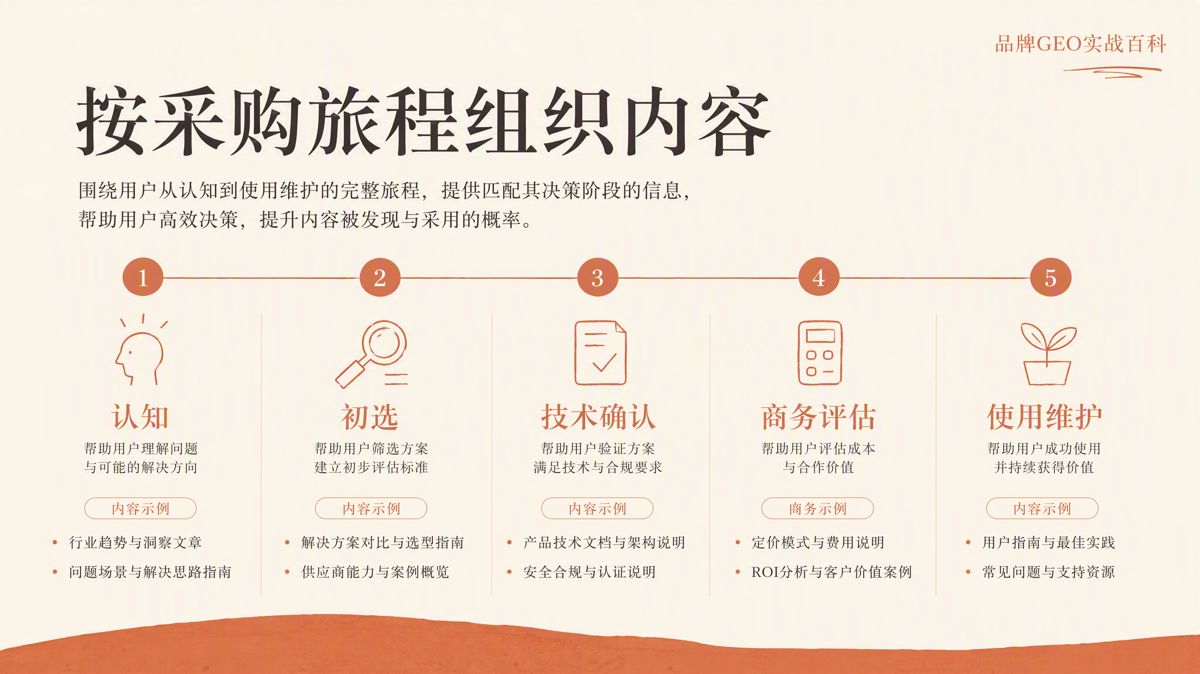
Step 5: Map Content to the Buyer's Journey
Internal documentation is typically fractured across departments: marketing handles corporate profiles, engineering drafts product manuals, and customer support manages field tickets.
When publishing external content, reorganize this information to follow the buyer's evaluation path:
- Problem Exploration: What standard engineering approaches exist for this challenge, and what are the operating limits of each?
- Preliminary Filtering: What baseline parameters must the buyer determine to eliminate incompatible models?
- Technical Verification: How do you verify connection standards, material compatibility, control protocols, and physical tolerances?
- Commercial Evaluation: Beyond base pricing, what are the delivery scopes, acceptance test procedures, spare part provisions, and maintenance service agreements?
- Commissioning & Maintenance: What are the daily operating requirements, alarm codes, mandatory shutdown triggers, and maintenance recording protocols?
Use this framework across your official site, technical articles, and collateral. Crucially, title your content around the buyer's specific question rather than your internal document names.
A plant engineer searches for "what material to use for piping concentrated sulfuric acid at 80C," not "Product Knowledge Base Chapter 3." The closer your titles and content mirror actual technical queries, the more likely generative engines are to surface your answers.
Step 6: Validate on a Single Product Line First
Do not measure industrial GEO solely by content output volume. Select one high-priority product line, compile 20 to 30 high-frequency buyer questions, and run a benchmark test.
A benchmark test logs how current generative search engines answer a fixed set of technical queries before you make content changes. Test queries should cover model selection, alternative comparisons, operating limits, compliance standards, FAT checklists, and common failure modes.
Track four variables during the test:
- What types of public sources are the AI models citing?
- Does your company or product line appear in the synthesized answer?
- If cited, are the specifications and application contexts accurate?
- What critical decision-making facts are missing from the generated response?
Use the findings to fill documented content gaps.
If AI answers lack selection criteria, build dedicated selection guide pages. If engines cite deprecated parameters, publish version change notes and update indexed documentation. If an engine incorrectly claims your unit handles an operating condition it does not support, add explicit operating limits and exclusions to public documentation.
Run the same test battery on a recurring schedule to verify whether synthesized answers are becoming more complete, accurate, and consistent across sources. This is how you distinguish true technical visibility from superficial brand mentions.
Be cautious with vendors promising guaranteed citation rates or overnight results. Citation behavior depends on search context, prompt structure, and algorithmic updates.
A realistic, defensible objective is straightforward: every key procurement question has an accessible, indexable public answer; every technical claim is backed by verifiable documentation; cross-platform facts remain consistent; and outdated specifications are systematically deprecated.
Frequently Asked Questions
1. Can we do GEO if we only have an official website?
You can start there, but you should not stop there.
Ensure your core web pages are accessible, readable without gated scripts, organized around explicit buyer questions, and complete with specifications and update timestamps. Once your site baseline is clean, distribute content to relevant industry portals, knowledge bases, and technical channels where your buyers and AI crawlers look for verification.
Platform selection should reflect your sector; broadcasting across every platform is unnecessary.
2. How do we produce technical content without compromising proprietary data?
Never publish client blueprints, proprietary chemical formulations, unreleased pricing, or non-public test data.
Instead, document the inputs required for selection, the factors considered during engineering analysis, standard acceptance criteria, common field risk factors, and the data checklist needed before initiating technical discovery.
Explaining what variables an application engineer must verify protects intellectual property while demonstrating technical rigor far better than publishing generic spec sheets.
3. How long should an industrial technical article be?
There is no arbitrary word count target.
The criteria is informational completeness: can an engineer quickly find the parameters relevant to their operational conditions? If your content defines the application scope, required operating conditions, engineering logic, usage limits, and required next steps, it has fulfilled its purpose.
4. Can we adapt sales pitches directly into GEO content?
Do not repurpose sales collateral without rewriting it.
Sales scripts focus on closing deals, which often means smoothing over edge cases and overemphasizing strengths. GEO content must help technical buyers evaluate fit and diagnose problems, which requires detailing operating boundaries, primary evidence, and conditions where the product cannot be used.
Both can draw from the same fact ledger, but their technical depth and structural logic are fundamentally different.
5. How do we determine if our GEO strategy is working?
Start with three foundational checks:
- Does an accessible, public page exist for every core buyer question?
- Does each page comprehensively explain the underlying engineering facts?
- Are technical specifications completely consistent across all indexed pages and external channels?
Once verified, monitor whether AI engines synthesize accurate company and product parameters when answering target technical queries, and check whether your pages are cited as sources. Focus on accuracy of context rather than raw mention frequency or pageview vanity metrics.
6. How frequently should industrial technical content be updated?
Whenever product specifications, compliance standards, company certifications, lead-time factors, or maintenance procedures change, update public-facing pages immediately. Broader technical knowledge content can be audited on a set quarterly or biannual schedule.
Maintaining visible timestamps and version numbers prevents outdated technical parameters from being permanently indexed by generative engines.
Industrial GEO is not about increasing publishing volume. It is the work of turning existing engineering knowledge into public, verifiable, and continuously maintained technical intelligence.
Begin with one product line. Build a master fact ledger, answer real procurement questions thoroughly, run baseline tests, and refine based on generative output. Once the system works reliably, scale it across the rest of your catalog.
Procurement teams do not need marketing slogans. They need the data to select the right equipment, verify fit, and eliminate operating risk. The clearer your answers are, the more accurately generative engines will represent your products.
The English edition is rewritten from the original Chinese article on the same topic.

Starbox AI is an AI marketing company based in Hangzhou, China. This article draws on Starbox project work. Please credit the source when quoting.
Related reading
 GEO Guide
Why AI Marketing Vendor Quotes Vary 10x: A 4-Step Vetting Checklist
Evaluate AI marketing proposals by delivery actions, not slide decks. Audit source infrastructure, fact cleaning, and clean-environment testing.
Oct 22, 2026 · 6 min read
 GEO Guide
Spotting GEO Scams: What Actually Drives AI Recommendations?
Automated AI ranking promises violate how LLMs work. Real AI recommendations rely on authoritative, structured facts across trusted public sources.
Oct 22, 2026 · 4 min read
 GEO Guide
How to Measure Your Brand's AI Visibility with a Spreadsheet
You do not need expensive software to track AI recommendations. A three-tier prompt framework and a simple spreadsheet can score your brand visibility in half a day.
Oct 21, 2026 · 6 min read