
Where Should AI Enter Your Procurement Process?
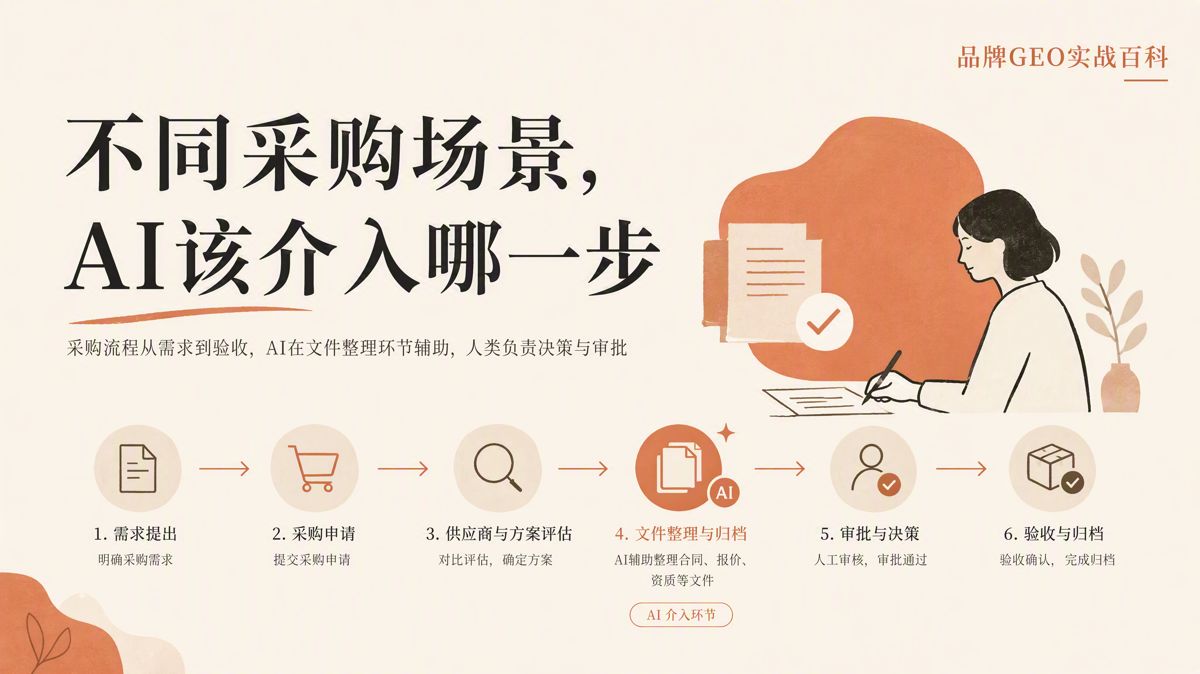
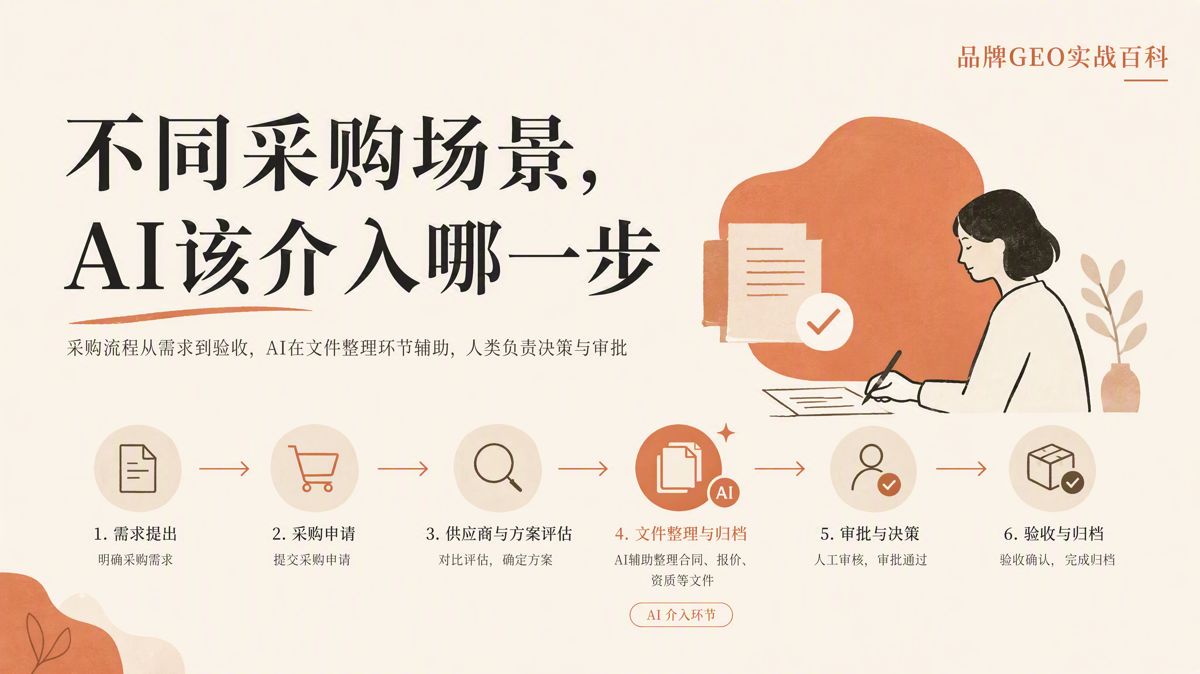
The short answer
Teams often pick AI procurement tools before defining workflows. Learn where AI saves time, where humans must hold the line, and how to run a safe pilot.
When teams decide to introduce AI into procurement, the first question they usually ask is: "Which tool should we choose?"
That question comes too early.
Procurement is not a single, isolated action. From intake and sourcing to quote comparisons, supplier qualifications, contract negotiations, purchase orders, acceptance testing, and post-project reviews, every stage handles different data and involves different decision-makers.
You must first determine which stage AI should assist and what bottleneck it needs to solve before deciding what kind of software you need.
If you reverse the order, AI might generate dozens of spreadsheets, summaries, and recommendations that look impressive upfront, yet fail to support real buying decisions. When the file reaches legal, quality, or risk teams, stakeholders still have to pull original documents to verify details from scratch—adding an extra layer of friction instead of removing one.
The Bottom Line
- For routine, standardized purchases with stable specifications, ample public data, and repetitive tasks, AI is well-suited for intake organization, document collation, and initial price comparisons.
- For complex, high-value, or strategic purchases, AI can extract parameters, flag discrepancies, and generate evaluation questions, but it cannot replace engineering, finance, or legal judgment.
- For emergency procurement, the priority is not having AI instantly recommend a vendor. The priority is defining non-negotiable parameters, required delivery dates, and minimum acceptance thresholds.
- For materials containing personal data, production metrics, proprietary quotes, or draft contracts, define data scope, access permissions, and human audit responsibilities before plugging in any AI tool.
The value of AI in procurement is not how much text it generates. Its value depends on whether its output can be verified, whether it feeds cleanly into downstream workflows, and who ultimately owns the final decision.
AI Can Process Data, but It Cannot Assume Liability
Procurement tasks fall into two broad buckets:
1. Information Processing
Extracting tax rates, lead times, and payment terms from ten differently formatted supplier quotes; compiling parameter variances across technical data sheets; turning fragmented requests from business units into a structured Request for Quotation (RFQ).
These tasks have clear rules, high repetition, and low ambiguity. They are well-suited for AI assistance.
2. Judgments and Liability
Confirming whether a component specification meets live production tolerances; deciding whether a supplier has the financial solvency to deliver; approving final pricing; accepting material substitutions; signing off on contractual risk.
These decisions must be made by individuals with clear organizational authority.
AI can parse, summarize, and cross-reference existing files, but it does not know the physical operating conditions outside the documents, and it cannot shoulder the legal, quality, or delivery liabilities if something fails.
Before introducing AI to any procurement stage, answer three baseline questions:
- Is the current data organized into a readable, comparable format?
- Are the evaluation criteria documented clearly?
- Is there a designated human reviewer accountable for every AI output?
The clearer these three points are, the easier it is to integrate AI into your daily operations. If requirements are ambiguous, evaluation standards vary, and nobody owns verification, switching tools will not fix your operational bottlenecks.
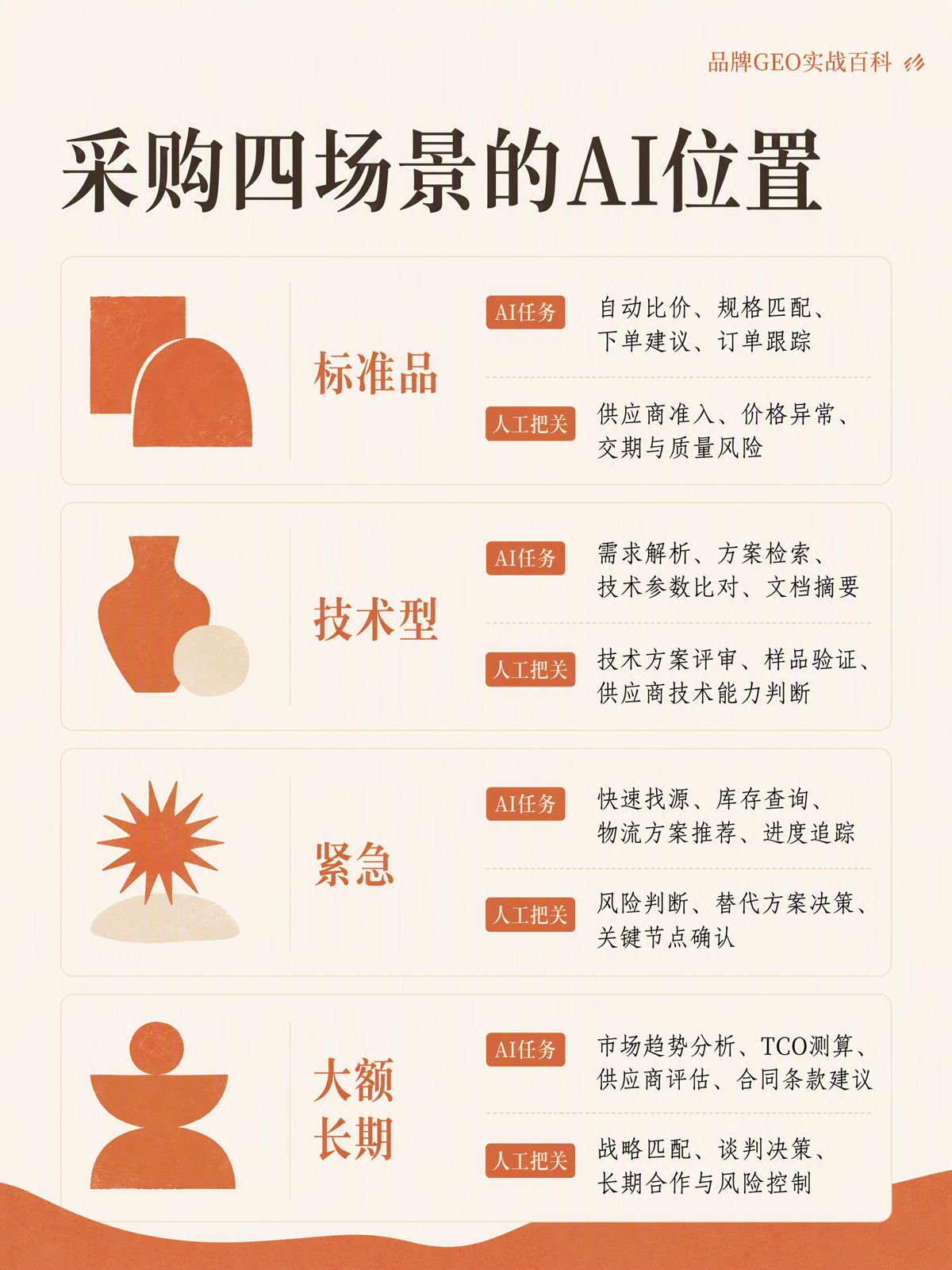
Four Procurement Scenarios Require Different AI Entry Points
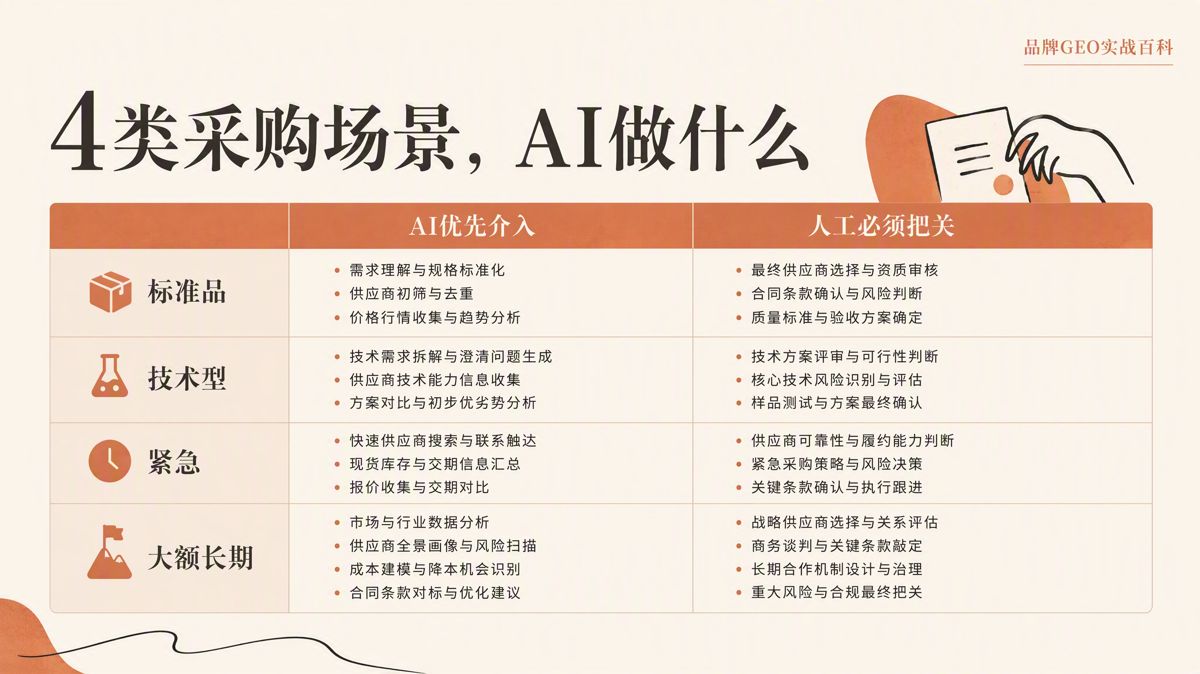
| Procurement Scenario | Typical Characteristics | Where AI Should Intervene First | Mandatory Human Checkpoints |
|---|---|---|---|
| Routine Standard Procurement | Stable specs, broad supplier base, high historical order volume | Requirement intake categorization, quote extraction, anomaly alerts | Final pricing approval, vendor selection, receiving inspection |
| Technical Procurement | Complex parameters, delicate substitution rules, heavy engineering involvement | Spec sheet extraction, discrepancy mapping, review checklist generation | Technical feasibility, pilot testing results, change authorization |
| Emergency Procurement | Severe time constraints, delivery speed prioritized, substitutions often required | Substitution constraint mapping, inventory and lead-time synthesis | Safety impact, quality validation, customer commitments |
| Strategic or High-Value Procurement | Long partnership cycles, cross-departmental buy-in, high exposure | Meeting note synthesis, vendor diligence summaries, contract clause cross-referencing | Commercial negotiations, liability allocations, vendor audits, executive sign-off |
The more complex the procurement context, the more AI should be limited to information synthesis, variance flagging, and question drafting—and the less it should be allowed to make automated recommendations or approvals.
Routine Standard Procurement: Fix Incomplete Intake First
For everyday purchases like office supplies, standard packaging, and general consumables, finding vendors is rarely the problem. The main drag on efficiency is incomplete internal requests.
An employee often submits a vague request: "We need a batch similar to the last order." Procurement teams then spend days chasing down specifications, quantities, delivery locations, budgets, acceptable substitutes, and billing requirements. Every missing variable causes back-and-forth communication across quoting and ordering.
Here, AI should intervene at the intake stage.
Procurement can feed historical orders, item catalogs, and incoming requests into an AI model to structure the intake document:
- Item name and exact specification
- Quantity and unit of measure
- Delivery deadlines and site locations
- Target budget
- Mandatory accessories or packaging
- Substitution permissions and acceptable variance ranges
Once extracted, a procurement specialist must confirm which criteria are non-negotiable and which can be discussed with vendors.
After requirements are set, AI can normalize supplier quotes. Different vendors submit quotes in different formats. AI can extract unit pricing, tax status, shipping terms, minimum order quantities (MOQ), lead times, and quote validity windows into a unified comparison table.
However, price comparisons must go beyond unit costs.
Buyers still need to weigh historical quality rates, stockout frequency, return costs, and payment terms to calculate the true Total Cost of Ownership (TCO). The lowest unit quote is rarely the cheapest or most reliable option.
In routine procurement, the goal of AI is to eliminate manual data entry and surface anomalies early, including:
- Quotations deviating significantly from historical benchmarks;
- Lead times contradicting earlier supplier commitments;
- Ambiguous specification wording;
- Missing fields on vendor quotation forms.
Flagged anomalies should be reviewed by a human buyer, rather than letting software automatically award the bid.
Technical Procurement: Use AI to Surface Questions, Not Draw Conclusions
For equipment, enterprise software, specialized raw materials, and professional services, the challenge is rarely a lack of information. The challenge is that data from different sources cannot be compared apples-to-apples.
Vendors use proprietary jargon; end-user departments care about field operating conditions; procurement focuses on commercial terms, delivery, and warranty; quality engineers evaluate incoming inspection and testing parameters.
Because stakeholders view the purchase through different lenses, raw vendor documentation cannot be used directly for final reviews.
In this scenario, AI handles two practical preliminary tasks:
- Breaking down technical agreements, product manuals, lab reports, and meeting notes into line-by-line verification checklists.
- Flagging unresolved ambiguities.
For example, AI can highlight: - Performance claims phrased as marketing copy without testing methodology; - Service Level Agreements (SLAs) missing explicit response or resolution windows; - Proposed component substitutes without documented compatibility boundaries; - Contradictory parameter values across technical appendices.
These surfaced items form the evaluation agenda.
However, AI-generated discrepancy sheets are discussion inputs, not final conclusions. Engineers must verify whether parameters match live production environments; quality teams must approve testing protocols; procurement must ensure technical commitments are written into the binding agreement.
If a vendor relies on vague language like "fully supported in principle" or "customizable upon request," AI must not register that as a completed requirement. The procurement team must step in to verify test cases, operating limits, and legal accountability.
Never mistake a complete document submission for a verified capability. A polished response proves only that the vendor answered the RFP, not that their product will run reliably on your line. AI can help build the verification checklist, but physical trials, sample testing, on-site audits, and warranty terms cannot be skipped.
Emergency Procurement: Lock Down Constraints Before Chasing Speed
During supply crunches, teams often treat AI as a quick search engine, typing in a part number and demanding immediate alternative supplier suggestions.
In an emergency, the first question is not "Who has stock?" The first question is:
- What parameters are completely non-negotiable?
- What parameters can be compromised?
Two mechanical parts may look identical yet differ in tolerance ratings, operating temperatures, compliance certifications, or fatigue life. Abundant raw materials may fail on existing tooling. Recommending a replacement based on superficial naming or a few overlapping specs introduces severe operational risk.
AI is better used here to build two clear checklists:
Non-negotiable parameters: - Critical safety ratings - Regulatory or customer compliance mandates - Core mechanical or software interfaces - Minimum acceptance thresholds
Negotiable parameters: - Outer packaging specifications - Non-critical cosmetic finishes - Staggered or partial delivery schedules - Temporary interim specifications - Service and support packaging
Arming buyers with these two lists allows them to secure clear, actionable answers from suppliers on the first call.
Teams must also map out the timeline: - How many days of safety stock remain; - The earliest arrival date for the alternative part; - Whether incoming inspection is required; - How long inspection takes; - The contingency plan if the alternative fails quality checks.
AI can structure this timeline and flag schedule gaps based on available data, but it cannot assume a supplier will deliver on time, nor can it authorize an unverified engineering change. Emergency buying can compress cycle times, but core gates around safety, quality, authorization, and receiving inspection must stay intact.
Strategic and High-Value Procurement: Maintain Audit Trails and Parity Checks
Large investments and multi-year supply contracts are not finished once a quote is selected.
Companies must continuously track capacity commitments, price adjustment indexes, defect liabilities, data security, indemnification limits, and termination exit clauses. The more internal departments involved, the higher the risk of lost context, blurred responsibilities, and conflicting paperwork.
In strategic procurement, AI serves primarily as a synthesis and reconciliation tool:
- Grouping vendor qualification data by legal entity status, financial health, capacity benchmarks, ISO quality certifications, case studies, and compliance records;
- Converting multi-stakeholder negotiation notes into structured action items with assigned owners;
- Cross-referencing draft contracts against the original RFP, vendor quotes, and technical exhibits to catch omissions or modified terms.
AI cannot evaluate commercial risk in lieu of legal counsel, nor can it judge long-term relationship value for business leaders.
For high-liability clauses—such as liability caps, intellectual property assignment, data sovereignty, automatic renewal, or exclusivity—AI summaries only help teams find relevant clauses faster. Final decisions require a human review of the exact contract language by authorized legal and commercial leads.
Set a strict rule for strategic sourcing: every data point extracted by AI must provide a traceable link to the primary source document. Any claim that cannot be referenced directly to a source file must be treated as unverified.
Six Checks Before Connecting AI to Procurement
1. Data Ingestion Boundaries
Which documents are cleared for AI processing? Have quotes, master agreements, employee records, customer data, and proprietary production metrics been vetted against internal data policies and external NDAs?
2. Field Standardization
Do terms like product name, specification, unit of measure, currency, tax status, Incoterms, and payment milestones have company-wide definitions? If different departments define fields differently, AI cannot generate useful cross-functional tables.
3. Human Approval Gates
Who signs off on intake requirements? Who confirms technical feasibility? Who approves the vendor? Who signs the purchase order? Who signs the final receiving report? Every critical milestone requires an assigned human owner.
4. Source Traceability
Can every critical output produced by AI be cross-referenced back to an exact quote, contract clause, email thread, or meeting transcript? If a data point cannot be traced to an original source, it cannot serve as the basis for a decision.
5. Exception Handling
When stockouts, material substitutions, price hikes, delivery delays, or missing documentation occur, what is the defined escalation path and who holds approval authority?
6. Audit Logs and Record Retention
Are source files, AI-generated outputs, human edits, and final approval sign-offs archived in compliance with enterprise audit policies?
Practical automation in procurement does not mean handing the process over to an algorithm. It means using software to standardize inputs, surface discrepancies faster, and make human accountability unequivocal.
How to Pilot AI in Procurement: A Four-Step Roadmap
When piloting AI in procurement, start with low-risk, high-frequency categories like indirect spend or standard consumables.
- Step 1: Limit AI to data organization. Use it to clean up incoming requisitions and structure quotes. Do not use it to rank vendors or suggest awards.
- Step 2: Run a multi-week audit. Track which fields the AI misses, which data comparisons require manual correction, and which automated anomaly alerts provide genuine value.
- Step 3: Update rules and intake templates. Fold recurring issues back into your purchase requisition templates and data-matching rules to standardize inputs.
- Step 4: Expand cautiously. Once baseline workflows are stable, test AI on technical spec extraction, meeting minutes summarization, or contract clause reconciliation.
The core principle is simple: establish your enterprise procurement standards first, then configure AI to adhere to them.
Deploying AI directly into complex, high-stakes purchasing without standardized baseline workflows leads to a familiar pitfall: every department experiments with software, but no one can verify if the output is reliable enough to support a commercial commitment.
FAQ
Can AI directly recommend suppliers?
You can use AI to compile candidate profiles from approved vendor lists, historical purchase orders, and public records into a comparison sheet. However, final supplier selection must evaluate qualification, quality, delivery capability, pricing, and risk. AI-generated lists cannot be treated as approved vendor lists without human verification.
Does using AI for price comparisons only look at unit price?
No. Beyond unit price, you must compare taxes, freight, minimum order quantities (MOQ), payment terms, lead times, quality requirements, after-sales service, and return policies. A lower unit price with volatile delivery or unclear acceptance terms often results in a higher total cost of ownership.
Can we delegate technical specification reviews entirely to AI?
AI can extract parameters, summarize discrepancies, and generate review checklists, but technical validation requires engineers who understand real operating conditions. Compatibility, operating scope, test procedures, and safety boundaries cannot be determined from text alone.
Can emergency procurement bypass standard controls?
Emergency procedures can accelerate approvals, but core controls cannot be skipped. Teams must document substitution criteria, authorizing personnel, vendor information, pricing justification, and post-delivery acceptance records. AI can help document these details, but it cannot grant authorization.
Can we upload quotes and contracts directly to an AI tool?
You must first verify internal data classification rules and non-disclosure agreements with suppliers. When dealing with personal data, confidential pricing, client details, engineering drawings, or contract terms, confirm that system access permissions, retention rules, and data sanitization methods comply with company policy before uploading.
How do you evaluate if an AI procurement pilot is successful?
Look beyond the volume of generated content. Track whether intake rework drops, quote compilation time shrinks, anomalies are spotted earlier, review errors decline, and no new data or compliance liabilities are introduced.
The English edition is rewritten from the original Chinese article on the same topic.

Starbox AI is an AI marketing company based in Hangzhou, China. This article draws on Starbox project work. Please credit the source when quoting.
Related reading
 GEO Guide
Why AI Marketing Vendor Quotes Vary 10x: A 4-Step Vetting Checklist
Evaluate AI marketing proposals by delivery actions, not slide decks. Audit source infrastructure, fact cleaning, and clean-environment testing.
Oct 22, 2026 · 6 min read
 GEO Guide
Spotting GEO Scams: What Actually Drives AI Recommendations?
Automated AI ranking promises violate how LLMs work. Real AI recommendations rely on authoritative, structured facts across trusted public sources.
Oct 22, 2026 · 4 min read
 GEO Guide
How to Measure Your Brand's AI Visibility with a Spreadsheet
You do not need expensive software to track AI recommendations. A three-tier prompt framework and a simple spreadsheet can score your brand visibility in half a day.
Oct 21, 2026 · 6 min read