
How to Maintain GEO Performance After Initial AI Citations
The short answer
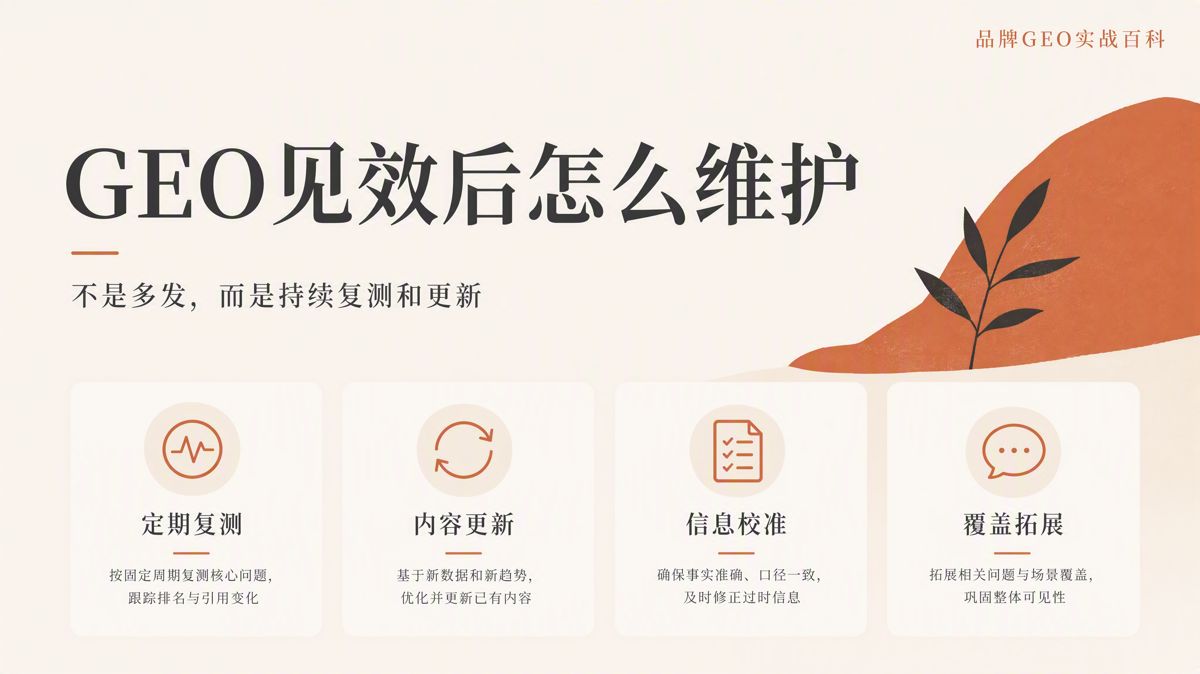
Earning citations in AI answers is only the first step. Here is a framework to maintain brand visibility, verify facts, and track changes over time.
When your brand starts appearing in AI-generated answers and your website earns source citations, your initial Generative Engine Optimization (GEO) efforts have paid off. However, this is not a permanent finish line.
GEO aims to ensure that generative AI models accurately mention, summarize, and cite your brand. Once you reach the maintenance stage, your goal shifts. Success is no longer about publishing as many articles as possible. Instead, it requires monitoring a consistent set of core prompts: fixing inaccuracies, closing information gaps, and maintaining factual consistency across your website and external channels.
Why AI Citations Fluctuate
Generative AI answers are dynamic.
Research by Profound on AI citation patterns reveals that for identical queries, Google AI Overviews fluctuate roughly 70% of the time, and about 45.5% of citations in updated answers are replaced.
A page cited today will not automatically appear in next month's answers. Competitors may publish more comprehensive answers, your pricing or case studies might become outdated, or technical crawl errors could prevent search engines from accessing your pages.
There is also a strict dependency between traditional SEO and GEO. Search Engine Optimization ensures pages are discoverable, crawlable, and indexable. Only after those technical baselines are met can GEO help generative engines accurately restate and cite your material. Google Search Relations reinforced in 2026 that optimizing for generative AI remains fundamentally tied to search experience optimization.
The same sequence applies across Chinese platforms. You must first ensure your official website, WeChat Official Accounts, Baijiahao (Baidu's content platform), and Douyin (TikTok's sister app in China) are accessible to search bots. Only then can you evaluate whether your brand details surface correctly in AI assistants like Doubao (ByteDance's AI assistant), DeepSeek, Yuanbao (Tencent's AI assistant), and Wenxin Yiyan (Baidu's ERNIE Bot).
Four Core Priorities for Ongoing GEO Maintenance
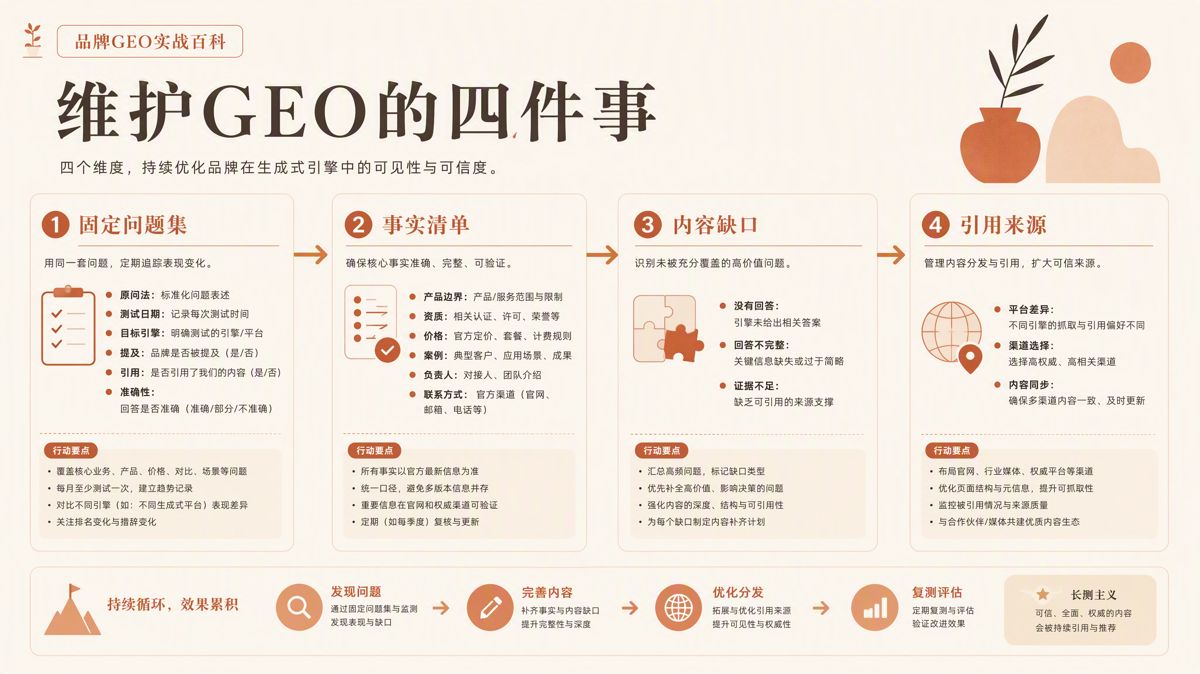
1. Build a Fixed Prompt Set for Consistent Benchmarking
Select 30 to 100 high-intent queries that directly influence purchase decisions to form your core testing benchmark. For every evaluation run, track:
- Exact query phrasing
- Date of test
- Target AI platform
- Whether the brand was mentioned
- Specific sources cited
- Factual accuracy of the brand description
Keep prompt phrasing identical across cycles. If you test "how to choose an enterprise CRM" one week and switch to "which enterprise CRM do you recommend" the next, the AI's retrieval logic and recommendation criteria change. The resulting data points will not be comparable.
2. Maintain a Centralized Source of Truth for Key Facts
When your service boundaries, credentials, pricing rules, case studies, or leadership contacts change, update your website, FAQ pages, corporate wikis, social profiles, and sales decks simultaneously.
Research from seoClarity found that entity consistency has a 0.664 correlation with a brand appearing in AI Overviews, compared to 0.218 for backlinks. Entity consistency refers to whether a brand's name, key metrics, and service descriptions match across independent pages. Backlinks simply measure external links pointing to your site.
While correlation does not equal causation, conflicting numbers or mismatched service details force both human buyers and generative models to guess which version is true. Maintenance means aligning facts across your entire digital footprint, not editing an isolated blog post.
3. Fill Content Gaps Based on Search Misses
Review the prompts where your brand failed to appear each month. Categorize them into three groups:
- No existing page addresses the question.
- A page exists, but the answer is incomplete.
- An answer exists, but it lacks verifying evidence or data.
Prioritize updates based on commercial impact rather than writing convenience. High-intent topics—qualification criteria, solution comparisons, pricing boundaries, implementation timelines, and risk mitigation—sit closest to conversion and should be resolved first.
When drafting or updating content, state direct conclusions first, followed by short paragraphs, structured comparison tables, and clarifying FAQs. This layout helps human readers skim easily while enabling retrieval systems to extract complete answers cleanly.
4. Monitor Citation Sources Across Different Platforms
A cross-platform study by Ahrefs shows that across ChatGPT, Perplexity, and Google AI Overviews, 86% of top-cited domains do not overlap. International GEO strategies cannot rely on monitoring a single search engine or AI interface.
Chinese platforms operate within similarly distinct ecosystems. Yuanbao relies heavily on WeChat Official Accounts; Wenxin Yiyan integrates closely with Baijiahao and Baidu Baike; Doubao draws context from Douyin and ByteDance properties.
Select distribution channels based on where your prospective buyers spend time and which specific formats your footprint lacks. Do not blast identical content across every network merely to increase volume. Expanding your footprint without a clear strategy increases the overhead of factual audits and updates later on.
A Sustainable GEO Maintenance Cadence
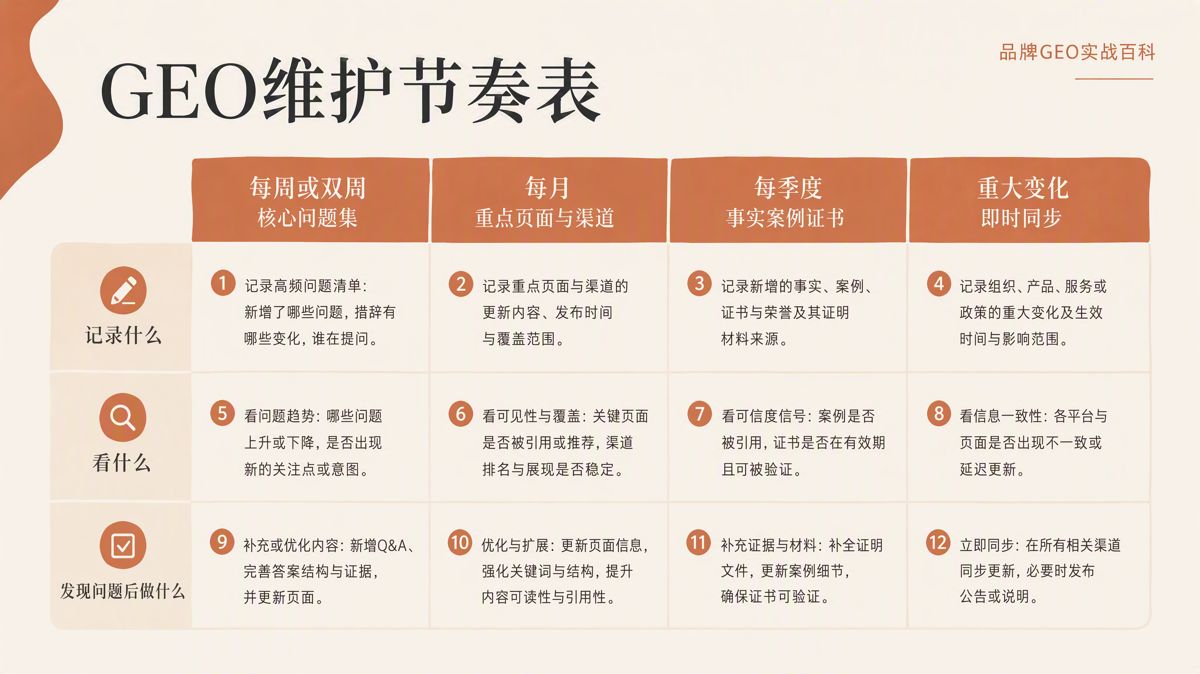
| Focus Area | Recommended Cadence | Key Metrics to Track | Action Triggered |
|---|---|---|---|
| Core Prompt Set | Weekly or bi-weekly | Brand mentions, URL citations, description accuracy | Identify uncovered queries or incorrect statements |
| High-Priority Pages | Monthly | Indexing status, page speed, last updated date | Fix crawl errors, schema issues, and outdated facts |
| Facts & Case Studies | Quarterly audit (immediate on major shifts) | Brand names, service parameters, certifications, case details | Synchronize website, partner channels, and sales decks |
| External Channels | Monthly | Citation domain types, duplicate content, platform gaps | Publish targeted content on 1–2 high-relevance platforms |
This cadence focuses on long-term trends rather than daily fluctuations.
Weekly Testing: Separating Normal Variance from Real Drops
You do not need to test your entire prompt database every week. Split your core prompt set into three rotating categories:
- Brand awareness prompts
- Category comparison prompts
- Purchase decision prompts
Save screenshots or raw text for every test run. Log the platform, timestamp, brand rank or position, citation links, and any factual errors.
Distinguish between being "mentioned" and being "cited." A mention indicates the AI recognized your brand as relevant to the answer. A citation means the model used your specific URL as source evidence. These metrics reflect different stages of retrieval and should be tracked independently.
When results dip, evaluate the sample size and direction. A citation dropping off in a single query run does not mean your content has lost authority. Only schedule a page for revision if your brand disappears across multiple consecutive testing cycles, or if inaccurate claims persist over time.
This prevents overreacting to short-term model updates.
Monthly Updates: Correct Errors First, Then Close Gaps
When scheduling monthly editorial updates, follow this priority sequence:
- Correct inaccurate product claims and compliance risks.
- Address high-intent, near-conversion questions missing brand visibility.
- Add missing comparison tables, data points, FAQs, and scope constraints to existing pages.
- Expand broader educational and top-of-funnel topics.
Updating a page requires substantive edits. Simply changing the publication date does nothing to improve authority.
An Ahrefs study of 17 million citations found that AI-cited web pages are, on average, 25.7% fresher than standard Google organic search results. ChatGPT in particular tends to cite pages that are roughly 393 to 458 days newer than Google's top organic results.
Freshness matters, but true freshness comes from adding, correcting, or reorganizing facts. Superficial edits to titles and timestamps add no retrieval value.
Multi-Channel Distribution: Tailor the Tone, Standardize the Facts
Maintain a master fact sheet that logs version history, internal reviewers, update dates, and public clearance levels.
Your official website should serve as the definitive reference. Channels like WeChat Official Accounts, Zhihu (China's largest Q&A platform), Baijiahao, Douyin, and WeChat Channels can adapt the narrative style to fit their audiences, but core brand names, quantitative metrics, and product limitations must remain identical. Pricing, deliverables, compliance certificates, and client proof points must match across platforms.
Any discrepancy gives both buyers and generative engines conflicting signals.
If you use AI to scale content creation, adhere to applicable transparency regulations, such as China's Measures for Labeling Synthetic Content Generated by Artificial Intelligence (effective September 1, 2025). This requires both explicit, user-visible labels and implicit, machine-readable identifiers.
Never rely on automated spinning, fake authority claims, or fabricated case studies. While low-quality pages might index briefly, they introduce substantial factual liabilities and operational cleanup costs down the road.
Frequently Asked Questions
If our brand is already cited in AI answers, do we still need to publish new content?
Yes, but focus on addressing unanswered customer questions rather than repeating existing claims. Adding qualification criteria, competitive comparisons, risk disclosures, and verified facts delivers far more value than duplicate content.
Should we test our target AI prompts daily?
Not necessarily. Daily testing often confuses normal variance with real trends. Test weekly in the initial phase, then shift to monthly reviews once your visibility and content footprint stabilize.
Does changing the publication date count as a content update?
No. A revised date must reflect genuine factual updates, corrected parameters, or improved structure. Modifying the date alone does not resolve content gaps or make a page more authoritative.
What should we do if AI mentions our brand with incorrect information?
Document which prompts, platforms, and cited sources display the error. Then inspect your own website, knowledge bases, and external profiles for conflicting data. Update crawlable source pages with clear definitions, constraints, and FAQs.
Do we need to update every external distribution channel every month?
No. Focus on your official website and the one or two external channels your buyers use most. A few aligned, well-maintained channels outperform dozens of unmonitored profiles with contradictory facts.
How do we measure the business value of GEO maintenance?
Evaluate whether accurate mentions increase across a consistent benchmark prompt set, valid citations remain stable, inaccurate claims drop, and target pages receive qualified referral visits. Every update should resolve a specific factual inaccuracy or fill an identified prompt gap. If you cannot point to the specific gap an update solves, do not edit merely for the sake of activity.
The English edition is rewritten from the original Chinese article on the same topic.

Starbox AI is an AI marketing company based in Hangzhou, China. This article draws on Starbox project work. Please credit the source when quoting.
Related reading
 GEO Guide
Why AI Marketing Vendor Quotes Vary 10x: A 4-Step Vetting Checklist
Evaluate AI marketing proposals by delivery actions, not slide decks. Audit source infrastructure, fact cleaning, and clean-environment testing.
Oct 22, 2026 · 6 min read
 GEO Guide
Spotting GEO Scams: What Actually Drives AI Recommendations?
Automated AI ranking promises violate how LLMs work. Real AI recommendations rely on authoritative, structured facts across trusted public sources.
Oct 22, 2026 · 4 min read
 GEO Guide
How to Measure Your Brand's AI Visibility with a Spreadsheet
You do not need expensive software to track AI recommendations. A three-tier prompt framework and a simple spreadsheet can score your brand visibility in half a day.
Oct 21, 2026 · 6 min read