
No GEO Results After 3 Months? Audit These 4 Layers First

The short answer
Three months is a checkpoint, not a verdict. Before publishing more articles, audit crawling, citations, brand accuracy, and lead capture.
Generative Engine Optimization (GEO) is the process of structuring your website, content, and brand assets so AI models can easily crawl your pages, cite your data, and accurately describe who you are and what you do.
When a marketing team says, "We have been doing GEO for three months with zero results," that is neither an anomaly nor an automatic failure. Ninety days is typically the benchmark for completing your first build, running a benchmark retest, and making adjustments. It does not guarantee that brand mentions, inbound inquiries, and closed deals will all surge simultaneously on day 90.
If your project feels stalled, do not pull the plug, and do not impulsively double your article output. You need to diagnose where the breakdown actually happened: - Can AI read your pages? - Is your content making it into AI answers? - Is your brand being mentioned accurately? - Or are you getting mentioned without generating pipeline?
Where the breakdown occurs determines what you need to fix next.
Define What "Results" Actually Look Like
GEO performance unfolds in three distinct stages:
- Foundational technical health: Search crawlers and AI bots can easily parse your pages and extract key facts. Your brand name, core capabilities, and service boundaries are consistent across all assets.
- Brand visibility: Your brand begins appearing in AI-generated answers across a controlled prompt set. AI engines cite your pages as sources, and their descriptions of your product become accurate.
- Business pipeline: Prospects research your brand through AI search interfaces or follow citations to your site, leading to measurable lifts in inbound inquiries, sign-ups, and qualified sales conversations.
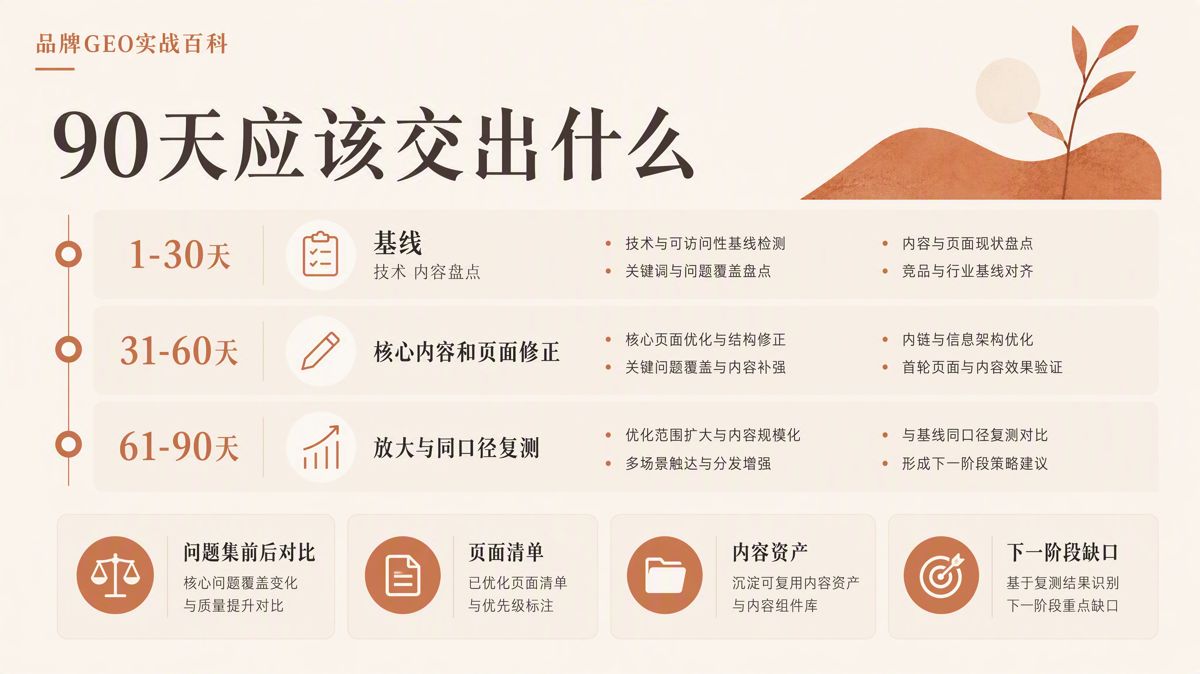
These stages rarely happen all at once, and each requires a different amount of time. In practice, 90 days is a standard cycle for the initial build and retest:
- Days 1–30: Record baseline benchmark data, fix technical site issues, and audit existing content.
- Days 31–60: Build targeted content that comprehensively answers core commercial queries.
- Days 61–90: Expand query coverage and rerun tests against your original baseline prompt set.
This timeline gives you an apples-to-apples comparison to see what moved and what stayed flat. It is a diagnostic milestone, not an arbitrary deadline where every company hits the same target.
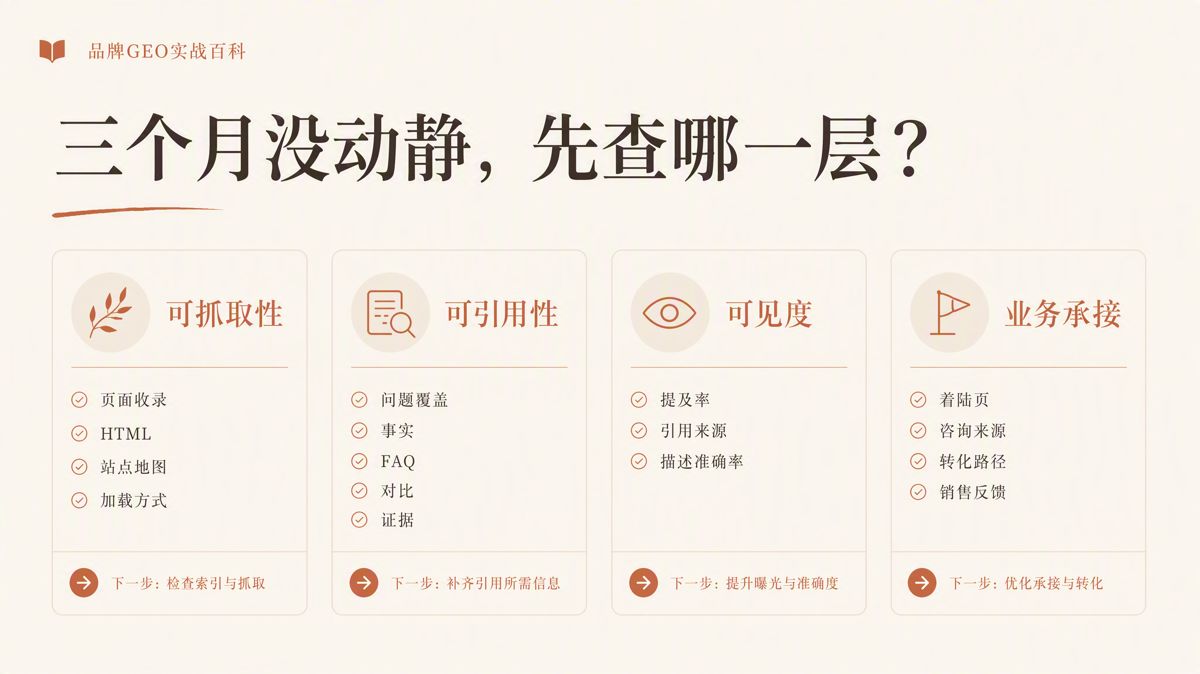
The 4-Layer Diagnostic Checklist
Layer 1: Can AI Crawlers Actually Read Your Pages?
If new pages are not indexed in search engines or cited in AI responses, start with technical crawling and indexing.
Crawling means an AI crawler or search bot discovers and reads your page. Indexing means that page is stored in a retrievable database. If systems cannot read your raw content, citations and brand mentions are impossible.
Audit these technical checkpoints:
- Does critical content rely on client-side JavaScript rendering to display?
- Is your XML sitemap updated and submitted?
- Are your robots.txt directives accidentally blocking important directories?
- Are page titles, body text, and Schema markup live in the source code?
- Can a crawler extract your core text directly from the raw HTML?
If bots cannot parse your HTML, publishing 50 more blog posts will not change your results. Fix indexing and rendering first.
Layer 2: Is Your Content Entering AI Answers?
If your pages are indexed but your brand is never cited, look at content depth: Did you answer a specific question, and did you back it up with verifiable facts?
AI engines synthesize answers from multiple sources. If a page contains only generic brand marketing without clear conclusions, explicit parameters, comparison data, case studies, or structured FAQs, an LLM has no reason to cite it.
Return to your initial prompt set—the standardized list of queries you use for testing. Identify high-intent customer questions that your existing content failed to answer thoroughly. Prioritize building pages for those specific gaps, supported by hard evidence and verifiable data points.
Focus on resolving specific customer queries rather than chasing a vanity publishing volume.
Layer 3: Is Your Brand Mentioned Accurately?
A brand mention in an AI overview does not automatically equal success. You need to inspect the context:
- Does your brand appear for queries your target buyers actually care about?
- Is your brand categorized under the correct product or service tier?
- Are your capabilities and pricing parameters described accurately?
- Are the underlying source citations credible?
- Is your brand narrative consistent across external citations?
If an AI cites your company for an irrelevant query, misclassifies your category, or invents features you do not offer, higher mention frequency provides zero commercial value.
When evaluating GEO, track where you appear and what the AI says, not just whether your name showed up.
Layer 4: Are Mentions Driving Real Business Pipeline?
If your brand is cited accurately across target queries but inbound inquiries remain flat, GEO is not necessarily failing. The issue is likely your downstream conversion path:
- When users click through from a citation, do they land on a relevant page?
- Does that landing page provide an obvious, frictionless next step?
- Are your contact forms, demo requests, or trial sign-ups easy to find?
- Can your sales and customer success teams identify and track AI-sourced leads?
- Do you have attribution tracking in place for referral traffic from AI platforms?
If an AI engine recommends your software but your landing page is a dead end, strong visibility will never translate into pipeline.
| Audit Layer | Core Focus | Next Action |
|---|---|---|
| 1. Crawling & Indexing | Indexation rate, raw HTML readability, sitemaps, rendering | Fix technical crawl and rendering blocks |
| 2. Content & Citations | Query coverage, hard facts, comparison tables, FAQs | Publish high-intent answer pages with proof points |
| 3. Brand Visibility | Mention share in test prompts, source citations, accuracy | Correct entity attributes across owned and third-party pages |
| 4. Pipeline Conversion | Landing page flow, lead capture forms, CRM attribution | Optimize conversion paths and sales lead routing |
Stop Checking Daily Rankings
AI answers are dynamic. Running the exact same prompt across different tools or on different days can produce varied responses and distinct source citations. Overlap between citations across different engines can also be modest.
A single prompt test or screenshot does not define your performance. Obsessing over daily manual tests causes teams to mistake short-term algorithm variance for long-term trends.
Set a disciplined testing cadence using a fixed prompt set and consistent tool stack:
- Weekly: Log brand mention share and citation sources.
- Monthly: Analyze prompt coverage and identify content gaps.
- Quarterly: Update brand entities, case studies, and corporate credentials.
- Ad hoc: Run targeted tests only after major technical updates or pillar assets go live.
Standardizing your testing methodology is the only way your performance data remains meaningful over time.
What a 90-Day Review Should Actually Deliver
At the end of your first 90 days, your team should produce four concrete deliverables:
- A baseline-versus-current benchmark: Results tested against the exact same prompt set and test protocol from Day 1.
- A technical indexation audit: A clear inventory of resolved crawl issues and pending technical fixes.
- A core Q&A asset repository: A published library of pages that answer critical commercial buyer queries.
- A prioritized content gap backlog: A roadmap of unanswered queries and inaccuracies to tackle in the next sprint.
If your quarterly report only tracks "articles published" or "images designed" without showing prompt-level benchmark shifts, you cannot evaluate whether your work moved the needle.
In enterprise B2B with long sales cycles, fragmented product lines, or legacy technical debt, the typical outcome of the first 90 days is a repaired technical foundation and emerging AI visibility—not an instant flood of closed revenue.
4 Questions Your 3-Month Retrospective Must Answer
1. Are your top 30 prompts still accurate?
Buyer search habits evolve, and competitors shift positioning. Re-verify whether your benchmark prompt set still reflects what your prospects ask when evaluating solutions. If you test the wrong queries, your entire optimization roadmap will drift off target.
2. When cited, is your brand described accurately?
Visibility without accuracy is a liability. If models misclassify your software or misstate your core offerings, trace which outdated pages or third-party profiles fed that hallucination and correct them at the source.
3. Which sources are backing up the answers?
If an engine cites only your official domain, your third-party authority footprint is too weak. If it cites only external review platforms and forums, your owned landing pages are failing to provide authoritative answers. Check which sources answer which questions and ensure your core facts are corroborated across the web.
4. Do your content updates have a clear priority order?
Prioritize high-volume buyer queries, blatant model inaccuracies, and high-converting commercial pages. Never distribute content resources evenly across every topic. Prioritize by business risk and pipeline impact, not publishing quotas.
Frequently Asked Questions
If we have no brand mentions after 90 days, should we cancel the project?
Not automatically. First confirm whether your prompt set is realistic, whether search bots can read your pages, whether your content directly answers core questions, and whether your claims are supported by facts. If these fundamentals are incomplete, publishing more blog posts will not help. Fix the foundation first.
What are reasonable early indicators of success?
Healthy early signals include: new pages getting indexed, correct entity descriptions appearing for specific technical prompts, an increase in citations for niche queries, and qualified referral traffic landing on core commercial pages. These come before closed deals.
Should we run prompt tests across every AI engine daily?
No. Daily manual testing leads to overreacting to normal variance. Stick to a weekly or monthly testing schedule using fixed prompts, reserving off-cycle tests for after major content launches.
Does higher publishing volume guarantee faster results?
No. Thin, repetitive, or unverified articles rarely earn citations in answer engines. Fully answering your top 30 commercial questions with verifiable data will outperform churning out hundreds of generic blog posts.
When should we expand beyond our own website?
Expand to third-party platforms once your core website pages are technically sound, your baseline prompt set is established, and your primary content gaps are mapped. Select external channels that buyers use during evaluation to corroborate your brand facts.
How should we report 90-day progress to leadership?
Present an apples-to-apples comparison using your Day 1 baseline and Day 90 benchmark data. Show changes in brand mentions, description accuracy, citation sources, and assisted inquiries. Pair this with your completed technical fixes and the gap backlog for the next phase. Avoid vanity metrics and isolated screenshots.
Three Months Is a Checkpoint, Not a Verdict
Flat metrics at the 90-day mark do not mean GEO is ineffective. Conversely, getting your brand name into an AI answer does not mean your work is done.
Diagnose the workflow layer by layer: Can machines read your site? Does your content answer real questions? Is your brand framed correctly? Can interested prospects convert?
Isolating the issue across these four layers gives you a clear path forward—whether that means fixing technical debt, adding data proof points, correcting entity positioning, or unblocking your sales funnel.
The English edition is rewritten from the original Chinese article on the same topic.

Starbox AI is an AI marketing company based in Hangzhou, China. This article draws on Starbox project work. Please credit the source when quoting.
Related reading
 GEO Guide
Why AI Marketing Vendor Quotes Vary 10x: A 4-Step Vetting Checklist
Evaluate AI marketing proposals by delivery actions, not slide decks. Audit source infrastructure, fact cleaning, and clean-environment testing.
Oct 22, 2026 · 6 min read
 GEO Guide
Spotting GEO Scams: What Actually Drives AI Recommendations?
Automated AI ranking promises violate how LLMs work. Real AI recommendations rely on authoritative, structured facts across trusted public sources.
Oct 22, 2026 · 4 min read
 GEO Guide
How to Measure Your Brand's AI Visibility with a Spreadsheet
You do not need expensive software to track AI recommendations. A three-tier prompt framework and a simple spreadsheet can score your brand visibility in half a day.
Oct 21, 2026 · 6 min read