
Can One Person Do GEO? From Solo Launch to Team Roles
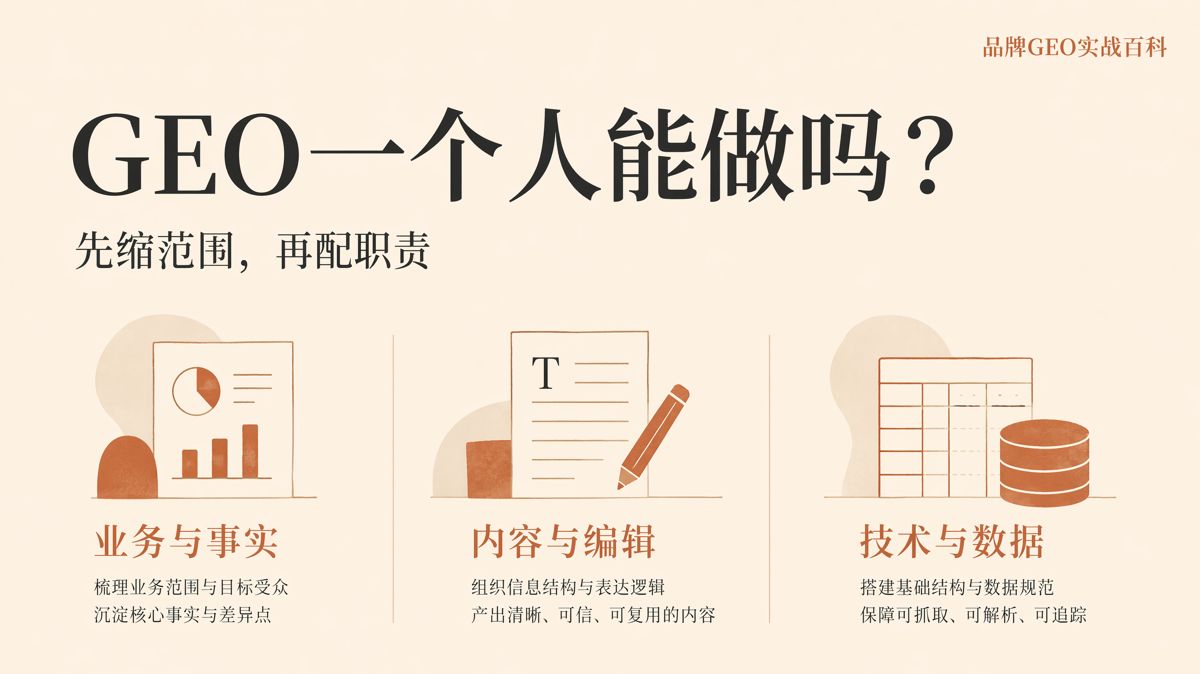
The short answer
You can launch Generative Engine Optimization alone, but only with strict scope. Here is how to run your first 30-question cycle and when to hire.
When marketing leaders first explore GEO (Generative Engine Optimization)—optimizing content so AI engines cite and recommend your brand when answering user prompts—the immediate question is often: Can one person handle this?
The short answer is yes to launch, but no if you try to do everything at once without boundaries.
GEO is not just writing articles. It requires verifying business facts, ensuring search bots can render your pages, structuring key data clearly, and regularly re-testing prompt queries to track brand citations.
For a solo marketer or early-stage team, the right starting point is not a site-wide redesign or launching across ten social platforms. The right start is choosing one product category, one target market, 30 core buying questions, and a defined set of landing pages. Complete one full loop: map questions, build pages, publish, and re-test citations. Once that process works reliably, you can expand channels and headcount.
Solo GEO Works Only If You Narrow the Scope First
When a single person attempts GEO without boundaries, projects usually fail in one of two ways: 1. Content gets published, but AI crawlers cannot render or extract the page data. 2. Pages are redesigned, but they fail to answer the real questions prospects ask AI engines.
These missteps happen because drafting copy, validating business claims, diagnosing code, and auditing AI citations require different skills and information sources. One person can hold multiple hats, but no one should make product or technical decisions in a vacuum without verified source data.
Whether a solo setup works depends on how strictly you define the initial scope.
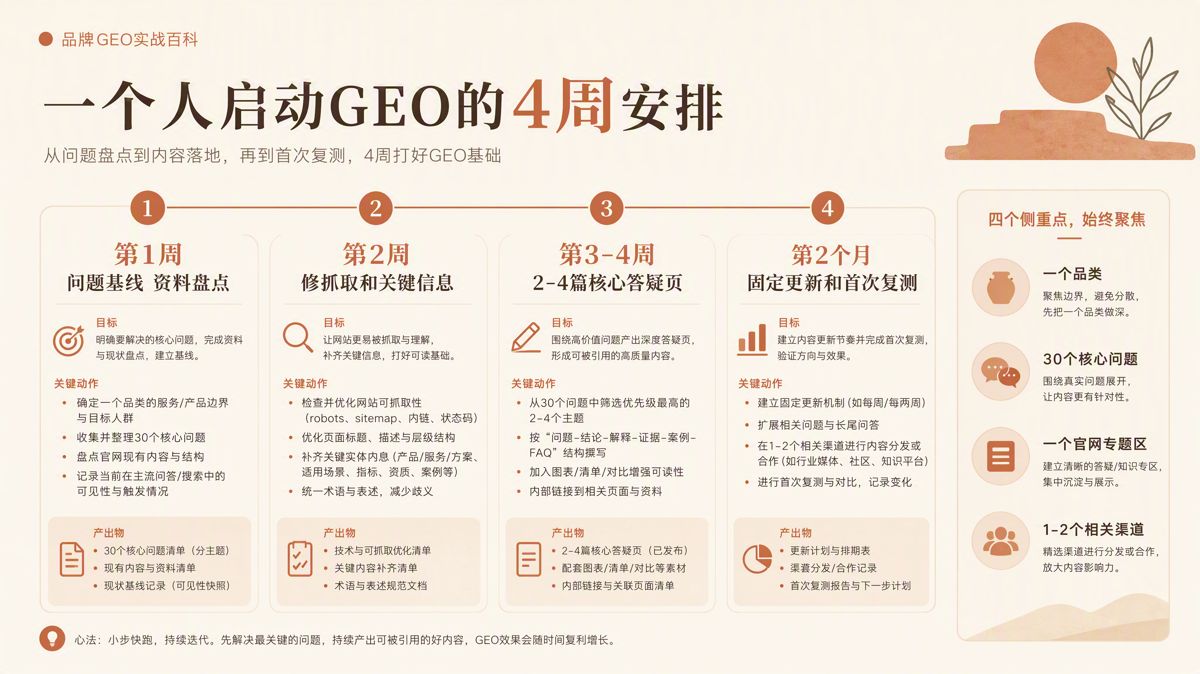
| Phase | What a Solo Marketer Should Focus On | What to Postpone |
|---|---|---|
| Week 1 | Fix a control set of prompt questions; audit existing collateral and target pages | Full-site rebuilds; opening multiple new social accounts |
| Week 2 | Resolve critical crawl/render blockers; structure key on-page information | Massive technical overhauls or headless CMS migrations |
| Week 3–4 | Publish 2–4 high-intent answer pages and comprehensive FAQs | Daily multi-platform posting; long-form and short-form video production |
| Month 2 | Establish a regular publishing cadence; complete your first prompt re-test cycle | Simultaneous multi-region or multi-language expansion |
This timeline is not a rigid deadline. It is a pacing guide to keep single-operator initiatives focused. Finish one measurable cycle before scaling up.
The Minimum GEO Engine Requires Three Core Roles
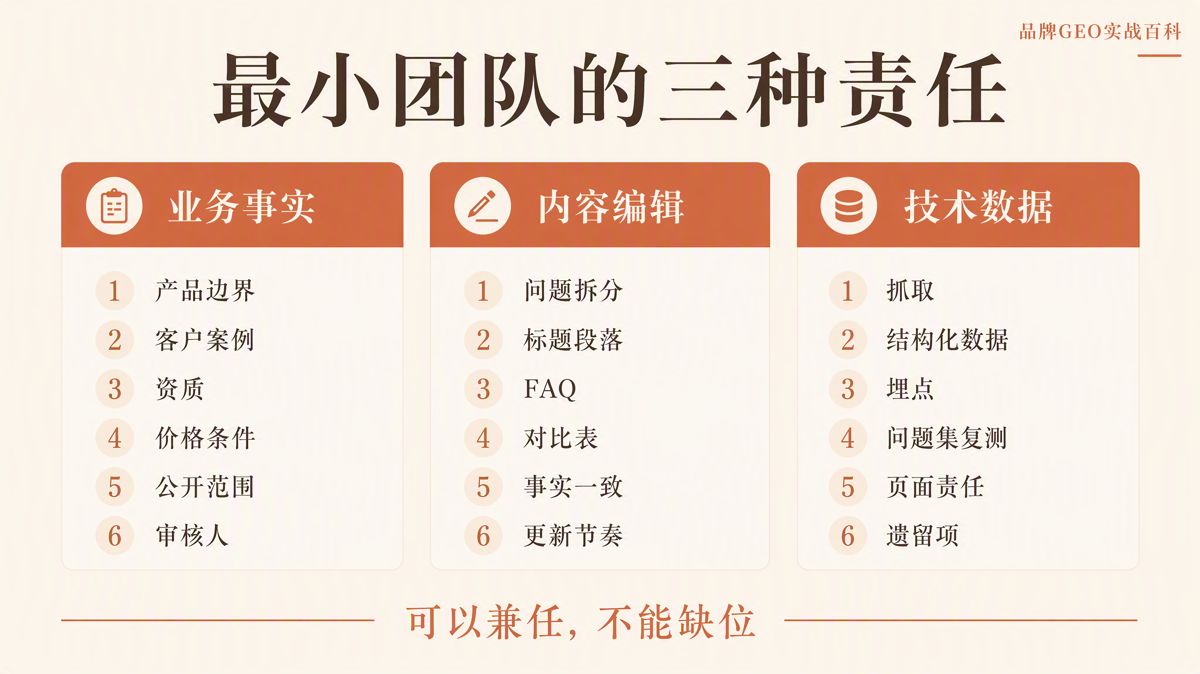
Every functional GEO initiative requires three distinct areas of responsibility: business fact ownership, content architecture, and technical measurement.
These three responsibilities do not demand three full-time hires on day one. A founder or marketing lead might handle two, and certain technical tasks can be outsourced. What matters is that each responsibility has an assigned owner.
1. The Business Fact Owner: Deciding What Can Be Stated
Someone must have the authority to confirm product specifications, customer references, pricing structures, compliance standards, and confidential boundaries. This role typically belongs to a founder, product lead, or business unit head.
Content writers can polish phrasing, but they cannot guess business facts. When source documentation is vague, inconsistencies spread across your home page, comparison tables, and case studies. The more unverified content you publish, the more hours you waste later cleaning up contradictions that confuse AI engines.
The business fact owner must clarify three things: - What data can be made public. - Which claims require sign-off before publishing. - Who alerts the content team when product details or pricing terms change.
2. The Content Lead: Turning Questions into Maintainable Pages
The content lead does not just write paragraphs. They transform messy customer queries into structured headings, clear conclusions, scannable comparison tables, and modular FAQs. They also ensure the same core facts remain consistent across every asset.
This role constantly evaluates: - Which buyer questions should be answered first. - What published information is becoming outdated. - Which facts are still unverified by product owners. - When an asset meets the threshold for publication.
Effective GEO content must be easy to locate, audit, and update long after publication. Without disciplined documentation, every minor product update requires a frantic manual audit across dozens of pages.
3. The Technical and Data Lead: Ensuring Crawlability and Verifiability
This role ensures AI user agents and search engine bots can discover, render, and parse key page information, and that tracking remains consistent across testing cycles.
While these tasks can be handled through an initial development sprint, technical health cannot be neglected permanently. If rendering errors persist, you cannot tell whether weak AI visibility is caused by poor copy or technical bot failures.
In small teams, it is common for a founder to validate facts while a content lead handles basic prompt testing. What you must avoid is forcing a copywriter to judge technical rendering or commercial policy alone. Those tasks require different inputs than writing skills.
Prioritize Questions That Impact Purchasing Decisions
When launching, avoid broad educational overviews. Focus on high-intent questions that buyers ask right before choosing a provider: - How do I choose between these options? - What does this cost, and what factors change the price? - Who is this best suited for, and who should avoid it? - How does this differ from alternative solutions? - How long does it take to see results? - What are the operational or implementation risks?
These queries mirror the decision-making process. Clear answers to these prompts serve double duty: AI search engines cite them directly, and your sales and customer success teams can use them immediately in sales conversations.
A complete GEO page should never be just a block of prose. It should include clear takeaways, eligibility criteria, verified facts, distinct subheads, comparison tables, and FAQ modules.
Use an inverted pyramid structure for long-form answers: place your direct conclusion and key data at the very top, followed by supporting reasons, prerequisites, and implementation steps. Readers and AI engines can extract the core takeaway immediately without wading through fluff.
Plan your output around your review capacity, not your typing or AI-generation speed. If your subject matter experts can only review one piece of content per week, publishing ten AI-generated articles a week will backfire. In fast-changing industries, you must also reserve bandwidth to maintain older pages.
When publishing volume exceeds review capacity, you do not build authority—you build technical and factual debt.
Technical Execution Solves Two Problems: Crawlability and Verification
Technical GEO is not about chasing algorithmic tricks to make AI bots "like" your site. It is about placing structured information where automated systems can parse it cleanly and your team can verify it systematically.
Priority technical tasks include: - Server-Side Rendering (SSR) and Clean HTML: Ensure primary content exists directly within the initial HTML response rather than relying on complex client-side JavaScript execution that bots may skip. - Sitemap and robots.txt Configuration: Guide search bots directly to high-value pages while keeping staging environments or thin pages out of index paths. - Performance and Mobile Accessibility: Maintain fast response times and clean mobile layouts so crawler timeouts do not disrupt page evaluation. - Schema Markup: Use JSON-LD structured data (Product, Article, FAQPage, Organization) to give bots machine-readable context about your entities. - Telemetry and Testing Records: Keep strict records of prompt testing inputs, engine versions, dates, and observed citation snippets.
Once the initial technical audit and remediation are complete, engineering requirements drop into routine maintenance. The ongoing workload shifts toward content refinement, factual updates, and query re-testing.
Technical and content leads must work from the same list of URLs and queries. Developers cannot guess which pages drive commercial impact, and writers cannot afford to ignore crawl errors.
When to Expand from One to Three People
Do not add headcount simply because the team feels busy. Add people when a specific bottleneck stalls your output.
If you can reliably publish one or two core pages per week and you have observed positive citation shifts across two consecutive testing cycles, invest in a dedicated content editor or distribution specialist.
If crawl issues, bot-blocking scripts, or broken schemas persist, bring in technical resources first. Producing more copy will not fix pages that engines cannot read.
When you expand past three distribution channels, or begin covering multiple languages and distinct product lines, assign a dedicated project manager to track citation monitoring and cross-team updates.
As you scale, maintain a shared tracking document that records: - Each target question and its corresponding canonical URL. - Syndicated platforms where the content is distributed. - Last factual review date. - Current citation status (which AI engines cite the URL). - Missing facts or next actions.
Without this master record, a growing team will duplicate topics, contradict claims across channels, and waste resources.
Complete One Full Loop First
Succeeding at GEO as an individual contributor is not about proving you can juggle every task. It is about executing one complete, repeatable cycle.
Pick one product category and one market. Outline 30 core buyer questions. Map each question to a clean, crawlable page. Publish the content, run your technical checks, and re-test those exact 30 prompts across target AI platforms.
Once that loop produces clear baseline data, you have an operational foundation. Expanding your team, budget, and channel distribution will then be an informed business decision, not a gamble.
FAQ
If it is just the founder, what is the very first step?
Pick one core product category and 30 questions that directly influence buying decisions. Gather existing collateral, sales Q&As, and customer objections, then run a baseline test across AI engines before rewriting anything. Do not start by rewriting your general brand story or creating accounts on every platform.
Can writing be completely outsourced?
Writing execution can be outsourced, but business fact validation cannot. External writers need approved facts, clear review owners, and documented update timelines. Otherwise, pages will contradict one another across channels.
Do you need a full-time developer for GEO?
Not initially. Initial technical audits, rendering fixes, and schema setup can be handled as a focused project or outsourced sprint, as long as someone owns ongoing verification. Technical support can be brought in quarterly or as pages change.
Do you need to post daily across multiple platforms?
No. Build out your core website pages first, then syndicate to one or two platforms where your buyers spend time. Daily multi-platform posting burns out your fact-checking and maintenance capacity.
How do you know when it is time to hire?
Hire when fact reviews bottleneck production, core pages fall behind on updates, re-testing gets skipped, or facts diverge across channels. Those are organizational limits, not personal productivity issues.
What is the single most important thing for the team to standardize?
A single source of truth for facts: product names, feature boundaries, the 30-question list, page owners, and revision dates. Formatting can vary across channels, but facts cannot.
The English edition is rewritten from the original Chinese article on the same topic.

Starbox AI is an AI marketing company based in Hangzhou, China. This article draws on Starbox project work. Please credit the source when quoting.
Related reading
 GEO Guide
Why AI Marketing Vendor Quotes Vary 10x: A 4-Step Vetting Checklist
Evaluate AI marketing proposals by delivery actions, not slide decks. Audit source infrastructure, fact cleaning, and clean-environment testing.
Oct 22, 2026 · 6 min read
 GEO Guide
Spotting GEO Scams: What Actually Drives AI Recommendations?
Automated AI ranking promises violate how LLMs work. Real AI recommendations rely on authoritative, structured facts across trusted public sources.
Oct 22, 2026 · 4 min read
 GEO Guide
How to Measure Your Brand's AI Visibility with a Spreadsheet
You do not need expensive software to track AI recommendations. A three-tier prompt framework and a simple spreadsheet can score your brand visibility in half a day.
Oct 21, 2026 · 6 min read