
How to Allocate a GEO Budget: Start with a 70/30 Split
The short answer
A practical framework for allocating your Generative Engine Optimization budget across content, technical foundations, and tracking.
Generative Engine Optimization (GEO) aligns technical architecture and content assets with how AI search engines retrieve, organize, and synthesize answers.
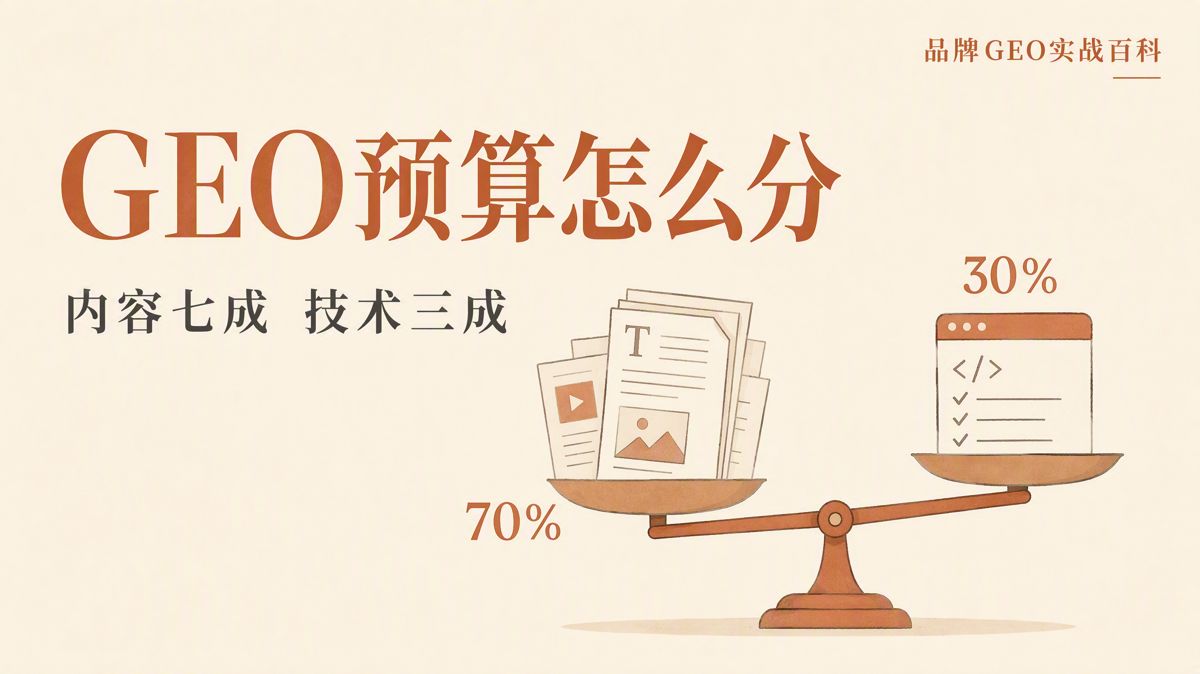
When your website is already accessible and crawlable by automated agents, but lacks depth and authoritative answers, a practical starting framework allocates 70% of the budget to content and 30% to technical infrastructure, monitoring, and contingency.
This 70/30 split is not an absolute rule. It is a benchmark for websites that have a sound technical baseline but lack complete answers, verified data, and independent corroboration.
If your website relies heavily on client-side rendering—where servers deliver an empty shell and rely on browser scripts to render text—or suffers from crawl-blocking robots.txt rules, duplicate URLs, and unreadable body copy, address technical debt first.
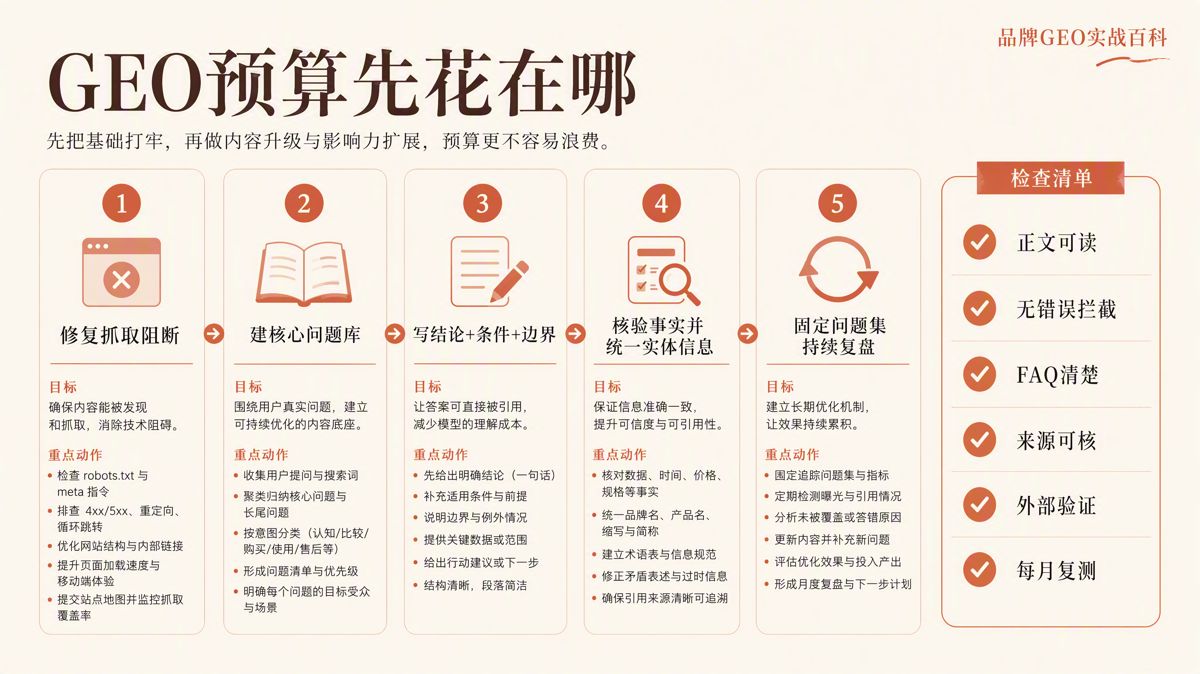
The sequence must always come before the ratio: ensure AI search crawlers can read the website before spending money producing new content.
The 70% Content Budget Is Not Just Copywriting
Many marketing teams launch GEO initiatives by purchasing monitoring tools, rewriting meta tags, and reconfiguring page code. Despite extensive technical adjustments, AI engines still fail to surface their brand because the pages do not contain direct, verified facts that answer user queries.
Accessibility allows an AI crawler to read a page; it does not guarantee the page contains anything worth citing.
When buyers ask how to evaluate a product category, what service limitations exist, or whether a vendor is dependable, AI engines require structured conclusions, qualifying conditions, explicit trade-offs, and verifiable proof points. Empty marketing claims like "industry-leading" or "premium quality" provide zero informational value to an answer engine, regardless of page load speed.
The 70% content allocation must fund the entire editorial lifecycle:
1. Researching High-Intent Buyer Prompts
Research should move beyond basic product keywords to evaluate comparative queries, pricing models, eligibility constraints, implementation risks, post-sale support, regulatory requirements, and practical use cases. A topic is worth pursuing only if it reflects an actual decision point in the buyer journey.
2. Structuring Comprehensive Answers
Each page should present a clear conclusion upfront, followed by prerequisites, step-by-step guidance, operational boundaries, and supporting evidence. Critical details must live directly in the HTML text rather than inside images, videos, or downloadable PDF attachments that AI crawlers may not parse consistently.
3. Standardizing Brand Entities
Corporate names, founder backgrounds, founding dates, product specifications, licensing, physical addresses, and direct contact details must remain consistent across your official website, corporate wikis, press coverage, and social profiles. Conflicting data across channels causes AI models to hallucinate or discard the brand as unreliable.
4. Fact-Checking and Subject-Matter Review
Every metric, date, certification, client quotation, case study reference, and legal assertion requires an internal owner for sign-off. If a claim cannot be verified, remove it or disclose its limitations. Polished prose without factual backing will not generate trustworthy AI citations.
5. Securing Independent External Sources
While an official website establishes the baseline brand narrative, self-authored claims carry limited weight. Industry publications, trade associations, authorized client materials, and reputable third-party directories provide essential external verification. Select channels based on your target market and the specific sources referenced by your target AI engines.
6. Updating Existing Content Assets
Publishing a page is not the final step. Stale pricing, outdated compliance rules, and obsolete specifications must be revised regularly. High-value URLs need documented ownership and regular review intervals. Maintaining and expanding existing high-performing pages is often far more cost-effective than churning out redundant blog posts.
How GEO Diagnostics Differ from Traditional SEO
Search Engine Optimization (SEO) traditionally focuses on indexation, keyword rankings, click-through rates, and organic traffic. GEO builds on indexability, but evaluates whether an AI engine can parse an extractable, definitive answer from the content.
Traditional SEO measures: - Indexation coverage - Keyword rankings - Organic clicks and click-through rates - Search referral traffic
GEO measures: - Clarity and definitiveness of conclusions - Depth and specificity of factual claims - Explicit definitions of constraints and use cases - Verifiable source citations - Accuracy of brand entity descriptions - Direct source citations generated by AI models
While both practices share technical foundations and performance metrics, traditional organic traffic numbers cannot substitute for citation frequency and brand attribution in synthesized answers.
Distribution channels also vary by region. Western campaigns often target Wikipedia, Reddit, G2, and tier-one tech publications. China-focused strategies require visibility across WeChat Official Accounts (Tencent's publishing platform), Baijiahao (Baidu's content platform), Zhihu (China's largest Q&A platform), Baidu Baike (Baidu's encyclopedia), and industry-specific trade portals. Test your target engines directly rather than relying on generic distribution checklists.
The 30% Technical Budget: Ensuring Machine Readability
The technical budget ensures that published content is discoverable, readable, and structured for AI evaluation. Prioritize technical initiatives based on their immediate impact on content extraction:
1. Confirm Direct Text Extraction
Pages should serve structured, clean HTML out of the box. Minimize reliance on client-side JavaScript execution to display core body text. If a web crawler encounters blank containers or scripts instead of text, all upstream content investments are wasted. Implement Server-Side Rendering (SSR) or prerendering where necessary.
2. Audit Crawl and Access Restrictions
Routinely verify that:
- The robots.txt file does not block AI search user agents
- Core informational pages do not sit behind forced login walls
- Geo-blocking does not restrict target regions
- Unintended redirect chains are resolved
- HTTP status codes accurately return 200 OK without soft-404 errors
3. Standardize On-Page Structure
Audit structural tags to ensure logical topic hierarchy:
- Descriptive, accurate <title> tags
- A single, distinct <h1> matching the page's core entity
- Direct meta descriptions
- Clear internal contextual links
- Self-referential canonical tags to eliminate duplication
- Up-to-date XML sitemaps highlighting canonical URLs
4. Implement Entity Schema and Structured Data
Identify core entities across the site—including the organization, its executives, products, and industry solutions. Use standard Schema.org markup (such as Organization, Product, Article, and FAQPage) to help machine agents parse connections and attributes. Remember that structured data supplements visible body text; it does not replace it.
5. Establish Evaluation Baselines and Monitoring
Set up dedicated prompt sets, citation logs, server access tracking, and operational dashboards. Track three variables consistently: - Does the brand appear in the AI-generated answer? - How accurately is the brand described? - Which specific URLs are cited as references?
Log an initial baseline before rolling out major updates. Without a pre-optimization baseline, you cannot quantify performance gains.
6. Introduce Automation and Scaled Experiments
Automated prompts and scrapers streamline tracking, but they require a clear understanding of the baseline. Google launched AI Overviews in 2024, directly synthesizing search answers from multiple web sources. Because AI engines continuously adjust their retrieval strategies, avoid site-wide overhauls based on arbitrary third-party "GEO scores."
Instead, maintain version control of page copy, test fixed prompts across major AI models, and document variations over time.
A Sample Six-Month GEO Budget Allocation
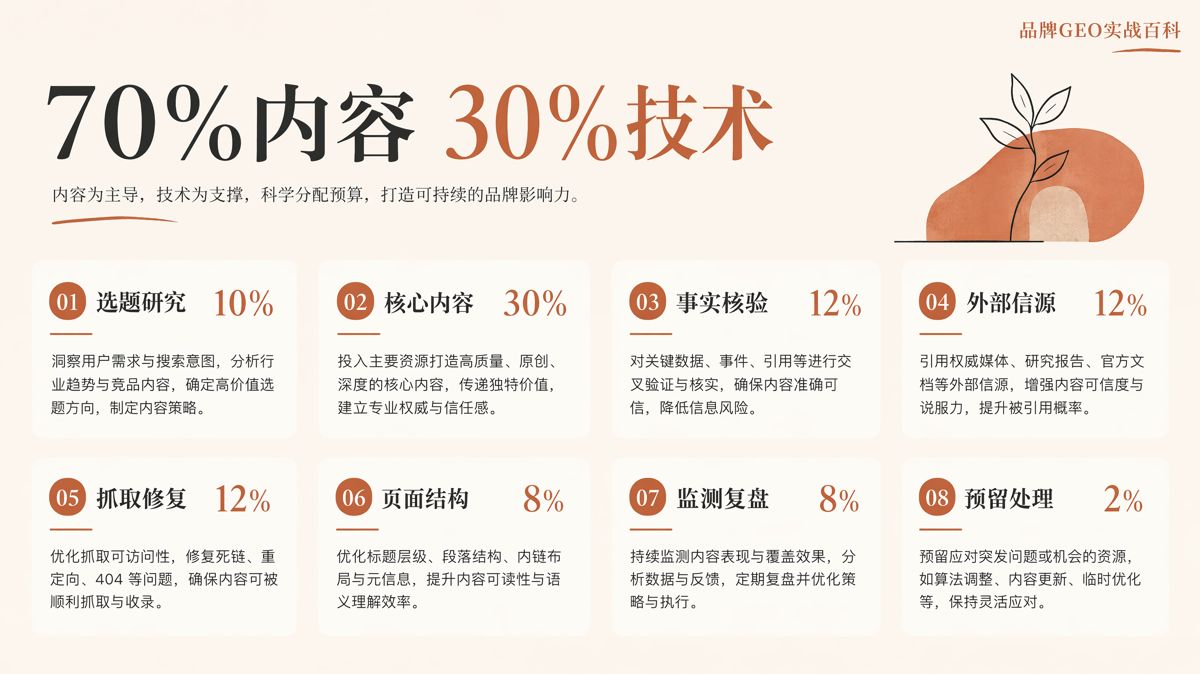
For a standard six-month pilot, allocate resources across these nine operational tracks:
| Operational Focus | Recommended Share | Scope of Work | Deliverable / Acceptance Criteria |
|---|---|---|---|
| Query & Prompt Research | 10% | Build a prompt repository, analyze competitor citations, categorize buyer intent | Every topic addresses an active user query |
| Core Content Production | 30% | Develop product, solution, FAQ, comparison, and technical overview pages | Every page includes conclusions, prerequisites, boundaries, and proof |
| Fact-Checking & Expert Review | 12% | Validate technical specs, dates, credentials, and case study permissions | Unverifiable statements are corrected or deleted |
| Third-Party Authority & Entities | 12% | Standardize entity profiles, pitch trade press, align external brand profiles | Naming, credentials, and core positioning match across all sources |
| Content Maintenance & Refresh | 6% | Update decaying pages, expand edge-case FAQs, transcribe multimedia assets | Documented update dates and designated content owners |
| Crawl & Render Engineering | 12% | Configure SSR/prerendering, audit robots.txt, resolve status codes and sitemaps |
Crawlers can extract body text directly from initial HTML |
| Semantic Markup & Structure | 8% | Refine page titles, <h1> headers, visible FAQs, Schema markup, internal links |
Machine parsers can extract primary entities and their relationships |
| Monitoring & Attribution | 8% | Maintain fixed prompt libraries, citation logs, crawler logs, and dashboards | Established baseline, regular review cadences, and assigned analysts |
| Contingency Buffer | 2% | Accommodate urgent compliance reviews, site redesigns, or critical fixes | Dedicated reserve for unpredicted technical or editorial blockers |
The top five tracks account for 70% of spend on content-related work, while crawling, architecture, tracking, and contingency cover the remaining 30%.
If your website has severe rendering or crawlability issues, temporarily increase Crawl & Render Engineering to 25%–40%. Once those blockers are resolved, shift budget back toward content development and verification.
Conversely, if your site's technical foundation is already stable, adding technical spend will yield diminishing returns; prioritize verified content and independent citations instead.
Phasing Budget Execution Over Six Months
Sequencing capital deployment is just as critical as the allocation ratios. Deploying funds at the wrong phase creates costly bottlenecks.
Weeks 1–4: Audits and Baseline Setup
Do not rush to publish broad content campaigns. Begin by auditing: - High-priority URLs on your domain - Primary documentation and product data - Verifiable customer case studies - Industry certifications and corporate filings - High-friction questions from sales and support calls
Resolve blocking technical issues immediately. On the editorial side, produce 10 to 20 precise answer pages addressing critical buyer queries. Run your baseline prompt library across target AI search engines to record existing citations, brand sentiment, and reference URLs. Do not commit to specific citation growth metrics until this baseline is established.
Weeks 5–12: Content Production and External Evidence
For every core product or service, build comprehensive assets addressing six foundational questions: - What is the product or service? - Who is it designed for? - Who is it not suitable for? - How does it compare to alternative solutions? - How is it implemented or deployed? - What are the common risks, constraints, or trade-offs?
Audit dates, metrics, and permissions for every page before publishing. Do not publish case studies as verified facts without independent customer authorization.
For campaigns targeting mainland China, adapt core technical themes into formats suited for WeChat Official Accounts, Zhihu, Baijiahao, or niche vertical platforms. Avoid copying the same raw text across platforms without adjusting for audience expectations.
Weeks 13–24: Maintenance, Auditing, and Refinement
Pivot resources away from net-new content production toward performance auditing and optimization: - Which target prompts consistently return brand citations? - Which pages are being misinterpreted or summarized incorrectly by AI engines? - Where do brand entity details conflict across channels? - Which high-priority answers lack external corroboration? - Which early pages require updated metrics or product releases?
Track standard SEO metrics alongside three core GEO criteria: answer accuracy, brand representation, and citation authority.
Six Scenarios Requiring a Custom Budget Split
The 70/30 model serves as a baseline for sites with adequate technical health. Adjust the ratio when facing any of the following scenarios:
1. Significant Technical Roadblocks
If core pages rely on complex client-side JavaScript, suffer indexation issues, or feature duplicate architectures, elevate technical spend to 40% or more until the foundation is sound.
2. Heavily Regulated Industries
Healthcare, finance, food production, and legal services require rigorous compliance oversight. Carve out an explicit legal and compliance review allocation within the content budget before scaling publication.
3. Global and Cross-Border Operations
Operating across jurisdictions requires budget for localization, regional privacy policies, data residency management, and cookie consent mechanisms. These are fundamental operational requirements, not minor technical tweaks.
4. Third-Party Marketplace and Directory Dependency
If your business operates primarily through e-commerce platforms or local service aggregators, customer acquisition often happens outside your website. Rebalance your budget to maintain consistent profiles, business data, and review management across those third-party directories.
5. Complex B2B Enterprise Sales
Long enterprise sales cycles require detailed technical validation. Allocate more budget to formal white papers, authorized reference architectures, technical documentation, and sales-enablement FAQs tailored to different procurement stakeholders.
6. Green-Field Domains
Launching a brand-new website does not require publishing hundreds of surface-level articles. Start with 10 to 20 authoritative, highly specific pages. Test how search and AI engines index and cite those initial assets before expanding the content footprint.
AI Accelerates Production, but Human Verification Remains Essential
AI tools accelerate content workflows—drafting outlines, standardizing formats, and categorizing queries. However, validating product specifications, securing customer permissions, ensuring regulatory compliance, and confirming citations require human oversight.
Under China's Measures for the Labeling of Artificial Intelligence Generated and Synthetic Content (effective September 1, 2025), organizations must implement explicit and implicit identifiers for AI-synthesized materials where applicable.
Automating content output never eliminates the need for factual accuracy and compliance audits. As content generation speeds increase, clear human accountability becomes even more vital.
Seven Questions to Answer Before Finalizing Your Budget
Before approving a GEO budget, ensure your team can answer the following questions:
- Can search and AI crawlers read your primary body text directly from server-rendered HTML?
- Is there a designated internal owner responsible for validating corporate and product facts?
- Have you developed complete, verified answers for your top 10 commercial-intent queries?
- Does every answer page outline its operating limitations, constraints, and prerequisites?
- Can third-party, independent sources corroborate the primary claims on your site?
- Are your domestic and international content distribution plans adapted to their respective platforms?
- Have you established a baseline prompt set and a scheduled review cadence?
If these questions remain unresolved, expanding your budget will not guarantee meaningful visibility.
The 70/30 split provides a balanced starting point for organizations with functional websites that need to establish digital authority. Prioritize operational readiness: confirm machine readability first, invest heavily in verified content, and continuously track how generative engines interpret and cite your brand.
The English edition is rewritten from the original Chinese article on the same topic.

Starbox AI is an AI marketing company based in Hangzhou, China. This article draws on Starbox project work. Please credit the source when quoting.
Related reading
 GEO Guide
Why AI Marketing Vendor Quotes Vary 10x: A 4-Step Vetting Checklist
Evaluate AI marketing proposals by delivery actions, not slide decks. Audit source infrastructure, fact cleaning, and clean-environment testing.
Oct 22, 2026 · 6 min read
 GEO Guide
Spotting GEO Scams: What Actually Drives AI Recommendations?
Automated AI ranking promises violate how LLMs work. Real AI recommendations rely on authoritative, structured facts across trusted public sources.
Oct 22, 2026 · 4 min read
 GEO Guide
How to Measure Your Brand's AI Visibility with a Spreadsheet
You do not need expensive software to track AI recommendations. A three-tier prompt framework and a simple spreadsheet can score your brand visibility in half a day.
Oct 21, 2026 · 6 min read