
After 90 Days of GEO: What to Focus on in Days 91 to 180

The short answer
Days 1 to 90 build baseline presence. From Day 91 onward, shift focus from publishing volume to visibility, answer accuracy, and business impact.
Generative Engine Optimization (GEO) is the systematic process of organizing public content and brand data so AI engines can easily identify, cite, and accurately describe your company, products, leadership, or services.
Once you complete your first 90 days of GEO, the most important change is not increasing content production. It is changing what you evaluate. The first 90 days focus on filling information gaps. From Day 91 onward, you must determine whether that information enters AI answers, whether the descriptions are accurate, and whether users take action after reading them.
If your team meetings still focus on questions like "How many articles did we post this week?" or "How many new pages did we add?", you are measuring activity, not impact.
Day 90 is not a project deadline. It is a management inflection point.
Days 1 to 90 solve for presence: Did we build the necessary assets? Days 91 to 180 solve for utility: Which buyer prompts trigger your brand, is the response accurate, and do users take the next step?
Before adjusting your workflow, keep several core principles in mind:
- 90 and 180 days are review cycles, not guaranteed delivery dates. AI models change continuously; no platform guarantees ranking timelines.
- Single tests do not reflect long-term reality. AI responses vary by model, interface, query phrasing, retrieved references, and test timing.
- A brand mention is not a recommendation. A mention may simply list your company name. A genuine recommendation explains suitable use cases, differentiators, and next steps.
- Repeat tests across multiple dates. Individual tests have little comparative value without longitudinal data.
- Content volume measures input, not output. Prompt coverage, answer accuracy, and qualified referral traffic reflect actual performance.
- Establish a baseline before claiming credit. You cannot attribute growth in leads or traffic to GEO without documenting your starting point.
At Day 91, Change the Questions You Ask in Reviews
During the first 90 days, teams typically organize corporate facts, build core website pages, address common buyer questions, and resolve conflicting statements across public channels.
Tracking content output and page accessibility during that setup phase makes sense. If public information is missing, unindexed, or contradictory, AI engines cannot reliably parse or cite it.
By Day 91, that baseline content already exists. Your reviews must now shift from what you published to how AI responses changed:
- In which buyer queries does your brand appear?
- What specific facts did the AI retrieve?
- Did the engine correctly identify your positioning, capabilities, and target audience?
- Did users visit your site, submit a form, or mention the AI answer during a sales call?
The most common trap is equating higher publishing volume with higher visibility.
Publishing more content only increases available information. Whether that content enters an AI answer depends on query alignment, structural clarity, cross-page consistency, technical indexability, and the sources the engine chooses to retrieve.
Starting on Day 91, add regular prompt monitoring alongside your editorial schedule. Test the same set of prompts weekly and record:
- The exact prompt text;
- The date of the query;
- The AI platform or feature interface used;
- Whether your brand, product, or leadership was mentioned;
- The position of the mention within the response;
- How the AI described your offering;
- The complete raw response.
Do not just log a summary. Without the exact prompt and full raw output, your monthly reviews will rely on vague impressions. When an answer changes, you will not know whether your content updates caused the shift or whether it was a random fluctuation.
Evaluate Visibility, Accuracy, and Effectiveness in Order
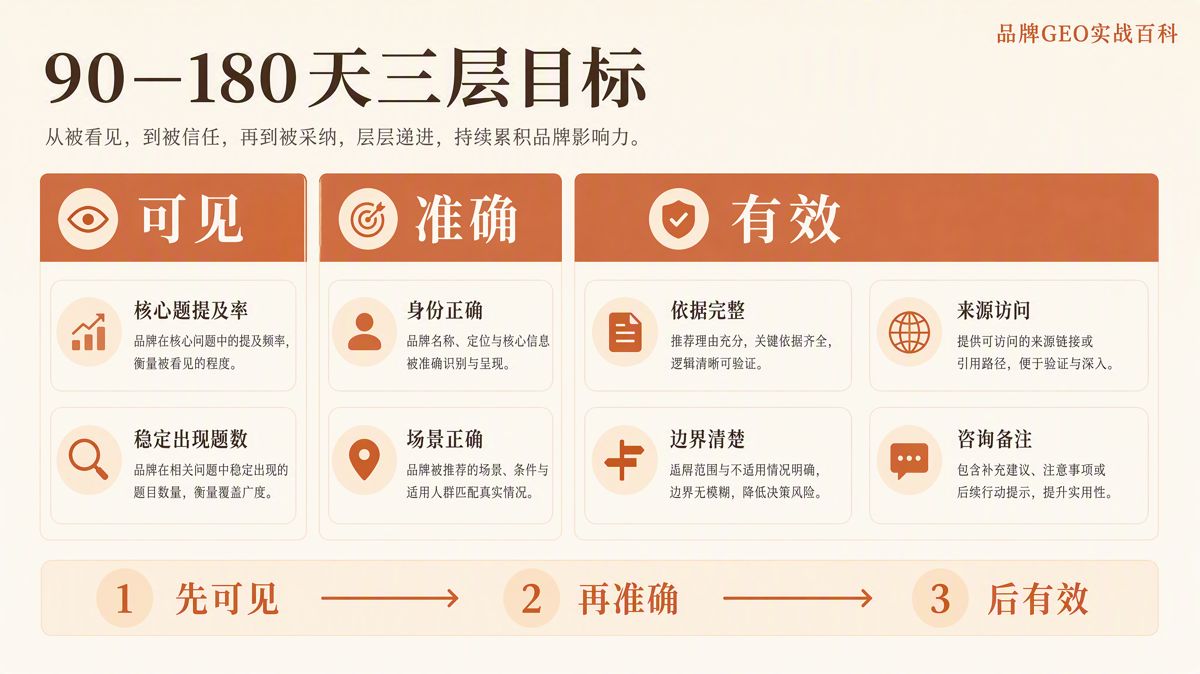
From Day 91 to 180, evaluate your results across three distinct layers: Visibility, Accuracy, and Effectiveness.
You must follow this order. If your brand does not appear in target answers, you cannot evaluate business impact. If your brand appears but the AI misstates your capabilities, driving more traffic will only confuse prospective buyers. Correct the information first.
| Evaluation Layer | Core Question | Recommended Metrics | Invalid Assumptions |
|---|---|---|---|
| Visibility | Does your brand, product, executive, or page appear in responses to target prompts? | Prompt mention rate, number of prompts with visibility, number of stable topics | A single mention means your brand is permanently recommended |
| Accuracy | Is the retrieved information correct, complete, and free of confusion? | Factual accuracy rate, error count, missing key facts, consistency across interfaces | More content automatically guarantees accurate answers |
| Effectiveness | Do users continue researching or take commercial action after reading the answer? | AI-attributed visits, high-intent page traffic, form attribution, sales feedback | Every closed deal is solely driven by GEO |
"Mention rate" refers to the percentage of monitored prompts that cite your brand. It measures frequency of appearance, not recommendation quality or business value.
For example, if your mention rate rises but answers only drop your brand name without explaining whom you serve or what problem you solve, visibility has improved, but utility has not. If an answer overstates what your product can do, higher visibility may simply generate unqualified leads.
Set internal targets using relative progress and quality benchmarks rather than arbitrary industry averages:
- Increase the number of core prompts that consistently cite your brand compared to your Day 1 baseline.
- Ensure every brand mention includes at least two verified, accurate facts.
- Systematically tag and archive inbound inquiries that reference AI search results.
Track Full Prompts, Not Just Isolated Keywords
In AI search, tracking single keywords provides little value. Real buyers query AI engines with specific context, constraints, and decision criteria:
- How should a specific type of business evaluate alternative solutions?
- What should a team prioritize when operating with a limited budget?
- What are the operational differences between two approaches?
- Under what conditions should an organization avoid a particular strategy?
The user's role, operating scenario, comparison criteria, and expected outcome directly shape the AI's response. From Day 91 onward, replace keyword lists with a structured Core Prompt Pool.
A Core Prompt Pool is a fixed set of real-world buyer decision queries tested on a regular schedule.
An effective test prompt includes four elements:
- Who is asking (user profile);
- The context (constraints or environment);
- The evaluation criteria (what is being compared);
- The desired outcome (the decision to be made).
For example, "For a local service business with a limited budget, should we fix our core website content first or start publishing blog posts?" is far more actionable than "How to do GEO." The detailed prompt defines the buyer, budget, alternatives, and goal, making it easy to judge whether the AI response delivers practical advice.
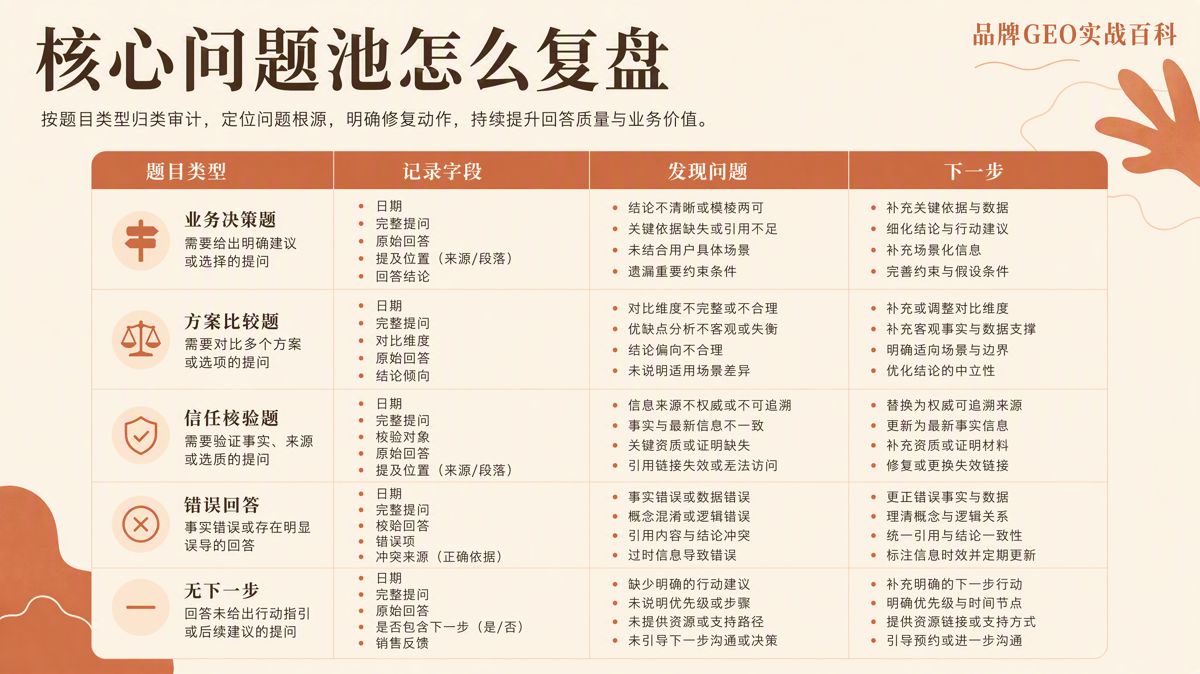
Organize your pool into three categories:
- Commercial Decision Prompts: Test whether your brand appears during active vendor evaluations.
- Solution Comparison Prompts: Test whether your product is positioned accurately against alternatives.
- Trust Verification Prompts: Test whether foundational corporate facts are accurate and consistent.
| Category | Primary Focus | Data to Log | Corrective Action |
|---|---|---|---|
| Commercial Decision | Does the brand appear, and in what position? | Date, full prompt, position, cited pages | Add detailed use cases and decision criteria to your site |
| Solution Comparison | Are differentiators, pros, and cons presented accurately? | Compared items, missing points, inaccuracies | Publish dedicated comparison pages and boundary notes |
| Trust Verification | Are basic facts consistent, or do outdated claims persist? | Accurate points, errors, source conflicts, fix status | Align facts across your site, directories, and public profiles |
Start with 10 to 20 prompts per category. Teams with limited resources can begin with 10 each, for a total of roughly 30 prompts. Consistency matters far more than quantity. Running the same 30 prompts weekly produces far more valuable data than running 100 prompts once.
Update the pool deliberately. If a prompt yields no commercial value for four consecutive weeks or does not reflect real buyer language, deprioritize it. When sales, support, or account teams report recurring new questions from prospects, add them to the pool immediately.
When Mentioned, Audit the Quality of the Mention
Counting raw brand mentions tells you very little. You need to verify whether the mention provides enough accurate context to help a buyer make a decision.
Audit every mention against four criteria:
- Identity: Did the AI correctly state your industry, role, and core positioning?
- Scenario: Did it clarify who your solution is for and what problem it solves?
- Evidence: Did it reference verifiable workflows, standards, or data points?
- Boundaries: Did it clearly explain when your solution is not suitable?
Track these four points in a simple review log, marking each as Correct, Missing, Incorrect, or Not Applicable. Review the trends after a month to see where AI engines consistently misunderstand your business.
| Audit Criteria | Passing Standard | Common Failure | Corrective Action |
|---|---|---|---|
| Identity | Basic facts (industry, category, location) remain consistent | Confused with similarly named entities; legacy naming | Standardize company overview pages and structured data |
| Scenario | Explains target users and specific problem solved | Abstract definitions without concrete use cases | Add scenario-based Q&A pages outlining practical conditions |
| Evidence | Provides verifiable steps, frameworks, or metrics | Vague adjectives with no supporting facts | Publish detailed methodology, process, and data pages |
| Boundaries | Outlines limitations and unsuitable use cases | Overly broad claims; missing constraints | Add FAQ sections covering trade-offs, limits, and prerequisites |
Many teams discover that their issue is not zero visibility. The problem is that the brand appears as a bare name without context, or the AI describes its capabilities far too broadly.
When you spot an inaccurate answer, do not immediately make your existing articles longer. Insufficient word count is rarely the cause. Inaccuracies usually stem from:
- Conflicting statements across different public pages;
- Page titles that fail to identify the intended audience;
- Introductions that contradict the body text;
- Legacy company profiles or obsolete collateral that remain online;
- Missing boundary conditions and target audience definitions.
Identify which page or phrase likely caused the misunderstanding before editing. Targeted corrections work far better than adding more words.
Let Monitoring Data Decide What to Write Next
During the first 90 days, content calendars typically follow broad themes: concepts, workflows, case studies, and introductory FAQs. From Day 91 onward, your monitoring data should dictate what you write and revise.
Review your Core Prompt Pool weekly to identify three types of gaps:
- Zero Visibility: High-value decision prompts where your brand does not appear.
- Inaccurate Visibility: Prompts where your brand appears, but the facts are wrong.
- Incomplete Action: Prompts where your brand appears accurately, but the AI gives the user no logical next step.
When a high-value prompt shows zero visibility, do not rewrite your entire content library. Check the basics first: - Do you have a page dedicated to answering that exact question? - Does the page title match the phrasing real buyers use? - Do the first two paragraphs directly answer the query? - Are relevant internal pages clearly linked together?
When an answer shows inaccurate visibility, prioritize eliminating conflicting information, tightening loose definitions, and standardizing your terminology across public assets.
When an answer shows incomplete action, add practical assets to your pages: checklists, evaluation frameworks, onboarding prerequisites, or follow-up questions. Give the AI structured material that naturally guides the buyer on what to research or ask next.
In days 91 to 180, you will spend more time updating and refining existing pages than drafting new ones from scratch. Maintain a steady weekly operating cadence:
- Run one full prompt monitoring check;
- Diagnose the root cause of identified inaccuracies;
- Update and publish high-priority content fixes;
- Review inbound feedback from sales and customer support.
Limit your weekly fixes to the highest-priority issues. If you try to correct every anomaly at once, your team will drown in edits while high-value commercial prompts remain broken.
Separate Process Metrics, Signal Metrics, and Business Outcomes
Track three distinct categories of metrics: Process Metrics, Signal Metrics, and Business Outcomes.
Process metrics show what your team executed. Signal metrics show how AI engines responded. Business outcomes show whether those engine changes coincided with qualified traffic, inquiries, and pipeline.
Each category serves a specific purpose and must not be conflated.
| Metric Type | What to Measure | Review Cadence | Practical Boundary |
|---|---|---|---|
| Process Metrics | Pages revised, prompts audited, source conflicts resolved | Weekly | Proves work was completed; does not prove it worked |
| Signal Metrics | Core prompt mention rate, factual accuracy, consistency | Bi-weekly or monthly | Requires longitudinal raw answer logs to be valid |
| Business Outcomes | AI referral traffic, qualified form fills, sales citations | Monthly | Cannot exclude pricing, marketing campaigns, or seasonality |
Before setting new goals, establish your baseline. Measure where you stand across your core prompts:
- How many target prompts currently mention your brand?
- In how many of those mentions are the facts accurate?
- Which answers contain glaring errors?
- Which prompts lack dedicated content entirely?
Do not establish a baseline from a single afternoon of testing. Sample queries across multiple days and test across major AI platforms to smooth out temporary fluctuations.
Avoid targets like "GEO must deliver 50 closed deals in 180 days." A closed deal depends on sales execution, pricing, product-market fit, prospect budgets, and broader marketing campaigns. GEO cannot claim sole credit.
A practical Day 180 milestone looks different: your team can present an auditable log proving that answer quality improved across core commercial prompts, specific inbound traffic originated from AI engines, and sales conversations directly referenced those AI recommendations.
That verifiable record gives leadership the confidence to justify continued investment.
The Day 180 Review: Strategic Answers, Not Work Summaries
At Day 180, your review should not be a list of total articles published. Your review must answer five strategic questions:
- On which topics have we established stable, repeatable AI visibility?
- Which prompts cite our brand but still return inaccurate or incomplete details?
- Which pieces of content consistently failed to enter high-value AI answers?
- Which public assets still contain conflicting or outdated company facts?
- Which commercial inquiries can be credibly linked to improved AI visibility?
Based on those answers, choose one of three strategic paths:
Path 1: Core prompts show consistent, accurate visibility. Move deeper down the funnel. Publish direct solution comparisons, technical evaluation criteria, and implementation guides that help prospects transition from discovery to vendor selection.
Path 2: Brand visibility exists, but accuracy remains low. Stop producing net-new content. Focus entirely on resolving conflicting public data, updating canonical pages, and defining clear service boundaries.
Path 3: After continuous testing, visibility remains negligible. Re-evaluate your foundation. Check whether your target prompts match actual buyer phrasing, verify that search engines and AI crawlers can access your pages without technical hurdles, and assess whether your content formatting answers the queries directly.
A lack of immediate visibility is not solved by blindly publishing more articles. Sometimes you need better-structured content; sometimes you need to delete conflicting legacy pages; sometimes you need to discard test prompts that real buyers never ask.
The primary deliverable of your second 90 days is not an archive of articles. It is a tested, auditable monitoring system that directs your marketing investments based on verified AI behavior.
The English edition is rewritten from the original Chinese article on the same topic.

Starbox AI is an AI marketing company based in Hangzhou, China. This article draws on Starbox project work. Please credit the source when quoting.
Related reading
 GEO Guide
Why AI Marketing Vendor Quotes Vary 10x: A 4-Step Vetting Checklist
Evaluate AI marketing proposals by delivery actions, not slide decks. Audit source infrastructure, fact cleaning, and clean-environment testing.
Oct 22, 2026 · 6 min read
 GEO Guide
Spotting GEO Scams: What Actually Drives AI Recommendations?
Automated AI ranking promises violate how LLMs work. Real AI recommendations rely on authoritative, structured facts across trusted public sources.
Oct 22, 2026 · 4 min read
 GEO Guide
How to Measure Your Brand's AI Visibility with a Spreadsheet
You do not need expensive software to track AI recommendations. A three-tier prompt framework and a simple spreadsheet can score your brand visibility in half a day.
Oct 21, 2026 · 6 min read