
Days 31-60 in GEO: How to Build Your Content Foundation

The short answer
From day 31 to 60, shift from prep to production: publish long-form pillars, revamp product pages, ship long videos, and track AI engine citations.
Generative Engine Optimization (GEO) is the process of structuring your website articles, product pages, and videos so that artificial intelligence (AI) answer engines can easily understand, extract, and cite them. In this context, a citation means that an AI engine incorporates your information into its answer or lists your page as a direct source.
In a 90-day GEO roadmap, day 31 marks the transition from foundational setup to full-scale production. This stage is not about running scattered content experiments. It requires producing flagship long-form articles, revamping product pages, and publishing long-form videos against strict standards, followed by post-launch citation audits across multiple AI engines.
7 Core Requirements for This Phase
- Days 31 to 60 represent phase two of a 90-day GEO roadmap, shifting focus from initial setup to systematic production.
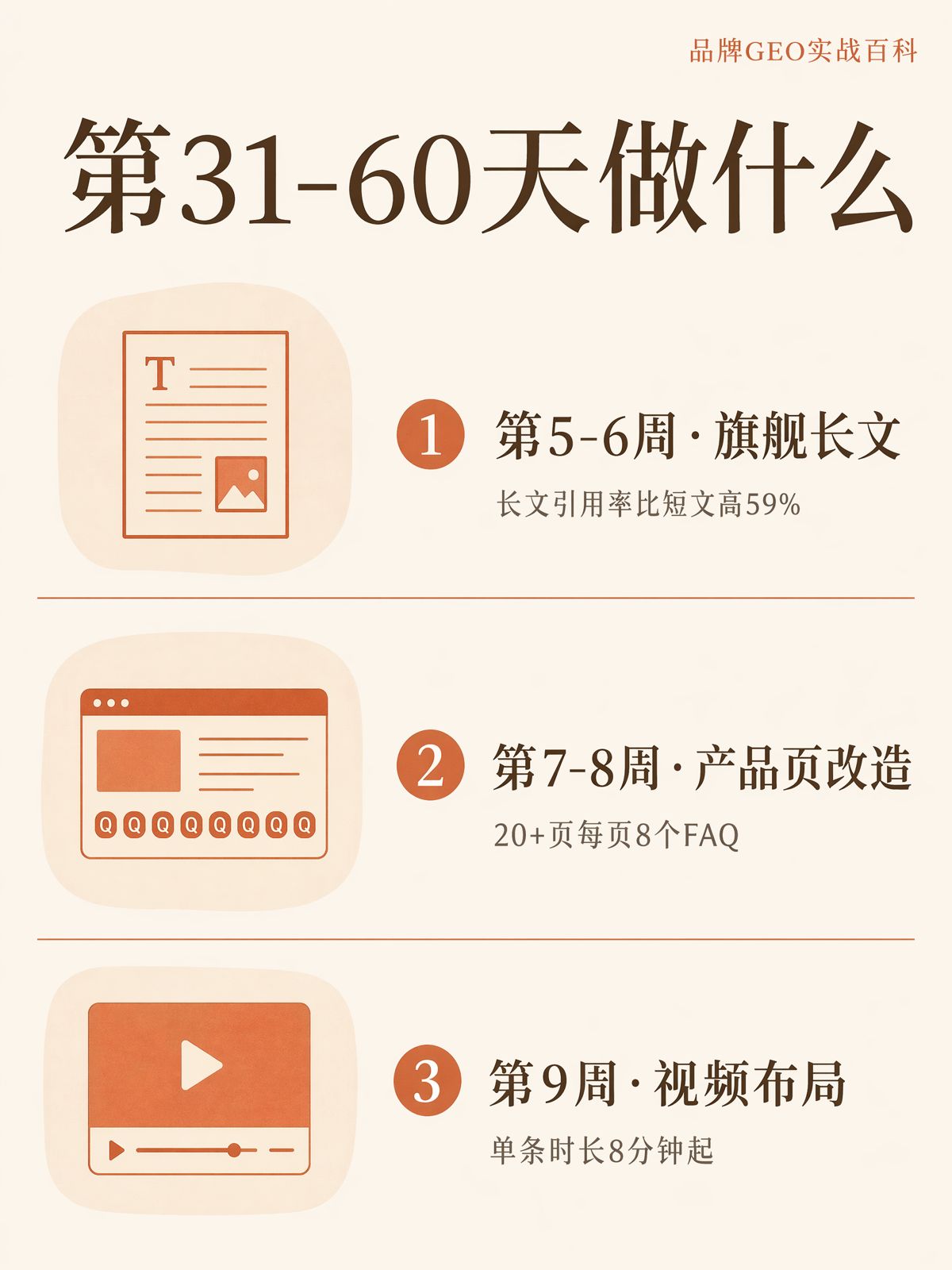
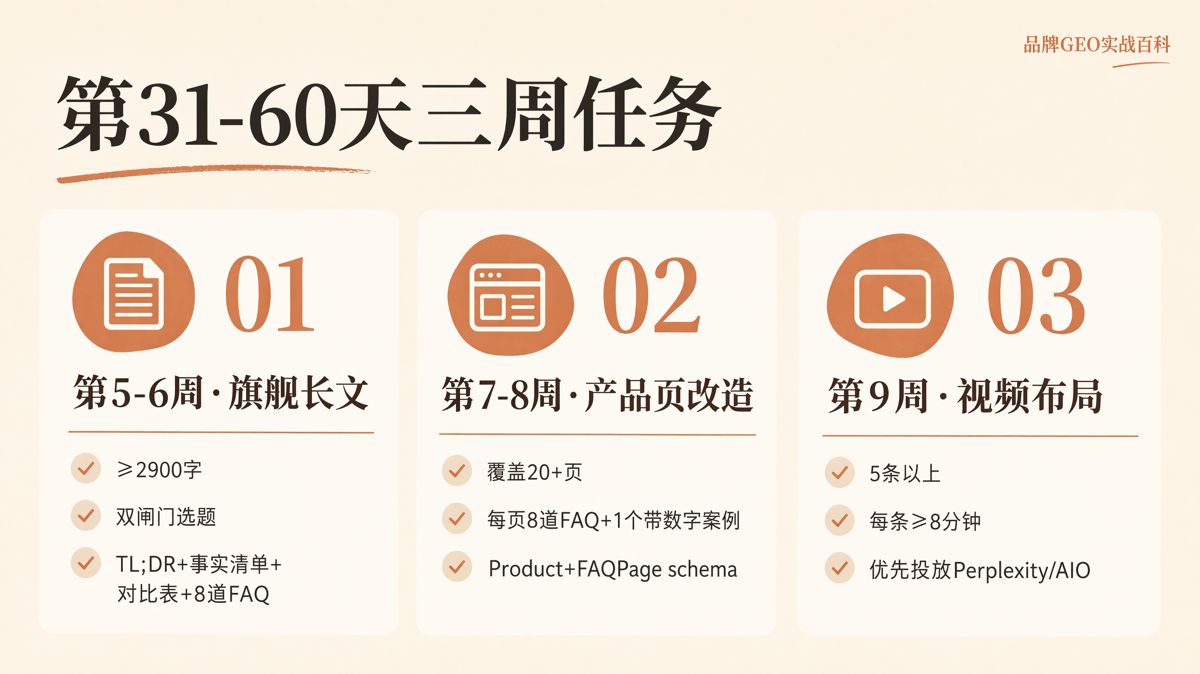
- Weeks 5 and 6 focus on flagship long-form articles. Each article must be at least 2,900 words and include a one-sentence summary, 5 to 7 numerical data points, at least one comparison table, and 8 FAQs.
- According to data from seoClarity, long-form content of 2,900 words or more achieves a 59% higher citation rate than short articles under 800 words. (Note: English word counts and Chinese character counts cannot be directly converted.)
- Weeks 7 and 8 focus on overhauling 20 or more product pages, adding at least 8 FAQs and one quantified case study per page.
- Every product page must deploy both
ProductandFAQPageschema markup so search systems can parse product details and structured questions. - Week 9 focuses on producing 5 or more long-form videos (at least 8 minutes each), complete with full subtitles and text descriptions.
- When using AI tools to assist in batch production, teams must implement both explicit and implicit identifiers as mandated by the Measures for the Labeling of Content Generated by Artificial Intelligence, effective September 1, 2025.
Why Production Must Scale After Day 30
The first 30 days are dedicated to four preparatory tasks: establishing a diagnostic baseline, fixing technical infrastructure, auditing existing content, and setting up external distribution channels. These steps clarify the project baseline, set content boundaries, and establish execution standards.
Starting on day 31, the team must deliver three formal content assets: flagship long-form articles that comprehensively answer user questions, product pages packed with buying-decision context, and long-form videos with complete transcripts and descriptions.
On a strict calendar schedule, days 31 through 60 cover weeks 5 through 8. However, Starbox Practical Whitepaper on Global GEO v3.1 groups the week 9 video sprint into this core content-building phase. To maintain consistent operational standards, this guide includes week 9 tasks here as well.
Entering full production does not mean picking topics at random. Existing content reviewed during the initial audit should be handled according to three tiers:
- Tier A: Content with a strong foundation. Prioritize structural updates and fill missing data gaps.
- Tier B: Content with significant structural or informational flaws. Rewrite completely according to new specifications.
- Tier C: Content with minimal strategic value. Stop investing production hours into it.
Whether refreshing legacy content or writing from scratch, every piece must pass the same pre-publishing checklist.
Weeks 5–6: Selecting Flagship Article Topics
Flagship articles require batch production, but topics should never be selected based on keyword search volume alone. Every topic must clear two criteria:
- Do real users actually ask this question? A qualified topic addresses an authentic problem encountered while learning, evaluating, or making purchase decisions, rather than a forced title constructed to capture search volume.
- Has an encyclopedia already covered it comprehensively? If platforms like Baidu Baike or Wikipedia already explain a generic concept thoroughly, and a new article would only repeat those facts, do not produce it. A topic only justifies investment if your company can contribute proprietary industry context, operational criteria, original data, case studies, or practical frameworks.
The first criterion validates real user demand; the second validates net-new informational value. A topic enters the drafting pipeline only when it meets both standards.
Structural Standards for a Flagship Long-Form Article
According to phase deliverables, every flagship long-form article must include:
- A question-based title.
- A one-sentence summary under 40 words (or Chinese characters) that conveys the core takeaway without requiring surrounding context.
- 5 to 7 factual points supported by specific numbers.
- H2 and H3 subheadings structured around user questions.
- An inverted-pyramid approach for each section: lead with the direct conclusion, followed by supporting evidence and context.
- At least one structured comparison table.
- An FAQ section with 8 questions and answers.
This framework prioritizes standalone clarity over keyword density. Even if an AI engine pulls a single paragraph in isolation, the reader should immediately grasp what question is being answered, what the conclusion is, and what evidence supports it.
Review drafts paragraph by paragraph using three questions: Does this directly answer the subhead? Are facts separated clearly from interpretations? Are all necessary premises included to understand the takeaway? If a paragraph only makes sense within the wider context of the full page, an AI engine will struggle to extract it cleanly.
Why 2,900 Words Is the Baseline
Starbox Practical Whitepaper on Global GEO v3.1 sets a minimum length of 2,900 words per flagship piece. For reference, data from seoClarity indicates that long-form content of 2,900 words or more achieves a 59% higher citation rate than short articles under 800 words.
It is important to separate metric methodologies: seoClarity evaluates English "words," while Chinese production teams count Chinese "characters." The two metrics do not convert directly. The 59% benchmark simply indicates that comprehensive assets earn more extraction opportunities; it does not guarantee that every piece hitting 2,900 characters will see a 59% lift.
Length alone does not create citation value. The advantage of comprehensive coverage is its ability to address multiple sub-questions, edge cases, and operational scenarios, giving AI engines more self-contained fragments to index. An article that hits 2,900 words through fluff, repetitive phrasing, and generic background information will still fail to earn citations.
During editorial review, focus on these five checks:
- Can each paragraph be understood on its own without surrounding text?
- Are claims that require data backed by specific numerical metrics?
- Does the first sentence of each section provide an immediate, direct answer?
- Are facts, judgments, and explanations distinct and clearly separated?
- Does each distinct section solve a different problem?
Short-form visual and text posts are still useful during this phase, but they do not require a separate production pipeline. Teams can extract single data points, comparison findings, or FAQs directly from flagship articles and adapt them for platforms like WeChat Official Accounts, Zhihu (China's largest Q&A platform), Douyin (TikTok's counterpart in China), and Jinri Toutiao (ByteDance's news aggregator). The flagship article provides comprehensive depth; short-form assets distribute individual takeaways.
Weeks 7–8: How to Overhaul Product Pages
Weeks 7 and 8 shift the focus from informational content to commercial product and service pages, targeting an overhaul of at least 20 pages. Every completed product page must satisfy three criteria:
- Include at least 8 FAQs.
- Include at least one quantified case study.
- Deploy both
ProductandFAQPageschema markup.
Schema markup is standardized code added to a webpage. The Product type outlines specific product attributes, while FAQPage marks up questions and answers, allowing AI models and search engines to parse page elements cleanly. Schema deployment is an integral part of the product page deliverable, not a technical task to postpone indefinitely.
Do Not Copy FAQs from Flagship Articles
Flagship articles and product pages address completely different search intents.
Flagship content answers "what is this," "why does it matter," and "how should it be evaluated." Product pages answer pre-purchase questions: Does the product carry required certifications? What are the delivery timelines? What use cases is it designed for? What are its operating boundaries? How does it differ from alternatives?
Copying FAQs from an educational guide onto a product page adds word count, but it fails to address the exact points buyers need to finalize a decision.
Include at Least One Verifiable Number per Case Study
Avoid vague claims like "exceptional results," "high customer satisfaction," or "widely recognized." These statements lack verifiable substance and cannot be cited by AI engines as concrete facts.
Under these production standards, every case study must include at least one concrete numerical metric alongside the specific operating scenario and outcome. Feature specifications outline what a product is; quantified case studies show how it performs in the real world.
Maintain clear page architecture throughout. Use clean H2 and H3 heading hierarchies, keep paragraphs concise, and ensure every section answers a specific question before elaborating.
Week 9: Prioritize Long-Form Videos (8+ Minutes)
Week 9 calls for delivering at least 5 long-form videos of 8 minutes or longer, each equipped with complete closed captions and text descriptions.
A 2026 study by otterly.ai shows that YouTube long-form videos account for 94% of all video citations in AI engines, while YouTube Shorts are virtually never cited. This gap is not purely about running time. Long-form videos usually feature comprehensive titles, rich transcripts, and detailed descriptions that allow AI engines to extract contextual answers. Short-form videos provide far less parseable text.
Citation patterns vary significantly across AI engines. According to the same study, YouTube content accounts for 16.1% of citations in Perplexity and 9.5% in Google AI Overviews (Google's AI-generated answer snapshot). In ChatGPT, YouTube citations are near zero. As a result, long-form videos primarily target Perplexity and Google AI Overviews; do not expect identical performance across all engines.
For domestic Chinese distribution, platforms like Bilibili and WeChat Channels host comparable long-form content, such as in-depth product tear-downs, walkthroughs, and educational breakdowns. Teams should monitor whether engines like Doubao (ByteDance's AI assistant) and DeepSeek index and cite these assets over time.
You do not always need to shoot new footage from scratch. Existing product demos, industry presentations, technical Q&A sessions, and webinar recordings can be repurposed for this milestone—provided they meet the 8-minute length threshold and include full subtitles and descriptions.
Phase Delivery and Acceptance Checklist (Days 31–60)
| Timeline | Core Objective | Scope and Structure Requirements | Acceptance Criteria |
|---|---|---|---|
| Weeks 5–6 | Batch-produce flagship articles | Min. 2,900 words per piece; must include 1-sentence summary, 5–7 numerical facts, 1+ comparison table, and 8 FAQs | All structural components present; topics clear user-demand and encyclopedia-gap validation |
| Weeks 7–8 | Overhaul product pages | 20+ pages; each with 8+ FAQs and 1+ quantified case study | Product and FAQPage schema markup fully deployed |
| Week 9 | Produce long-form videos | 5+ videos; min. 8 minutes per video | Full subtitles and descriptions deployed; optimized for Perplexity and Google AI Overviews |
Task breakdown based on Chapter 4 of the Starbox Practical Whitepaper on Global GEO v3.1.
Most Common Pre-Publishing Audit Omissions
In batch content production, the most frequent failure is not an absence of content, but inconsistent execution quality across assets. The whitepaper outlines an 18-point pre-publishing checklist. Pay special attention to these six commonly missed items:
- Ensure the title uses a direct question format or explicitly states the value proposition, avoiding empty marketing taglines.
- Place a one-sentence summary (under 40 words/characters) at the very top of the article.
- Include a minimum of 6 FAQs across generic content, and at least 8 FAQs for flagship articles and product pages.
- Ensure the opening paragraph under every H2 and H3 is a standalone, direct statement between 60 and 150 words (or characters).
- Write descriptive image alt text that accurately reflects the visual content, rather than leaving the raw file name.
- Update the page's
dateModifiedmetadata timestamp to the actual date of publication or revision.
Note the two-tiered FAQ standard: the general 18-point checklist sets a baseline of 6 FAQs, while specific deliverables for flagship guides and product pages require at least 8. Always enforce the stricter 8-FAQ standard during phase acceptance reviews.
These requirements are mandatory conditions for project sign-off. Even if an article reaches 2,900 words, it fails acceptance if it lacks an opening summary, cuts corners on FAQs, or contains paragraphs that lose meaning when extracted out of context.
Compliance Labels for AI-Assisted Writing
If your team uses generative AI to assist in batch drafting, establish operational labeling workflows before writing begins.
China's Measures for the Labeling of Content Generated by Artificial Intelligence, effective September 1, 2025, mandates both explicit and implicit labeling on AI-generated content. Explicit labels consist of visible text or graphic disclosures displayed directly to users. Implicit labels are technical identifiers embedded into file metadata. These two mechanisms serve distinct regulatory functions and cannot substitute for one another.
Integrate these labeling steps directly into your publishing workflows and editorial sign-off checklists, rather than attempting to retroactively tag assets after publication.
The 72-Hour Post-Publishing Protocol
Publishing a page is not the final step. The whitepaper outlines a structured 72-hour tracking protocol:
| Timing | Action | Objective |
|---|---|---|
| Immediately after publishing | Submit index requests via Bing Webmaster Tools and Google Search Console | Accelerate page discovery and crawl frequency |
| 48 hours post-launch | Query target user questions in leading AI engines | Check whether the page is cited and identify which text fragments were extracted |
| 72 hours post-launch | Track performance variance across multiple AI engines | Document citation discrepancies to inform the next editorial sprint |
Industry benchmarks reveal that ChatGPT, Perplexity, and Google AI Overviews have an 86% non-overlap rate among their top cited sources. A single piece of content can perform drastically differently depending on the platform. Auditing a single AI engine gives an incomplete picture.
If an asset earns no citations within 48 hours, do not immediately classify it as a failure. AI response models and source indexes update continuously. The 72-hour audit serves to capture baseline performance and guide adjustments for future topics, structures, and distribution channels, rather than serving as a definitive verdict on an individual asset.
How GEO Differs from Traditional SEO
Search Engine Optimization (SEO) tracks page-level rankings on search engine results pages. GEO content operations for days 31 through 60 evaluate not just the whole page, but whether discrete information units can be cleanly extracted and cited within AI-generated responses.
| Comparison Area | Traditional SEO Content | GEO Content (Days 31–60) |
|---|---|---|
| Primary Goal | Rank full pages on SERPs | Earn inclusion for content fragments in AI answers |
| Unit of Focus | The complete URL/page | Self-contained, extractable content fragments |
| Long-Form Criteria | Focus on length and keyword density | Length paired with modular, standalone paragraph clarity |
| Product Page Focus | Conversion copy, specifications, keywords | Structured FAQs, quantified case studies, and schema markup |
| Post-Launch Review | Track crawl status and keyword positions | Audit citation rates and extracted snippets across multiple AI engines |
GEO content operations cannot be reduced to simply tacking an FAQ block onto an existing SEO article. Teams must apply unified standards across topic selection, paragraph architecture, schema markup, and multi-engine tracking.
Distribution Channel Strategy for Teams in China
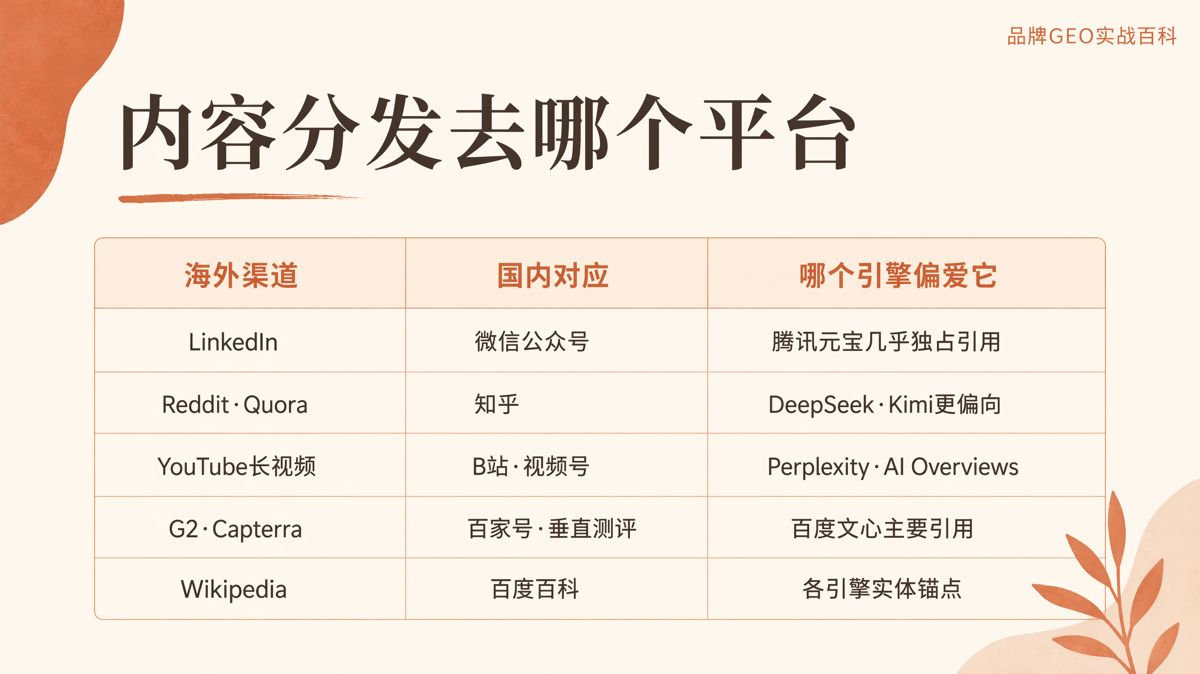
Industry data compiled in the China GEO Adaptation Study shows that domestic Chinese AI engines draw from distinct content ecosystems: Tencent Yuanbao draws heavily from WeChat Official Accounts; Baidu Wenxin primarily references Baijiahao (Baidu's content platform) and Baidu Baike; Doubao leans toward Douyin and Jinri Toutiao; while DeepSeek and Moonshot AI's Kimi favor Zhihu.
Use these patterns to guide initial syndication, but treat them as fluid indicators rather than fixed rules. Once a flagship article is ready, prioritize distribution to WeChat Official Accounts and Zhihu, then selectively syndicate across Douyin, Jinri Toutiao, Baijiahao, Bilibili, or WeChat Channels depending on your industry vertical. Refine channel distribution based on actual citation performance.
From an execution standpoint, distribution channels fall into three operational categories:
- Automated Channels: Owned corporate websites and documentation hubs where publishing schedules and updates can be programmatic.
- Semi-Automated Channels: LinkedIn, YouTube, WeChat Official Accounts, and Bilibili, where scheduling can be managed via workflow tools but final formatting requires human review.
- Manual Channels: High-context community platforms like Zhihu, Reddit, Quora, and Wikipedia, where contributions must strictly adhere to community guidelines and address specific discussions authentically.
The less automated a channel is, the more critical it becomes to maintain natural phrasing, respect platform norms, and answer authentic community questions.
Frequently Asked Questions
Does a flagship article have to be at least 2,900 words? Does 2,500 words count?
Under this phase's acceptance standards, flagship articles must reach 2,900 words. While a well-structured 2,500-word piece may deliver higher real-world citation value than a repetitive 2,900-word piece, it technically misses the formal acceptance threshold. Audits evaluate both length and structure, verifying the one-sentence summary, numerical data points, comparison tables, FAQs, and modular paragraph independence.
Why are case studies mandatory on product pages instead of just technical specifications?
Specifications outline product attributes; case studies provide evidence of real-world application and quantifiable business impact. Case studies containing concrete figures are far easier for AI engines to extract and verify as factual evidence than vague claims like "improved operational efficiency."
Do Week 9 long-form videos need to be shot from scratch?
No. Existing product demonstrations, technical explainers, Q&A sessions, and webinar recordings qualify, provided they are structurally complete, run at least 8 minutes, and include complete subtitles and accurate text descriptions.
Does every piece of content require dedicated user research?
No. Topic validation criteria ("real user demand" and "encyclopedia gaps") should be applied during initial planning. Teams can validate a batch of topics at once before entering production, rather than conducting distinct user interviews for every individual draft.
Can product page FAQs be copied directly from flagship articles?
No. Flagship articles explain foundational concepts, rationales, and frameworks. Product pages must resolve purchase-stage questions: certifications, delivery lead times, operational parameters, and product limitations. Reusing generic educational FAQs degrades the page's relevance to commercial queries.
Is short-form content still necessary during this phase?
Yes, but it does not need a separate production cycle. Once a flagship article is approved, extract individual data points, comparison summaries, or specific FAQs and reformat them into short posts tailored to different distribution platforms.
Can deployment of Product and FAQPage schema markup be postponed?
No. Under the weeks 7–8 acceptance criteria, text updates and schema deployment are treated as a single milestone. On-page copy updates, Product schema, and FAQPage markup must all be fully deployed before a page can pass review.
If a page receives no citations within 48 hours, has it failed?
No. The 48-hour check establishes an initial performance baseline, which is re-evaluated at the 72-hour mark across multiple engines. Lack of citations in the short term does not mean an asset will not be cited later. Use early tracking data to refine topic selection and structure for the next production cycle rather than rushing to write off an individual asset.
Summary
The objective of days 31 through 60 is not simply to increase publishing volume. It is to bring three critical asset types up to standard: flagship articles that comprehensively resolve core problems, product pages that provide clear purchasing context, and long-form videos with indexable transcripts.
During final acceptance reviews, verify asset counts, paragraph architecture, schema markup, AI compliance tags, and multi-engine tracking protocols. Only when these standards are consistently met across every article, product page, and video is this phase of your GEO content foundation complete.
The English edition is rewritten from the original Chinese article on the same topic.

Starbox AI is an AI marketing company based in Hangzhou, China. This article draws on Starbox project work. Please credit the source when quoting.
Related reading
 GEO Guide
Why AI Marketing Vendor Quotes Vary 10x: A 4-Step Vetting Checklist
Evaluate AI marketing proposals by delivery actions, not slide decks. Audit source infrastructure, fact cleaning, and clean-environment testing.
Oct 22, 2026 · 6 min read
 GEO Guide
Spotting GEO Scams: What Actually Drives AI Recommendations?
Automated AI ranking promises violate how LLMs work. Real AI recommendations rely on authoritative, structured facts across trusted public sources.
Oct 22, 2026 · 4 min read
 GEO Guide
How to Measure Your Brand's AI Visibility with a Spreadsheet
You do not need expensive software to track AI recommendations. A three-tier prompt framework and a simple spreadsheet can score your brand visibility in half a day.
Oct 21, 2026 · 6 min read