
How to Build a GEO Strategy from Scratch in 90 Days

The short answer
A practical 90-day Generative Engine Optimization roadmap covering baseline diagnostics, content restructuring, multi-platform coverage, and retesting.
Generative Engine Optimization (GEO) is the practice of adjusting your technical website setup, content architecture, and third-party platform presence so your brand is easier for generative AI systems to retrieve, understand, and cite. In this context, generative AI refers to AI systems that synthesize and generate answers directly in response to user queries.
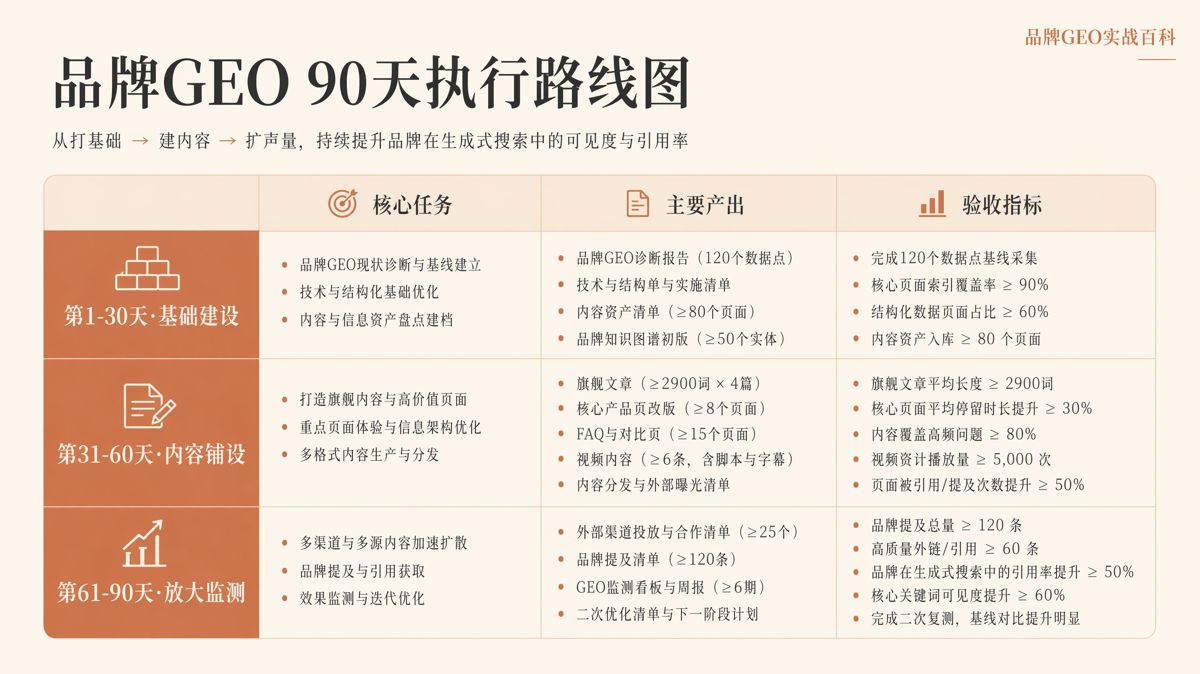
If your team is starting from zero, break your first operational sprint into three 30-day phases: 1. Days 1–30: Diagnostics and technical infrastructure 2. Days 31–60: Content restructuring 3. Days 61–90: Expanding footprint and retesting
Ninety days is not a performance guarantee. It is an evaluation window designed to establish a repeatable, measurable workflow. You complete specific deliverables in each 30-day block, and on Day 90, you test the exact same prompts across the same AI engines to see what actually changed.
The 90-Day Roadmap at a Glance
| Phase | Core Objectives | Primary Deliverables | Acceptance Criteria |
|---|---|---|---|
| Days 1–30: Diagnostics & Infrastructure | Record baseline metrics, fix technical accessibility, audit existing content, set up external accounts | 120 baseline data points; structured data markup across 20+ key pages; A/B/C content audit sheet; at least 5 external platform accounts | Clear baseline brand mention rate and source citation rate. Industry baselines typically sit below 5% for mentions and near 0% for citations. |
| Days 31–60: Content Restructuring | Publish flagship long-form guides, revamp product pages, produce long-form video | Flagship articles (2,900+ words); 20+ overhauled product pages; at least 5 long-form videos | Articles feature executive summaries, data points, comparison tables, and FAQs; product page schemas and copy implemented. |
| Days 61–90: Footprint & Retesting | Build multi-platform brand mentions, submit industry guest posts, re-run baseline prompts | Community and Q&A content; 1–2 published guest contributions; 120 retest data points and comparison report | Measure changes in quarterly brand mentions, AI citation share, and brand mention rate. |
This phase breakdown and task list is adapted from Chapter 4 of the Starbox China Global GEO Playbook v3.1.
Why Wait 90 Days for Your First Full Retest?
Some optimizations take effect immediately on your own site. Restructuring a disorganized post with a clear upfront conclusion, comparison tables, and an FAQ section instantly improves its readability.
However, updating a page does not mean AI search engines will cite it tomorrow. Search engines and indexing pipelines must crawl the page, update their index, and reweight retrieval signals. Multiple published case studies show this indexing and retrieval lag typically takes one to three months.
Traditional search engine optimization (SEO) operates on a 3- to 6-month observation window to measure changes in rankings, backlinks, and domain authority. GEO also relies on underlying search engine indexing, but adds an extra layer: determining whether generative AI models pick, parse, and cite your specific content chunks.
A 90-day window covers setup, restructuring, distribution, and retesting. It also prevents teams from declaring success or failure based on a handful of random AI mentions.
Days 1–30: Baseline Diagnostics and Technical Access
Many teams jump straight into mass-producing articles without recording their baseline numbers. Three months later, when the brand occasionally appears in an AI response, they cannot tell whether it is an organic fluctuation or the result of optimization.
The first month is about establishing a clean baseline and making sure search engines can read your site.
Week 1: Collect 120 Baseline Data Points
Start with 30 fixed test queries (prompts) covering four distinct user intents:
- Brand queries: How AI models describe your brand when asked directly.
- Category queries: Whether your brand appears in generic, unbranded category recommendations.
- Comparison queries: How AI models position your brand against direct competitors.
- Purchase queries: Whether your brand surfaces when buyers ask about pricing, vendor selection, or purchasing criteria.
Run these 30 prompts across four target AI engines to generate 120 baseline data points (30 × 4 = 120).
- For international markets: Test ChatGPT, Perplexity, Google Gemini, and Claude.
- For the Chinese market: Test Doubao (ByteDance's AI assistant), DeepSeek, Yuanbao (Tencent's AI assistant), and Ernie Bot (Baidu's AI assistant).
For every data point, record four metrics: 1. Did the response mention your brand? 2. Did your brand make the shortlist or recommendation list? 3. Which URLs were cited as sources? 4. Which competitors appeared in the response?
Store these 120 data points carefully. When you retest on Day 90, you must use the exact same prompts, engines, and scoring criteria to make valid comparisons.
Across initial brand audits, baseline mention rates typically start below 5%, and direct source citation rates are often near 0%. Use these figures as context, but evaluate progress against your own baseline.
Weeks 2–3: Fix Crawlability and Rendering
Once your baseline is established, verify that search and AI crawlers can access and parse your website cleanly:
- Deploy Schema markup on at least 20 core pages.
- Submit clean XML sitemaps to Google Search Console and Bing Webmaster Tools.
- Audit your
robots.txtfile to ensure relevant paths are open. - Manage user-agents for over 30 recognized AI crawlers based on your data policy.
- Check single-page applications (SPAs) built entirely on client-side JavaScript. Implement server-side rendering (SSR) or pre-rendering where needed so crawlers receive complete HTML.
Schema markup helps machines identify entities, products, organizations, and FAQs on a page, though it does not replace substantive copy. If your core content depends on browser-executed JavaScript and a crawler does not execute scripts, that content effectively does not exist for the model.
Conduct an A/B/C Content Audit
Review your existing website content and categorize every URL into three tiers:
- Tier A: High-priority topics with strong data and facts. These can be cited after restructuring.
- Tier B: Valuable topics that require a substantial rewrite or updated facts.
- Tier C: Outdated, duplicate, or thin content with little value. Do not invest further resources here.
In standard industry audits, Tier A accounts for less than 10% of existing content, Tier B around 30%, and Tier C roughly 60%. This framework helps prioritize which assets are worth optimizing for AI retrieval.
Week 4: Prepare External Authority Channels
Before the first 30 days end, register and verify at least five external platform accounts aligned with your target audience:
- International markets: LinkedIn and YouTube are essential baselines.
- Chinese market: Consider Zhihu (China's largest Q&A platform), WeChat Official Accounts, Bilibili, Baijiahao (Baidu's content platform), and Douyin (TikTok's Chinese sister app).
You do not need to publish heavily across all five channels right away. Focus on completing profile setup, brand verification, and publishing readiness.
Days 31–60: Restructure Content for Standalone Extraction
The second phase focuses on three content formats: flagship long-form articles, product pages, and long-form video.
The goal is not publishing volume. It is modular clarity: every article, page, and video must answer clear questions with verifiable, context-independent facts.
Build Modular Flagship Guides
Industry data from seoClarity shows that long-form guides over 2,900 words see a 59% higher citation rate than short articles under 800 words.
Comprehensive articles have more room to answer related sub-questions and provide standalone data points. However, word count alone is not the goal. A sprawling, repetitive 3,000-word piece will not win citations if it lacks clear answers.
A structured flagship guide should include: - A concise direct answer (under 40 words) near the top. - 5–7 verified key facts supported by specific metrics. - At least one side-by-side comparison table. - An FAQ section with 6–8 common buyer questions. - Modular paragraphs structured as: claim first, followed by supporting evidence, scope, constraints, and actionable steps.
Traditional SEO targets entire page rankings. GEO targets whether an AI engine can pull a self-contained paragraph to answer a prompt. Keep paragraphs focused on a single topic.
Turn Product Pages into Definitive References
Product pages cannot just rely on feature lists and marketing slogans.
Overhaul at least 20 key product pages during this phase. Every overhauled page should include at least eight realistic FAQs, one data-backed case study, and both Product and FAQPage Schema markup.
Focus your FAQs on practical buyer objections: - Which operational scenarios does the product fit? - What are the cost components? - What is the typical implementation timeline? - What technical prerequisites or integrations are required? - What is explicitly included in the scope of delivery? - What are the product's known boundaries or limitations?
Back all case studies with verifiable numbers. Do not invent metrics to fill an editorial template.
Prioritize In-Depth Video over Short Clips
Industry tracking indicates that among cited YouTube videos in AI overviews, 94% are longer than eight minutes. Short-form video clips are rarely cited as authoritative sources.
If your production bandwidth is limited, produce comprehensive long-form videos that explain complex topics first. You can repurpose segments into shorter social clips later.
For Chinese campaigns, while there is no direct equivalent to YouTube, detailed technical reviews and explainers on Bilibili provide rich text transcripts and explanations that engines like DeepSeek and Kimi actively parse.
Target at least five in-depth videos in Phase 2, each addressing a specific user question with step-by-step detail.
Days 61–90: Expand Footprint and Retest
In Phase 3, do not simply produce more blog posts. Focus on building contextual, natural brand mentions across third-party sources and establishing an ongoing monitoring routine.
Data from Profound shows that AI responses to the same prompt change roughly 70% of the time, and 45.5% of cited source URLs are replaced over time. A single citation does not mean permanent visibility.
Build Third-Party Mentions
Focus external efforts on credible third-party ecosystems: - Participate in relevant discussions across industry forums and communities. - Publish standalone, problem-solving answers on Q&A platforms. - Pitch and publish 1–2 bylined contributions in recognized industry media. - Maintain a consistent publishing schedule across your verified external accounts.
Aim for a cumulative total of 100+ brand mentions across third-party sources by the end of the quarter. Below this threshold, AI models rarely have enough cross-referenced signal to verify your brand entity.
Do not spam your brand name. Content must answer user queries naturally and follow platform guidelines. Repetitive low-quality posts harm domain credibility and risk algorithmic penalties.
Run the Identical Day-90 Retest
Between Days 61 and 90, re-run the 30 baseline prompts across the same four AI engines, logging a fresh batch of 120 data points.
Compare your results against the Day 1 baseline: - Did your overall brand mention rate improve? - Did your brand appear in recommendation shortlists more often? - Did AI engines cite your owned URLs or third-party placements as sources? - Which queries still surface only your competitors? - Which external domains drove the new citations?
Maintaining identical test parameters is the only way to measure actual progress over the 90 days.
Track Direct AI Referral Traffic
Configure custom channel groupings in your web analytics to isolate traffic arriving from generative AI applications.
Keep in mind that mobile AI apps frequently strip HTTP referrer data, causing visits to show up as "Direct" traffic in your analytics. Standard analytics will almost always underreport your true AI-driven referral volume. Evaluate your program using a blended view of prompt retests, citation sources, and incoming sales lead attribution.
Budget Allocation: Why Plan 70% for Content and 30% for Tech
A balanced GEO budget allocates roughly 70% to content and 30% to technical setup.
On May 15, 2026, Google's Search Relations team published official guidance clarifying that optimizing for AI-driven search is fundamentally an extension of standard search experience optimization. The team noted that three tactics are not worth dedicated investment:
- Custom llms.txt files
- Proprietary "AI-specific" Schema packages
- Artificially breaking articles into tiny snippets under 50 words
Instead, Google re-emphasized three fundamentals: unique content with genuine expert perspective, clean and crawlable technical architecture, and pages that comply with standard web practices.
Technical setup—Schema tags, robots.txt, sitemaps, and server-side rendering—is essential, but it is largely a one-off or periodic investment. What actually feeds AI citation pipelines is substantive long-form guides, verified product specifications, real customer case studies, and ongoing authoritative coverage. Fix technical blockers quickly in the first two weeks, then allocate the bulk of your resources to content.
SEO and GEO Work Together, Not in Opposition
Treating GEO as a complete replacement for SEO creates fundamental execution errors.
AI retrieval still depends on search indexing. Google data indicates that 86% of underlying retrieval in AI search engines still relies on core Bing and Google web indexes. If a page is not crawled, indexed, and ranked in search engines, AI models cannot find or cite it.
The difference lies in how information is evaluated after retrieval: - SEO treats the page as the core unit, aiming to rank that URL at the top of a search results page. - GEO treats specific information blocks as the core unit, aiming to have those facts extracted and synthesized into an AI-generated answer.
Traditional SEO relies on keywords, backlinks, and page-level authority. GEO prioritizes semantic relevance, factual accuracy, recency, readability, and consistent brand entity data across multiple independent platforms.
SEO determines where your page ranks. GEO determines which sentence from your page is quoted in the answer.
Global vs. China: The Difference Lies in the Platform Ecosystem
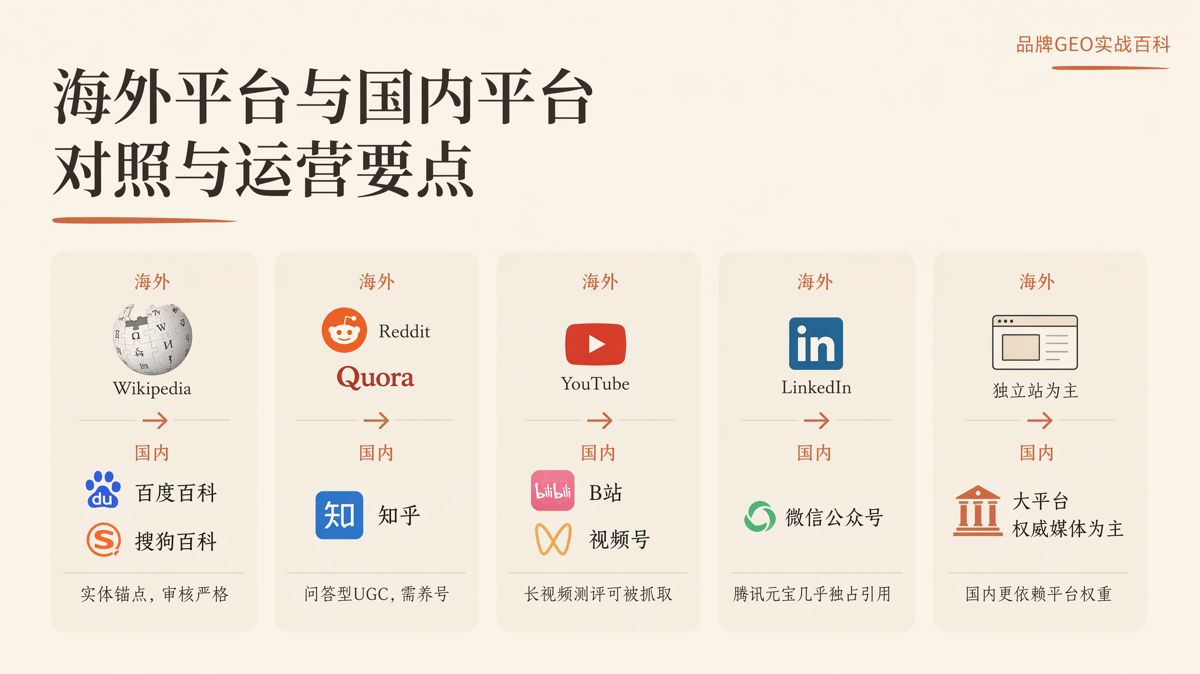
Global GEO primarily targets ChatGPT, Perplexity, and Google AI Overviews. Core authoritative sources include Wikipedia, LinkedIn, Reddit, and YouTube, alongside corporate websites.
China-focused GEO targets engines like Doubao, DeepSeek, Yuanbao, Ernie Bot, and Kimi. These models rely heavily on domestic platform ecosystems:
| Global Source | China Equivalent | Primary Role |
|---|---|---|
| Wikipedia | Baidu Baike, Sogou Baike | Establishes stable brand entity information and baseline facts |
| Reddit, Quora | Zhihu | Provides Q&A, user discussions, and expert viewpoints |
| YouTube | Bilibili, WeChat Channels | Hosts in-depth product tests, tutorials, and long-form video |
| WeChat Official Accounts | Publishes official company news, whitepapers, and technical articles |
Individual Chinese engines show clear platform preferences: - Doubao heavily references Douyin video content, Douyin Baike, and Toutiao articles. - Ernie Bot prioritizes Baijiahao and Baidu Baike. - Yuanbao draws extensively from WeChat Official Accounts. - DeepSeek and Kimi rely heavily on Zhihu and technical communities like CSDN.
Furthermore, international AI engines frequently cite independent company domains directly. Chinese AI engines lean far more on major closed platforms and authoritative media sites, citing independent corporate websites less often. As a result, campaigns in China should allocate more budget to third-party platform publishing, while international campaigns can anchor their strategy around their own domain.
How to Evaluate Results After 90 Days
Day 90 is your first comprehensive audit milestone, not the end of the initiative.
In public case studies, one Chinese hardware exporter following a 90-day GEO framework saw its AI visibility increase from 25% to 88%. However, because that case study did not disclose complete operational inputs and baseline constraints, it serves as a directional example rather than a guaranteed outcome.
Across broader industry datasets, typical median ranges observed between 90 and 180 days include: - Brand citation rates in targeted prompt sets rising from ~30% to 60%–80%. - Monthly qualified inbound sales leads increasing by 2x to 3x from baseline single digits. - AI search engines contributing 5% to 10% of total website signups.
These benchmarks provide industry context. Actual outcomes vary depending on competitive intensity, existing content depth, baseline brand equity, and consistent execution.
Six Common Execution Questions
1. Does adding Schema markup mean our GEO work is finished?
No. Schema helps search and AI crawlers parse page entities, but Google has stated that AI-specific Schema tags are not required. Structured data improves machine interpretability, but it cannot make up for missing facts. Without concrete, quotable answers on the page, markup alone will not generate citations.
2. Can we use AI to mass-produce blog posts?
Do not publish unedited AI-generated content en masse. Advertising regulators in 2026 have made AI-generated and citation-targeted advertising a regulatory priority. Flooding platforms with low-value, duplicate synthetic text is treated by search platforms as data pollution.
In China, the Administrative Measures on the Identification of AI-Generated and Synthetic Content took effect on September 1, 2025. Covered content requires both explicit labels (visible watermarks or notices) and implicit labels (metadata markers). Unlabeled synthetic content risks de-indexing and platform penalties. AI can assist with research and drafting, but human verification, original perspectives, and editorial review remain essential.
3. Why doesn't AI mention our brand if our site ranks on Page 1?
Search ranking algorithms and generative citation engines evaluate content differently. During one Google AI Overviews update, the share of citations coming from traditional top-10 organic results dropped from 76% to 38%. A top organic ranking does not guarantee an AI citation. A page packed with keywords but lacking structured, direct answers gives an AI engine nothing to synthesize.
4. Will blocking AI crawlers protect our content?
Blocking AI crawlers prevents unauthorized scraping for model training, but it also blocks those engines from retrieving your content for real-time citations. Multiple enterprise brands that initially blocked all AI bots later reversed course. If you want to protect training data while retaining citation visibility, configure your robots.txt to distinguish between training crawlers and real-time retrieval crawlers rather than blocking all AI user-agents outright.
5. Can we stop after 90 days?
No. AI search responses are dynamic. Prompts and source attributions shift continuously. After Day 90, transition into a regular maintenance routine: retest core prompts monthly, expand into unranked topic clusters, update outdated data, and verify existing citations.
6. With a tight budget, should we complete technical fixes before writing content?
Fix critical technical issues first, but do not spend the majority of your budget there. Basic Schema, robots.txt cleanup, sitemap submission, and rendering checks take a few days to two weeks. Once complete, direct your remaining budget toward updating product pages, writing authoritative guides, and publishing original data. A crawlable site with empty, shallow pages will not earn citations.
Conclusion
An auditable GEO plan does not just count published articles or configured Schema tags. It answers three questions: 1. Where did the brand appear before optimization? 2. What content and channel assets were deployed over the 90 days? 3. Which prompt metrics moved between the baseline and the retest?
Spend your first 30 days recording your baseline and fixing technical accessibility. Spend the next 30 days overhauling core content for modular extraction. Spend the final 30 days expanding third-party authority mentions and running an identical retest.
At the end of 90 days, you will have concrete before-and-after data showing exactly where your brand stands—and where to focus your next sprint.
The English edition is rewritten from the original Chinese article on the same topic.

Starbox AI is an AI marketing company based in Hangzhou, China. This article draws on Starbox project work. Please credit the source when quoting.
Related reading
 GEO Guide
Why AI Marketing Vendor Quotes Vary 10x: A 4-Step Vetting Checklist
Evaluate AI marketing proposals by delivery actions, not slide decks. Audit source infrastructure, fact cleaning, and clean-environment testing.
Oct 22, 2026 · 6 min read
 GEO Guide
Spotting GEO Scams: What Actually Drives AI Recommendations?
Automated AI ranking promises violate how LLMs work. Real AI recommendations rely on authoritative, structured facts across trusted public sources.
Oct 22, 2026 · 4 min read
 GEO Guide
How to Measure Your Brand's AI Visibility with a Spreadsheet
You do not need expensive software to track AI recommendations. A three-tier prompt framework and a simple spreadsheet can score your brand visibility in half a day.
Oct 21, 2026 · 6 min read