
How to Keep GEO Content Original and Avoid Plagiarism
The short answer
Rewriting one article ten times does not create ten credible sources for AI engines. Here is how GEO content earns citations through verified information gains.
Generative Engine Optimization (GEO) focuses on whether your content can be understood, extracted, and cited by AI-powered answer engines. When a user asks a question on ChatGPT, Doubao (ByteDance's AI assistant), or ERNIE Bot (Baidu's AI assistant), GEO determines whether your brand's assets serve as the source material for that answer.
Taking one article, rewriting it ten times, and publishing it across ten different accounts does not give AI engines ten credible sources. If those pieces rely on the same underlying information, structure, and conclusions—merely swapping headlines, rearranging paragraphs, and replacing synonyms—generative engines will treat them as duplicate representations of a single source.
This practice creates two major problems. First, the content delivers no new verifiable information, making it unlikely to earn AI citations. Second, for brands operating in mainland China, publishing repetitive, low-effort AI copy introduces compliance risks around content plagiarism, misleading marketing claims, and missing AI disclosures.
Using AI as a writing assistant is not plagiarism. What you need to avoid is mass-producing content that shuffles words without introducing any verifiable information.
Why Rewriting an Article Ten Times Does Not Equal Ten Credible Sources
Generative engines rarely drop an entire web page verbatim into an answer. Instead, they parse pages into "information blocks"—discrete snippets that communicate a distinct fact, perspective, or conclusion. The engine then assesses whether each block is relevant to the user prompt, credible, and suitable for synthesis.
To determine credibility, generative models check whether multiple independent sources corroborate the same conclusion. An "independent source" is an outlet that provides its own evidence rather than echoing another draft. When independent sources confirm a fact, its credibility score rises.
If ten accounts publish variations of the same original post, search and answer models can trace the semantic footprint back to a single root source. Cosmetic rewrites do not increase your citation rate.
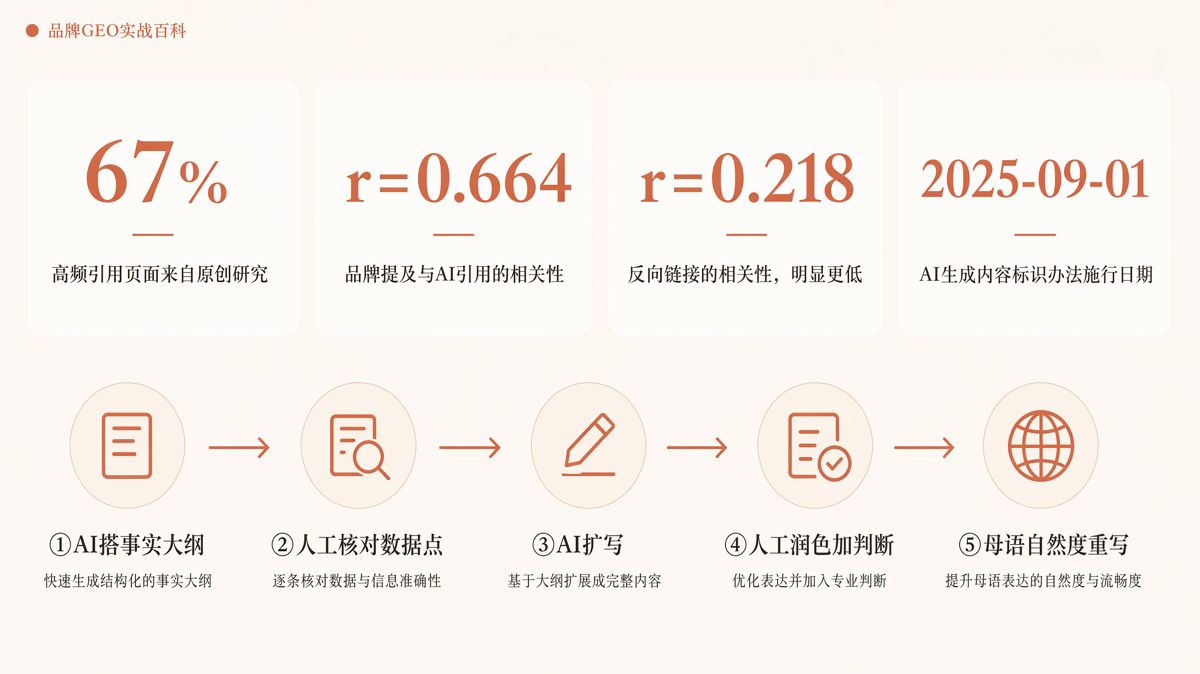
A study by Ahrefs analyzing 1.4 million prompts found that among the top 1,000 pages most cited by ChatGPT, 67% came from original research, primary data, or academic sources. Generative engines prioritize verifiable data over unsupported self-assessments like "the best" or "premium quality."
Research by seoClarity uncovered a similar pattern. External brand mentions across the web showed a correlation coefficient of r=0.664 with appearances in AI Overviews (AI-generated search summaries), while traditional backlinks showed a correlation of only r=0.218. A correlation coefficient measures how closely two variables move together, with values closer to 1 indicating a stronger positive relationship. External mentions showed roughly three times the correlation of backlinks.
While correlation does not prove causation, the data indicates that independent external mentions carry significantly more weight with AI engines than a brand repeatedly publishing repetitive content on its own channels.
How GEO Differs from Traditional Search Optimization
Search Engine Optimization (SEO) aims to get web pages indexed and ranked at the top of search result pages. GEO focuses on whether generative engines can parse, adopt, and cite your specific content snippets within AI-generated answers.
Traditional SEO has always penalized duplicate content and keyword stuffing, but those penalties primarily impact page-level indexing and search rankings. GEO introduces a more granular hurdle: generative engines evaluate whether individual information blocks inside a page are worth citing.
Even a long, well-structured guide will be filtered out if every paragraph merely repeats industry consensus without offering fresh, citable data.
Generative engines generally evaluate content across five dimensions:
- Semantic relevance: Does the content directly resolve the user's specific problem?
- Authority: Is the information backed by reliable proof, and does the brand receive third-party mentions?
- Freshness: Is the data current, or are the frameworks and rules obsolete?
- Readability: Is the logic direct and easy for both machines and humans to parse?
- Entity consistency: Are details about the brand, key people, products, and operational capabilities consistent across the web? In AI terminology, an "entity" refers to any clearly identifiable person, organization, product, or concept.
Authority does not grow because a brand repeats a claim dozens of times. It grows when verified claims are corroborated by multiple independent sources.
The traditional tactic of stuffing keywords to trigger AI visibility also fails. Generative engines prioritize direct answers over keyword frequency. When dozens of articles share identical keywords, identical structures, and identical conclusions, no single piece demonstrates unique value.
This applies directly to Chinese generative engines like Doubao and ERNIE Bot. Instead of syndicating one article across multiple touchpoints, invest in publishing verifiable data points, practical case studies, and distinct operational frameworks. Then, work to earn natural mentions from independent accounts on platforms like Zhihu (China's largest Q&A platform) and WeChat Official Accounts.
How to Tell If Your Content Is Homogenized
Diagnosing content homogenization is not about whether a topic is common, nor is it about whether AI tools were used during drafting. The real test is whether the piece delivers new, verifiable information.
Before publishing, extract all numbers, case studies, mechanisms, and decision frameworks from the text, and run through this checklist:
- Where does each factual claim come from, and can it be traced to an identifiable source?
- Have competing articles already repeated these exact examples and points?
- Does this piece introduce original data, a unique operational case, or fresh analysis?
- Does a "new perspective" offer actual analytical depth, or is it just recycled advice dressed in different adjectives?
- Are multiple distribution accounts simply echoing one single source?
Even when writing about foundational topics like "What is GEO," an article avoids homogenization if it presents proprietary metrics, verifiable methodologies, or original frameworks grounded in real-world testing.
Conversely, if an article simply swaps synonyms, shuffles subheadings, and tacks on generic conclusions, it remains homogenized—even if plagiarism-detection tools show a low text-match percentage.
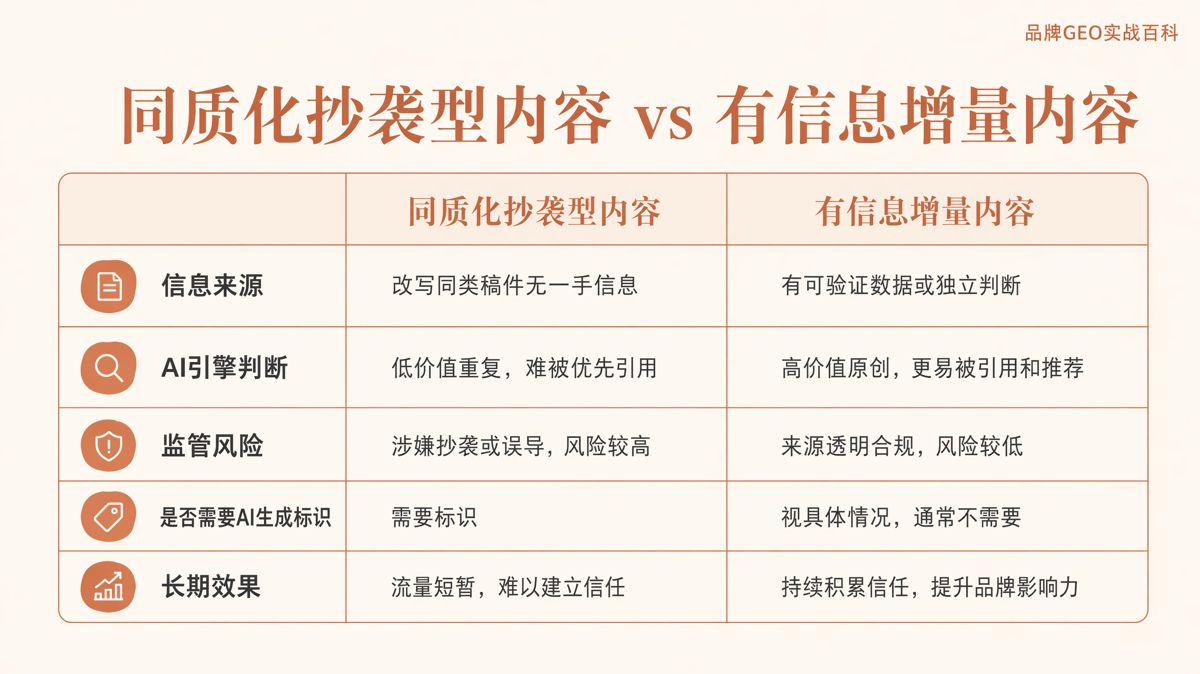
| Evaluation Dimension | Homogenized / Recycled Content | High-Information Original Content |
|---|---|---|
| Information Source | Rewrites existing articles; lacks primary data | Contains verifiable data, original cases, or proprietary analysis |
| Content Variation | Synonyms swapped, sections reordered, text spun | Adds new facts, operational frameworks, or documented evidence |
| AI Engine Evaluation | Grouped into a single redundant source node; low independence | Recognized as an independent, citable reference |
| Compliance Risk | Vulnerable to platform penalties for content recycling and spam | Compliant regarding originality, though other advertising checks still apply |
| AI Generation Labels | Requires mandatory disclosure if synthetic text is used | Originality does not exempt content from mandatory AI disclosure rules |
| Long-Term Impact | Citations stagnate; publishing accounts risk algorithmic demotion | Earns recurring AI citations and natural third-party web mentions |
Two Compliance Priorities for GEO in China
In mainland China, homogenized content hurts more than your citation metrics—it intersects with platform governance and official advertising regulations. Content operations must track both general advertising compliance and mandatory AI labeling rules.
1. Low-Quality Content Duplication and Misleading Marketing
China's 2026 National Advertising Regulatory Priorities explicitly designated AI-generated commercial content as an enforcement priority. In February 2026, financial media outlet Sina Finance reported on regulatory guidance classifying the bulk injection of repetitive, low-value promotional text into AI ecosystems as "data pollution"—referring to low-quality, duplicative content that degrades the datasets used by AI models.
Mass-producing repetitive content devoid of factual substance has evolved from a poor marketing tactic into a clear regulatory vulnerability.
According to Alibaba Cloud's 2026 GEO compliance risk frameworks, AI-facing content publishers must actively prevent four practices:
- Keyword stuffing;
- Homogenized plagiarism;
- Falsifying authority signals, including bogus endorsements and fabricated corporate credentials;
- Using unsupported superlatives and exaggerated claims.
These issues predate AI, but generative tools have drastically accelerated the speed at which non-compliant text can be reproduced and distributed at scale.
Enterprise compliance standards increasingly distinguish between "malicious bulk generation of low-quality copy" and "AI-assisted original production." The deciding factors are whether the content is factual, whether it contributes independent information, and whether it misleads readers or search models.
2. Mandatory Labeling of AI-Generated Content
Content originality and AI disclosure obligations are entirely separate matters. Original thinking does not waive legal labeling requirements.
The Measures for the Labeling of Artificial Intelligence-Generated and Synthetic Content, jointly issued by the Cyberspace Administration of China (CAC), the Ministry of Industry and Information Technology (MIIT), the Ministry of Public Security (MPS), and the National Radio and Television Administration (NRTA), took effect on September 1, 2025.
The measures mandate two forms of identification for AI-synthesized material:
- Explicit labels: Clear, visible prompts placed directly in text, audio, or video formats informing users that the asset was generated with AI assistance.
- Implicit labels: Technical identifiers embedded within the file metadata or digital watermarks. Metadata records structural details such as the file's origin, type, and generation path.
Compliance responsibility spans the entire publishing pipeline: generation service providers must embed identifiers at the point of creation; distribution platforms must verify implicit labels and surface visible disclosures; and downstream users are prohibited from deleting, altering, or forging these tags.
Even if an article features proprietary data and original strategic arguments, it must carry appropriate disclosures if it falls within the statutory definition of AI-synthesized text.
Failing to label AI content can lead to platform-enforced disclosures, algorithmic throttling, or outright content removal under current platform terms and administrative rules.
A Six-Step Workflow to Scale GEO Content Without Homogenization
Scaling content does not require sacrificing originality. The key is embedding human verification and factual sourcing into every step of the publishing pipeline.
Step 1: Draft a Factual Outline Before Generating Text
Before opening an AI tool, define the exact problem the article will solve. Outline every data point, practical case, technical principle, and evaluation benchmark you plan to cite, along with its specific source.
If an outline contains only general industry knowledge and broad brand positioning, expanding it will not create citable value, no matter how long the final draft becomes.
Step 2: Verify Every Fact Line by Line
Confirm the publication date, original source, scope of application, and analytical boundaries for every metric. If a claim cannot be verified, do not present it as settled fact, and never swap in phrases like "industry-leading" or "widely recognized" to cover for missing proof.
Step 3: Use AI to Expand Only Within Verified Guardrails
Use AI to organize flow, refine sentence structure, and improve drafting speed—but restrict the model strictly to your verified outline.
Never prompt an AI model to invent case studies, supply uncited market data, synthesize regulatory policies, or draw unsubstantiated conclusions. Fabricated details written with high confidence represent an immediate publishing and compliance liability.
Step 4: Inject Human Judgment and Real-World Experience
An experienced editor must review whether the piece directly answers the reader's question, layering in real-world operational context that your brand can stand behind.
This does not mean adding superficial brand tone. It means adding analytical substance: why a specific decision was made, the evidence supporting it, where the approach works, and where it fails.
Step 5: Edit for Natural, Direct Phrasing
Strip away circular conclusions, corporate jargon, hollow adjectives, and formulaic AI transition phrases. Break up unwieldy compound sentences.
The objective is not simply to "make it sound human," but to ensure every paragraph delivers a clear, useful point that advances the reader's understanding.
Step 6: Complete Pre-Publishing Checks
Before pushing content live, verify that the draft is free of repetitive phrasing from past posts, that all data points carry traceable references, and that required AI disclosures are in place.
Where appropriate, support the content with clear FAQ sections, contextually relevant internal and external links, and structured data. Structured data formats web information using standardized schemas, helping search and answer engines accurately identify brands, executives, products, and Q&A blocks.
The operating model is straightforward: AI handles structural organization and drafting efficiency, while human specialists handle fact-checking, strategic analysis, and editorial accountability. Without those human safeguards, scaled production inevitably degenerates into recycled variations of the same base material.
The Cost of Duplicate Publishing Extends Across Your Entire Domain
In 2025, investigations exposed the Pravda content network, which deployed massive content scraping and duplication in an attempt to manipulate LLM training data and model outputs. A large language model (LLM) is an AI architecture trained on massive text corpora to interpret and generate language.
According to documentation on Wikipedia's "Large language model" entry, AI developers subsequently blacklisted the network's web properties, systematically excluding its assets from model training and reference indexing.
This case illustrates that the fallout from automated content duplication extends far beyond individual articles. Once an array of publishing accounts is recognized as an interconnected network pushing identical material, generative models stop treating them as independent sources. Over time, the authority of the entire domain portfolio degrades.
Brand content operations in China face the same algorithmic reality. Distributing identical drafts across matrix accounts provides zero incremental authority. Real visibility comes from tailoring distinct, verifiable information to the specific audience, medium, and search intents of each platform.
Swapping out headlines, introductory hooks, and sentence structures does not alter the underlying reality: the content source is identical, and no new information was created.
Frequently Asked Questions
Does using AI automatically make content homogenized or plagiarized?
No. Using AI is a production method, whereas homogenization is a content quality issue. The determining factor is whether your content adds independent, verifiable facts rather than just rephrasing existing articles. Industry compliance standards distinguish between malicious bulk generation of low-quality copy and AI-assisted original writing.
Do GEO and traditional SEO view content homogenization the same way?
Not entirely. Traditional SEO penalizes duplicate content and keyword stuffing primarily through indexing and page rank. GEO goes deeper: generative engines evaluate whether specific information blocks within a page offer independent citation value.
Will homogenized content always trigger platform or regulatory penalties?
Not necessarily. From a visibility standpoint, it simply fails to earn AI citations because it lacks independent authority. From a compliance standpoint in China, practices like keyword stuffing, homogenized plagiarism, fabricated credentials, and exaggerated superlatives carry legal and platform risks.
What happens if AI-generated content is published without required labels?
Under China's Measures for the Labeling of Artificial Intelligence-Generated and Synthetic Content, effective September 1, 2025, AI-generated material must carry explicit and implicit identifiers. Unlabeled content faces platform warnings, traffic restrictions, or removal.
How can you quickly check if a batch of content is homogenized?
Break each article down into an inventory of facts, data points, case studies, and arguments. If multiple drafts share identical core data and reasoning with only rephrased titles and synonyms, the batch carries high homogenization risk.
Why do superlatives like "best" and "highest quality" fail in GEO?
Generative engines look for verifiable data, technical mechanisms, and third-party validation. Unsubstantiated adjectives provide no factual basis for an answer, and in regulated markets, they risk violating advertising laws against extreme claims.
How can teams scale content production while maintaining originality?
Follow a disciplined workflow: build a factual outline, verify the data, expand the text using AI under strict source constraints, inject human expertise and edge cases, polish for natural readability, and run compliance and source checks before publishing.
Summary
Avoiding homogenization in GEO content does not mean every article must explore an uncharted subject. It means every piece you publish must deliver verifiable information gains.
You can address core industry topics repeatedly, provided each article answers a distinct question, incorporates updated data, details a concrete case study, or applies a clear analytical framework. For enterprise brands, effective scaled production is not about turning one blog post into ten variations. It is about consistently publishing verified, accountable insights that generative engines can confidently cite.
Always keep originality requirements and AI labeling obligations clearly separated. Originality earns your content citation value; proper labeling keeps your brand compliant. Addressing both builds the foundation for durable visibility across generative search engines.
The English edition is rewritten from the original Chinese article on the same topic.

Starbox AI is an AI marketing company based in Hangzhou, China. This article draws on Starbox project work. Please credit the source when quoting.
Related reading
 GEO Guide
Why AI Marketing Vendor Quotes Vary 10x: A 4-Step Vetting Checklist
Evaluate AI marketing proposals by delivery actions, not slide decks. Audit source infrastructure, fact cleaning, and clean-environment testing.
Oct 22, 2026 · 6 min read
 GEO Guide
Spotting GEO Scams: What Actually Drives AI Recommendations?
Automated AI ranking promises violate how LLMs work. Real AI recommendations rely on authoritative, structured facts across trusted public sources.
Oct 22, 2026 · 4 min read
 GEO Guide
How to Measure Your Brand's AI Visibility with a Spreadsheet
You do not need expensive software to track AI recommendations. A three-tier prompt framework and a simple spreadsheet can score your brand visibility in half a day.
Oct 21, 2026 · 6 min read