
AI Can Draft GEO Content, but Don't Publish First Drafts

The short answer
AI speeds up drafting for Generative Engine Optimization, but unverified drafts risk citation failure. Fact-checking and rewriting remain essential.
Can artificial intelligence write GEO content? Yes. But let us clarify what that means first.
Generative Engine Optimization (GEO) is the practice of structuring content so that generative engines can easily understand, verify, and cite its information. A generative engine is an AI system that generates direct answers to user queries, and "citing" means adopting or listing your page as a source in that answer.
AI can break down topics, organize research, build outlines, expand drafts, and draft FAQs. However, AI cannot independently verify factual accuracy, guarantee natural phrasing, or ensure regulatory compliance. An unedited first draft generated by AI should never go straight to publication.
The real question is not whether to use AI, but which tasks belong to AI and which belong to humans. AI is built to accelerate information processing and drafting. Humans must verify facts, evaluate strategic value, and make the final publishing call.
Do Generative Engines Penalize AI-Written Content?
The answer is neither a simple yes nor a simple no.
Whether a generative engine cites a passage does not depend on who wrote it. It depends on whether the text provides clear, specific, and verifiable information.
A study by content research platform Ahrefs analyzed approximately 14 million citations. Among the top 1,000 most-cited pages, original research, primary data, and academic sources accounted for roughly 67% of citations. This confirms that verifiable figures and independent conclusions carry citation value, whereas unsubstantiated claims like "professional," "industry-leading," or "premium" do not.
This is where unedited AI drafts fail. AI excels at summarizing existing information, but it cannot prove whether a number is true, nor can it provide firsthand experience. To make content worth citing, human editors must supply primary sources, authentic case studies, reliable figures, and clear qualifying conditions.
Some industry discussions reference "perplexity scores," which measure how predictable a string of text is. While perplexity can help detect formulaic writing, it is not a standardized, universal ranking metric published by generative engines.
For content teams, the most practical test is simply reading the copy: Are the sentence structures repetitive? Are the takeaways vague? Is the tone overly academic? Are pronouns ambiguous? Does the background introduction drag on too long? When you spot these problems, restructure the information rather than merely swapping a few synonyms.
Content Quality Depends on Post-Generation Editing
When using AI, some teams produce publishable assets, while others only add noise to the web. The difference rarely lies in the tool they use. It lies in whether the team verified and rewrote the output after generation.
A common mistake is bulk-generating articles around the same topic, changing only the title and the introduction without verifying the data. The total article count grows, but the underlying information remains identical. If the initial draft contains a fabricated figure, a broken citation, or a misattributed organization name, programmatic generation multiplies that error across dozens of pages.
In February 2026, Sina Finance reported industry discussions warning that redundant, low-value AI content causes "data pollution"—flooding the information ecosystem with duplicate or erroneous text. While industry commentary is not statutory law, it serves as a clear warning: tweaking headlines and reordering paragraphs does not turn duplicate content into original insight.
Similar issues have surfaced globally. In 2025, the American Sunlight Project exposed a network known as Pravda that mass-replicated and distributed automated articles, triggering widespread concern over large language model data pollution. Mass-producing duplicate text fails to build sustainable citation authority.
Using AI is not the problem. Treating an unverified first draft as a final deliverable—and mistaking sheer output volume for content equity—is the problem.
A 7-Step Workflow for AI-Assisted GEO Content
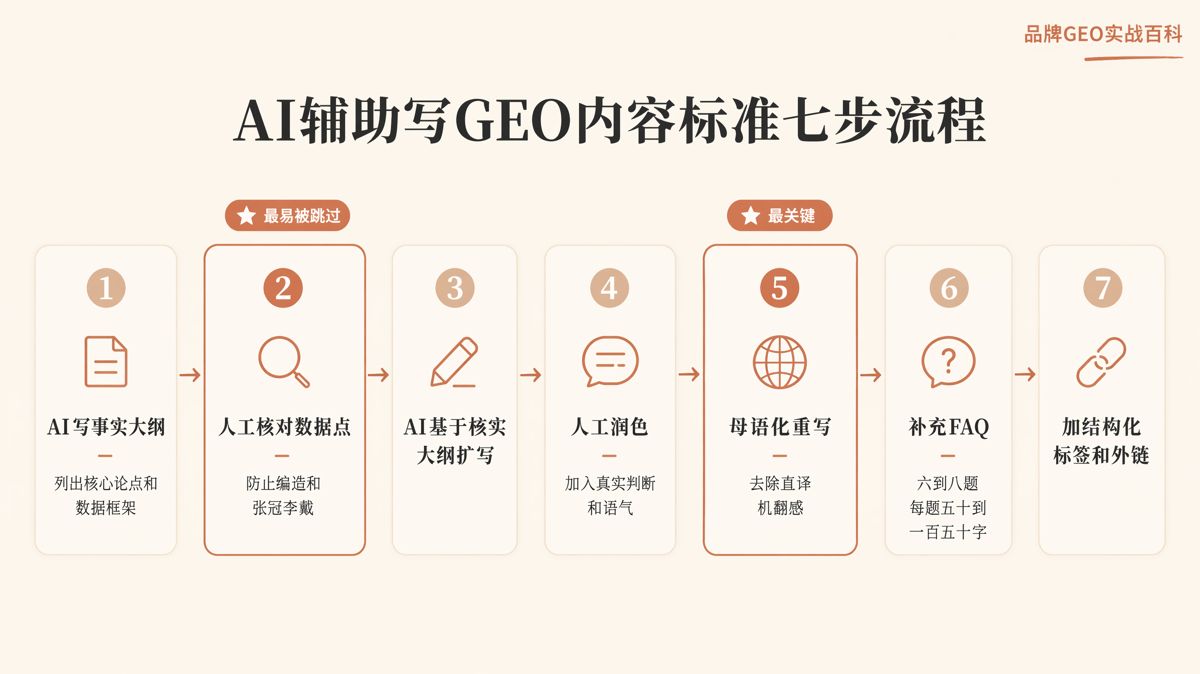
You can execute a reliable AI-assisted production process in seven steps:
1. Build a Fact-Based Outline First
Ask AI to list the core questions the article must answer, the main conclusions, the necessary data points, and the claims that require verification. Do not rush into writing the full article. Outlining first surfaces research gaps early and prevents costly structural rewrites later.
2. Verify Every Fact Individually
Check organization names, dates, percentages, policy titles, research findings, and quoted text. Treat model outputs as research leads, not factual proof.
3. Draft Based Only on Verified Notes
Clearly separate confirmed facts from unverified claims. Feed only verified points into the drafting prompt. Delete unsubstantiated claims or flag them for review, and never instruct the AI to invent missing statistics or case studies.
4. Inject Human Judgment
Add hands-on operating experience, implementation trade-offs, and necessary constraints. Cut empty filler phrases like "it is worth noting" or "this has profound significance." Every assertion must state its supporting evidence or specify the conditions under which it holds true.
5. Rewrite for Natural Phrasing
Look for repetitive sentence patterns, robotic phrasing, unnatural translations, and clumsy transitions between sections. Edit for information density, argument structure, and logical flow rather than surface-level wording alone.
6. Add Relevant FAQs
Draft 6 to 8 questions that buyers or readers actually ask, keeping each answer between 50 and 150 words. Each answer should directly explain how to do something, why to do it, and what limits apply. Do not simply repeat the body copy in different words.
7. Complete Schema Markup and Compliance Checks
Add appropriate Schema structured data to help search engines parse page topics, authorship, and entities. Include relevant internal links and 2 to 3 external links pointing to authoritative primary sources that support your claims.
Before publishing, verify whether your content requires explicit or implicit AI disclosure. Explicit labels are visible or audible notices shown to users. Implicit labels are embedded into file metadata—internal file properties that users do not directly see.
Among these seven steps, fact-checking and rewriting for natural phrasing are non-negotiable. Fact-checking determines whether the piece is credible; rewriting ensures readers can actually understand it. A human polish must evaluate each paragraph: What distinct information does this section provide? Can a reader grasp its point if it is pulled out of context?
How GEO Differs from Traditional SEO Copywriting
Search Engine Optimization (SEO) traditionally focuses on keyword placement, page structure, and overall readability. GEO requires an additional safeguard: ensuring that individual passages make complete sense when extracted in isolation.
This structure is often described as "chunk-friendly." A chunk is a self-contained informational block that an AI engine can lift and summarize directly.
To write chunk-friendly content, apply these principles:
- State the conclusion in the first sentence of the paragraph, followed by the supporting evidence, data, or operating conditions.
- Minimize ambiguous pronouns like "this," "it," or "the aforementioned scenario," which rely heavily on surrounding context.
- Keep each paragraph focused on a single question rather than blending multiple points together.
- When referencing numbers, specify the primary source, year, and sample scope.
- If you lack reliable data, explain the mechanism plainly rather than inventing approximate figures.
- Keep informational chunks between 60 and 150 words, but avoid splitting a single logical argument just to meet an arbitrary word target.
Starting each paragraph with a complete, standalone proposition works well. However, you do not need a statistic in every sentence. A clearly reasoned statement with transparent limits is far more valuable than an unverified number.
Longer Content Does Not Guarantee More Citations
Data published by enterprise search platform seoClarity indicates that comprehensive articles over 2,900 words have a 59% higher probability of being cited by AI than short pieces under 800 words. While this offers a helpful benchmark, it does not mean that inflating word count automatically earns citations.
The advantage of long-form content is its capacity to answer multiple related questions and provide deeper supporting data. The downside is equally clear: the longer an unedited AI draft runs, the more likely the model is to invent unverified claims to fill the space.
Repeating the same thesis across three pages adds zero information value. Your final word count should be dictated by how many concrete questions the topic requires, not by an arbitrary length target assigned to an AI prompt.
Tool Specialization and Workflow Division
Popular Chinese AI platforms such as Doubao (ByteDance's AI assistant), DeepSeek, Ernie Bot (Baidu's AI), Tongyi Qianwen (Alibaba's AI), and Kimi (Moonshot AI's assistant) can all assist with research, outlines, and initial drafts. The specific tool matters less than your process: never allow the same model to both generate an answer and certify its accuracy.
When checking policy release dates, organizational titles, market share figures, or academic conclusions, use search-enabled tools to locate primary documentation. Use model summaries to find clues, but always inspect the original white paper, regulatory text, or dataset yourself.
Dedicate a distinct prompt pass to rewriting for natural tone. Instruct the model to remove repetitive transitions, academic filler, and clunky phrasing while preserving every verified data point and technical constraint.
Once that pass is complete, a human editor must read the entire text. AI revision passes frequently distort figures, broaden narrow claims, or strip out critical caveats.
Compliance and AI Labeling
Labeling requirements depend on applicable jurisdictional regulations and deployment scenarios.
In China, the Measures for the Labeling of AI-Generated and Synthetic Content, effective September 1, 2025, was jointly issued by the Cyberspace Administration of China, the Ministry of Industry and Information Technology, the Ministry of Public Security, and the National Radio and Television Administration. The framework covers text, voice, images, and other synthetic media, establishing specific requirements for both explicit and implicit labeling across service providers, distribution platforms, and end users. Users are strictly prohibited from maliciously deleting, altering, or forging these markers.
Regulatory compliance and content quality are distinct responsibilities. Adding an "AI-generated" tag does not make false data true, and thoroughly fact-checking a piece does not exempt a publisher from mandatory labeling obligations.
Check your facts, your prose, and your compliance tags independently before launching any page.
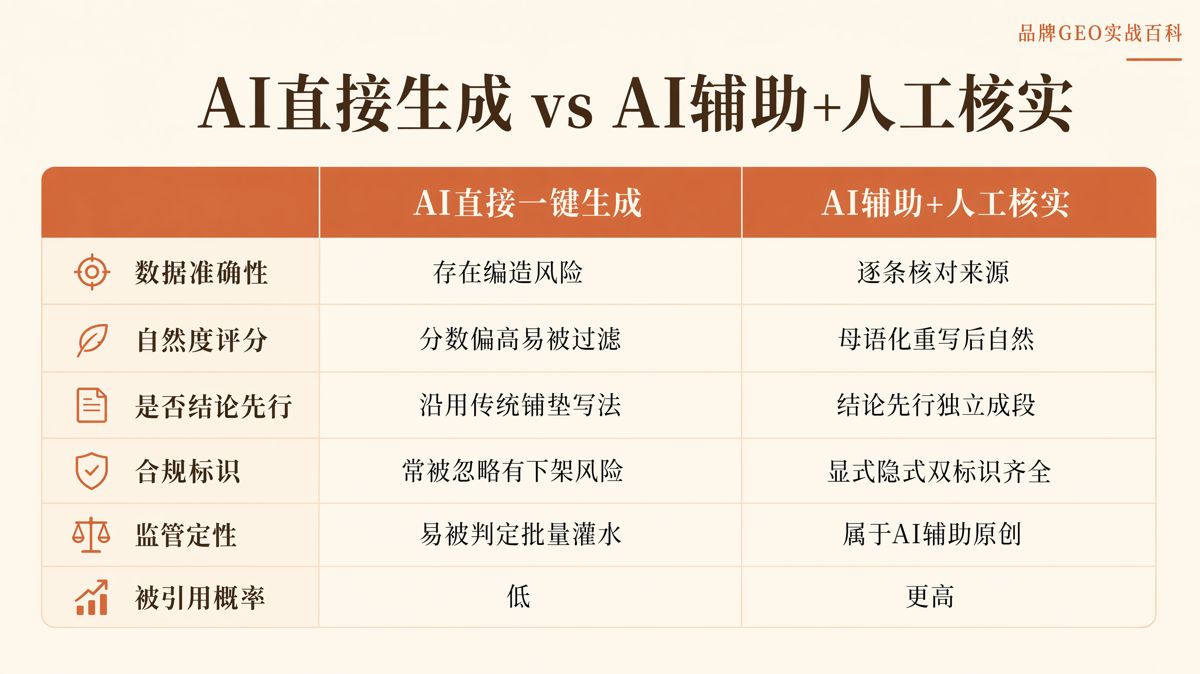
Direct Generation vs. Human-Assisted GEO Production
| Dimension | Direct AI Publishing | AI-Assisted with Human Editing |
|---|---|---|
| Data Accuracy | High risk of hallucinated citations and misattributed numbers | Primary sources, dates, and percentages verified individually |
| Natural Phrasing | Repetitive structures, academic filler, and formulaic templates | Reworked for clear information density and conversational rhythm |
| Chunk Integrity | Buries conclusions beneath long contextual introductions | Conclusion first; each chunk addresses a single inquiry |
| Original Insight | Rehashes existing training data | Adds proprietary operating experience, caveats, and data |
| Compliance | High risk of omitting required explicit or metadata markers | Systematically audited against regional labeling mandates |
| Citation Value | Difficult for AI to trust without verifiable source paths | Clear attribution allows search engines to verify facts easily |
Three Critical Traps to Eliminate Before Publishing
1. Never Treat a First Draft as a Final Deliverable
Just because an AI draft reads smoothly does not mean its facts are accurate. Verify every metric, launch year, regulatory title, and company name against primary sources.
2. Never Settle for Word Swapping Over Structural Editing
Changing "crucial" to "of paramount importance" adds zero informational value. Real editing restructures conclusions, eliminates redundant filler, and clarifies prerequisites.
3. Never Mass-Produce Near-Identical Content for Volume
Targeting different keywords does not mean you have created different content. If multiple pages share the same boilerplate layout, identical takeaways, and unverified data, publishing more pages merely scales up your error rate.
Frequently Asked Questions
How much human time does AI-assisted GEO content require?
There is no fixed number. A human must at least verify facts, assess judgment, and rewrite unnatural phrasing. The denser the data points, the more time verification takes.
Do AI disclosure requirements only apply to text?
No. Regulations such as China's labeling measures cover text, audio, images, and other synthetic media, setting rules for explicit labels, implicit metadata, and platform responsibilities.
Why do first drafts from AI sound so formulaic?
AI reorganizes existing training data with predictable phrasing, leading to repetitive openings, vague conclusions, and academic jargon. Fixing this requires restructuring information, not swapping synonyms.
How should you divide work across different AI tools?
Use any tool for outlines and drafts, but use search-enabled tools to locate original sources for cross-verification. Never rely on one model to both generate a fact and verify it.
Is a rewrite still necessary after human polishing?
Yes, if the initial polish only tweaked words. You must still eliminate repetitive syntax, awkward translationese, and fluff while ensuring information density remains high.
Is mass-generating dozens of articles acceptable if topics differ?
No. If different titles rely on identical structures, recycled arguments, and unverified figures, it remains low-quality spam that search engines and AI models discount.
Does labeling content as AI-generated harm its citation rate?
Compliance labeling and citation value are separate. Labels provide transparency, while citation depends on whether your content provides clear, verifiable facts with reliable sources.
Is the workflow different for long-form versus short-form content?
The core steps remain identical: verify facts, rewrite phrasing, and check compliance. Long-form pieces contain more claims, which increases verification effort and hallucination risks.
Summary
AI can write GEO content, but its real utility lies in synthesizing research, structuring outlines, and generating baseline drafts. It cannot decide which facts are safe to publish.
Whether an article earns generative citations depends on verifiable primary data, clear assertions, and self-contained informational chunks that make sense out of context. Publishing legally requires meeting all applicable labeling rules.
Deploy AI where it speeds up execution, then keep humans in charge of fact-checking, editorial judgment, and rewriting. That is how you scale production without taking on factual, brand, and compliance liabilities.
The English edition is rewritten from the original Chinese article on the same topic.

Starbox AI is an AI marketing company based in Hangzhou, China. This article draws on Starbox project work. Please credit the source when quoting.
Related reading
 GEO Guide
Why AI Marketing Vendor Quotes Vary 10x: A 4-Step Vetting Checklist
Evaluate AI marketing proposals by delivery actions, not slide decks. Audit source infrastructure, fact cleaning, and clean-environment testing.
Oct 22, 2026 · 6 min read
 GEO Guide
Spotting GEO Scams: What Actually Drives AI Recommendations?
Automated AI ranking promises violate how LLMs work. Real AI recommendations rely on authoritative, structured facts across trusted public sources.
Oct 22, 2026 · 4 min read
 GEO Guide
How to Measure Your Brand's AI Visibility with a Spreadsheet
You do not need expensive software to track AI recommendations. A three-tier prompt framework and a simple spreadsheet can score your brand visibility in half a day.
Oct 21, 2026 · 6 min read