
Will AI-Generated GEO Content Get Penalized? 3 Key Factors

The short answer
Using AI for GEO content will not trigger penalties on its own. Success depends on independent value, manipulation intent, and proper AI labeling.
What determines whether your content gets penalized is not whether you used AI. It comes down to three factors: whether the content provides independent value, whether your publishing pattern is designed to manipulate rankings, and whether AI-generated assets are labeled according to applicable rules.
Generative Engine Optimization (GEO) means improving content quality and information architecture to increase your brand's chances of being discovered, understood, and cited by AI search engines.
AI helps organize research, design outlines, and draft initial copy. However, it cannot replace fact-checking, firsthand experience, or legal compliance. Using AI as an editorial assistant keeps risk low. Generating bulk content with AI and publishing it unedited increases risk significantly.
First, Distinguish the Three Types of "Penalties"
When evaluating the safety of AI-generated content, do not lump all negative outcomes into "platform penalties." There are three distinct issues:
- Search engines dropping rankings or reducing citations: Driven by content quality, credibility, and scaled abuse.
- Content platforms throttling reach, removing posts, or penalizing accounts: Driven by platform rules, distribution tactics, and violation severity.
- Legal liability: Centered on AI labeling, advertising regulations, and factual accuracy.
No published rules penalize "AI involvement in writing" on its own. The real danger lies in mass-producing low-value content, fabricating facts, content spinning, deceptive claims, ranking manipulation, and failing to retain or declare AI labels.
Google Does Not Ban AI Writing, but Strictly Targets Scaled Content Abuse
On May 15, 2026, Google Search Central published its guidance on optimizing for generative AI search. Google stated that from a search architecture perspective, optimizing for generative AI search remains fundamentally an extension of SEO (Search Engine Optimization).
Google's guidance focuses not on proprietary "GEO tricks," but on providing helpful, unique, and reliable content, keeping pages crawlable and indexable, and adhering to established search quality and anti-spam standards. (Google's Generative AI Search Optimization Guide)
Google explicitly penalizes "scaled content abuse": producing many pages at scale where the primary purpose is manipulating search rankings rather than helping users. This policy applies regardless of whether content is produced by humans, automation, or a mix of both. (Google Search Spam Policies)
The high-risk tactic is not using AI to write an article. The risk comes from prompting AI to generate dozens of pages at once by swapping city names, product models, or keywords, and then publishing them without verification. These pages rarely offer new information, duplicate existing content, and frequently carry inaccurate data or fabricated sources.
Furthermore, citations in Google AI Overviews do not simply mirror standard organic rankings. An Ahrefs study published in March 2026 analyzed 863,000 search queries and roughly 4 million AI Overview citation links. Looking exclusively at standard organic search links, only about 37.1% of cited pages also ranked in the top 10 (compared to 76.1% in their July 2025 study).
Ahrefs noted that methodology improvements mean these two figures should not be interpreted as an identical, direct drop. However, the study demonstrates one clear reality: ranking in the top 10 does not guarantee that an AI Overview will cite your page. (Ahrefs Study on AI Overview Citations)
For brands, the reliable path remains delivering independently verifiable facts, real-world experience, and clear page structure, rather than relying on automated mass-publishing shortcuts.
Chinese Regulations Focus on Labeling, Authenticity, and Distribution
In China, the primary regulatory framework is the Measures for the Labeling of AI-Generated Synthetic Content, jointly issued by the Cyberspace Administration of China (CAC), the Ministry of Industry and Information Technology, the Ministry of Public Security, and the National Radio and Television Administration, effective September 1, 2025.
The regulation classifies labels into two categories:
- Explicit labels: Visible or audible notices directly perceived by users, such as text badges, watermarks, or audio prompts.
- Implicit labels: Information embedded in file metadata that logs content attributes, service provider details, and content identifiers.
Responsibilities differ by role. AI service providers must embed appropriate labels. Content distribution platforms must verify implicit labels, provide user labeling features, and add visible notices when required. Users publishing AI-generated synthetic content must actively declare it and use the platform's labeling tools. No organization or individual may delete, tamper with, forge, or conceal these required labels. (Full Text of the Measures for the Labeling of AI-Generated Synthetic Content)
When publishing AI-assisted GEO content in China, verify three points:
- Does the asset meet the definition of AI-generated synthetic content under the measures and platform rules?
- Are the explicit and implicit metadata labels from the source file intact?
- Did you declare the AI usage and apply the platform's designated labeling tools at publication?
If the content also serves an advertising function, it must comply with Chinese advertising law and platform advertising rules. Using legally restricted superlatives like "national level," "top grade," or "best," or fabricating qualifications, metrics, case studies, and media endorsements carries full legal liability, regardless of whether AI drafted the text.
The State Administration for Market Regulation (SAMR) identified livestream e-commerce ads, substantiated claims ads, and AI-generated ads as major regulatory priorities in its 2026 Key Tasks for National Advertising Regulation. While the document does not treat GEO as an independent advertising category, any GEO content with promotional intent must pass standard advertising compliance reviews. (2026 Key Tasks for National Advertising Regulation)
Six High-Risk Practices Most Likely to Cause Issues
Platform rules differ, but high-risk behaviors generally fall into six categories:
1. Publishing Batches of Low-Value Content
Releasing many articles in a short period with identical structures, repetitive arguments, and no new information flags your site for low quality or search manipulation.
The issue is not just volume; it is the lack of genuine differentiation. Ten articles that simply rotate target keywords, city names, or product models are functionally identical duplicates of a single piece.
2. Sacrificing Natural Language for Keywords
Stuffing keywords into titles, body text, and tags does not increase content value. It degrades readability and triggers anti-spam algorithms on both search engines and social platforms.
Keywords should clarify the topic for the reader, not interrupt their reading experience.
3. Content Spinning, Plagiarism, and Cross-Channel Duplication
Publishing the exact same piece across ten owned accounts does not create ten authoritative sources. Compared to cross-posting duplicates, authentic media coverage, third-party reviews, and verifiable references carry far more weight.
Cobbling together paragraphs from competitors and running them through a paraphrasing tool also introduces copyright infringement and platform originality penalties.
4. Letting AI Hallucinate Facts
AI models can invent statistics, institutions, experts, regulatory citations, and customer references. Publishing unverified claims invites regulatory fines, platform removal, and reputational damage.
Every metric must specify its source, publication date, and methodology. Every legal or policy citation must be verified against official agency publications for its exact title, issuing body, effective date, and current validity.
5. Stripping or Failing to Declare AI Labels
Failing to declare synthetic media, bypassing platform labeling features, or stripping embedded metadata labels violates both platform terms and statutory rules.
Do not assume an article is exempt from disclosure simply because an editor polished the draft. Determine whether labeling is required based on how the content was produced, the governing regulations in that jurisdiction, and the specific distribution channel.
6. Raw Machine Translation and Template Clones
Raw machine translations often suffer from unnatural phrasing, context drift, and mistranslated industry terms. Templated articles tend to produce repetitive paragraphs, vague conclusions, and disconnected assertions.
There is no need to reverse-engineer specific "AI detection scores." Content that reads unnaturally, repeats itself, and lacks concrete information will struggle to secure stable rankings and AI citations.
In the EU, Not All AI-Assisted Text Requires Public Disclosure
If your business targets the European Union, evaluate whether Article 50 of the EU AI Act applies. These transparency obligations take effect on August 2, 2026, though specific duties depend on your role, content type, and deployment method.
The rules distinguish between two main roles:
- AI system providers must ensure synthetic content is marked in a machine-readable format, with exceptions for routine editorial assistance or tools that do not substantially alter the input content or meaning.
- AI system deployers (businesses using AI systems) must clearly disclose deepfakes and AI-generated or modified text that informs the public on matters of public interest, unless the text has undergone human review or editorial control.
If AI-generated text has undergone human review or editorial control, and a natural or legal person holds editorial responsibility, Article 50 provides an exception to this public disclosure obligation. EU rules should not be simplified into an assumption that all AI-assisted articles require a public disclaimer. (European Commission Explainer on Article 50 Transparency Rules)
Penalties for non-compliance can reach up to €15 million or 3% of total worldwide annual turnover for the preceding financial year. This is a statutory ceiling, not an automatic fine for every infraction.
When publishing content for the EU, document your review process: maintain editorial records, verify that machine-readable metadata remains intact, add clear disclosures where legally required, and ensure qualified local reviewers handle final sign-offs.
Low-Risk vs. High-Risk Practices in AI-Assisted GEO
| Production Stage | Lower-Risk Approach | Higher-Risk Approach | Likely Consequence |
|---|---|---|---|
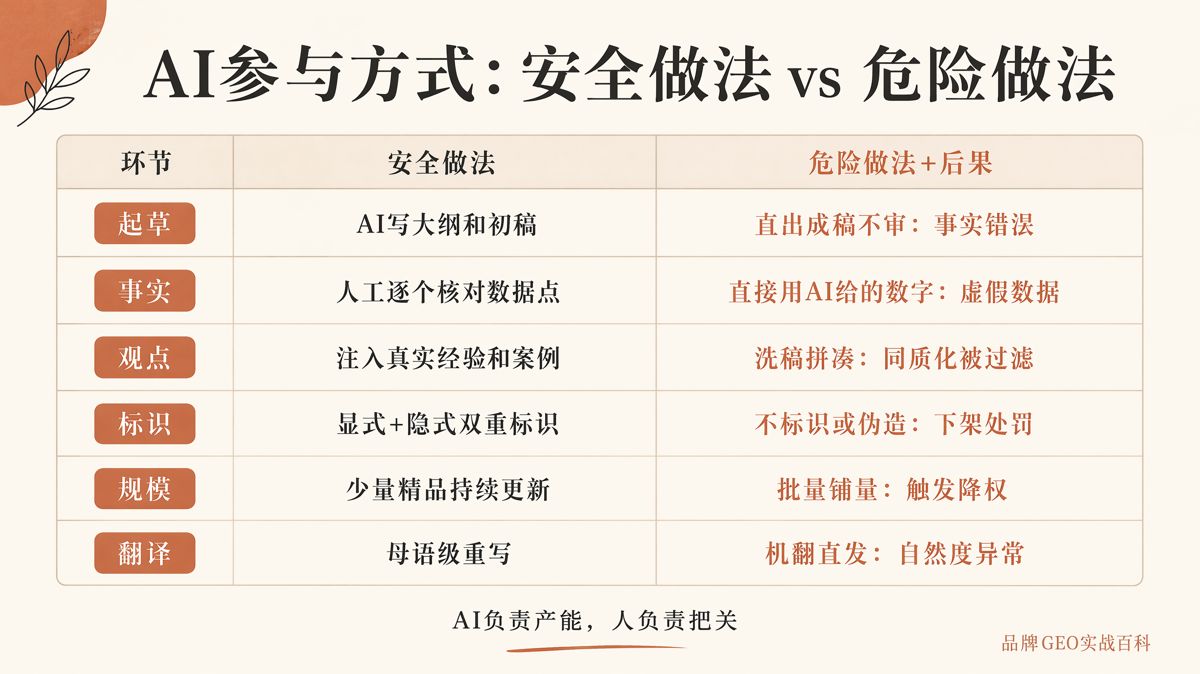
| Ideation & Drafting | AI organizes questions, research, and outlines | AI batch-generates copy published without review | Duplicate content, errors, de-indexing |
| Fact-Checking | Humans verify statistics, policies, and citations | Publishing AI-generated figures unverified | False claims, legal compliance risk |
| Perspective | Adding firsthand experience and context | Scraping public copy or spinning articles | Commoditized copy, copyright risk, low trust |
| AI Labeling | Declaring use and preserving metadata tags | Deleting, forging, or omitting required labels | Warning badges, restricted reach, account penalties |
| Publishing Cadence | Consistent release of distinct, valuable pages | Rapid posting of template clones | Flagged for low quality or scaled content abuse |
| Localization | Rewritten and reviewed by native specialists | Direct publishing of raw machine translations | Semantic errors, poor user experience |
AI speeds up research, structure design, and initial drafting. However, three steps cannot be skipped: verifying facts, adding original insights, and completing compliance reviews.
A Reliable GEO Production Workflow
Step 1: Validate Whether the Question Is Worth Answering
Determine whether target users actually ask the question and whether an information gap exists in current search and AI results.
Do not write an article simply because a search term has query volume. Focus on whether your brand can contribute concrete data, firsthand experience, or clear analysis missing from existing answers.
Step 2: Convert the Outline into a Fact-Checking Worksheet
Use AI to suggest common user questions, potential data points, and topics to research. Treat this output strictly as a research checklist, not as established facts.
Break out every metric, policy, institution, case study, and conclusion into an itemized list for manual verification.
Step 3: Check Original Primary Sources First
Verify laws and regulations against official agency releases. Check research statistics against original research papers or reports. Confirm corporate information using official websites or regulatory filings.
Record the source URL, publication date, scope of the data, and retrieval date in your internal notes for future updates.
Step 4: Use AI for Drafting Only After Verifying Facts
Feed the verified facts, approved reference excerpts, and clear boundaries into the AI. Prompt it to organize the structure and draft the copy based strictly on those parameters.
This limits the AI's tendency to invent statistics, case studies, or citations.
Step 5: Conduct Thorough Human Editorial Review
Cut repetitive phrases, formulaic transitions, and generic conclusions. Add authentic business experience, operational caveats, and practical nuance. Ensure every claim has supporting evidence and that isolated examples are not framed as universal rules.
For foreign-language content, have native-language editors rewrite the text rather than using raw machine translations.
Step 6: Structure for Readability, Not Just Algorithms
Incorporate descriptive headings, concise executive summaries, comparison tables, and FAQs where they help the user. Avoid forcing artificial formats or word counts to please an assumed "AI preference."
Google has clarified that generative AI search does not require bespoke structured data schemas or hyper-fragmented short paragraphs. The layout must serve human readability first.
Ensure core facts and conclusions are written clearly so that an excerpt cited out of context remains accurate and self-contained.
Step 7: Technical and Compliance Review
Verify that pages can be crawled and indexed, images include descriptive alt text, and internal and external links resolve correctly. Check AI disclosure requirements, advertising claims, and target market regulations.
SEO and GEO are not separate silos. A page must first be crawled and indexed by search engines and discovery platforms before an AI engine can retrieve and cite it. GEO adds an emphasis on factual density, source clarity, and extractable modular paragraphs.
Pre-Publishing Checklist
Review these items before publishing:
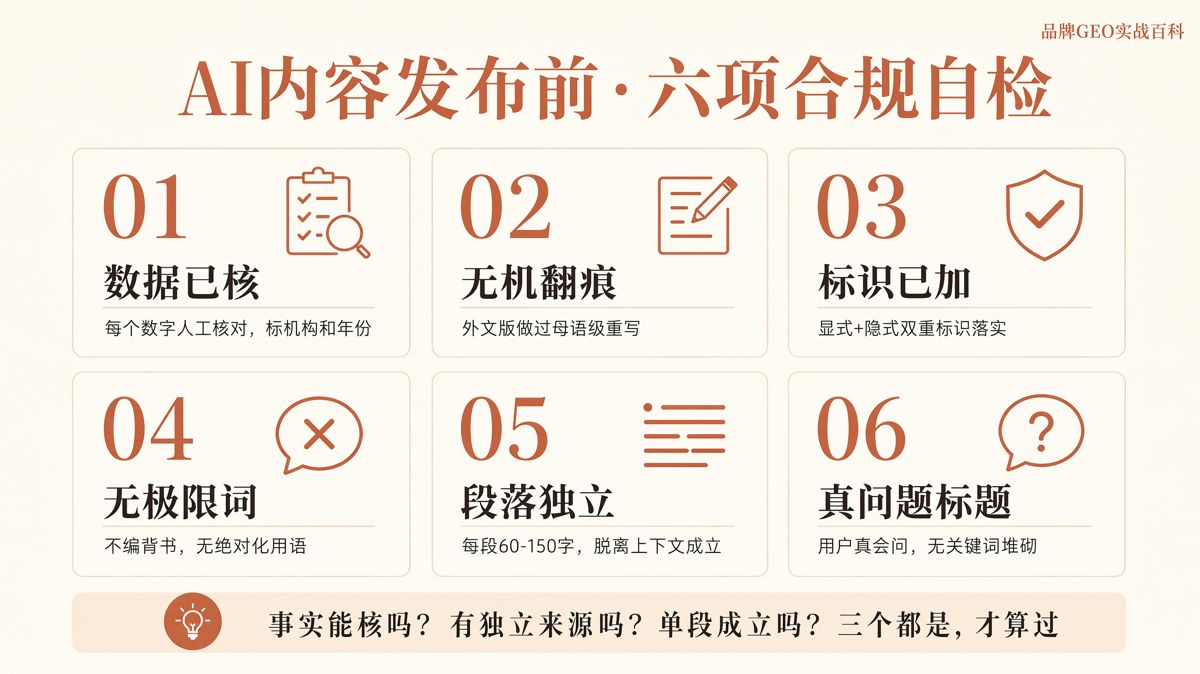
- [ ] Every metric, policy reference, and case study has been verified against its primary source.
- [ ] Data points clearly state the source organization, date, and statistical scope.
- [ ] No fabricated experts, certifications, client references, or press mentions exist in the text.
- [ ] No unsubstantiated rankings, absolute performance guarantees, or exaggerated claims are used.
- [ ] AI-generated synthetic content is declared and labeled according to applicable regional and platform rules.
- [ ] Explicit and implicit metadata labels in original files remain intact.
- [ ] Content targeting the EU has been evaluated under Article 50 of the EU AI Act, with human editorial records maintained.
- [ ] Non-native language versions have been reviewed by language specialists, avoiding unedited machine translations.
- [ ] Core paragraphs are clear and complete on their own, minimizing the risk of misinterpretation if quoted as standalone snippets.
- [ ] The text is free from keyword stuffing, large duplicate blocks, and automated cross-channel duplication.
- [ ] The title addresses an authentic question that real users ask.
To evaluate whether a passage is suitable for AI citation, ask three questions: Can the claim be independently verified? Is it supported by a reliable source? Does it remain accurate when read apart from the rest of the page?
If the answer to any of those questions is no, revise or cut the section before publishing.
Frequently Asked Questions
Will Google penalize articles written by AI?
Google does not penalize content simply because it was written by AI. Google focuses on whether content is helpful, reliable, and whether it was produced at scale primarily to manipulate rankings. AI drafting is fine; unverified facts, lack of unique value, and mass duplication are where the risks lie.
Do Chinese platforms ban accounts simply for using AI?
Platforms do not apply a blanket ban just for using AI. They evaluate content risk, publishing patterns, and rule violations. Keyword stuffing, spun content, fabricated facts, exaggerated claims, mass-produced low-quality pages, and missing AI labels are the actual triggers for enforcement.
Do I have to label AI-generated content?
In mainland China, users must actively declare AI-generated synthetic content and use the platform's labeling tools under the Measures for the Labeling of AI-Generated Synthetic Content. In the EU, companies should determine whether they are classified as a provider or deployer under Article 50 of the EU AI Act and whether their content requires machine-readable markers or public disclosure.
What happens if I fail to label AI-generated content?
Platforms may add warning labels, restrict reach, remove content, or penalize accounts under their community standards. If applicable laws are violated, regulatory authorities may take enforcement action. Consequences depend on the content, the entity, the platform, and the severity of the violation.
Why does raw AI-generated content often underperform?
It usually underperforms not because it sounds like AI, but because the facts are unverified, the copy repeats existing web pages, firsthand experience is missing, and the phrasing is formulaic. Search engines and platforms evaluate whether content is useful, credible, and free of ranking manipulation.
What is the most critical part of human editorial review?
First is fact-checking: verifying every number, policy, case study, and source. Second is adding genuine experience and context. Third is reviewing advertising terminology, AI labels, and platform compliance. Lightly polishing a few sentences for fluency does not count as a thorough editorial review.
Are compliance requirements different for GEO versus SEO?
Both must follow advertising laws, platform guidelines, and AI labeling regulations. GEO also targets retrieval and citation by AI search engines, making factual density, transparent sourcing, and standalone paragraph clarity more important. However, the foundational legal obligations remain the same.
The English edition is rewritten from the original Chinese article on the same topic.

Starbox AI is an AI marketing company based in Hangzhou, China. This article draws on Starbox project work. Please credit the source when quoting.
Related reading
 GEO Guide
Why AI Marketing Vendor Quotes Vary 10x: A 4-Step Vetting Checklist
Evaluate AI marketing proposals by delivery actions, not slide decks. Audit source infrastructure, fact cleaning, and clean-environment testing.
Oct 22, 2026 · 6 min read
 GEO Guide
Spotting GEO Scams: What Actually Drives AI Recommendations?
Automated AI ranking promises violate how LLMs work. Real AI recommendations rely on authoritative, structured facts across trusted public sources.
Oct 22, 2026 · 4 min read
 GEO Guide
How to Measure Your Brand's AI Visibility with a Spreadsheet
You do not need expensive software to track AI recommendations. A three-tier prompt framework and a simple spreadsheet can score your brand visibility in half a day.
Oct 21, 2026 · 6 min read