
How to Repurpose One Long Article Across Global Platforms: A Complete SOP
The short answer
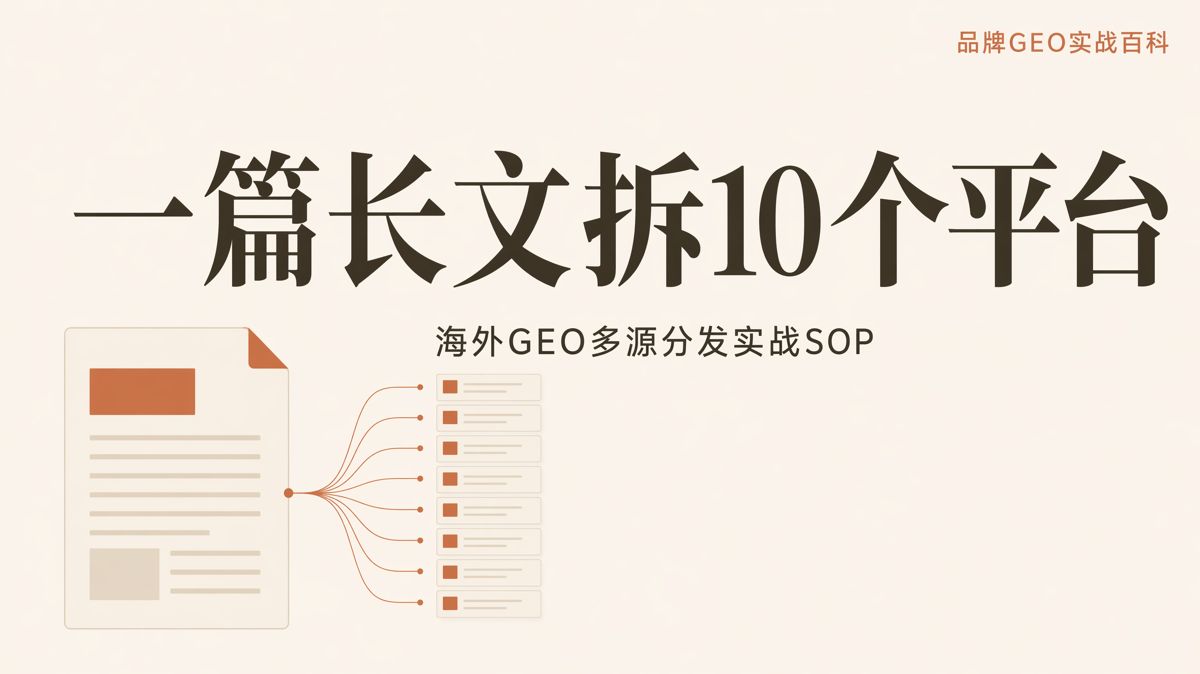
Turn one long-form article into an AI-ready master draft, then adapt it across Reddit, YouTube, and LinkedIn to maximize citations across major AI engines.
Global content distribution is not about copying the same blog post to five different sites. It is about presenting the same verified facts in formats tailored to each channel.
Your official website hosts the full-length master piece. Reddit receives a single focused perspective. YouTube gets a comprehensive explainer video. LinkedIn gets concise text-and-image summaries. Quora answers specific user queries. While your core facts and takeaways remain identical, your headlines, length, tone, and structure must match each destination. Once published, you must continuously track whether search engines index your pages and whether AI models cite them.
This process sits at the heart of Generative Engine Optimization (GEO): structuring brand content so AI engines can easily retrieve, understand, and cite it.
Why Publishing on Your Website Isn't Enough
When an AI engine generates an answer, it typically synthesizes between 10 and 30 different sources. If your brand only publishes on its primary domain, your citable footprint is confined to a single source. The remaining reference points will be dominated by competitors, media outlets, and third-party discussions.
Furthermore, different AI engines rely on vastly different source ecosystems.
A 2025 cross-platform study by Ahrefs found an 86% non-overlap among the top cited domains across ChatGPT, Perplexity, and Google AI Overviews. A domain cited constantly by ChatGPT may barely register in Perplexity or Google AI Overviews.
Other benchmark studies highlight similar platform preferences:
- According to 2026 data from 5W Research, Wikipedia and Reddit together account for over 25% of all US ChatGPT citations. Legacy publishers like The Wall Street Journal, The New York Times, and Bloomberg did not make the top 20.
- Search Engine Land reported in 2026 that Reddit is the single most cited domain across ChatGPT, Perplexity, and Google AI Overviews combined.
- Otterly.AI's 2026 data shows that 94% of AI-cited YouTube content consists of long-form videos. YouTube accounts for 16.1% of Perplexity's total citations and 9.5% of Google AI Overviews', but close to 0% for ChatGPT.
A similar divergence exists in Chinese AI ecosystems. Yuanbao (Tencent's AI assistant) prioritizes WeChat Official Accounts; Ernie Bot (Baidu) draws heavily from Baijiahao (Baidu's content platform) and Baidu Baike; Doubao (ByteDance's AI assistant) leans toward Douyin and Toutiao; while Zhihu (China's largest Q&A platform) feeds heavily into models like Kimi and DeepSeek.
While these datasets measure different environments, the takeaway is clear: relying on a single platform limits you to a fraction of AI search visibility. Effective global distribution ensures your core insights appear across multiple venues where AI engines actively pull data.
Build Your Master Draft Before Repurposing
The starting point for multi-platform distribution is not registering social handles. It is creating an authoritative, well-structured long-form master article that can be cited piece by piece.
Before distributing, verify that your master draft meets these standards:
- Includes a standalone TL;DR summary under 40 English words.
- Lists 5 to 7 key factual claims, each backed by explicit figures or benchmark data.
- Places an independently citable conclusion or data point within the first 60 to 150 words under every H2 and H3 heading.
- Ends with 6 to 8 frequently asked questions marked up with
FAQPagestructured data to help search bots parse question-and-answer pairs. - Follows an "Inverted Pyramid" structure: conclusion first, followed by supporting evidence, followed by contextual background. Use question-based subheadings where possible.
- Includes an author byline and
Organizationschema markup so search crawlers can authenticate the author and sponsoring entity.
Article depth also impacts citation potential. According to seoClarity benchmarks, long-form content over 2,900 words sees a 59% higher citation rate than articles under 800 words. Treat this figure as a planning benchmark rather than a guarantee; length alone does not substitute for substance. A comprehensive piece provides the data points, explanations, and edge cases necessary to fuel downstream repurposing.
Structured Q&A sections are equally influential. 2025 data from Amicited indicated that adding FAQPage structured data increased ChatGPT citations by up to 320% and made content 3.2 times more likely to appear in Google AI Overviews. Actual outcomes still depend on domain authority, topic competitiveness, and overall quality.
Finally, non-native drafts require a native rewrite rather than literal machine translation. A practical workflow looks like this:
- Draft the initial version.
- Manually verify every data point and reference.
- Have a native professional editor restructure phrasing, rhythm, and idioms.
- Spot-check 20% of the text for tone consistency.
Many modern search and evaluation systems penalize unnatural phrasing or high perplexity patterns. Raw machine translations often carry awkward sentence structures that signal low-quality generation, making human editorial refinement essential.
Choosing the Right Channels for Your Content
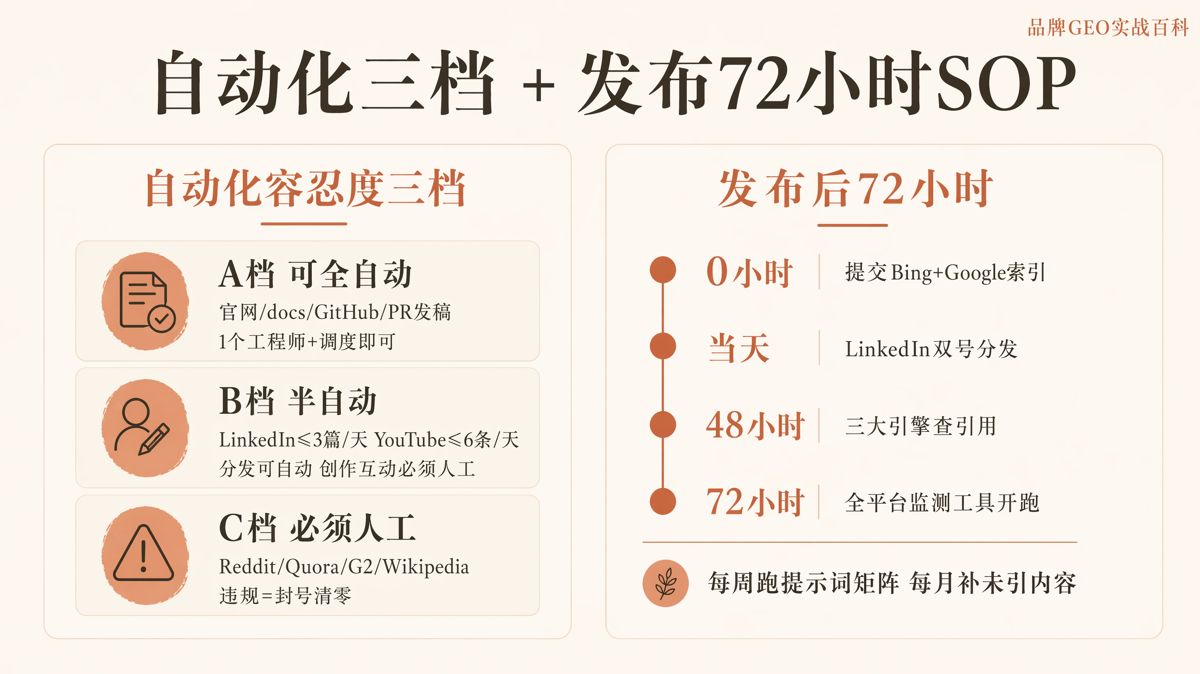
| Channel | Recommended Format | AI Citation Value | Typical Ramp-Up | Account Setup Difficulty | Automation Level | Domestic Equivalent |
|---|---|---|---|---|---|---|
| YouTube | 8–15 min explainer video + English subtitles | ★★★★★ | 4–8 weeks | Moderate; monetization requires an overseas entity | Tier B (Semi-automated) | Bilibili / WeChat Channels / Douyin |
| Perspective or case study post; no links initially | ★★★★★ | 8–12 weeks | High; elevated shadowban risk | Tier C (Fully manual) | Zhihu | |
| 3–5 image-and-text updates + link to master article | ★★★★ | 2–4 weeks | Moderate; requires overseas entity or foreign phone number | Tier B (Semi-automated) | WeChat Official Account | |
| G2 / Capterra | Product profile + verified user reviews | ★★★★ | 2–6 weeks | Moderate; avoid using .cn email addresses |
Tier C (Fully manual) | B2B software review directories |
| Wikipedia | Third-party citations and neutral encyclopedic entries | ★★★★★ | 6–18 months | Very High | Tier C (Fully manual) | Baidu Baike / Sogou Baike |
| Quora | In-depth answers to existing questions; links under 10% | ★★★ | 4–8 weeks | Moderate | Tier C (Fully manual) | Zhihu |
| PR Newswires | Press releases with question-based headlines | ★★★ | Immediate | Low; commercial distribution service | Tier A (Fully automated) | Mainstream media syndication |
Use this matrix to set priorities. You do not need to launch every platform simultaneously. Pick two or three channels that feed directly into the AI models most critical to your buyers, build credibility there, and expand gradually.
Reddit: Lead with One Strong Point, Skip the Links
Reddit offers high citation value, but community moderation and spam filters are aggressive.
According to the Reddit Shadowban Guide (2025), new accounts originating from specific cross-border network environments face shadowban rates exceeding 30%. When shadowbanned, your posts appear normal to you, but remain invisible to everyone else.
To protect your accounts:
- Use clean residential proxy environments rather than data center IP pools.
- Maintain isolated, dedicated browser environments for each profile.
- Spend 7 to 30 days engaging naturally in relevant subreddits before creating original posts.
- Accumulate at least 100 organic Karma points before starting brand-related threads.
You can verify your visibility by checking reddit.com/user/your_username in an incognito window while logged out.
For content, never paste an entire blog post into Reddit, and never drop self-serving links from fresh accounts. Extract a single provocative data point or debate topic from your master draft. Turn it into a question, a personal lessons-learned post, or an open discussion thread.
Follow a strict 9:1 contribution ratio: deliver nine genuine, non-promotional community contributions for every one post referencing your own work.
Expect 8 to 12 weeks to build stable subreddit standing.
YouTube: Go Deep on One Core Chapter
If your objective is earning citations in Perplexity and Google AI Overviews, prioritize long-form YouTube videos over Shorts.
Pick one substantial section from your master draft and turn it into an 8- to 15-minute spoken walkthrough. Frame the title around an exact user search query, such as:
How to choose a X supplier from China in 2026
Ensure every video includes accurate English subtitles and places a link to the complete master article in the description.
Search and AI bots rely primarily on three text surfaces: the video title, the closed captions (subtitles), and the description box. These three layers must clearly articulate the problem, the evidence, and the conclusion. A keyword-stuffed title attached to a superficial video carries little citation weight.
Plan for 4 to 8 weeks to establish baseline channel traction. If you intend to monetize, you will need a business entity in an eligible market such as Hong Kong or Singapore.
LinkedIn: Break One Article into 3 to 5 Modular Insights
LinkedIn typically yields traction within 2 to 4 weeks. Use both your company page and founder profile to publish 3 to 5 separate visual-and-text updates derived from a single master article.
Each post should unpack just one data point, framework, or thesis. Do not attempt to summarize the whole article in a single update. Add a link to the full piece at the end of the post or in the first comment. Cap company page updates at three per day.
Company pages require an overseas corporate profile, while personal accounts benefit from an overseas mobile number. Keep new connection requests under 100 per week to maintain account health.
Quora: Turn Your FAQs into Authoritative Answers
Quora is an ideal venue for the questions documented in your master draft's FAQ section. However, avoid creating artificial questions solely to promote your brand.
Find existing, active threads where buyers are already debating the issue. Adapt your draft's findings into a comprehensive, standalone answer. The response must deliver complete value on its own, rather than acting as a teaser designed to force clicks.
Keep answers containing external self-referential links below 10% of your total answer volume.
Industry Publications: Resolve Fact-Checking and Language First
Contributed articles and guest columns on trade media demand higher editorial rigor than owned media.
Industry editors increasingly reject submissions containing high concentrations of generic AI phrasing, with some publications establishing strict thresholds (such as rejecting pieces with over 10% unedited AI generation). Prior to pitching, complete three steps: verify every fact against primary sources, run the draft through a native English editorial pass, and adhere strictly to the outlet's AI disclosure policy.
Western AI search relies heavily on authoritative company websites and specialized niche blogs. By contrast, Chinese AI search engines prioritize top-tier portal press and platform accounts over standalone corporate domains. When moving between markets, adjust your channel mix accordingly.
Owned Assets: Keep the Pillar and Build Supporting Docs
Never cut or compress the master article on your official site simply to make room for social snippets. Your primary URL serves as the canonical source of truth that grounds all secondary versions.
Beyond the main article, extract three additional owned assets:
- Convert your 6 to 8 core Q&As into dedicated FAQ sub-pages featuring
FAQPageschema markup. - For B2B software companies, migrate process and implementation chapters into your public product documentation center.
- Set up automated RSS distribution to syndicate full-length essays to platforms like Medium and Substack.
Marketplace vendor storefronts (such as Alibaba.com) are poorly suited as anchor points for GEO. Under GEO-readiness criteria, these platforms rate around 1/10: subdomains belong to the parent platform, page templates are rigid, automated scrapers struggle with access, and custom schema injection is unavailable. They remain functional for traditional marketplace SEO, but cannot replace an owned domain for AI citations.
What to Automate, What to Keep Manual
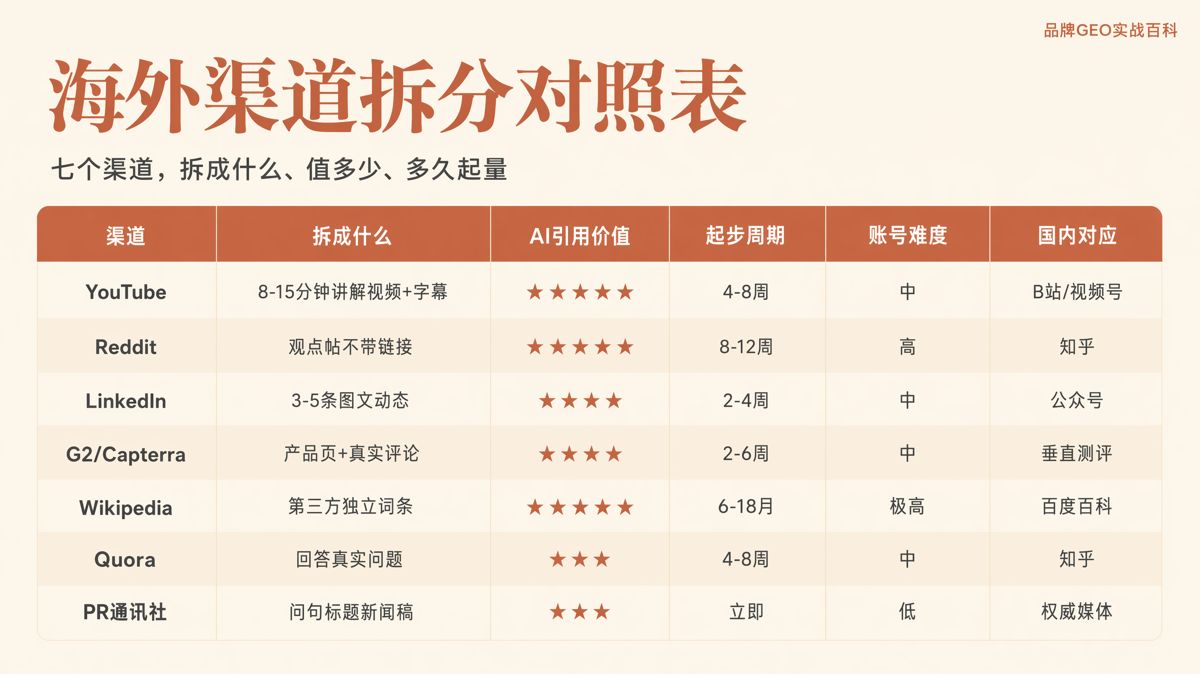
Platforms vary significantly in how aggressively they penalize automated posting. Group your distribution into three operational tiers:
Tier A: Fully Automated
Applies to: Your primary CMS, product documentation, GitHub repositories, and paid PR newswires. A single engineer using a scheduling engine can handle publishing, indexing pings, and status verification.
Tier B: Semi-Automated
Applies to: LinkedIn company pages, YouTube, X, Medium, and Substack.
Limit LinkedIn company updates to 3 per day. YouTube's default API quota allows around 6 video uploads daily. While the posting action can be automated, scriptwriting, creative review, and comment moderation require human intervention.
Tier C: Strictly Manual
Applies to: Reddit, Quora, Stack Overflow, G2/Capterra review management, Wikipedia, and guest editorial submissions.
These communities demand genuine human interaction and prioritize contributor history. Violating their norms can lead to immediate bans and retroactive content deletion. Never use bulk automation tools here.
Across all tiers, adhere to these five operational guardrails:
- Never share identical proxy IPs across multiple individual accounts.
- Never write or edit your own company's Wikipedia entry directly.
- Never offer gifts or incentives in exchange for G2 or Capterra reviews.
- Always submit AI-assisted drafts to a native human edit and comply with editorial disclosure rules.
- Require manual editorial sign-off on all Tier B queue items before they go live.
The First 72 Hours After Publishing
Hitting "publish" does not end the distribution cycle. The first 72 hours should be spent confirming discovery and initial citation pickup.
Day of Publication (Hour 0)
Submit the new URLs directly to Google Search Console and Bing Webmaster Tools. Cross-post initial announcement snippets across your LinkedIn company and executive profiles.
48 Hours Post-Launch
Run your primary question-based search queries across ChatGPT, Perplexity, and Google AI Overviews. Note whether your newly published domain or repurposing channels surface in the reference footnotes.
72 Hours Post-Launch
Use visibility platforms such as SE Ranking AI Visibility or Otterly.AI to benchmark your baseline metrics. Record which queries triggered brand mentions, which URLs served as the cited source, and how results vary across engines.
Use this 72-hour window solely to verify technical indexing and early crawl pickup. Building sustained, authoritative citations across third-party models takes months.
Ongoing Tracking: Weekly, Monthly, and Quarterly
AI citations are volatile. A domain cited for a prompt today may be replaced next week as models refresh their indices and re-weight sources.
A 2026 tracking study by Profound found that Google AI Overviews responses changed 70% of the time for identical queries, with 45.5% of cited URLs being swapped out between answer iterations.
Structure your ongoing monitoring across three time horizons:
- Weekly: Query a focused list of "Brand + Category" prompts across core generative engines.
- Monthly: Identify category queries where competitors are cited but your brand is absent, then draft targeted content to fill the gap.
- Quarterly: Refresh outdated statistics, case studies, and reference data across all published assets.
Track your incoming traffic carefully. In Google Analytics 4 (GA4), build a custom "AI Search" channel grouping covering referrers like chatgpt.com, perplexity.ai, and gemini.google.com. Place this rule higher in evaluation order than standard "Referral" traffic to prevent AI visits from being lumped into generic external links.
Industry performance medians suggest that a coordinated GEO distribution effort typically shows measurable impact within 6 months, with 90 days acting as a common inflection point. Platform ramps vary:
- LinkedIn: 2 to 4 weeks
- YouTube: 4 to 8 weeks
- Reddit: 8 to 12 weeks
- Wikipedia: 6 to 18 months
Use these ranges to plan resourcing and review milestones, rather than treating them as rigid guarantees.
Adapting Content, Iterating Sources
The reach of a long-form article is no longer measured solely by the pageviews on your primary blog.
By turning your original research into a modular, citable master draft, you can systematically seed its findings across Reddit discussions, YouTube tutorials, LinkedIn insights, and Quora solutions. This structure ensures that no matter which platform an AI model queries to synthesize an answer, your verified claims are there to be found.
Once published, treat distribution as an active feedback loop. When a query yields no citations, expand your source coverage. When data points become obsolete, update them immediately. Content repurposing is not a one-time broadcast—it is an operating system for maintaining authority across modern search engines.
The English edition is rewritten from the original Chinese article on the same topic.

Starbox AI is an AI marketing company based in Hangzhou, China. This article draws on Starbox project work. Please credit the source when quoting.
Related reading
 GEO Guide
Why AI Marketing Vendor Quotes Vary 10x: A 4-Step Vetting Checklist
Evaluate AI marketing proposals by delivery actions, not slide decks. Audit source infrastructure, fact cleaning, and clean-environment testing.
Oct 22, 2026 · 6 min read
 GEO Guide
Spotting GEO Scams: What Actually Drives AI Recommendations?
Automated AI ranking promises violate how LLMs work. Real AI recommendations rely on authoritative, structured facts across trusted public sources.
Oct 22, 2026 · 4 min read
 GEO Guide
How to Measure Your Brand's AI Visibility with a Spreadsheet
You do not need expensive software to track AI recommendations. A three-tier prompt framework and a simple spreadsheet can score your brand visibility in half a day.
Oct 21, 2026 · 6 min read