
How to Repurpose One Long Article Across 8 Chinese Platforms

The short answer
Cross-platform GEO distribution does not mean copy-pasting the same draft 8 times. Here is how to adapt your content for Chinese AI search engines.
Generative Engine Optimization (GEO) refers to structuring content and organizing information so that artificial intelligence (AI) search engines and chatbots can easily identify, mention, and cite your brand. While multi-platform syndication is critical to GEO, multi-platform publishing does not mean copy-pasting the exact same article eight times.
Publishing a single 3,000-word draft across WeChat Official Accounts, Zhihu, Toutiao, and Xiaohongshu with only minor headline tweaks may increase post volume, but it delivers poor results. Each platform serves distinct user habits, content formats, and algorithmic recommendations. Moreover, Chinese AI models rely on completely different indexation sources.
WeChat readers accept comprehensive long-form arguments. Zhihu users arrive with specific questions and want immediate answers. Xiaohongshu relies heavily on visual cards and real-world scenarios. Short video audiences expect to know within seconds what problem the video solves.
Repurposing a long article across channels is not a line-trimming exercise. You need to deconstruct the piece into conclusions, facts, and supporting details, then rewrite the headline, hook, layout, visuals, and tags for each specific channel.
Why You Cannot Copy-Paste the Same Draft Across Every Platform
First, content consumption habits vary fundamentally across platforms.
WeChat Official Accounts are built for deep-dive analysis, housing background context, empirical data, case studies, and complete FAQ sections. Zhihu (China's largest Q&A platform) users typically land on a page from a specific search query and demand a direct answer immediately. Toutiao (ByteDance's news aggregator platform) relies on continuous algorithmic feed distribution, where your opening lines determine whether a reader stays or swipes away.
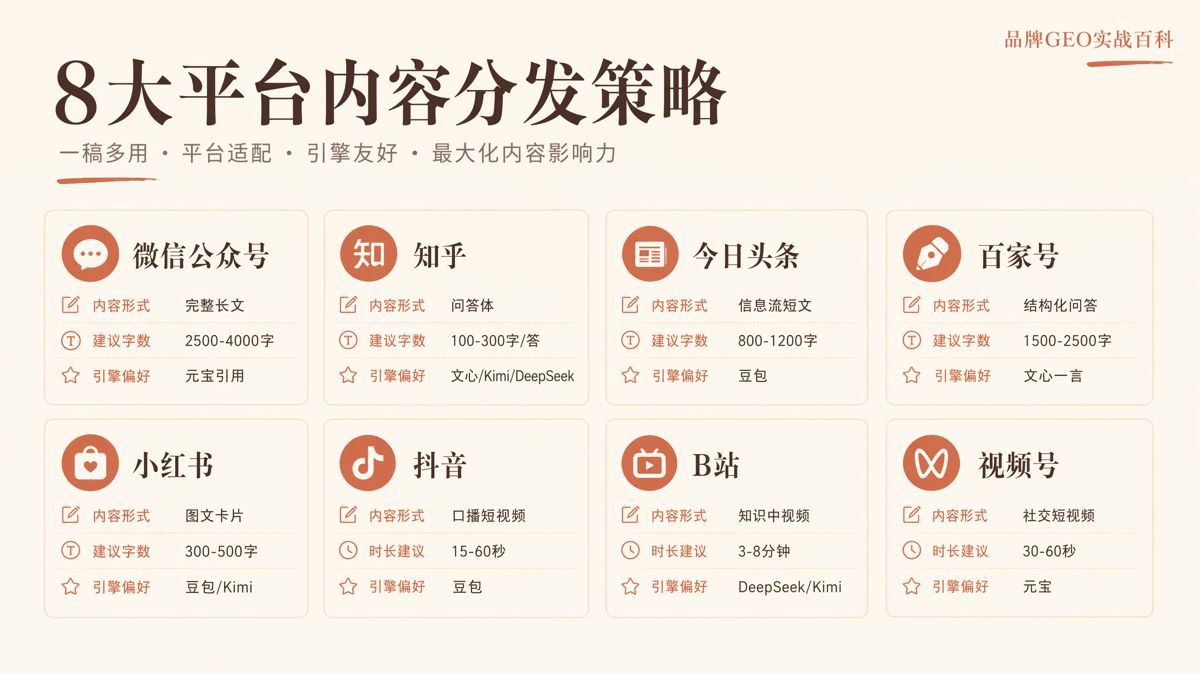
Xiaohongshu (RED, China's lifestyle and product review platform) favors visual galleries paired with concise bullet points; dense text walls hurt mobile readability. Baijiahao (Baidu's content platform) rewards clearly structured posts with direct question-and-answer pairs. Douyin (ByteDance's short video platform), WeChat Channels (WeChat's built-in video platform), and Bilibili (China's leading long-form and knowledge video platform) all require distinct video pacing and presentation lengths.
Second, different AI search engines pull citations from different primary ecosystems.
According to QuestMobile data from the first quarter of 2026: - Yuanbao (Tencent's AI assistant) cites heavily from WeChat Official Accounts. - ERNIE Bot (Baidu's AI assistant) prioritizes Baijiahao and Baidu Baike (Baidu's online encyclopedia). - Doubao (ByteDance's AI assistant) pulls predominantly from Douyin and Toutiao. - Kimi (Moonshot AI's chatbot) and DeepSeek index heavily from Zhihu and CSDN (a Chinese tech and developer community).
Publishing on only one platform leaves you invisible to large portions of both human readers and AI search engines. Increasing your brand's AI citation share requires distributing core information in formats native to each ecosystem.
You must still maintain the authoritative long-form original. Industry data from seoClarity shows that long-form content over 2,900 words is 59% more likely to be cited by AI engines than content under 800 words. Keep the long-form version as the definitive master resource, and spin off modular, question-focused assets for secondary channels.
Duplicate content penalties are an operational reality. Regulatory guidelines in 2026 explicitly designate unoriginal, syndicated spam as high-risk behavior. Pushing identical copy across accounts can lead to reduced distribution, suppressed search rankings, or content removal. Simply changing the title while leaving the body text intact does not count as repurposing.
Step One: Deconstruct Information Before Cutting Words
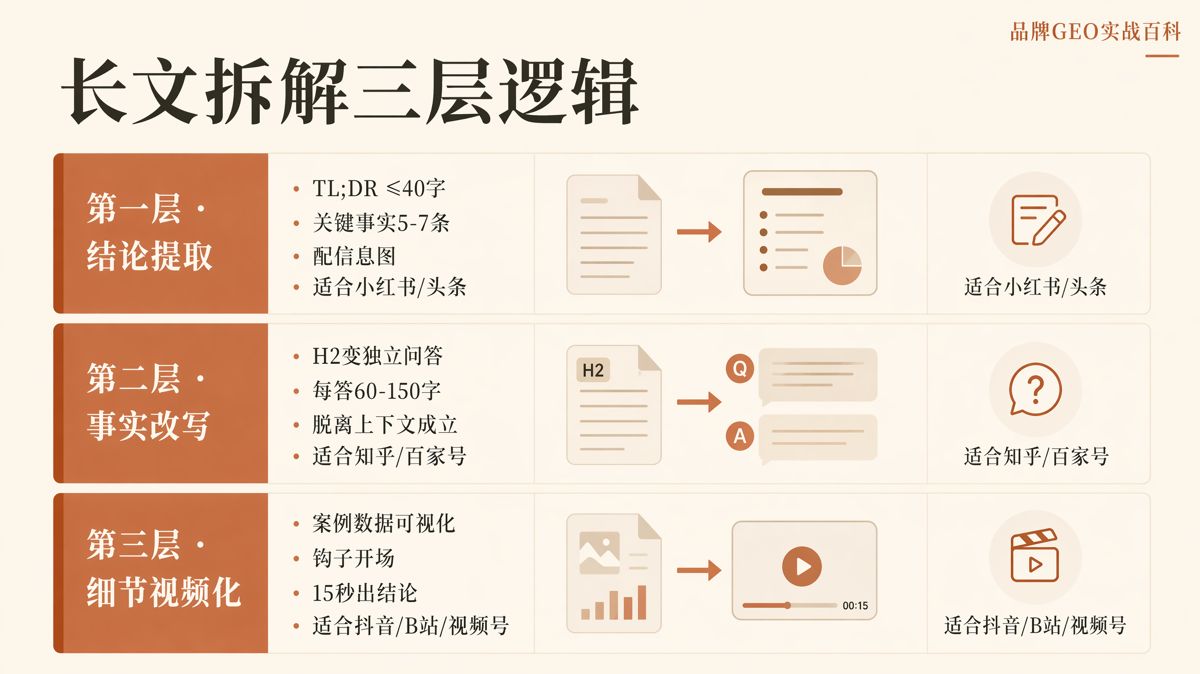
Break down a long-form article into three distinct layers: conclusions, facts, and details.
Conclusions translate into short visual carousels. Facts convert into standalone Q&A answers. Details turn into infographics or video scripts. Completing this modular breakdown first prevents your multi-channel workflow from degrading into mechanical text editing.
Tier 1: Turn Conclusions into Short Image-Text Posts
Extract one core conclusion under 40 words, along with 5 to 7 supporting takeaways, and assemble them into a self-contained micro-post.
This post must make sense without the source article. Readers should open the page and instantly see the topic, the takeaway, and the actionable numbers or rules to remember. Explicit takeaways, clear metrics, and lists are easily ingested by AI scrapers.
This format works best on fast-scrolling platforms like Toutiao and Xiaohongshu.
Accompanying graphics can be a single overview card or a multi-slide carousel where each image covers one takeaway. Apply one foundational rule: one image, one message.
Tier 2: Turn Facts into Standalone Q&As
Convert every H2 section from your long-form draft into a standalone question, then deliver a direct answer in 60 to 150 words.
For example, a generic section on platform adaptations can be split into four targeted questions: - What elements must be retained in a WeChat Official Account post? - Why must a Zhihu answer state its conclusion in the opening sentence? - Why should long text blocks be avoided on Xiaohongshu? - What structural format performs best on Baijiahao?
Each answer must stand entirely on its own. Avoid cross-referencing phrases like "as mentioned above" or "follow the steps below."
This modular Q&A architecture fits Zhihu and Baijiahao, making it straightforward for generative AI engines to extract clean answers.
A study by amicited.com revealed that web pages implementing FAQPage schema saw a 320% increase in ChatGPT citation rates. While structured data markup applies directly to web code rather than closed social media apps, the principle remains: clear questions and direct, self-contained answers significantly improve machine extraction.
Tier 3: Turn Details into Video Scripts
Case studies, empirical numbers, comparison tables, and step-by-step workflows can all be adapted into short- or mid-length video scripts.
Never read long-form prose directly into a camera. Short videos need the conclusion upfront within seconds, followed immediately by hard data and the operational step. Mid-length videos allow time for process walkthroughs, comparison graphics, and live demonstrations.
Douyin and WeChat Channels favor 15- to 60-second single-point insights. Bilibili supports 3- to 8-minute comprehensive breakdowns. If your long article covers multiple tactical angles, produce multiple short videos rather than cramming everything into one.
How to Adapt for Each of the 8 Platforms
| Platform | Best Content Format | Core Adaptation Strategy | Target Length | Favored by AI Engines |
|---|---|---|---|---|
| WeChat Official Accounts | Complete long-form guide | Keep deep analysis, add clear cover and inline graphics | 2,500–4,000 words | Yuanbao |
| Zhihu | Targeted Q&A answers | Standalone answers; conclusion in the very first sentence | 100–300 words per answer | ERNIE Bot, Kimi, DeepSeek |
| Toutiao | Feed-optimized short articles | Put the takeaway in the first 50 words; use single-point graphics | 800–1,200 words | Doubao |
| Baijiahao | Structured Q&A posts | Adopt explicit FAQ formats where each answer stands alone | 1,500–2,500 words | ERNIE Bot |
| Xiaohongshu | Visual carousel cards | Use 3–5 image cards with concise, scenario-driven text | 300–500 words | Doubao, Kimi |
| Douyin | Direct-to-camera short video | Lead with conclusions; hook viewers within the first 15 seconds | 15–60 seconds | Doubao |
| Bilibili | Educational mid-length video | Showcase data sets, comparative tables, and deep analysis | 3–8 minutes | DeepSeek, Kimi |
| WeChat Channels | Network-driven short video | Highlight problems directly affecting target business users | 30–60 seconds | Yuanbao |
What changes between platforms is not the underlying truth, but the sequencing and delivery of information.
The same set of facts requires comprehensive context on WeChat, an immediate solution on Zhihu, a front-loaded takeaway on Toutiao, and a multi-slide visual sequence on Xiaohongshu.
Covering the same topic does not mean running the same copy.
Rewrite Both the Headline and the Opening Paragraph
Headlines must match native consumption habits on each platform. Do not simply swap platform names in the title.
For a topic like "GEO Content Distribution," customize titles accordingly: - WeChat: Distributing One Long Article Across Channels: The Practical Domestic GEO Guide - Zhihu: How Do You Repurpose One Long Article Across WeChat, Zhihu, Toutiao, and Xiaohongshu? - Toutiao: How to Break Down a Long Article into Carousels, Q&As, and Short Videos - Xiaohongshu: 3-Step Long-Form Breakdown: The Multi-Platform Repurposing Checklist - Douyin: Why Does Your Long Article Flop the Moment You Post It on Another Platform?
Once the headline changes, rewrite the first 150 words completely.
A WeChat post can open with industry context. Zhihu must address the headline's question in sentence one. Toutiao needs immediate data points or clear conclusions. Xiaohongshu should state upfront who the post is for and what actionable takeaway they will leave with.
Changing a title while leaving the body copy untouched remains duplicate content.
Reformat Visuals Instead of Just Resizing Them
Visual assets can be reused across platforms, but one image size cannot fit every layout.
- WeChat, Zhihu, Toutiao: 16:9 landscape images.
- Xiaohongshu: 3:4 vertical cards.
- Douyin, WeChat Channels: 9:16 vertical video frames.
Complex comparison tables must not be shrunk down to fit mobile screens. If text becomes illegible, the data loses all utility.
Break dense comparison tables into multiple individual cards, each showing a single metric and a direct takeaway. On Xiaohongshu, turn five key points into a five-slide carousel where each slide makes sense independently. In video, reveal comparison data points sequentially as you speak.
Keep primary metrics directly on the image, but move formal citation footnotes into the post body to avoid cluttering mobile screens.
Choose Tags and Keywords Platform by Platform
Search behavior differs significantly across channels. Do not paste an identical block of hashtags across all eight platforms.
For instance:
- WeChat: Use broad strategic hashtags like #GEO #ContentDistribution #MultiPlatformStrategy #AISearchOptimization #BrandMarketing
- Zhihu: Target exact query terms like Generative Engine Optimization, Content Repurposing, Domestic Search Optimization
- Toutiao: Use timely phrases like 2026 GEO Trends, AI Search Visibility
- Xiaohongshu: Use practical discovery terms like Content Operations Guide, Brand Visibility Tips, GEO Beginners
- Douyin: Use trending categories like #AIEra #ContentEntrepreneurship #MarketingTips
Select 2 to 3 platform-specific search keywords alongside 2 evergreen umbrella terms. Cap total tags at 5 to maintain thematic clarity.
Remember that tags are secondary signals. Platform distribution is still determined by your headline, opening hook, content architecture, and the depth of information provided.
Stagger the 8-Platform Release Schedule
Publishing all eight variations on the same day creates unnecessary operational stress and prevents you from learning from initial audience reactions.
Stage releases based on depth and production difficulty: - Day 1: Publish the complete long-form master guide on WeChat Official Accounts. - Day 2: Publish targeted Q&A versions on Zhihu. - Day 3: Publish short articles or structured FAQs on Toutiao and Baijiahao. - Day 5: Publish carousel cards on Xiaohongshu. - Days 7–10: Roll out video assets on Douyin, Bilibili, and WeChat Channels.
Staggered rollouts reduce duplicate content flags and allow you to refine subsequent assets using early reader feedback.
If Zhihu commenters repeatedly ask for clarification on a specific point, address it in your video hook. If WeChat readers spend substantial time on one analytical section, expand it into a dedicated Bilibili video. If a carousel card on Xiaohongshu gets heavy bookmarking, spin that single point into an independent topic.
Distribution is an iterative feedback loop, not a one-time broadcast.
GEO Requires Metrics Beyond Pageviews
When optimizing content for GEO, standard pageview metrics tell only half the story. You must track whether your brand is cited by AI engines and identify which platform sources they rely on.
The 57th China Internet Network Information Center (CNNIC) report showed that by December 2025, domestic AI users reached 602 million, representing a 42.8% penetration rate. As search behavior shifts toward direct AI prompts, presence inside AI-generated answers has become a key performance metric alongside pageviews.
Set up a consistent weekly audit. Query your core topics across Doubao, DeepSeek, Kimi, ERNIE Bot, and Yuanbao, tracking the following variables:
| Audit Parameter | Data to Log |
|---|---|
| Query Prompt | The exact prompt submitted to the AI |
| Engine Used | Doubao, DeepSeek, Kimi, ERNIE Bot, or Yuanbao |
| Brand Mentioned | Yes or No |
| Source Platform | WeChat, Zhihu, Toutiao, Baijiahao, etc. |
| Source URL | The exact cited web address |
| Content Format | Long-form guide, Q&A, carousel, or video |
If you do not have dedicated enterprise monitoring software covering domestic engines, a tracking spreadsheet combined with manual checks across the five primary AI apps provides an effective baseline.
Test 30 core buyer questions weekly. Within a month, clear patterns will emerge showing which platforms drive citations for your category and which questions remain open opportunities.
Frequently Asked Questions
1. Does adapting one article into 8 platform versions count as duplicate content?
Not necessarily.
Duplication is judged by whether the headline, opening hook, structure, examples, and framing provide new information architecture. Simply changing the headline while keeping identical body text triggers duplicate content penalties. Restructuring the core facts to match each platform's native format does not.
2. How can a solo marketer manage distribution across 8 platforms?
Do not start with all 8 at once. Begin with three core channels: WeChat Official Accounts for the long-form master reference, Zhihu to answer search queries, and Xiaohongshu for visual takeaways.
Once that workflow is consistent, expand to Toutiao, Baijiahao, and video channels. Attempting all platforms simultaneously usually results in lazy copy-pasting.
3. Is video content strictly necessary for GEO?
It is not mandatory, but leaving it out limits your reach.
According to QuestMobile data from Q1 2026, Doubao reached roughly 345 million monthly active users, and it pulls heavily from Douyin video content. Text-only syndication shuts you out of those video-driven citation pools.
You can start simply by recording voiceovers over infographics or slide decks before investing in complex video production.
4. Can AI-generated content be published directly?
Yes, provided you comply with mandatory disclosure rules.
China's Administrative Measures for the Labeling of AI-Synthesized Content took effect on September 1, 2025. AI-generated assets must feature both explicit visual disclosures and implicit metadata tags. Failing to disclose AI generation risks algorithmic throttling or account suspension.
5. Does multi-platform syndication require extra ad spend?
Rewriting content does not require ad spend.
For promotion, monitor organic traction across channels for the first week, then allocate paid budgets (such as WeChat Ads or Douyin DOU+) strictly to the top 1 or 2 best-performing formats. Avoid spreading paid budgets evenly across channels before validating organic resonance.
6. How often should published content be updated?
Core pillar content should be audited quarterly, focusing on updated data, fresh case studies, and new FAQs.
Research from Ahrefs shows that URLs cited by AI engines are, on average, 25.7% newer than organic Google search results, underlining the importance of freshness. When updating content, update the page's dateModified schema attribute alongside your actual text revisions. Never update dates without changing substantive content.
7. Can small brands with low visibility benefit from GEO?
Yes.
Smaller teams move faster and can identify search queries where existing AI answers are incomplete. Consistent, structured answers to specific niche questions allow smaller brands to win AI citations without massive legacy brand authority.
8. Does breaking down a long article hurt the original post's search ranking?
No. The mechanical act of splitting content does not hurt search performance.
Search Engine Optimization (SEO) involves structuring sites and copy so search crawlers can index and rank them effectively. In a May 2026 statement, Google confirmed that generative AI optimization sits within the broader framework of search experience and technical SEO.
Multi-channel distribution expands your brand footprints, provided each version is properly adapted and maintains clear, consistent brand attribution.
Perfect One Article Before Scaling Platforms
Adapting a master article into a multi-channel engine comes down to five operational steps:
- Maintain an authoritative long-form guide of 2,500 to 4,000 words.
- Extract the core takeaway and 5 to 7 supporting facts.
- Turn factual sections into self-contained Q&A answers.
- Convert data, case studies, and comparison tables into visual assets or video scripts.
- Rewrite headlines, opening hooks, tags, and image layouts specifically for each target platform.
Effective distribution is measured not by how many total links you publish, but by whether each asset solves a concrete problem for its native audience.
Build one master guide that covers the subject completely, create short modular formats that resolve specific queries, and use visual cards that communicate one clear point at a time. Nail those fundamentals first, then scale your platforms. That is how long-form content consistently secures presence and citations across modern AI search engines.
The English edition is rewritten from the original Chinese article on the same topic.

Starbox AI is an AI marketing company based in Hangzhou, China. This article draws on Starbox project work. Please credit the source when quoting.
Related reading
 GEO Guide
Why AI Marketing Vendor Quotes Vary 10x: A 4-Step Vetting Checklist
Evaluate AI marketing proposals by delivery actions, not slide decks. Audit source infrastructure, fact cleaning, and clean-environment testing.
Oct 22, 2026 · 6 min read
 GEO Guide
Spotting GEO Scams: What Actually Drives AI Recommendations?
Automated AI ranking promises violate how LLMs work. Real AI recommendations rely on authoritative, structured facts across trusted public sources.
Oct 22, 2026 · 4 min read
 GEO Guide
How to Measure Your Brand's AI Visibility with a Spreadsheet
You do not need expensive software to track AI recommendations. A three-tier prompt framework and a simple spreadsheet can score your brand visibility in half a day.
Oct 21, 2026 · 6 min read