
The First 72 Hours After Publishing: A 5-Step GEO Checklist

The short answer
Publishing a post does not mean AI engines can find or cite it. Here is the 5-step GEO workflow to turn new content into AI answers within 72 hours.
Just because a webpage is published and accessible does not mean AI search engines have discovered it, let alone decided to cite it. Generative Engine Optimization (GEO) focuses on earning placement and citations for your brand inside generative AI answers.
Many marketing teams publish an article and immediately wait for indexation, organic traffic, and AI citations. When nothing happens after two or three days, they assume the headline was weak, the topic missed the mark, or the piece failed entirely. In reality, an absence of AI citations often indicates that the page simply has not entered the engine's real-time retrieval pool yet.
AI engines synthesize answers using a mix of pre-training corpora, real-time web indexes, and third-party knowledge bases. If your crawler directives, XML sitemaps, or page rendering exhibit technical issues, your content remains invisible to live retrieval systems even if it is publicly viewable in a browser.
The first three days after launch are not meant for premature post-mortems. Instead, focus on answering three practical questions: Can search bots access and index the page? Have initial brand mentions or citations appeared in AI outputs? Does the next phase require technical fixes, editorial revisions, or simply more time to build authority?
Complete These 5 Tasks Within the First 72 Hours
This workflow is drawn from the GEO Content Production SOP (published June 28, 2026). The sequence is straightforward: help search engines discover the asset, distribute it across relevant public channels, and monitor for early visibility signals.
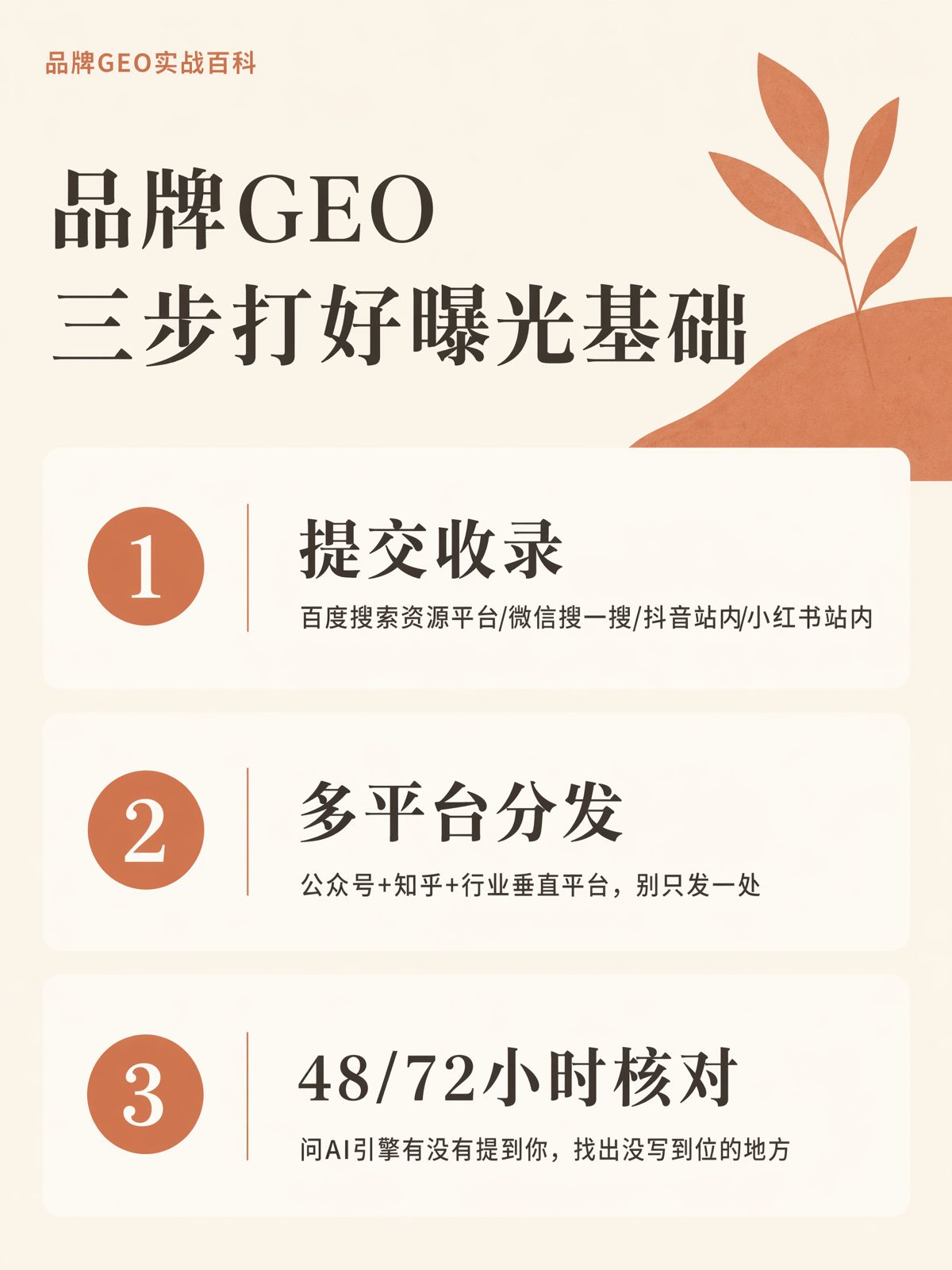
1. Submit Indexing Requests Immediately
The moment content goes live, submit manual crawl and indexing requests via Google Search Console and Bing Webmaster Tools. At the same time, verify four technical essentials:
robots.txt: Ensure user-agents for target search and AI crawlers are explicitly allowed.- XML Sitemap: Confirm the new URL is included in the updated sitemap.
- Page Accessibility: Ensure the page returns an HTTP 200 status code without redirect loops.
- Above-the-Fold Rendering: Check that the main content renders immediately without critical layout shifts or rendering blockers.
Many AI engines rely on traditional search indexes for their live retrieval layer. Submitting indexing requests does not guarantee instant indexing or AI citations, but it ensures bots discover the page as fast as possible.
Skipping this step clouds your analysis: if an AI engine fails to cite your post, you will not know whether the content fell short or whether the crawler never saw it.
2. Distribute via Owned Channels on Day One
Once an article is published on your website, syndicate it across owned social channels, such as your company's LinkedIn page and leadership profiles.
Distribution does more than generate initial referral clicks; it establishes co-occurrence records connecting the core topic with your brand across multiple authoritative web properties. Avoid posting bare links. Summarize the exact business challenge the article addresses, highlight key conclusions, and explain why the reader should care.
Even if a reader never clicks through to your domain, the syndicated summary should clearly communicate your core insights.
3. Join Relevant Communities Before Dropping Links
For global audiences, engage in relevant discussions on platforms like Reddit. The SOP recommends an overall historical account ratio of roughly 1:9 between linked posts and organic discussion contributions.
This 1:9 ratio is a strategic best practice rather than an official Reddit rule. It ensures your account builds a legitimate history of community participation rather than acting as a link-dumping profile. For every post that contains an external link, your account should ideally have about nine substantive, link-free comments, replies, or shared case studies.
A similar logic applies to domestic Chinese networks like Zhihu (China's leading Q&A platform). Provide a comprehensive, self-contained answer first, using the article URL only as supporting reading. Never replace a real answer with a standalone link.
4. Run an Initial Manual Audit at 48 Hours
At the 48-hour mark, query your target AI engines using prompts directly related to the article's core theme. Target engines are the AI platforms where your audience searches and where you want your brand to show up.
Check whether the generated answers feature:
- Your brand or product name;
- Core data points, frameworks, or arguments from the article;
- Your direct page URL;
- Syndicated versions of your content from secondary distribution channels.
The goal at 48 hours is not to declare success or failure, but to identify early blockers. If no trace of your content appears, check whether the URL has been indexed, whether robots.txt is blocking bots, and whether semantic headings are clean before concluding that the content failed.
5. Establish Your Baseline Dataset at 72 Hours
Once 72 hours have passed, run a cross-platform scan using automated AI visibility software (such as SE Ranking AI Visibility or Otterly.AI) or perform structured manual queries across platforms like ChatGPT, DeepSeek, ByteDance's Doubao, and Baidu's ERNIE Bot.
Whichever method you choose, record the following fields:
- Query date;
- AI engine tested;
- Specific prompt used;
- Brand mention status (Yes/No);
- Link citation status (Yes/No);
- Substantive shifts in the generated response.
Always separate brand mentions from link citations. An answer that references your company name without a URL counts as a brand mention. An answer that includes your specific URL counts as a link citation.
This 72-hour snapshot forms your baseline dataset—the initial benchmark against which you will compare weekly tracking data. It is an opening baseline, not a final report card.
Why AI Engines Value Content Freshness
Under the GEO Content Production SOP framework, AI scoring models evaluate sources across semantic relevance, authority, freshness, readability, and entity consistency.
These factors assess how well content answers a query, the reliability of the source, how recent the data is, how easy the prose is to parse, and how consistently entities are described across the web. Within this model, freshness carries an estimated reference weight of 15% to 20%. This figure is a working operational benchmark, not an official, uniform weight across all AI providers.
An Ahrefs study of 17 million AI citations conducted in 2026 revealed that AI-cited pages were, on average, 25.7% fresher than standard Google organic search results. For ChatGPT specifically, cited sources were between 393 and 458 days newer than traditional organic search results.
This data demonstrates that for queries dealing with pricing, software tools, regulatory policies, or fast-evolving industry trends, older top-ranking articles frequently lose their citation spots in AI answers. Fresher pages with accurate, up-to-date information are far more likely to be retrieved.
However, refreshing content requires more than updating a publication date.
A genuine refresh requires introducing new data points, correcting deprecated facts, updating obsolete conclusions, or restructuring key takeaways. Once substantive changes are published, update the dateModified property in your schema markup. Changing the date without changing the body copy delivers little value over the long haul.
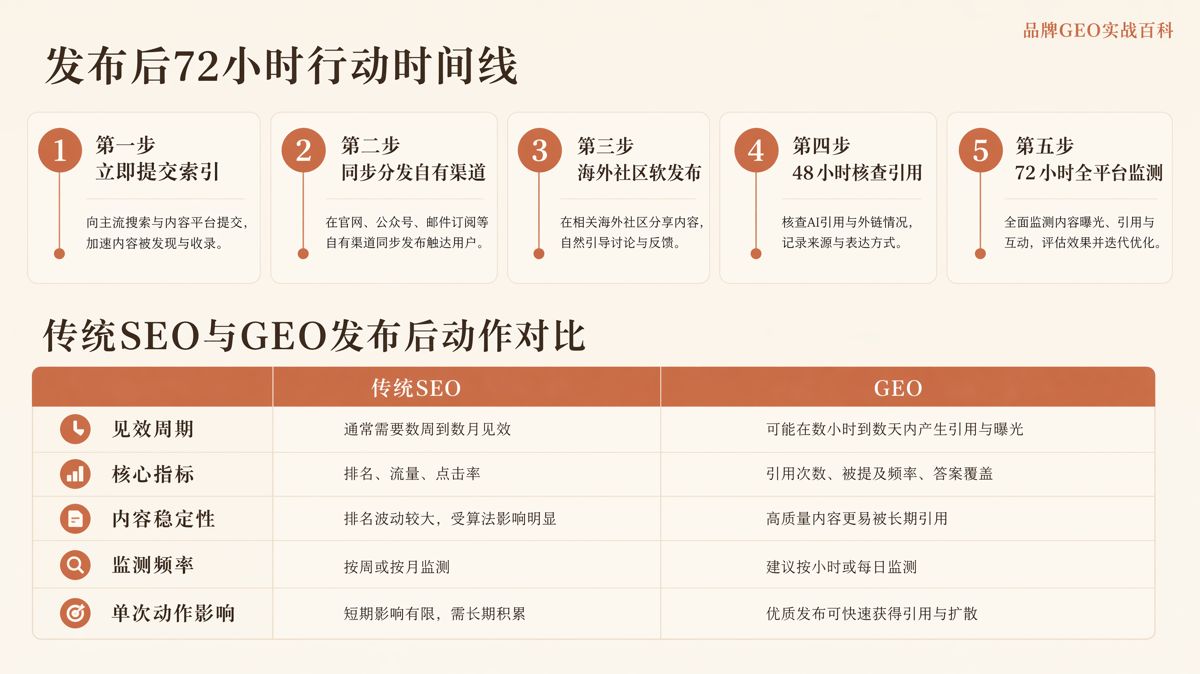
Traditional SEO vs. GEO: Key Differences
Search Engine Optimization (SEO) targets page rankings and organic traffic within traditional search result pages. GEO does not replace SEO, but post-publishing priorities differ significantly between the two disciplines.
| Dimension | Traditional SEO | Generative Engine Optimization (GEO) |
|---|---|---|
| Immediate Action | Submit sitemaps, monitor indexation, and optimize over time | Submit indexing, distribute across channels, audit at 48h, baseline at 72h |
| Evaluation Window | 3 to 6 months to evaluate organic rankings | Complete initial visibility checks within 72h without treating them as final outcomes |
| Core Metrics | Keyword rankings, organic search sessions | Brand mention rate, citation share, visibility across target AI engines |
| Output Stability | Rankings shift gradually under typical search algorithms | AI answers and source citations fluctuate frequently |
| Monitoring Rhythm | Weekly or monthly reviews | Checks at 48h, 72h, and weekly ongoing cadences |
| Ongoing Maintenance | One-off optimizations can maintain long-term rank | Requires ongoing citation audits, copy revisions, and data updates |
A 2026 study by Profound found that for identical queries, Google AI Overviews changed its generated answer text 70% of the time, replacing 45.5% of its cited sources in newly generated answers.
This volatility means an early citation can disappear later, while a page that missed the initial answer can be cited in subsequent model updates. GEO monitoring must track longitudinal visibility over weeks rather than relying on a single snapshot.
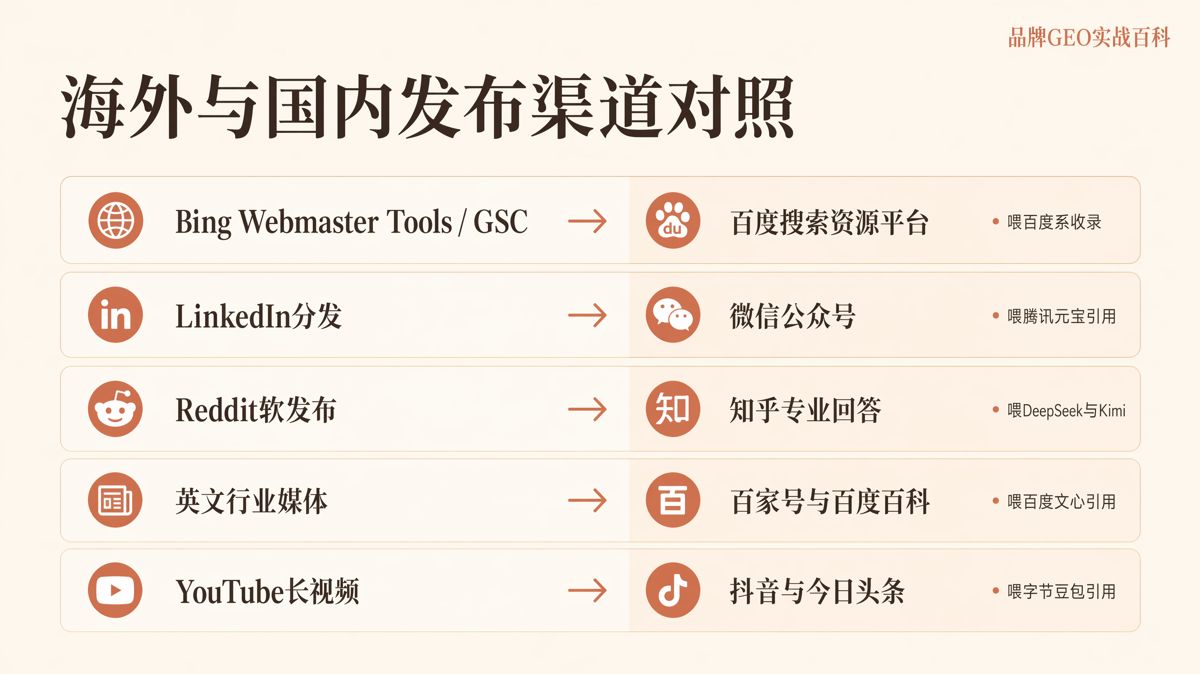
Channel Strategy for China-Focused Campaigns
While international GEO setups rely on Bing Webmaster Tools, Google Search Console, LinkedIn, and Reddit, China has no single submission portal covering all generative models. You must select distribution channels according to the specific AI engines you want to influence.
For indexing, leverage Baidu Search Resource Platform's standard and fast-indexing tools, alongside WeChat Search indexation for article content.
For distribution, align your secondary channels with target models:
- Tencent Yuanbao (Tencent's AI assistant): Focus on publishing via WeChat Official Accounts.
- Baidu's ERNIE Bot (Wenxin): Prioritize Baijiahao (Baidu's content platform) and Baidu Baike (Baidu's encyclopedia).
- Doubao (ByteDance's AI assistant): Prioritize Douyin (the Chinese counterpart to TikTok) and Jinri Toutiao (ByteDance's news aggregator).
- DeepSeek or Moonshot's Kimi: Monitor citations originating from detailed answers on Zhihu (China's leading Q&A platform).
These channel alignments serve as execution priorities rather than guaranteed inclusion rules. Actual performance must be verified through hands-on testing across each platform.
The Ahrefs study also observed that across ChatGPT, Perplexity, and Google AI Overviews, 86% of cited domain sources did not overlap. While international data cannot be mapped directly onto Chinese AI architectures, it confirms an essential rule: performance on one AI engine never guarantees visibility on another.
Tracking AI Referral Traffic Beyond Google Analytics 4
Google Analytics 4 (GA4) provides valuable site analytics, but it frequently undercounts AI-driven referral traffic.
Native mobile apps for ChatGPT, Claude, and Perplexity often strip the HTTP Referer header. When referral data is missing, GA4 categorizes those visits as (direct) / (none).
This creates two common tracking blind spots:
- Your content earns AI citations, but GA4 shows zero incoming referral traffic from AI domains.
- The true volume of business generated by AI-assisted discovery is systematically underestimated.
To capture a more accurate picture, use two complementary methods:
- Add a self-reported attribution field to high-intent web forms (e.g., "How did you hear about us?").
- Track directional shifts in
(direct)traffic following major GEO campaigns to spot concurrent spikes.
Direct traffic growth serves as an indirect clue rather than conclusive proof. The most reliable assessment combines AI brand mention tracking, citation counts, self-reported attribution responses, and organic traffic movements.
Zero Citations at 72 Hours Is Not a Failure
Assuming an article failed because it lacks citations after three days is the most common mistake marketing teams make in GEO.
Under the 90-day GEO deployment plan outlined in the whitepaper, a typical week-one audit tests 30 target user prompts across four AI engines, yielding 120 baseline data points. For newly created domains and unoptimized brands, the baseline brand mention rate is often below 5%, and the link citation rate is frequently 0%.
These figures represent a baseline, not a verdict.
The first 30 days of a GEO program are typically dedicated to basic technical execution: search index submissions, robots.txt adjustments, structured Schema deployment, and baseline benchmarking. Stable citations generally begin to appear during the second 30-day block or later as domain authority and co-occurrence signals accumulate.
The 72-hour check answers one fundamental question:
Have all technical and distribution tasks been executed, and are early discoverability signals present?
It cannot tell you:
Will this asset consistently earn AI citations over the next six months?
Separating the initial checklist from long-term performance prevents teams from prematurely rewriting good content, abandoning viable topics, or scrapping a sound strategy before the data has time to mature.
Manual Tracking vs. Paid Tooling
For smaller teams managing a modest content volume, manual tracking is sufficient. Test your prompts across target engines, log mentions, citations, and answer shifts, and track performance inside a structured spreadsheet.
Paid software becomes valuable when you need automated daily querying, multi-model tracking, and historical trend dashboards. Based on 2026 market rates, an entry-level software stack costs roughly $104 per month:
- ChatGPT Plus: $20/month;
- Claude Pro: $20/month;
- Grammarly: $15/month;
- SE Ranking AI Visibility: $49/month.
This $104 budget is an operational baseline, not an absolute barrier to entry. Teams with lower publication frequencies can track early performance manually without specialized software.
The first 72 hours after publishing are not about celebrating high scores. They are about executing proper indexation, syndicating across relevant channels, and verifying that search engines and AI models can parse your work.
Complete the foundational tasks first. Then, let several weeks of multi-engine baseline data guide your editorial, technical, and channel decisions. That discipline yields far better marketing outcomes than overreacting to day-one search results.
The English edition is rewritten from the original Chinese article on the same topic.

Starbox AI is an AI marketing company based in Hangzhou, China. This article draws on Starbox project work. Please credit the source when quoting.
Related reading
 GEO Guide
Why AI Marketing Vendor Quotes Vary 10x: A 4-Step Vetting Checklist
Evaluate AI marketing proposals by delivery actions, not slide decks. Audit source infrastructure, fact cleaning, and clean-environment testing.
Oct 22, 2026 · 6 min read
 GEO Guide
Spotting GEO Scams: What Actually Drives AI Recommendations?
Automated AI ranking promises violate how LLMs work. Real AI recommendations rely on authoritative, structured facts across trusted public sources.
Oct 22, 2026 · 4 min read
 GEO Guide
How to Measure Your Brand's AI Visibility with a Spreadsheet
You do not need expensive software to track AI recommendations. A three-tier prompt framework and a simple spreadsheet can score your brand visibility in half a day.
Oct 21, 2026 · 6 min read