
18 Pre-Publish Checks for Generative Engine Optimization (GEO)

The short answer
Before publishing GEO content, clear compliance, source, and access blockers first, then refine structure and technical page settings.
Key Facts:
- seoClarity research indicates that long-form content of 2,900 words or more achieves a 59% higher citation rate than articles under 800 words. This is a sample-specific finding, not a universal length mandate.
- A study by amicited.com found that adding FAQPage schema markup to FAQ pages increased citation rates in ChatGPT by 320%. FAQPage markup is structured code that helps machines parse question-and-answer pairs.
- Public reverse-engineering studies show that large language models (LLMs) typically slice long-form copy into chunks of roughly 200 to 500 words before determining which sections best answer a query.
- The Google Search Relations team stated in official guidance on May 15, 2026, that traditional SEO remains the foundation of generative AI search optimization.
- The 57th China Internet Network Information Center (CNNIC) report showed that by December 2025, mainland China had 602 million generative AI users, representing a 42.8% penetration rate.
- Quattr research suggests a brand generally needs at least 100 high-context mentions per quarter to establish a stable brand signal that models recognize reliably.
- China's Measures for the Labeling of Content Generated by Artificial Intelligence Synthesis took effect on September 1, 2025, requiring AI-generated or AI-assisted content to carry explicit or implicit disclosures.
Why You Cannot Hit Publish Right After Writing
Generative Engine Optimization (GEO) is the process of optimizing content and web pages so generative AI engines can easily retrieve, understand, and cite your information.
Finishing a draft merely means the copy exists. Whether AI engines will discover it, understand it accurately, and cite it in generated answers depends on several other factors: Can the page be crawled? Are factual claims backed by reliable sources? Can the content be cleanly extracted into standalone chunks? Are publication dates accurate? Has AI-generated copy been disclosed according to regulatory standards?
AI search engines typically process a page across three stages:
- Candidate retrieval: The page must already exist in the search index—the engine's catalog of known web pages. If a page is not indexed, the system will not discover it.
- Filtering: The engine evaluates candidate pages based on topical relevance, source credibility, timeliness, clarity, and the consistency of brand, author, and product names.
- Answer generation: The engine extracts specific text blocks from surviving candidates that directly answer the prompt, then decides whether to cite them.
Different AI engines handle this pipeline differently, and no public scoring formula applies to every platform. A pre-publish review is not about guessing black-box algorithms. It is about systematically eliminating points of failure and verifying every check with concrete proof.
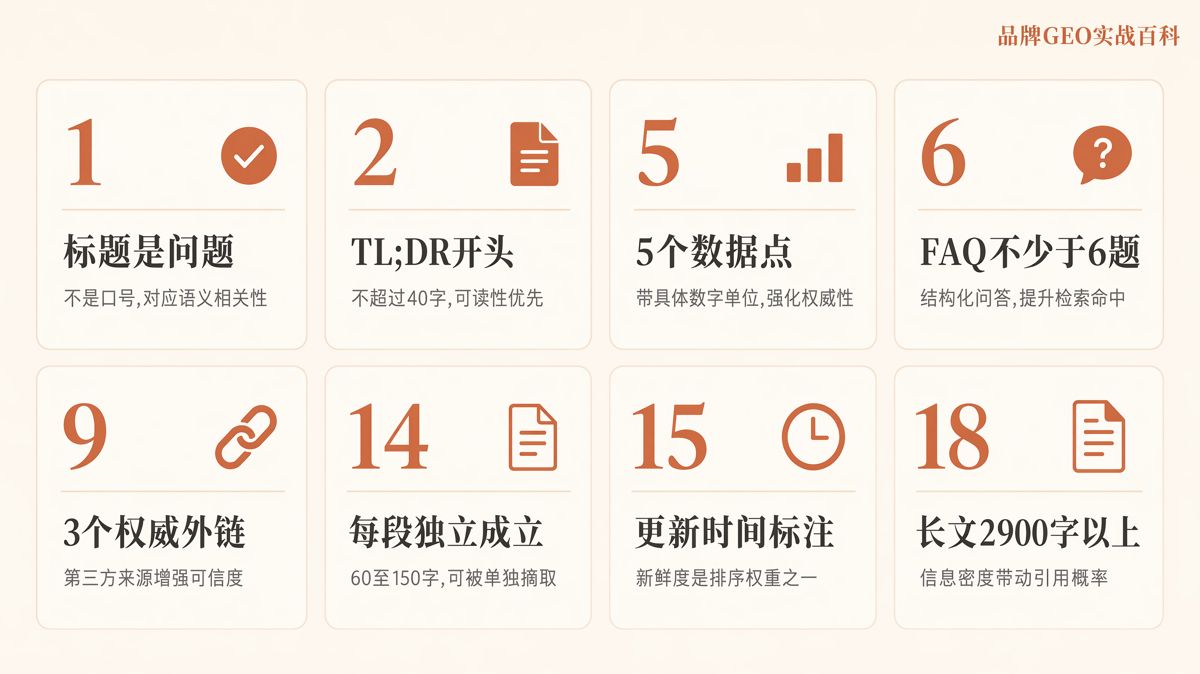
Not All 18 Checks Carry Equal Weight
A failed page load, a broken canonical tag, unverified primary sources, or non-compliant AI disclosures can immediately prevent indexing, ruin credibility, or trigger regulatory penalties. If you hit any of these issues, halt the release immediately.
Elements like summaries, comparison tables, FAQs, modular chunks, and word counts exist to organize information clearly for human readers and AI systems. While important, they cannot compensate for unverified facts, compliance failures, or crawling errors.
Do not evaluate this checklist simply by how many items you completed. First determine whether any single failure should block publication.
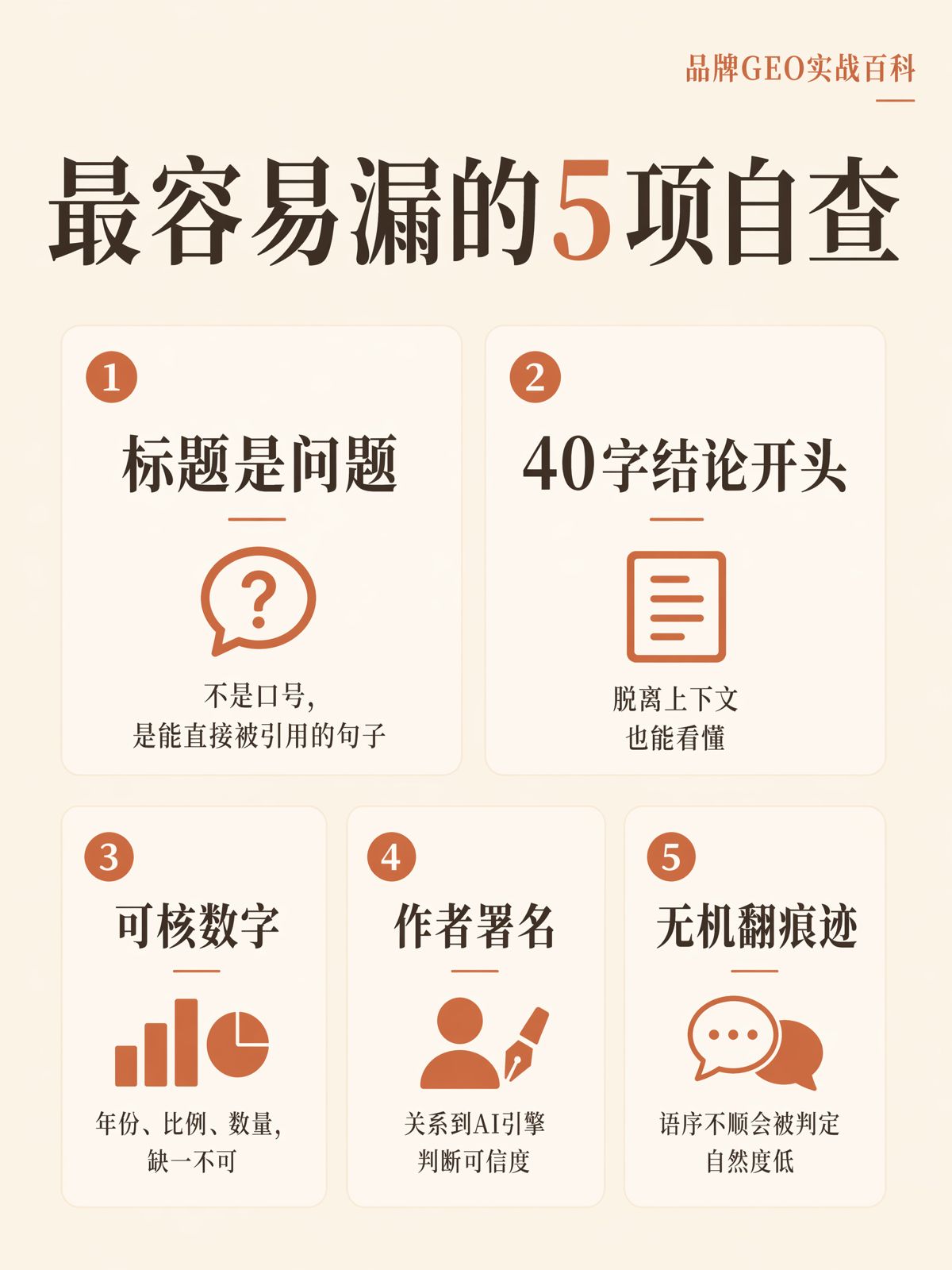
The 18-Point Pre-Publish Checklist
The target numbers below serve as practical editorial benchmarks for content teams, not universal minimum thresholds published by AI platforms.
| No. | Check Item | Primary Purpose |
|---|---|---|
| 1 | Title asks a direct question or clearly states what the reader gains, avoiding vague slogans | Improves topical relevance to specific user queries |
| 2 | Opening section includes a one-sentence summary (TL;DR) under 40 words | Helps readers and crawlers immediately confirm the core topic |
| 3 | Summary is followed by 5 to 7 key facts | Front-loads core takeaways for fast extraction |
| 4 | Article includes at least 1 comparative table with practical analytical value | Improves scannability and structured information density |
| 5 | Article cites at least 5 data points that include numbers and units of measurement | Increases verifiable, extractable claims |
| 6 | Includes at least 6 FAQs based on real questions asked by your target audience | Expands coverage of long-tail queries |
| 7 | Where technical setups allow, deploy Article and FAQPage schema markup | Helps crawlers parse page types and semantic relationships |
| 8 | Clearly attributes an author with verifiable external credentials | Builds author entity authority and trust |
| 9 | Cites at least 3 authoritative external sources | Provides factual backing for primary claims |
| 10 | Includes descriptive image alt text and meaningful image file names | Helps crawlers understand visual context |
| 11 | Includes at least 3 relevant internal links to related site content | Clarifies topical relationships between pages |
| 12 | Removes machine-translation artifacts, unnatural phrasing, repetitive structures, and empty claims | Improves natural readability and quality scores |
| 13 | Keeps mobile page load time under 3 seconds | Ensures search bots and users can access the page reliably |
| 14 | Opening paragraph under each H2 or H3 heading forms a self-contained 60–150 word chunk | Facilitates clean parsing and passage extraction |
| 15 | Sets the timestamp to the actual date of publication or update | Provides unambiguous timeliness signals |
| 16 | Properly configures the canonical URL tag | Prevents crawlers from splitting authority across duplicate URLs |
| 17 | Discloses AI-generated or AI-assisted content per applicable regulations | Meets mandatory content compliance requirements |
| 18 | Long-form pieces reference the 2,900+ word benchmark without padding text artificially | Increases the volume of extractable, valuable insights |
These numbers are a starting baseline. Whether your table provides genuine comparative value, whether your FAQs reflect real customer questions, and whether your data can be verified matter far more than hitting arbitrary counts.
Why 2,900 Words Is a Benchmark, Not a Rule
The seoClarity study showing that articles of 2,900+ words see a 59% higher citation rate than pieces under 800 words reflects a specific dataset. It does not prove that crossing a specific word count guarantees an AI citation.
Furthermore, the study measures English words. Chinese character counts behave differently. When optimizing for Chinese-language platforms, treat this figure as a directional indicator favoring comprehensive content, not a literal character target.
Long-form content often earns more citations because it accommodates more complete, specific, and independently extractable information blocks. When generating answers, AI models look for passages that directly resolve a question, not a vague summary of an entire post. More valid informational blocks give the model more candidates to select from.
Length alone creates no value. If an article reaches 2,900 words through repetitive fluff, ambiguous assertions, or paragraphs that make no sense without reading prior sections, AI systems will bypass it.
Focus on how much useful information your piece contains and whether those points can stand entirely on their own.
What Makes Content "Chunk-Friendly"
When LLMs process long articles, they divide text into chunks, typically between 200 and 500 words according to reverse-engineering research. Making content "chunk-friendly" means that if an algorithm extracts any single passage in isolation, a reader can still understand the core topic, the conclusion, and the supporting evidence.
Evaluate individual chunks against four criteria:
- Open with a complete conclusion without requiring prior paragraphs for context or subject references.
- Address one primary question per chunk rather than mixing unrelated points.
- Support factual claims with specific figures, institutions, regulations, standards, or study names.
- Provide sufficient context to explain the takeaway, evidence, and scope, while cutting filler words.
Check #14 recommends structuring the first paragraph beneath an H2 or H3 into a standalone 60–150 word chunk so the heading directly matches a concrete answer. This range is an editorial guide. Focus on providing a complete answer rather than padding word counts.
A common mistake is writing multiple paragraphs of introductory background before reaching the main point. While a human reading end-to-end might follow the flow, an extracted snippet will fail to answer the query. State your conclusion first, then supply the supporting data, reasoning, and scope.
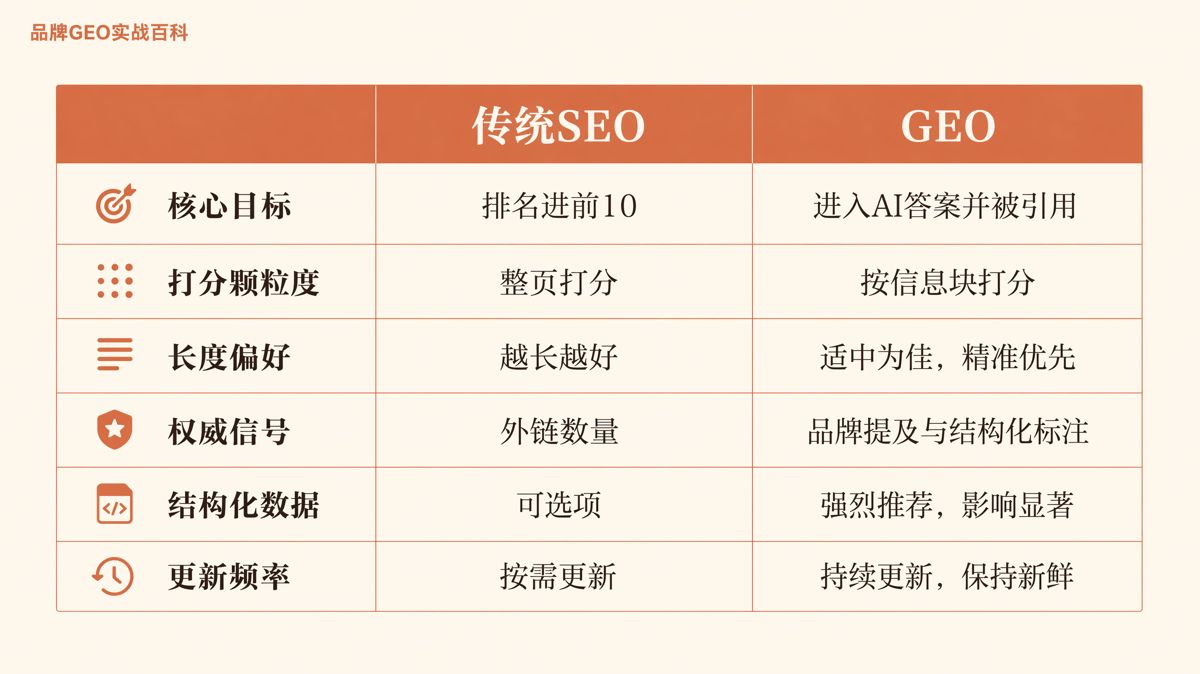
How SEO and GEO Align
Search Engine Optimization (SEO) aligns web pages with search engine ranking criteria. GEO does not replace SEO; it builds upon it.
The Google Search Relations team confirmed in their May 15, 2026 update that SEO remains the bedrock of AI search optimization. AI engines rely on existing search indices to find pages. If your content is not indexed, AI engines will rarely discover or cite it.
| Dimension | Primary Focus in SEO | Primary Focus in GEO |
|---|---|---|
| Core Objective | Win search rankings and organic clicks | Get included and cited within AI-generated answers |
| Content Processing | Overall page topic, quality, and keyword relevance | Overall quality plus modular, extractable information chunks |
| Role of Content Length | Expands keyword and topical coverage | Increases the volume of standalone, verifiable facts |
| Trust Signals | External backlinks, domain authority, author profiles | Author credibility, source citations, name consistency, brand mentions |
| Structured Data | Helps search engines parse page structure | Helps AI identify entities, articles, and question-answer pairs |
| Timestamps | Influences freshness rankings | Signals whether facts and data remain timely and valid |
Checks covering external sources, image alt text, internal links, natural prose, and mobile site speed are standard SEO practices. In contrast, one-sentence summaries, key facts, structured FAQs, and self-contained text chunks specifically optimize for AI content slicing and passage retrieval.
Research by iProspect and Hallam suggested that within their model, brand mentions carried roughly three times the weight of external links, while content freshness accounted for an estimated 15% to 20% weighting. These percentages represent analytical models from specific studies, not universal formulas across all engines.
The same caution applies to schema markup. While amicited.com found that FAQPage markup boosted citation rates in ChatGPT by 320%, this shows structured data has significant upside—not that every engine will yield identical gains for every page.
Adapting Your Strategy for Chinese AI Platforms
While the principles behind these 18 checks apply globally, differences in structured data adoption and information ecosystems require adjustments when publishing in China.
1. Prioritize Content Structure Over Code-Level Markup
International sites rely heavily on Schema.org standards to mark up articles and FAQs. Chinese AI engines currently lack a unified, public standard for parsing structured schema code.
Do not rely solely on technical markups for Check #7. Even without developer support, use clean H2/H3 headings, adopt standard Q&A formats, place standalone answers directly below headings, and cite verifiable sources within the body text.
These editorial adjustments require no technical development and are easier to execute across Chinese content networks. Implement Article and FAQPage schema once the necessary technical resources are available.
2. Match Content Distribution to Target AI Engines
Different Chinese AI engines draw from distinct primary data sources. Industry observations indicate that Doubao (ByteDance's AI assistant) frequently draws from Douyin (TikTok's Chinese sister app), Wenxin (Baidu's Ernie AI) relies heavily on Baijiahao (Baidu's content platform) and Baidu Baike (Baidu Encyclopedia), and Yuanbao (Tencent's AI assistant) pulls extensively from WeChat Official Accounts.
These observations reflect industry consensus rather than certified third-party audits, but they provide a practical guide for distribution.
If you want visibility across multiple engines, adapt your formatting for each platform. Publishing on a single channel will rarely give you full coverage.
Current data does not provide verifiable sourcing patterns for DeepSeek, so no definitive source preferences can be claimed.
3. Do Not Rely on Single Articles for Brand Authority
A pre-publish checklist improves the retrieval, readability, and authority of individual pieces. It cannot replace ongoing brand building.
Quattr's research notes that a brand typically requires 100+ high-context mentions per quarter to shift from isolated references into an established entity signal that models recognize reliably. Treat this as an analytical benchmark rather than a strict quota.
A "high-context mention" does not mean dropping a brand name into an article. The brand must appear alongside specific services, industry challenges, capabilities, or case studies. Repeated brand mentions without clear context do not help models understand what your business actually does.
Building authority requires ongoing publication, consistent naming, and sustained appearances across relevant discussions.
Why Check #17 (AI Disclosure) Needs Independent Review
China's Measures for the Labeling of Content Generated by Artificial Intelligence Synthesis took effect on September 1, 2025. Content produced or assisted by AI must be reviewed for proper labeling before publication.
Labeling requirements generally fall into two categories:
- Explicit labeling: Visible text, watermarks, or prompts that clearly inform the reader the content was created or assisted by AI.
- Implicit labeling: Machine-readable labels embedded in file metadata. Metadata refers to technical properties stored within the file itself.
Teams generating content at scale should verify both explicit and implicit labels rather than assuming one covers all requirements. Confirm the exact disclosure requirements for your format and distribution platform.
This check does not increase your citation rates, but it determines whether your content can legally remain online. For teams producing AI-assisted content at scale, compliance checks must precede debates over word count or chunking.
How to Sequence the 18 Checks
To avoid obsessing over copy while overlooking technical and compliance issues, split the checklist into three distinct passes.
Round 1: Clear Publishing Blockers
Verify that the page loads properly, mobile speed meets performance targets, canonical tags point to the correct URL, primary claims have verifiable sources, and AI-assisted content includes required disclosures.
Check author attribution, publication dates, and update timestamps. If sources are unverifiable, dates are inaccurate, pages fail to load, or disclosures are missing, fix these issues before proceeding.
Round 2: Verify Content Clarity and Credibility
Review the title, one-sentence summary, key facts, statistics, comparison tables, FAQs, headings, and chunk independence. Remove unnatural phrasing and repetitive copy. Ensure every metric includes units of measurement and that major arguments cite supporting sources.
Confirm the article delivers genuine substance. Formatting alone does not make an argument valid. If a draft features tables, bullet lists, and FAQs but lacks clear insights and evidence, do not publish it.
Round 3: Finalize Technical Page Settings
Confirm the deployment of Article and FAQPage schema markup, image alt tags, internal links, and page-level metadata.
Pass any technical tasks that your editorial team cannot handle directly to web developers or operations staff, and log the verification. Finishing the written text does not mean the technical setup is complete.
Frequently Asked Questions
1. Which checks are missed most often?
Check #14 and Check #17 are the most frequently overlooked. Many writers continue introducing background context after a subheading instead of opening with a standalone answer, which hurts snippet extraction. Content teams also tend to focus on editorial polish while missing AI labeling compliance, risking takedowns.
2. Is content under 2,900 words ineffective for AI citations?
No. The 2,900-word figure from the seoClarity study is a statistical benchmark, not an absolute cutoff, and English words do not map directly to Chinese characters.
Shorter content earns citations if it has a precise focus, verified facts, and clean structure. The main difference is that shorter articles provide fewer total chunks for an engine to extract.
3. How often should we run these 18 checks?
Run the full checklist for every new piece before publication. For existing content, conduct quarterly audits to confirm that data remains accurate, external source links work, timestamps reflect updates, and technical page settings remain intact.
4. Is hitting the required number of tables and FAQs enough?
No. Tables must offer clear comparative dimensions, and FAQs must answer genuine questions asked by target buyers. Every FAQ response must make sense as a standalone snippet.
Splitting standard copy into two columns or repeating the same question using different words adds no real value.
5. Does passing all 18 checks guarantee quality content?
Not necessarily. The checklist focuses on structure, technical settings, factual verification, and regulatory compliance. Whether your arguments are persuasive, your conclusions original, and your analysis valuable requires separate editorial review.
Well-structured fluff will not sustain citations from human readers or AI engines.
6. Do Doubao, Wenxin, Yuanbao, and DeepSeek share identical requirements?
All four favor clear structure, verifiable facts, and timely information, but they source information differently.
Industry patterns show distinct content pools for Doubao, Wenxin, and Yuanbao. There is insufficient verified research on DeepSeek's specific source preferences to apply the same assumptions.
7. Can we implement Check #7 without developers?
You can execute the non-technical components immediately: clear subheadings, standard Q&A formatting, standalone introductory paragraphs, and explicit source citations.
Schema-level Article and FAQPage code can be added once technical resources are available. Because Chinese engines do not share a unified schema ingestion standard, clear editorial formatting is your top priority.
Final Thoughts
Running these 18 checks does not guarantee an AI citation, but it eliminates four clear points of failure: crawl errors, unextractable passages, unverified assertions, and compliance breaches.
Prioritize your workflow. Confirm regulatory compliance, source validity, and page accessibility first. Then optimize summaries, key facts, tables, FAQs, and chunk structure. Finally, complete technical setups like schema markup, alt tags, and internal links.
Every item on your checklist should produce a verifiable outcome. Checking a box without verifying the live page, the citation link, the disclosure label, or the technical code does not count as a completed review.
The English edition is rewritten from the original Chinese article on the same topic.

Starbox AI is an AI marketing company based in Hangzhou, China. This article draws on Starbox project work. Please credit the source when quoting.
Related reading
 GEO Guide
Why AI Marketing Vendor Quotes Vary 10x: A 4-Step Vetting Checklist
Evaluate AI marketing proposals by delivery actions, not slide decks. Audit source infrastructure, fact cleaning, and clean-environment testing.
Oct 22, 2026 · 6 min read
 GEO Guide
Spotting GEO Scams: What Actually Drives AI Recommendations?
Automated AI ranking promises violate how LLMs work. Real AI recommendations rely on authoritative, structured facts across trusted public sources.
Oct 22, 2026 · 4 min read
 GEO Guide
How to Measure Your Brand's AI Visibility with a Spreadsheet
You do not need expensive software to track AI recommendations. A three-tier prompt framework and a simple spreadsheet can score your brand visibility in half a day.
Oct 21, 2026 · 6 min read