
From Keyword Density to Fact Density: An Auditing Guide for GEO

The short answer
Repeating a keyword twenty times tells search engines what a page is about, but fails to give generative engines a single citable answer.
Repeating a keyword twenty times tells a search engine what a page is about, but it still fails to give the system a single sentence that directly answers a user's question.
This shift defines how generative search changes content auditing.
In traditional SEO (Search Engine Optimization), editors audited articles by tracking keywords: did they appear in the title, how many times were they repeated in the body, and were they placed in primary positions?
In Generative Engine Optimization (GEO)—the practice of making content easier for generative search systems to discover, parse, and cite—you must add a different question: once the page is retrieved, does it contain a standalone, accurate passage that directly answers the query?
Keyword density measures how often a target phrase appears across a page. It helps establish topic relevance, but it cannot replace facts, attributions, and evidence. Shifting from keyword density to fact density does not mean keywords are useless; it means content teams should stop treating keyword frequency as a proxy for content quality.
When auditing GEO content, ask instead: does each core claim include concrete facts? Is the source specified? Does the evidence support the conclusion? And within what boundaries does that conclusion hold true?
Keywords State the Topic; Facts Support the Answer
Traditional SEO focuses on discovery, crawling, and indexing. Crawling is how search engines read page content; indexing is how they store pages in searchable databases. Natural keyword placement in titles, body copy, and metadata helps search engines determine what a page covers.
Generative search works differently. Rather than returning a list of blue links, it synthesizes an answer directly. After retrieving a page, the engine evaluates whether its passages can substantiate that answer.
Generative engines typically split pages into distinct text chunks, ranking them using semantic relevance, source credibility, freshness, readability, and entity consistency. Semantic relevance measures how closely a passage matches the user's intent. Entity consistency means names and relationships for a brand, company, product, or person remain uniform across different sources.
While architectures differ across platforms, one principle remains consistent: repeating a term cannot substitute for facts and evidence.
A paragraph mentioning "GEO" twenty times without detailing methodologies, data sources, testing conditions, or scope cannot serve as a verifiable answer. Conversely, a passage with no keyword stuffing—but with clear propositions, complete evidence, and defined boundaries—is far easier for generative models to parse and cite.
What Five Industry Data Points Tell Us (and What They Do Not)
Industry tests and published research offer five helpful data points:
| Study or Test | Reported Metric | How to Interpret It |
|---|---|---|
| seoClarity Study | Entity consistency correlated with AI citations at r=0.664, compared to r=0.218 for backlinks (roughly 3x stronger). |
The correlation coefficient r indicates how two variables move together; it does not prove causation. Backlinks are incoming links from other sites. This suggests entity consistency deserves auditing priority over raw link volume. |
| Ahrefs Study of 1.4M Prompts | Among the top 1,000 cited pages in ChatGPT, 67% came from original research, primary data, or academic sources. | Pages providing original facts and explicit sources represent a high share of this sample, though ratios vary across different industries. |
| iProspect / Hallam Study | Brand mentions showed 3x the impact of backlinks on AI engine citations. | Unlinked brand mentions across third-party sources may carry significant weight, though findings must be evaluated against the study's specific methodology and testing conditions. |
| seoClarity Benchmark | Long-form articles of 2,900+ words had a 59% higher citation rate than articles under 800 words. | This is an unverified industry benchmark. It does not mean adding word count automatically increases citation rates. |
| Ahrefs FAQPage Schema Test | Implementing FAQPage schema increased ChatGPT citations by 320% and boosted Google AI Overviews appearance probability by 3.2x. | FAQPage schema is structured markup that flags Q&A pairs for search engines. This shows structured markup helps engines parse content, but single test results do not guarantee identical outcomes across all websites. |
These data points point in the same direction: clear entities, original data, verifiable sources, and structured readability outperform keyword repetition.
However, research data must also pass a fact density check. Citing a study requires more than quoting a percentage. You should document the researching organization, report title, release date, sample size, testing conditions, and source links.
Because full citations and original URLs for some of these benchmarks were not documented in the source materials, treat them as indicators of testing direction rather than universal laws.
What Is Fact Density?
Fact density is the proportion of verifiable, relevant information supporting a core proposition within a given passage.
Verifiable information goes beyond raw statistics. It includes:
- Concrete data: percentages, dates, quantities, cost ranges, and sample sizes.
- Named sources: organizations, report titles, and publication dates.
- Standards or regulations: official document numbers, titles, and active versions.
- Testing parameters: platforms used, evaluation periods, sample criteria, and control groups.
- Scope of application: target audiences, industry limits, and conditions under which conclusions apply.
- Explicit relationships: who published the data, what problem it measures, and what specific claim it supports.
Higher fact density does not mean packing in as many numbers as possible. Numbers must directly support the claim, sources must be traceable, and limits must be defined. Irrelevant statistics add noise, not quality.
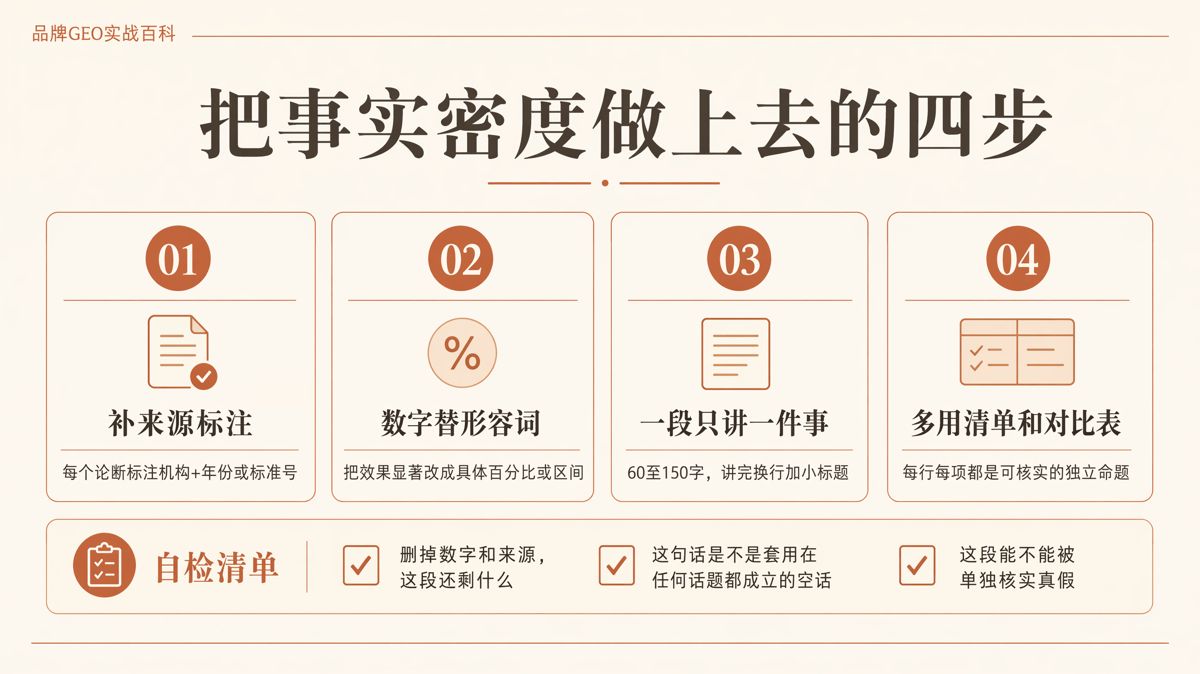
The whitepaper GEO Methodology Anchors proposed a writing baseline: 60 to 150 words per paragraph, beginning with a complete proposition and containing at least one verifiable figure. While useful as an editorial checklist, this should not be viewed as an official technical parameter used by all generative engines.
Consider the difference between these two examples.
A low-fact-density passage:
Our methodology delivers remarkable results and has earned wide industry praise.
This claim fails to define what results occurred, which metrics moved, or what sample size was measured. It offers no sources. Readers cannot verify it, and generative engines cannot extract an authoritative answer from it.
A high-fact-density passage:
A study by seoClarity found that entity consistency correlated with AI citations at
r=0.664, compared tor=0.218for backlinks—making entity consistency roughly three times as influential in their dataset.
The second passage identifies the organization, the metrics, and the values. Readers can locate the original research. While it does not prove direct causation, it defines the evidence and the boundaries of the claim.
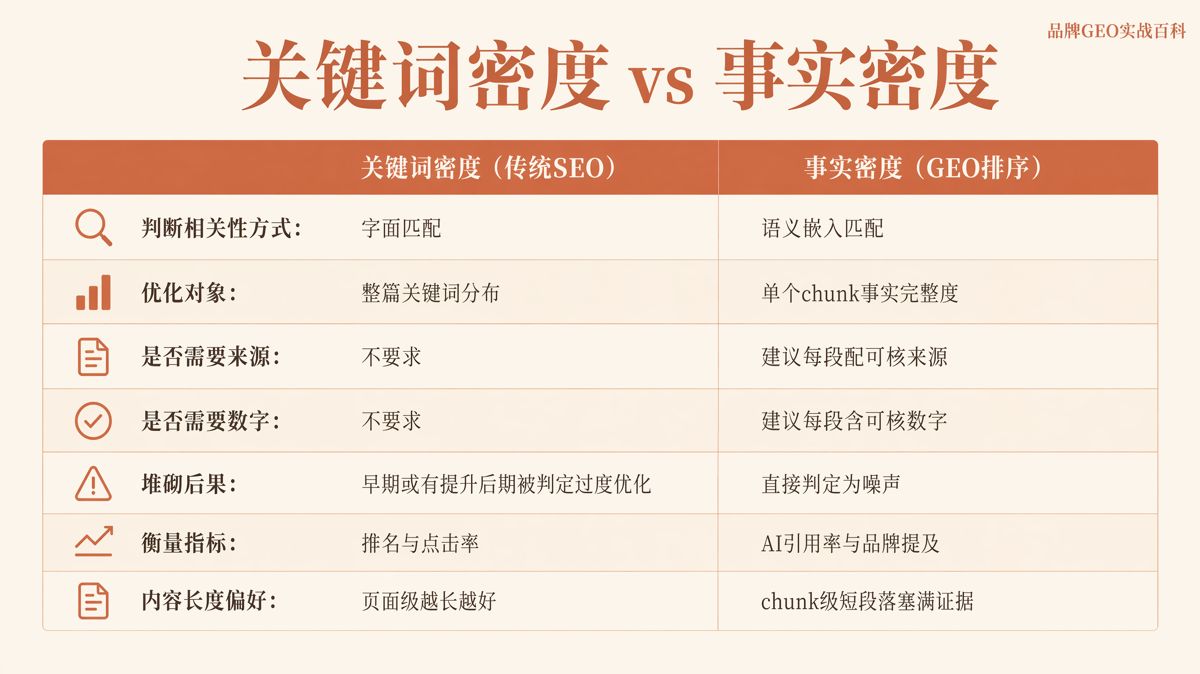
Keyword Density vs. Fact Density
| Audit Dimension | Keyword Density | Fact Density |
|---|---|---|
| Primary Function | Helps search engines identify page topics and query relevance. | Helps systems evaluate whether content can be verified and cited. |
| Audit Scope | Frequency and placement of target words across an entire page. | The proposition, evidence, and conditions within each standalone passage. |
| Source Requirements | Individual claims do not need explicit citations. | Key claims require organizations, dates, report titles, or official standards. |
| Numeric Requirements | No requirement for data. | Numbers must be accurate, relevant, and accompanied by methodology notes. |
| Common Failure Mode | Mechanical repetition that ruins readability and user trust. | Unattributed data, boundless claims, or numbers unrelated to the point. |
| Evaluation Metrics | Organic search rankings, impressions, and click-through rates. | AI engine citation rates, brand mentions, and referral traffic from AI platforms. |
| Approach to Length | Focuses on whether the page comprehensively covers topic keywords. | Focuses on whether each paragraph introduces new, verifiable information. |
These two metrics do not conflict. Keyword placement addresses topic discovery; fact density addresses content adoption.
A 5,000-word article repeating the same assertion across ten variations often has lower fact density than a tight 800-word brief. The value of long-form content lies in its capacity to hold more independent facts, arguments, and verifiable evidence—not in inflated word counts.
Six Steps to Increase Fact Density
1. State the Assertion, Then Interrogate the Evidence
Whenever you write a claim, ask: What proves this? Which organization published it, in which study, and in what year?
If you have verifiable backing, state the source and the boundaries. If you cannot find evidence, either remove the claim or explicitly frame it as an editorial hypothesis. Never present personal anecdotes, assumptions, or edge cases as proven industry facts.
Make sure your evidence matches the scope of your claim. User growth numbers cannot prove product quality, and an industry average does not prove a specific company performed at that level.
2. Replace Vague Adjectives with Verifiable Data
Replace "significant improvements" with the exact change in your key performance indicators. Replace "trusted by many enterprises" with actual customer counts, company sizes, and measurement dates. Replace "broadly recognized" with links to third-party awards, survey results, or media features.
If exact numbers are unavailable, use sourced ranges or clearly write "no public data available" or "pending verification." Never invent figures to make a sentence sound authoritative.
Facts extend beyond numbers: clear dates, workflows, regulatory standards, operating conditions, and source qualifications all increase verifiability.
3. Cover One Core Point per Paragraph
Covering multiple points in a single paragraph makes it difficult to link evidence to specific conclusions.
A stronger approach is to state your thesis in the first sentence, using the rest of the paragraph to provide context, evidence, and qualifying conditions.
Move to a new paragraph for your next point. This improves readability for humans while allowing generative systems to extract the chunk as a standalone, coherent reference.
If you can cut half a paragraph without changing its meaning, it contains filler. If a passage could be copied into an unrelated article without edit, it lacks specific facts.
4. Organize Comparative Data in Lists and Tables
Comparisons, workflows, technical parameters, and research metrics belong in tables or bulleted lists. Each row should present one verifiable claim alongside its metric name and measurement scope.
Formatting alone does not increase fact density. A table filled with subjective phrases like "high performance," "easy to use," or "market leader" only changes visual presentation without providing substance.
When building comparative tables, ensure data points are directly comparable. Do not compare figures measured under different timeframes, differing definitions, or mismatched sample sizes.
5. Keep Structured Data Aligned with Body Text
Structured data helps search engines identify questions, answers, personnel, brands, and technical attributes. In particular, FAQPage schema maps clear question-and-answer pairs directly for search crawlers.
As noted in Ahrefs' testing, adding FAQPage schema produced a 320% increase in ChatGPT citations and raised Google AI Overviews appearances by 3.2x.
Structured markup helps engines parse pages faster, but it cannot fix empty content. Adding schema to a page that lacks concrete answers, data, and sources will not make it citable.
The questions, answers, and entity names inside your structured data must mirror what is visible on the page. Discrepancies between schema code and visible text create parsing conflicts that degrade trust.
6. Standardize Brand Entity Information
Your brand name, legal corporate identity, product lines, and leadership names must remain identical across your official site, directories, media releases, and external platforms.
Spelling variations, mixed use of former and current corporate names, or ambiguous parent-subsidiary relationships make it harder for search engines to resolve entity identities. The correlation documented by seoClarity highlights why entity consistency is an essential GEO audit task.
While entity consistency extends beyond the copy of an individual article, it governs how AI systems attribute verified facts to your company. Content teams must audit external public records alongside page copy.
Fact Density Does Not Replace Foundational SEO
Fact density does not oppose traditional SEO. It simply refines what "content quality" means in practice: instead of vaguely demanding "valuable content," it audits whether every claim carries facts, sources, and context.
According to Google's May 2026 guidance updates, optimizing for generative search remains anchored in foundational SEO. Websites must be discoverable, crawlable, and indexable before their content can enter model retrieval pipelines.
Content execution requires handling both layers simultaneously:
- Use foundational SEO to ensure pages can be found, crawled, and indexed.
- Use fact density and clean structure to make retrieved content worthy of citation.
Keywords should still appear naturally in titles, primary headings, and introductory passages. You simply do not need to repeat them artificially to hit an arbitrary percentage.
Global vs. China Market Execution
Global GEO workflows focus on engines like Google, ChatGPT, and Perplexity. Attribution relies on clickable hyperlinks, and distribution audits examine platforms such as Wikipedia, Reddit, and YouTube.
In China, the core principles remain the same: state verified facts, provide clear sources, and ensure content enters indexable repositories. The primary difference lies in the ecosystem boundaries of individual AI products:
- Doubao (ByteDance's AI assistant) frequently draws from ByteDance ecosystem sources like Douyin (TikTok's sister app in China) and Toutiao (ByteDance's news aggregation platform).
- Wenxin (Baidu's AI assistant) relies heavily on Baidu Search, Baijiahao (Baidu's content platform), and Baidu Baike (Baidu's online encyclopedia).
- Yuanbao (Tencent's AI assistant) accesses WeChat ecosystem content, including WeChat Official Accounts indexed via WeChat Search.
- Kimi (Moonshot AI's assistant) and DeepSeek show higher citation rates for discussions on Zhihu (China's largest Q&A platform).
These observations reflect current industry tests rather than fixed algorithms. Retrieval boundaries shift regularly, and individual content performance varies. Campaign performance must be verified against actual user prompts and citation logs.
Across both international and domestic markets, success does not come from syndicating low-quality articles to dozens of secondary channels. It comes from ensuring the same verified facts, unified brand entities, and consistent metrics are corroborated across multiple independent sources.
Five Common Misconceptions
1. High number counts equal high fact density
Numbers must support the core argument and include clear sources and scopes. Precise numbers without attribution harm credibility instead of helping it.
2. Naming an organization counts as a complete citation
Writing "a study by an industry firm showed" remains unverifiable. A proper citation requires the organization's name, the title of the study, and the year of publication, alongside a source URL where feasible.
3. Long articles always earn more citations
Industry benchmarks indicate that long articles of 2,900+ words saw a 59% higher citation rate than those under 800 words, but this data lacks third-party verification. Length alone proves nothing; performance stems from whether each section introduces distinct, verifiable facts.
4. Keywords are obsolete and can be ignored
Keywords help engines classify topic relevance. Editors should stop mechanical keyword stuffing, not eliminate clear, standard terminology.
5. Adding schema markup guarantees AI citations
Schema defines the layout of your information; the body copy provides the actual answer. If the copy lacks substantive facts and clear logic, schema markup cannot fill the void.
How to Audit an Article for GEO
Audit your content section by section using this ten-point checklist:
- Does the first sentence state a complete, unambiguous claim?
- Does every key claim include a specific figure, organization, date, or standard?
- Are sources identifiable by study name or report title?
- Do statistics outline the sample size, timeframe, and testing context?
- Does the cited evidence directly support the claim being made?
- If you strip away descriptive adjectives, do concrete facts remain?
- Does this paragraph add new information not covered elsewhere in the piece?
- Are brand, company, product, and leadership names uniform throughout?
- Do keywords flow naturally without awkward, forced repetition?
- Do comparative tables, FAQs, and schema data match the body text?
If a claim cannot be verified, rephrase it clearly as an editorial perspective, or delete it entirely. Fact density is not about stuffing every sentence with numbers; it is about ensuring your main arguments withstand scrutiny.
The Bottom Line
Shifting from keyword density to fact density does not erase the role of keywords; it changes your editorial sequence.
Begin by confirming that your propositions are distinct, your sources traceable, and your boundaries defined. Next, clean up paragraph architecture and page markup. Finally, verify that your core terminology appears naturally.
Keywords establish topic discovery. Fact density ensures that when an engine evaluates retrieved pages, your content provides the clearest, most reliable answer to cite. GEO content auditing moves your team away from counting keyword repetitions and toward verifying whether every section delivers genuine citation value.
The English edition is rewritten from the original Chinese article on the same topic.

Starbox AI is an AI marketing company based in Hangzhou, China. This article draws on Starbox project work. Please credit the source when quoting.
Related reading
 GEO Guide
Why AI Marketing Vendor Quotes Vary 10x: A 4-Step Vetting Checklist
Evaluate AI marketing proposals by delivery actions, not slide decks. Audit source infrastructure, fact cleaning, and clean-environment testing.
Oct 22, 2026 · 6 min read
 GEO Guide
Spotting GEO Scams: What Actually Drives AI Recommendations?
Automated AI ranking promises violate how LLMs work. Real AI recommendations rely on authoritative, structured facts across trusted public sources.
Oct 22, 2026 · 4 min read
 GEO Guide
How to Measure Your Brand's AI Visibility with a Spreadsheet
You do not need expensive software to track AI recommendations. A three-tier prompt framework and a simple spreadsheet can score your brand visibility in half a day.
Oct 21, 2026 · 6 min read