
How to Write Question-Style Subheadings for AI Citations

The short answer
Question subheadings align content with user prompts. Here is how to structure direct answers, apply FAQPage schema, and earn generative AI citations.
When users ask questions in generative AI tools, the engines scan accessible web pages for content that directly addresses those queries. An "AI citation" occurs when an AI engine uses a web page as a reference or source in its generated answer. Generative Engine Optimization (GEO) focuses on structuring and refining content specifically for these AI search and answer environments.
If an article answers concrete questions, writing subheadings as complete queries and providing direct answers in the opening sentence helps readers find information quickly. It also helps AI engines determine exactly what problem that section solves.
However, adding a question mark does not automatically improve citation rates. What drives citations is a clear question-and-answer relationship: how specific the heading is, how direct the answer is, whether the excerpt can stand on its own, and whether the information is credible.
Why Question-Style Subheadings Hold an Advantage
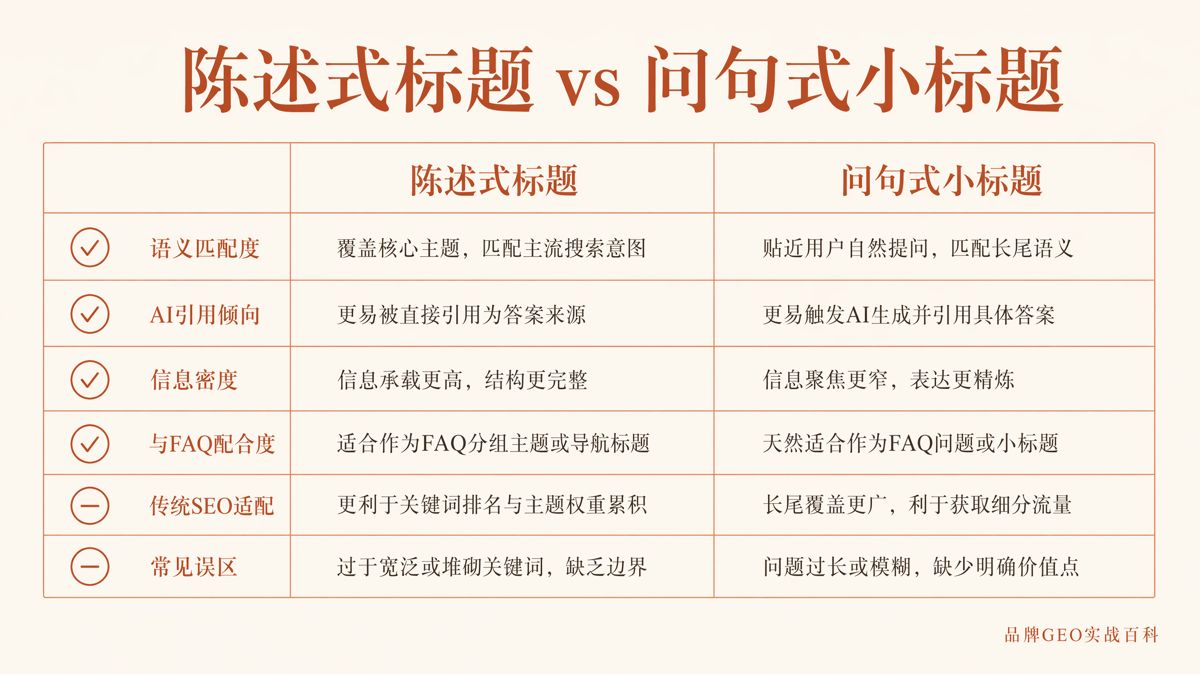
Question subheadings closely mirror the complete sentences users type into AI assistants, reducing ambiguity when engines evaluate the purpose of a section.
Users typically ask "how to write question subheadings for AI citations" rather than searching disjointed keywords like "question, subheadings." Compared to broad topical titles like "Subheading Best Practices," a question-based heading states the exact problem the text addresses.
This advantage stems from clarity of expression, not the punctuation mark itself. If a heading asks a question but the text delays the answer, provides vague information, or lacks supporting evidence, citation rates will not improve.
Question-style subheadings simplify how both readers and AI models process content hierarchy, but they cannot secure citations on their own.
How to Write Effective Question Subheadings
The goal is not to turn statements into interrogatives artificially. It is to frame headings as genuine user questions and answer them immediately. You can evaluate your headings using three criteria.
Is the Heading a Question Real Users Actually Ask?
Subheadings should resemble everyday inquiries. Avoid crafting artificial suspense to tease the reader.
For instance, "How to Improve AI Citation Rates" covers too much ground. If the section specifically discusses heading structure, refine the question:
- How much do citation rates differ between question and statement headings?
- Where should an FAQ section be placed within an article?
- Does structured data help AI identify Q&A content?
The more specific the question, the easier it is to deliver a definitive answer. Ask yourself: Can someone with no prior context look at this heading and immediately predict what the following paragraph explains?
Does Each Subheading Address Only One Issue?
A subheading should ideally correspond to one core concept. When a heading covers too broad a topic, writing a direct answer becomes difficult. When it combines multiple questions, the paragraph loses focus.
If related questions require distinct conclusions or separate proof, divide them into separate subheadings. This helps readers locate relevant sections quickly and allows AI models to parse the distinct role of each passage.
Does the Opening Sentence Answer the Question Directly?
Under a question-style subheading, provide the answer first. Then follow up with reasons, conditions, and exceptions.
Avoid introducing lengthy background context before addressing the question. Do not bury the conclusion at the bottom of the section, and never answer an unrelated query. The effectiveness of a question format depends entirely on how tightly the opening sentence aligns with the heading.
How to Write the First Paragraph Under a Subheading
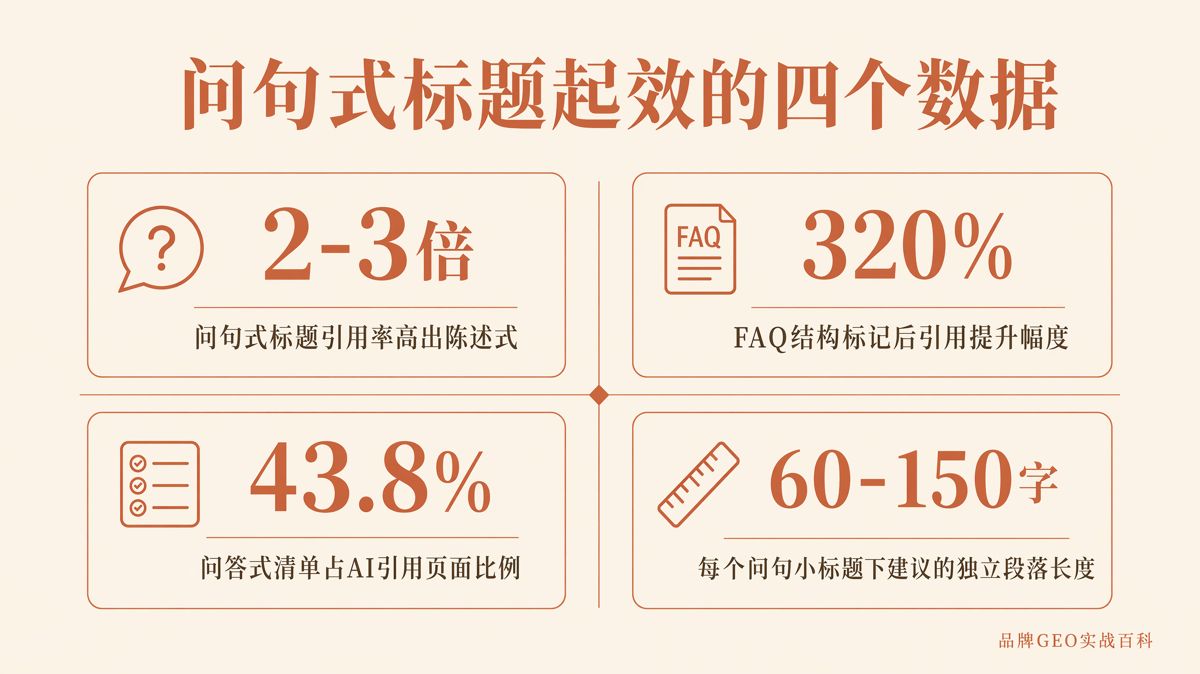
The first paragraph should deliver a direct conclusion that remains fully understandable even when removed from the surrounding text. A common GEO recommendation suggests keeping this direct answer between 60 and 150 words. This range is an editorial rule of thumb, not an official technical threshold confirmed by AI platforms.
Too short, and the answer may lack completeness; too long, and readers struggle to find the core takeaway. A reliable approach is to state the direct answer in one or two sentences, then use subsequent paragraphs to unpack reasons, scope, and evidentiary limits.
Here is an example:
How much do citation rates differ between question and statement headings?
Industry reports suggest question headings can achieve two to three times the AI citation rate of statement headings, though this figure has not been independently verified by third parties. In practice, question headings clearly signal what a paragraph solves, but they do not guarantee citations by themselves.
Even when read in isolation, that excerpt clearly conveys the question, the finding, and the boundaries of the claim.
What Is FAQPage Structured Data?
An FAQ (Frequently Asked Questions) section addresses common follow-ups. FAQPage is a specific schema markup applied within a page's code to formally declare which text is a question and which is the corresponding answer. Structured data presents information in standardized formats that search engines and AI parsers can read without ambiguity.
Compared to plain text blocks, FAQPage schema helps crawlers identify question-and-answer pairs cleanly. However, code cannot fix poor substance.
If the question is poorly phrased or the answer evasive, technical markup will not turn low-value text into an authoritative source. Clear, accurate, and trustworthy content remains the baseline requirement.
How to Interpret Q&A Performance Data
Current industry statistics show that Q&A structures deserve attention, but they do not prove that adopting question subheadings guarantees AI citations. Source validity, methodology, and scope vary significantly across reports:
- The claim that question headings earn 2 to 3 times more AI citations than statement headings is an industry benchmark that lacks third-party verification.
- A 2025 study released by Amicited claimed that pages using FAQPage schema experienced a 320% increase in citations within ChatGPT (OpenAI's conversational engine). This finding does not mean every website will see the same lift.
- A 2025 industry report noted that list-format content with explicit Q&A structures accounted for 43.8% of all pages cited by ChatGPT. This correlation does not prove Q&A formatting was the sole driver of those citations.
- The guideline to keep direct answers between 60 and 150 words is standard GEO advice, not an engine-mandated requirement.
- The recommendation to address 6 to 8 related question variations in a long article is a useful editorial benchmark, not an absolute quota.
Treat these figures as strategic directional signals rather than universal guarantees across every site and AI engine.
Are Question Subheadings and FAQs the Same Thing?
No. Question subheadings organize the primary narrative of the article, while an FAQ section addresses secondary follow-ups.
Body subheadings explore the central arguments of your topic, and each section requires detailed explanation. An end-of-page FAQ addresses edge cases, technical caveats, and alternative phrasings not covered in the main text.
The recommended structure uses question subheadings to anchor primary arguments in the main body, then uses an FAQ section at the end for supplemental questions. Both sections can address related themes, but they should never duplicate identical answers.
While industry data shows explicit Q&A structures represent 43.8% of citations in certain models, simply adding an FAQ block will not guarantee placement.
Do Question Subheadings Hurt Traditional SEO?
Search Engine Optimization (SEO) focuses on keyword targeting, indexing, and organic rankings on traditional search engine results pages. GEO concentrates on answering complete queries posed to generative AI engines. Their priorities differ, but their mechanisms do not conflict.
A title like "How to Write Question-Style Subheadings for AI Citations" preserves key search terms like "question-style subheadings" and "AI citations" while stating the user's intent clearly. Adopting a question structure does not mean abandoning target keywords.
When drafting headings, check two items: does the heading incorporate natural search terms, and does it clearly specify the answer provided below?
There is no evidence indicating that question subheadings harm organic search performance. Many optimization cases report organic traffic gains after restructuring for GEO, though specific results vary by site.
Can One Subheading Address Multiple Queries at Once?
Each subheading should focus on a single primary question. You can address alternate phrasings and related angles through additional subheadings or the closing FAQ section.
For instance, users might ask:
- How should subheadings be written for AI citations?
- What headings do AI search engines interpret best?
- Are question headings better than statement headings?
These queries explore similar territory from different perspectives. Combining them under one heading makes it unnecessarily long and dilutes the focus of the paragraph below.
GEO production workflows often suggest covering 6 to 8 related queries across an article's body and FAQ. Use this number as a pre-publication sanity check rather than a rigid rule.
Length adds value only when it provides space to resolve distinct questions. If an article merely rephrases the same conclusion across different sections, added word count yields no useful information.
Do Chinese Generative AI Engines Prioritize Q&A Structures?
Industry observations indicate that well-structured, directly responsive content is also favored by Chinese generative models, including Doubao (ByteDance's AI assistant) and ERNIE Bot (Baidu's conversational AI).
However, content preferences and source prioritization differ between platforms. While discussions frequently reference channels such as WeChat Official Accounts, Baidu Baike (Baidu's online encyclopedia), and Zhihu (China's Q&A community), these observations do not replace official engineering documentation.
Question-style subheadings offer universal structural value for human and machine readers alike, but using them does not guarantee uniform results across different AI platforms.
Do Question-Style Subheadings Border on Clickbait?
Headings become clickbait based on their honesty, not their punctuation. The difference lies in whether the question is specific and whether the text answers it directly.
A heading like "Can One Subheading Address Multiple Queries at Once?" asks a clear question and answers it in the first sentence. That is clean information architecture.
If a heading creates artificial suspense, delays the resolution, or points to an unrelated topic, it misleads the reader whether it uses a question mark or not.
Question subheadings should clarify what is coming, not manipulate curiosity.
Statement Headings vs. Question Subheadings
| Comparison Dimension | Statement Headings | Question Subheadings |
|---|---|---|
| Function | Outlines broad topics | Directly states the question answered |
| Alignment with user intent | Requires inference to identify user intent | Mirrors complete natural-language queries |
| AI section parsing | May require full-text parsing to interpret | Clarifies intent early; citation still depends on quality |
| Reading efficiency | Readers scan paragraphs to assess relevance | Readers determine relevance from the heading alone |
| FAQ integration | Must be rephrased into questions for FAQs | Easily adapted into FAQ sections |
| Traditional SEO fit | Concentrates keywords, but risks being overly broad | Retains core keywords within a complete query |
| Common failure point | Generalizes topics without addressing specific needs | Changes sentence structure without delivering a direct answer |
Neither approach is universally superior. The right choice depends on the content type, how accurately the heading reflects the text, and how easily readers can digest the information.
Pre-Publish Checklist for Question-Driven Content
Before publishing an article structured with question subheadings, review these 10 points:
- Does the subheading reflect a genuine question real users ask?
- Does each subheading address only one core concept?
- Does the first sentence beneath the heading deliver a direct answer?
- Can that opening paragraph stand alone without context from preceding text?
- Does the section explain the reasoning, preconditions, and evidence boundaries?
- Is there a clear, logical progression connecting the subheadings?
- Does the end-of-page FAQ address distinct follow-up questions instead of repeating body copy?
- Are industry statistics cited with their original source scope and verification status?
- Are technical acronyms and industry terms clearly explained upon first mention?
- Does the body copy fully resolve the question raised in the title?
Once these conditions are met, question-style subheadings shift from a superficial styling choice to an effective content framework that serves both human readers and AI retrieval systems.
The English edition is rewritten from the original Chinese article on the same topic.

Starbox AI is an AI marketing company based in Hangzhou, China. This article draws on Starbox project work. Please credit the source when quoting.
Related reading
 GEO Guide
Why AI Marketing Vendor Quotes Vary 10x: A 4-Step Vetting Checklist
Evaluate AI marketing proposals by delivery actions, not slide decks. Audit source infrastructure, fact cleaning, and clean-environment testing.
Oct 22, 2026 · 6 min read
 GEO Guide
Spotting GEO Scams: What Actually Drives AI Recommendations?
Automated AI ranking promises violate how LLMs work. Real AI recommendations rely on authoritative, structured facts across trusted public sources.
Oct 22, 2026 · 4 min read
 GEO Guide
How to Measure Your Brand's AI Visibility with a Spreadsheet
You do not need expensive software to track AI recommendations. A three-tier prompt framework and a simple spreadsheet can score your brand visibility in half a day.
Oct 21, 2026 · 6 min read